
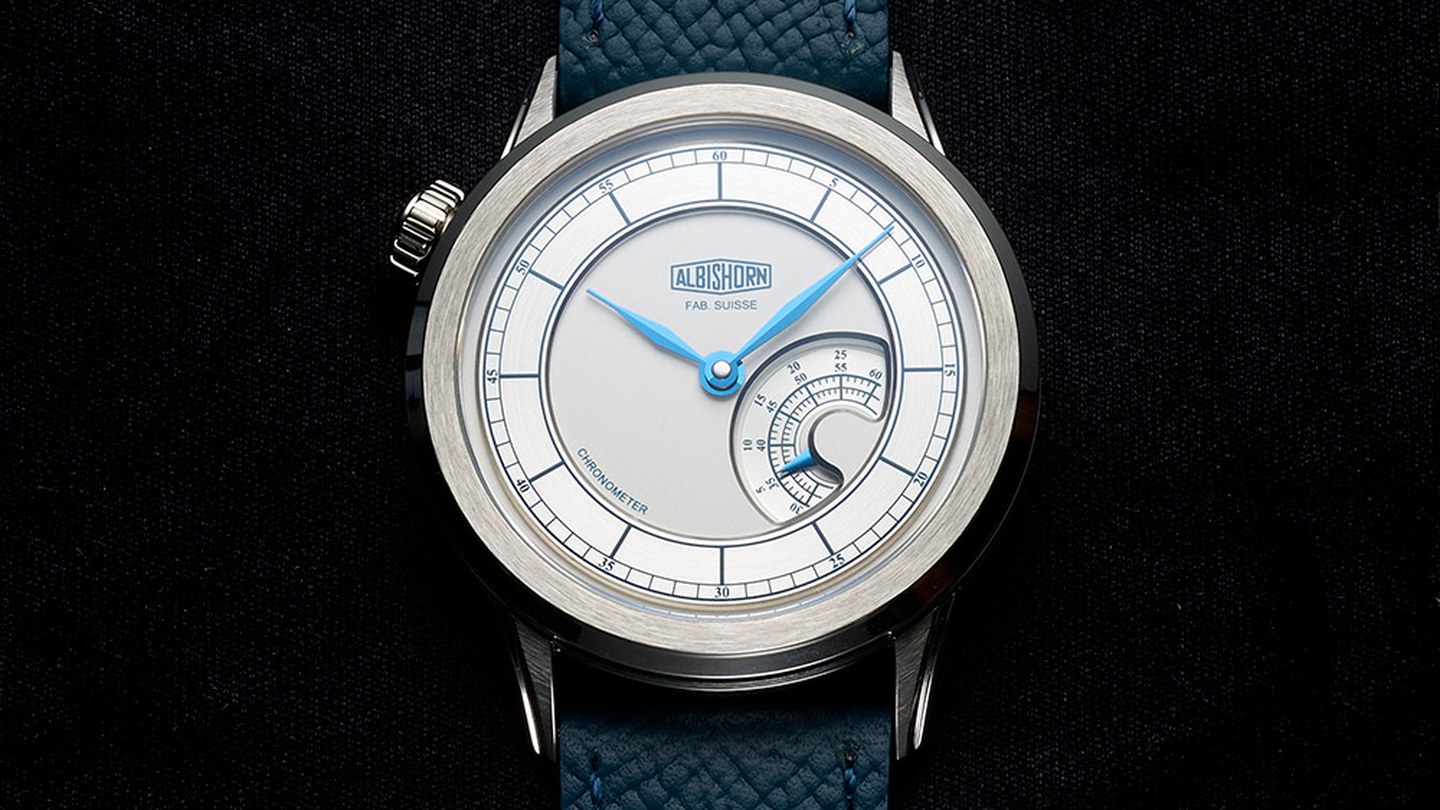
Gabriel Voisin built aeroplanes first and cars second, and he treated both as engineering problems with bodywork attached. Albishorn, a small Swiss maker in La Chaux-de-Fonds, has now built the watch it reckons Voisin would have commissioned for himself in the 1930s, at the time of his C28 Aérosport. It goes on sale today, November 11.
The Voisin Aérosport is a 38mm chronometer with a sector dial built in three physical layers, a hand-wound movement developed around that display, and a crown sitting at ten o’clock where no crown normally sits.
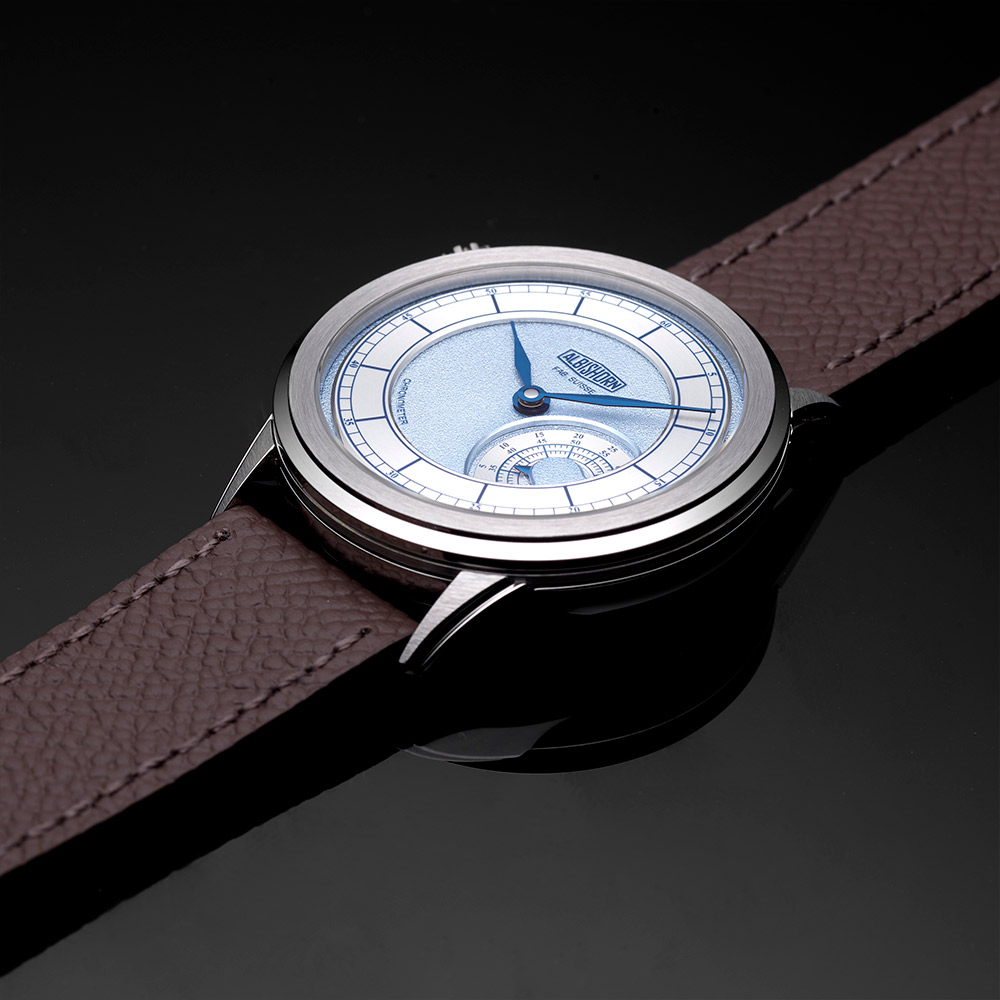
Two dial versions exist, Classic and Ice Blue, and every watch ships with two calf leather straps, one petrol-blue and one taupe. Production stops at 99 pieces, unnumbered, spread across three years. Pricing starts at $4,204 on strap. A steel bracelet takes it to $4,752. Deliveries begin at the end of November 2026, direct from the maker.
Albishorn Voisin Aérosport
38mm steel case, 9.6mm thick · Hand-wound ALB04 M, COSC chronometer, 60-hour reserve · Limited to 99 unnumbered pieces over three years
Price: $4,204 on strap · $4,752 on bracelet
Built for a man who designed aeroplanes, then cars
Gabriel Voisin started with gliders in 1903, worked with Louis Blériot, then built aircraft with his younger brother Charles. On January 13, 1908, Henri Farman flew a one-kilometre closed circuit at Issy-les-Moulineaux in a Voisin biplane and took the Deutsch-Archdeacon Grand Prix d’Aviation, establishing an important milestone in European flight.

Charles died in a car accident in 1912. Gabriel kept building aircraft, and Voisin became a major military supplier during the First World War. Peace pushed him toward the road. Under the Avions Voisin name he produced some of the strangest and most considered French cars of the interwar years, shaped by wind tunnels and lightweight structures rather than by styling departments.
The C28 Aérosport carried that thinking furthest, a streamlined coupé whose form followed its engineering.
Albishorn calls its approach Imaginary Vintage. The watches are missing links, pieces that fit inside real watchmaking history without ever having existed in it. Founder Sébastien Chaulmontet runs the brand and shapes the product.
He has ten patents to his name, wrote a book on the history of the chronograph, and has led innovation at Sellita and Manufacture AMT since 2017. Head of design Fabien Collioud draws the watches. Collioud has handled movement design at Sellita since 2017, and he leads design at Atiles Design Studio.
Three layers deep, and the seconds get their own sector
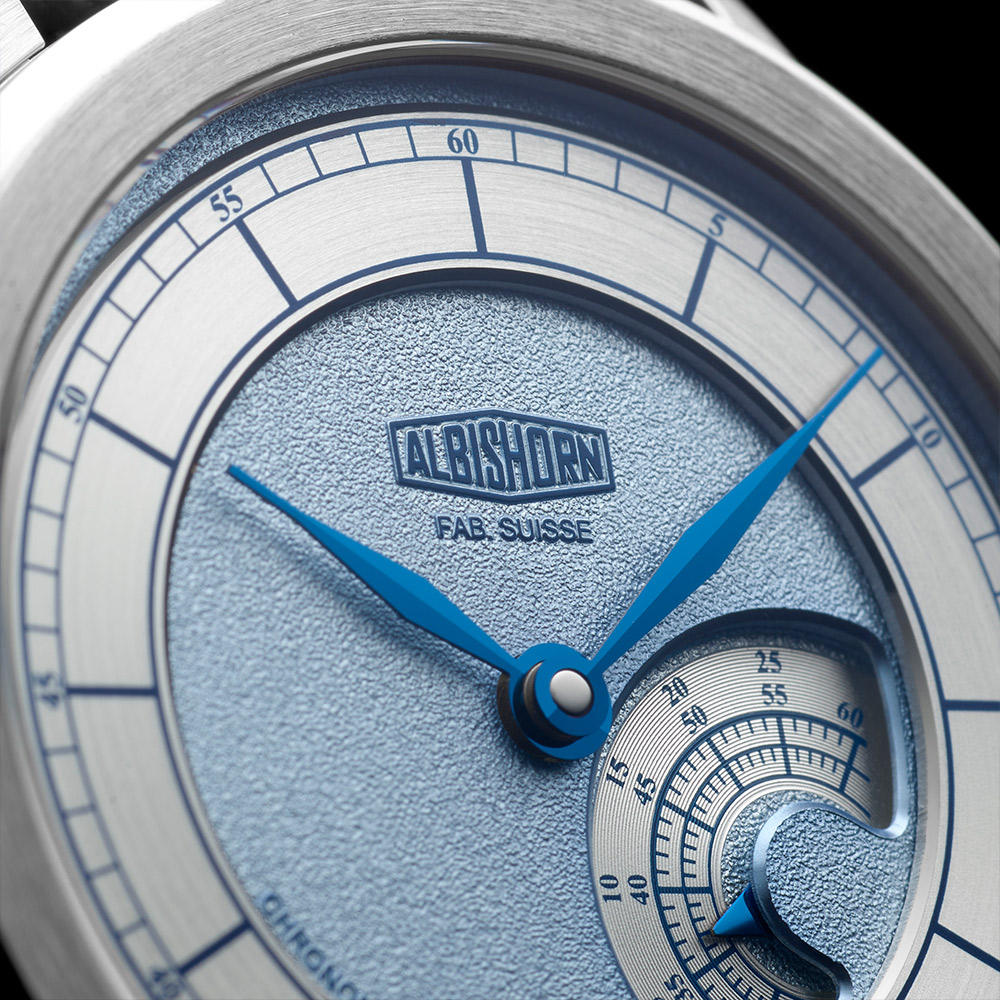
Look at the dial straight on and it seems calm, almost plain. That calm is constructed. Three elements sit one above another, at different heights, and the eye reads depth before it reads decoration. Nothing printed flat could produce the same effect.

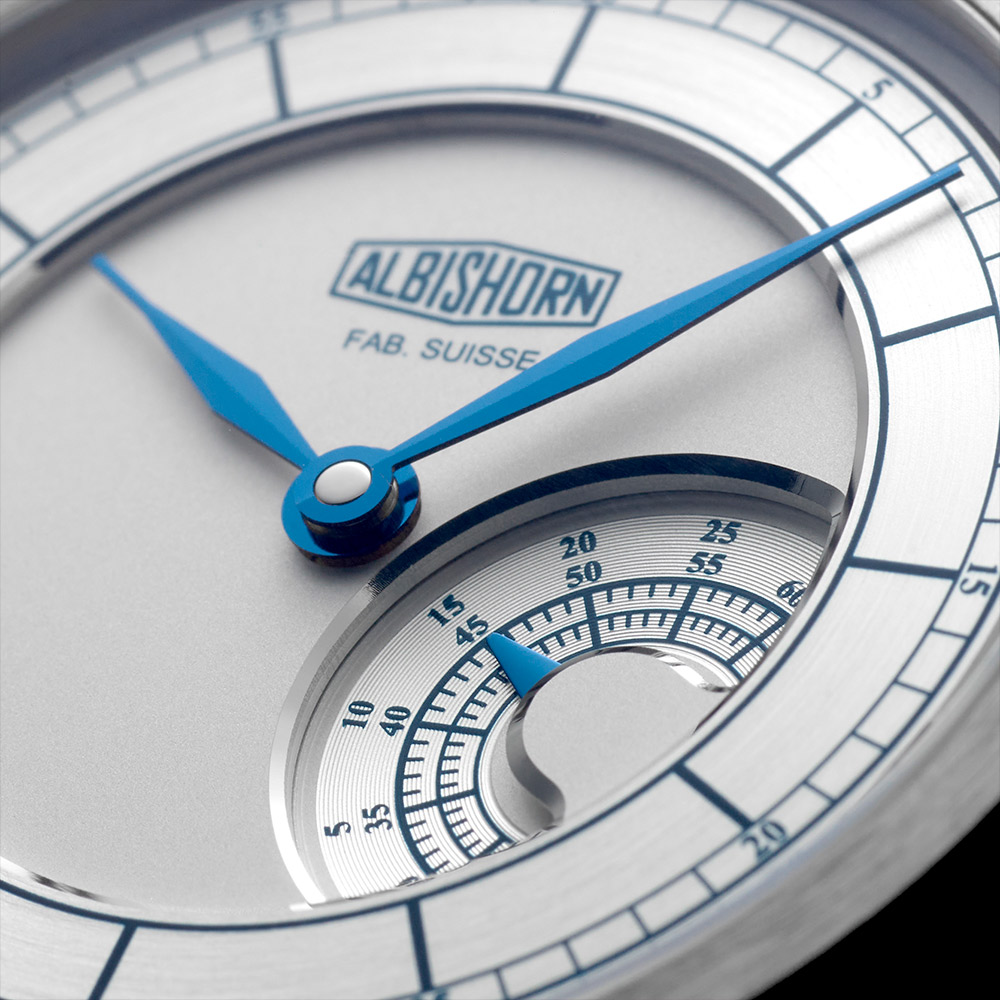
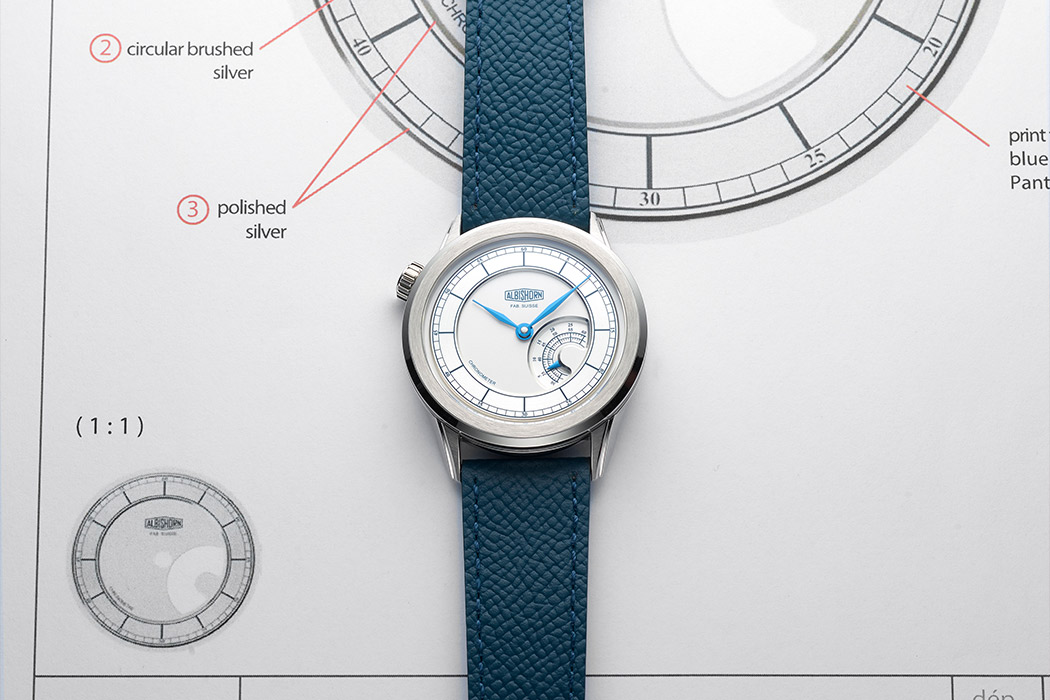
The lowest layer carries the running seconds, a 180-degree sector with a snailed finish, set at four o’clock. Above it sits the main dial in silver opaline.
A raised chapter ring tops the stack, circular satin-brushed, with polished edges and blue printing.
Art Deco usually arrives as ornament. Here it arrives as structure, geometry doing the decorating, exactly how Voisin treated a car body.
A case built from steps, and a crown at ten o’clock
The case runs 38mm across and 9.6mm thick with its sapphire crystal fitted, 8.9mm without it. Lug to lug measures 45.2mm, the lugs take a 20mm strap, and the whole watch seals against water to 50 metres. On paper, a slim and modest set of numbers.
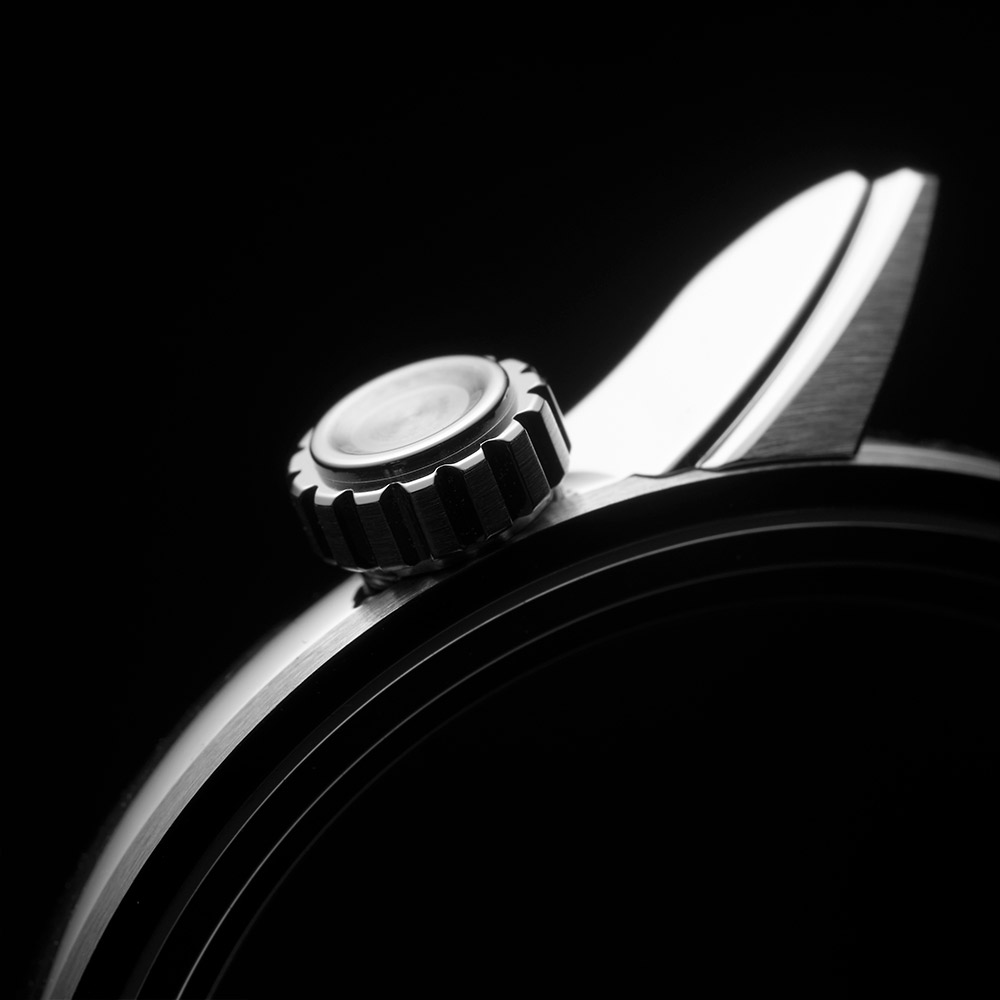
The shape earns its keep in section, not in silhouette. The bezel steps down in two levels, the upper surface circular-grained, the lower step inclined and mirror-polished. A circular-grained ring sits inside the caseband, dividing its levels. The lugs step twice as well, finished with circular satin across their tops. Bezel, band and lugs follow one system, so light breaks differently on every plane as the watch turns.
Chamfered edges take a polish, catching a line of light along each step.
Then there’s the crown, planted at ten o’clock instead of three.
A central recess splits its volume, turning a functional part into a small piece of architecture. Symmetry never stood a chance, deliberately.
Sapphire sits front and back. The front crystal carries anti-reflective coating on both faces, layered until reflections nearly vanish and the dial’s levels stay readable from sharp angles.
The movement was designed around the dial, not under it
Calibre ALB04 M fills the case at 30mm across and 4mm high, proportions closer to a 1930s chronometer movement than to a modern slim calibre. It’s hand-wound, built on an ébauche from Manufacture AMT, and COSC-certified as a chronometer. Sixty hours of power reserve, 28,800 vibrations per hour, 17 jewels, and a stop-seconds device for setting the time precisely.
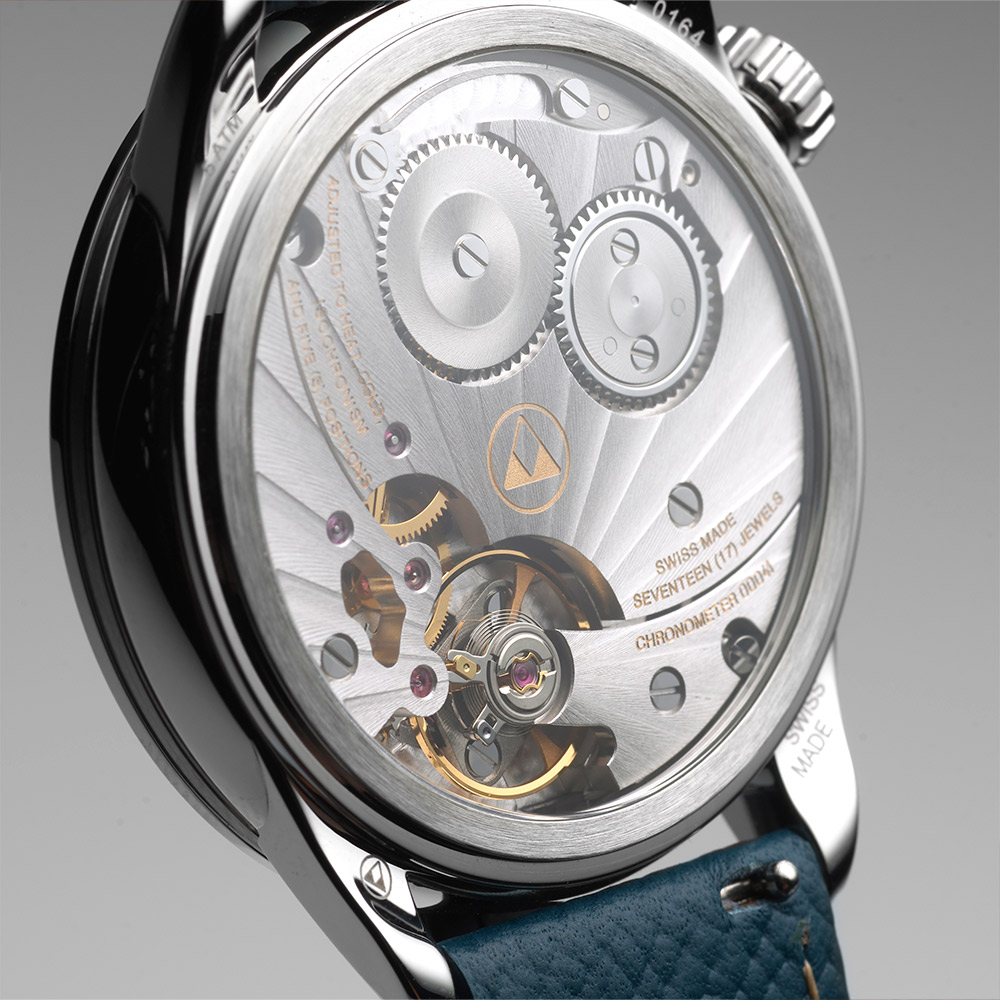
Two separate dial assemblies sit on the movement, one driving the sector seconds at four o’clock, another carrying hours and minutes across its two levels. That split is why the dial can stack the way it does. The display dictated the mechanics underneath, reversing the usual order of watch development.
Finishing runs to the parts nobody sees. Radiating Côtes de Genève cross the bridges, the winding wheels carry a fine double colimaçon finish, and perlage covers the mainplate, including the surfaces hidden beneath the dial. Screw heads are polished, engravings are picked out in gold tones, and the balance assembly sits exposed, adding one more layer of depth at the back.
Ruby jewels punctuate the bridges with small points of red.
Hand-winding suits the fiction. In the 1930s, winding a watch each morning was ordinary life, not a ritual invented for enthusiasts.
Two dials, two straps and a hard stop at ninety-nine
Classic keeps the silver opaline dial and the blue printing.
Ice Blue trades the centre for a grained ice-blue finish, keeping the same layered construction, the same blued hands and the same sector seconds. Same architecture, colder light.
Every watch arrives with two calf leather straps, petrol-blue and taupe, each closed by a buckle signed by the maker. A stainless steel bracelet joins the options list for buyers who want the watch on metal.
Ninety-nine pieces, total. No numbers on the cases, no second run announced, and the production stretches across three years because a workshop this size builds at its own pace. Sales run through the maker’s own site only, at $4,204 on strap and $4,752 on the bracelet, before taxes. Deliveries start at the end of November 2026.
Plenty of watches borrow car history as decoration, stripes and logos pasted over a standard dial. This one borrows the engineering culture instead, then rebuilds a movement and a case to match. As imaginary commissions go, Voisin got a good one.