
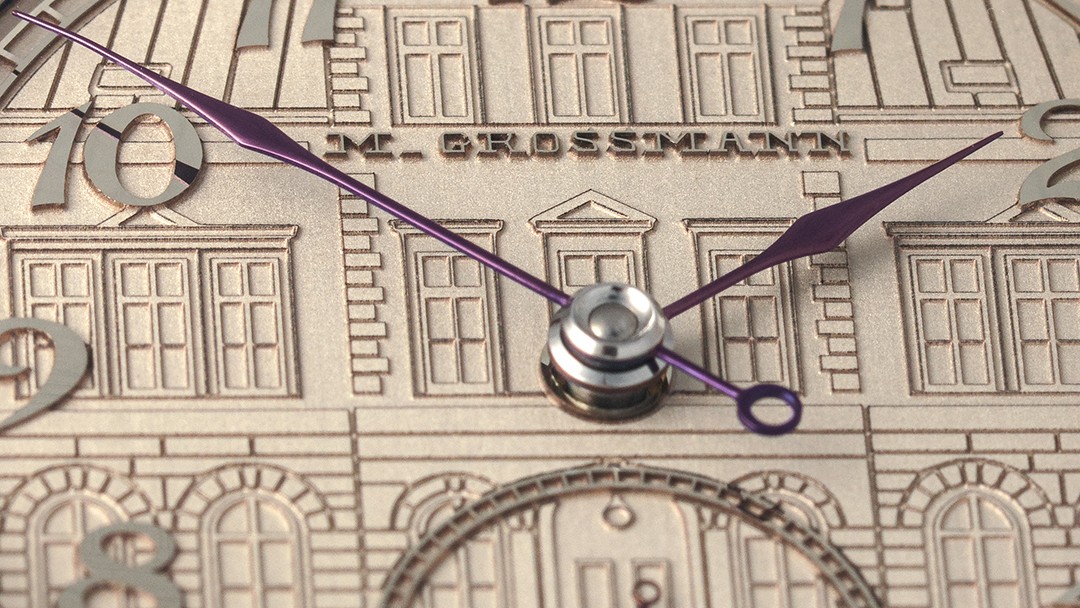
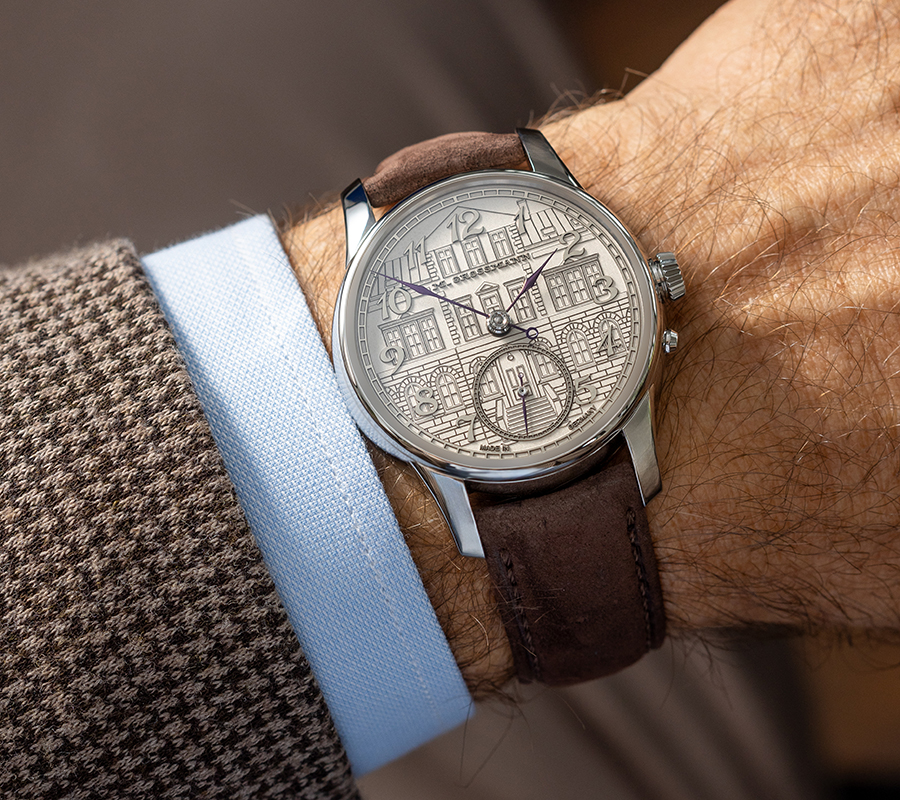
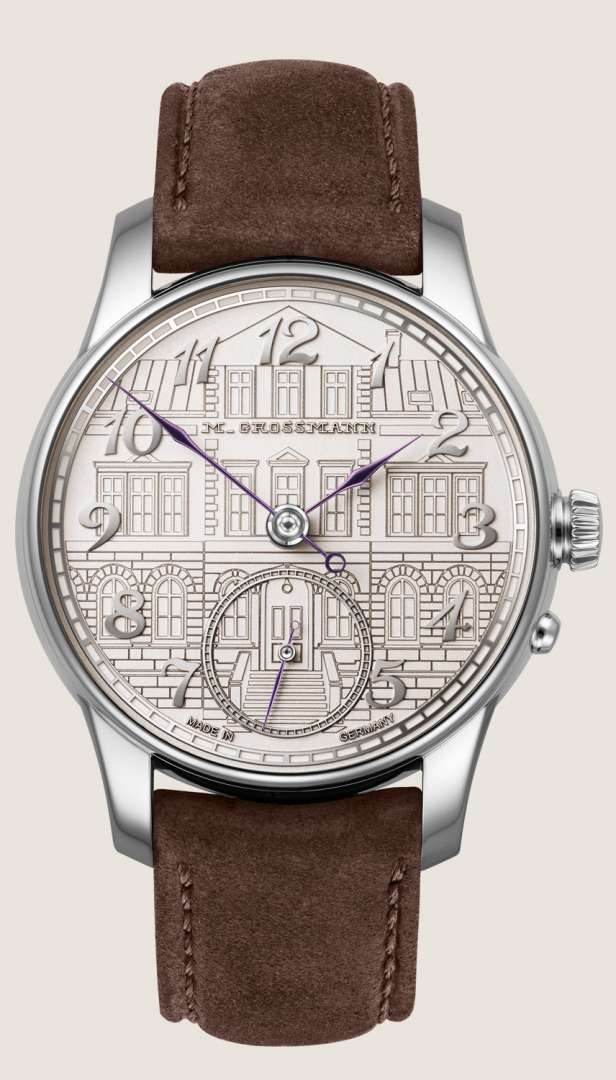
Twenty-six pieces, and every one of them carries a school. For the founder’s 200th birthday year, Moritz Grossmann has engraved the German School of Watchmaking across the dial of a Benu in stainless steel, the facade of the old main building worked in relief into German silver, windows, cornices and all.

The date does double duty.
Grossmann Uhren GmbH turns eighteen today. Christine Hutter founded the company on 11 November 2008, and the Benu 1878 is the eighth anniversary edition the manufacture has dedicated to its namesake. He was born in Dresden on 27 March 1826, two hundred years ago this year, and the reference MG-004211 holds both anniversaries at once.
The school came first
Grossmann reached Glashütte in 1854, talked into the move by his friend Ferdinand Adolph Lange, and set up the workshop that made his name. The watches built the reputation. The teaching built everything else, because he spent his life passing the craft on as an author, a theorist and a working instructor.

The school was his idea before it was a building.
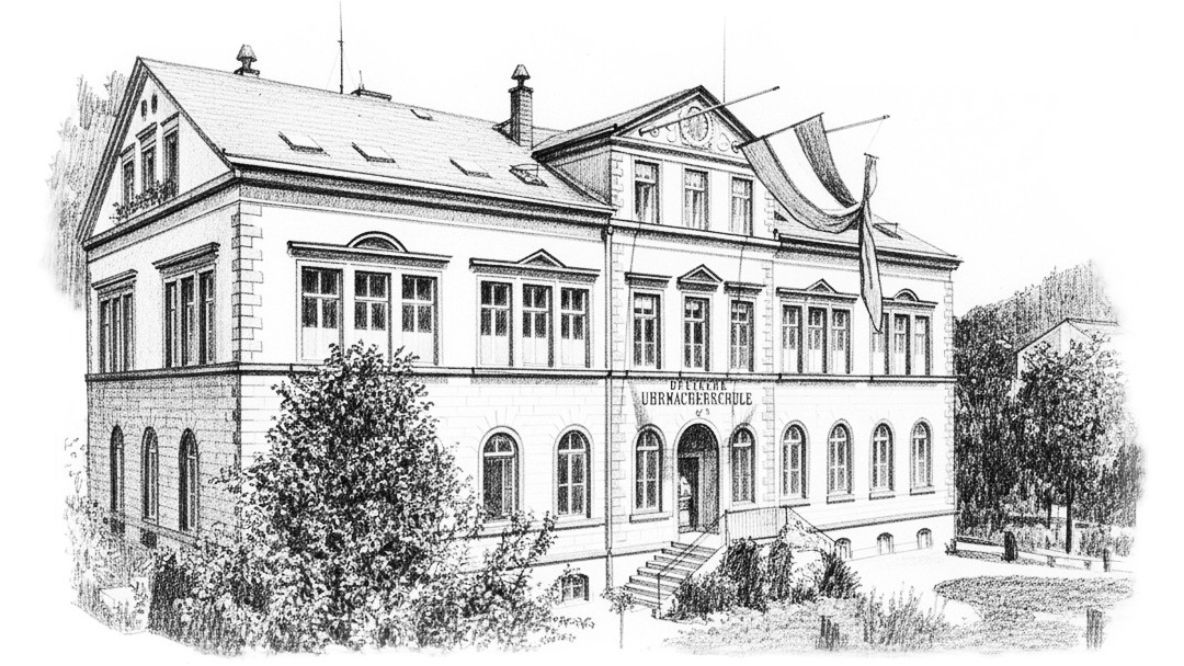
He initiated the German School of Watchmaking and spoke at its opening on 1 May 1878. Generations of watchmakers trained there, and the small Saxon town’s name became the German word for precision on a dial. The building on this watch is the school’s original main block, raised in the Historicist style and opened in 1881, extended in 1923 with a new wing and its broad front steps. It houses the German Watch Museum Glashütte today.
His opening words to the first students still read like a warning. The best thing the school could teach, he told them, was the revelation that the field runs so wide that nobody in it counts as much more than an apprentice.
A facade in relief
The dial is German silver, and nothing on it comes printed or applied. The manufacture developed its relief technique through long trials on this metal, modelling the building in three dimensions so the architecture itself carries the design: symmetrical windows, moulded cornices, brickwork running down into the small seconds.
Even the numerals are carved, not set on.
The Arabic numerals stand in relief, and so do the railway minute track, the ring around the small seconds and the M. Grossmann signature from 1875. Two tones and the rhythm of the engraved lines do the rest of the work.
The school’s entrance, steps and all, sits inside the small seconds counter at six o’clock. The hands are the house lance form, made by hand and annealed to a brown-violet hue, the same heat treatment the movement’s screws get on the other side of the watch.
Calibre 100.1 under glass
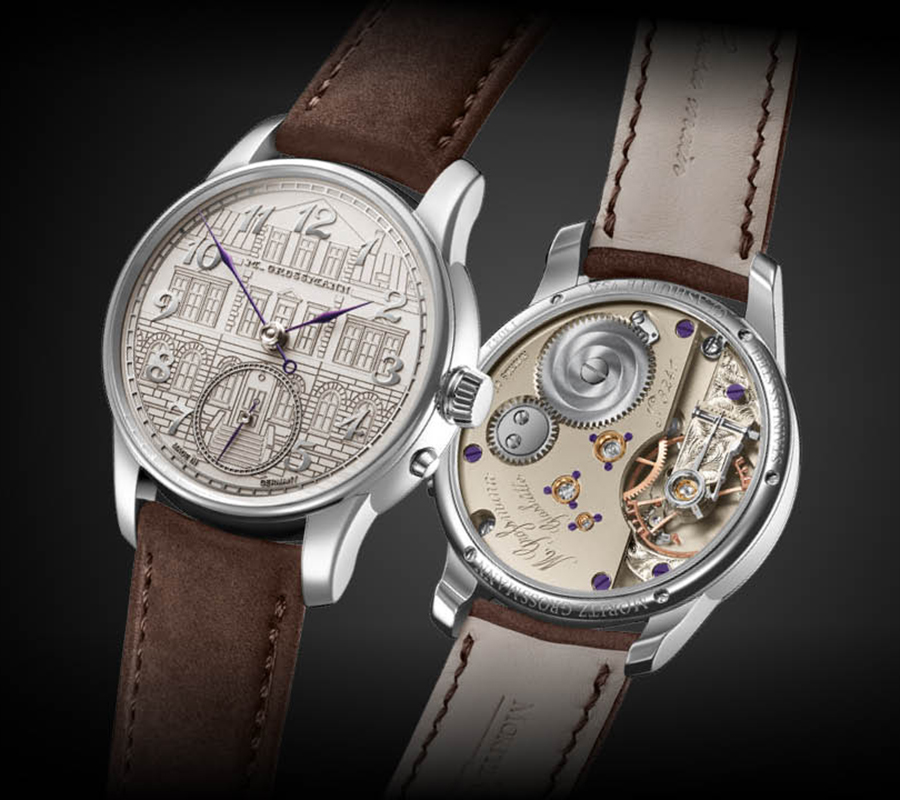
Under the dial sits the manufacture calibre 100.1, wound by hand and adjusted in five positions: 198 parts, 20 jewels with three of them in screwed gold chatons, and a 42-hour power reserve. The Grossmann balance runs at 18,000 semi-oscillations an hour on a newly engineered oscillator, and the whole movement shows through a sapphire back.

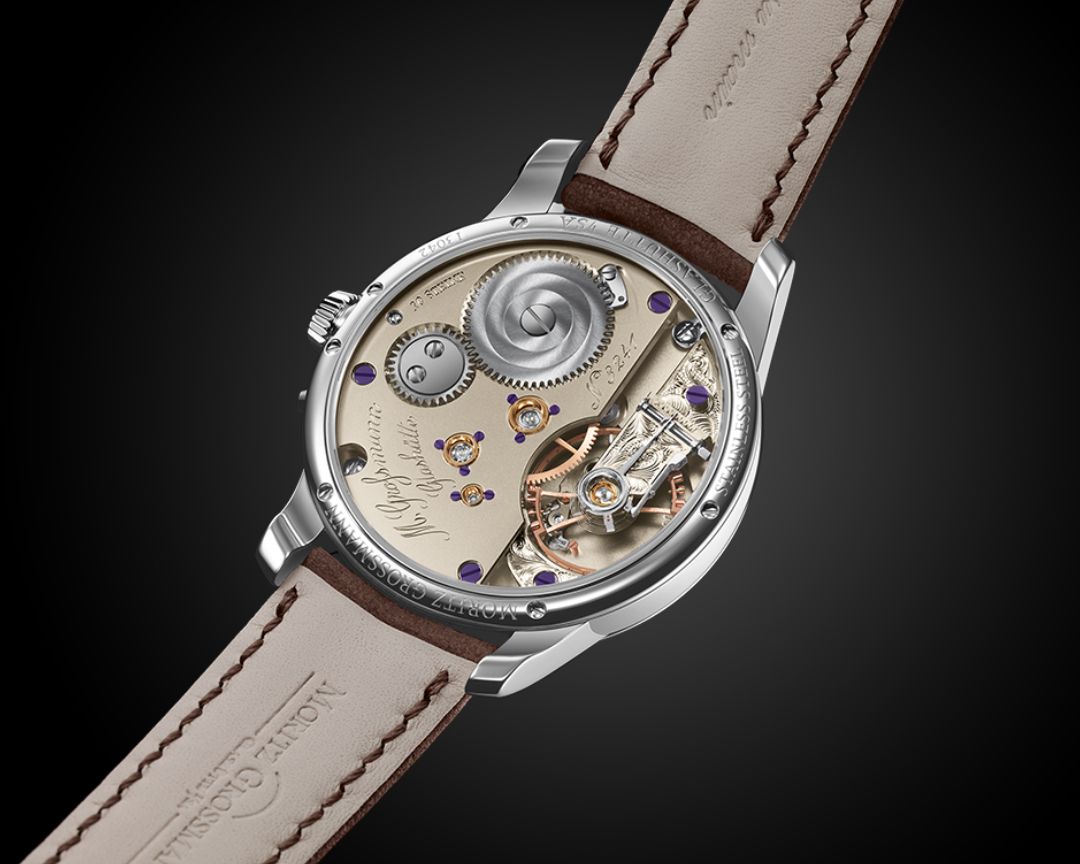
The pusher beside the crown gives the calibre away as a Grossmann.
Press it and the hand-setting mode uncouples, then restarts the movement cleanly, with stop seconds for setting. The pillar movement carries its 2/3 plate and frame pillars in untreated German silver, the same metal as the dial, so the watch is one material and one idea from front to back.
The balance earns its own paragraph in the manufacture’s notes. Its moment of inertia is set during the handcrafting, chasing high kinetic energy with the least air resistance and the smallest mass the design allows.
Engraving where nobody has to look
The balance cock and the escape-wheel cock carry a floral pattern engraved by hand, work that serves no function beyond the standard it sets. The train-wheel bridge is German silver grained by hand for an even surface, its edges bevelled and polished all the way round, and the ratchet wheel wears the house three-band snailing.

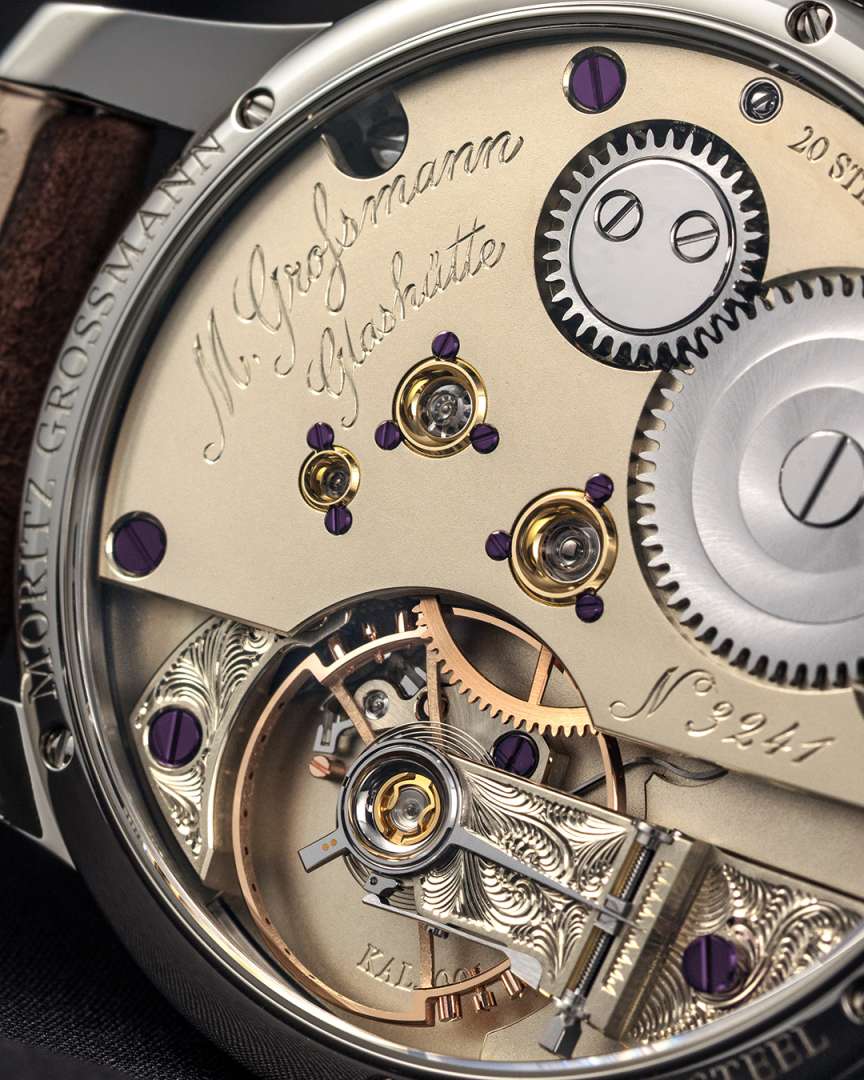
Look closer and the bearing jewels are white sapphire, raised in gold chatons and held by screws annealed to brown-violet, each jewel removable on its own for cleaning without risk to the plate. Grossmann’s own pocket watches sat their jewels proud in the same way. A century and a half on, the signature holds.
Steel, kudu and a short run
The case is three parts of polished stainless steel, 41.0 mm across and 11.35 mm high, with sapphire at the front and the back. The strap is kudu leather, hand-stitched in brown, on a steel prong buckle, and the whole watch keeps the quiet proportions the Benu line has carried since it reopened the company’s modern era. The crown and the pusher beside it are steel too, the pusher placed at two o’clock in the Grossmann manner.

Twenty-six pieces will be made, priced at $42,870 before taxes, sold through the manufacture’s own boutique and its retailers. The school trained generations and asked for nothing back. Twenty-six buyers get the building on a dial, and everyone else gets the museum that now sits inside the real one.