

Agate does something lacquer can’t do on any dial, because light passes through the stone instead of stopping at its surface. Translucency does the rest. Arnold & Son cuts it to just 0.4 mm for the hours ring on two Time Pyramid 42.5 editions.
A calibre built along a single vertical line


Built along a 6-to-12 o’clock axis, the A&S1615 calibre draws its layout from 19th-century precision regulators and British skeleton clocks linked to John Roger Arnold. Circular geometry sits on an annular main plate, and that plate carries the bridges for the power-reserve indicators out at the periphery. The middle stays open. Nothing crowds the center, so the pyramid silhouette reads clearly from the first glance onward.
Two barrels sit side by side at the base and feed a linear gear train that climbs toward the balance wheel at 12 o’clock, below a triangular balance cock. Each barrel gets its own power-reserve indicator, placed on either side of the gear train, and together they deliver a 90-hour reserve. Winding happens through the crown at 6 o’clock, and a reader’s eye follows the energy upward from stored power to regulation.
Inside that slim profile sit 27 jewels, a 37.60 mm diameter and a thickness of just 4.40 mm, with a frequency of 3 Hz or 21,600 vibrations per hour. Finishing stays traditional throughout, with hand-chamfered bridges, polished flanks, Côtes de Genève striping and blued screws. Traditional poising screws ring the balance rim. A Swiss lever system handles regulation at the top, completing a movement that hides nothing from view.
Hours, minutes and seconds join only the double power-reserve indication that the twin barrels require, and that restraint suits an architecture built on a single clean line. Every added complication would break the vertical run from crown to balance, so the design subtracts almost everything outside structure, energy and regulation. Clarity comes from subtraction here, not from decoration added later.
Platinum and blue agate


Platinum pairs with blue agate in the first edition, and 950 platinum sharpens the stone’s color instead of competing with it across the open dial. Arnold & Son describes the blue as evoking deep space or the Arctic Ocean, a comparison that holds up in the brand’s photographs. Its tone shifts with the light. Under the translucent ring, the seconds ring stays visible, so the dial gains depth from the movement beneath it. Few skeleton dials gain depth that honestly.
Across the case, the dimensions read 42.5 mm by 10.72 mm, and a domed sapphire crystal with anti-reflective coating on both sides keeps the open display legible. Turning the watch over reveals a second slice of blue agate, 0.8 mm thick, set behind the sapphire case back as a mineral backdrop for the twin barrels. Water resistance sits at 3 bar, and the azure blue alligator strap, hand-stitched and closed with a platinum pin buckle, completes one cool palette.
Red gold and red agate

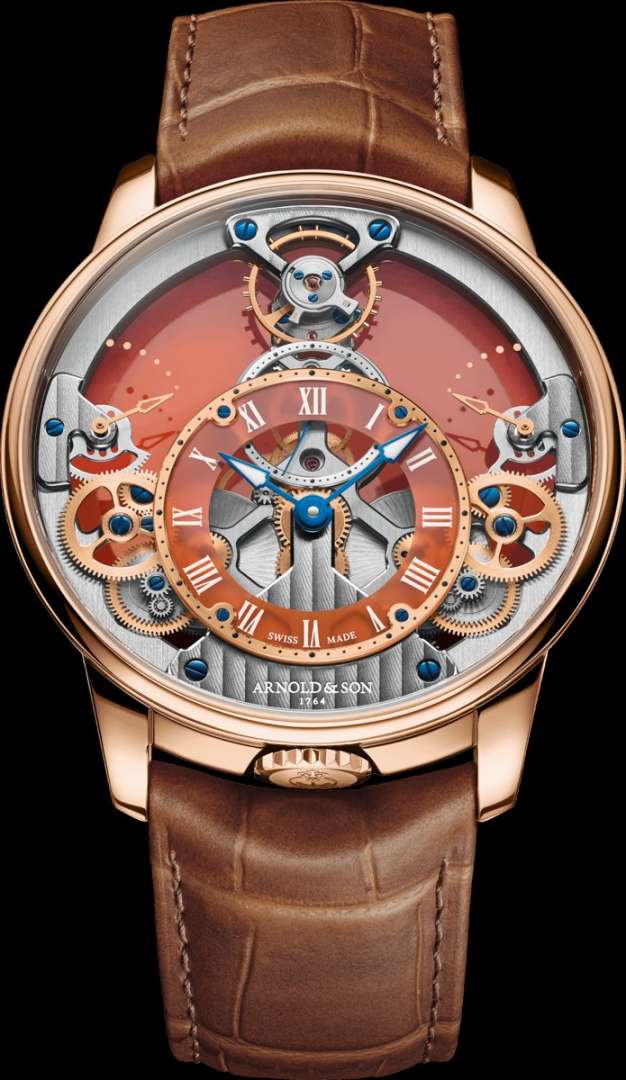
Red gold takes the same architecture and warms every part of it, pairing 18-carat red gold 5N with a red agate hours ring on the second edition. Arnold & Son calls the red stone radiant and says it captures the light, and the warmer metal gives that color a deeper base than platinum could offer. Contrast runs opposite here. Where platinum cools the stone down, red gold turns its temperature up, and the watch gains a stronger wrist presence.

Dimensions and calibre match the platinum edition exactly, at 42.5 mm by 10.72 mm with the same 0.8 mm agate disc behind the sapphire back. Amber brown alligator leather replaces azure on the strap, and the pin buckle comes in red gold 5N to match the case on the wrist. One design serves both editions, and color does the separating work between them.
Sixteen pieces and no second run

Eight pieces per edition cap the full agate run at sixteen watches across both metals and both stone colors, among the smallest Time Pyramid releases so far. Agate forms over thousands of years, and that slow formation means no two hours rings or case-back discs carry identical banding, density or depth of color. Sixteen watches carry sixteen different stones. Choosing one isn’t a production-line decision, because a given stone can’t be repeated in a later example.
Scarcity also shapes how the watches move, since they’re offered through the brand’s own channels rather than as an open online release. Arnold & Son lists no price for either reference on its site, so an inquiry goes to the brand directly. The platinum reference is 1TPEX.Z01A.C1483X and the red gold reference is 1TPER.Z01A.C1488A, and those codes are the fastest route into a conversation about availability. Small runs reward early calls. Waiting rarely helps on a run this small.
Both straps are hand-stitched alligator leather, and both buckles match their case metal rather than borrowing a standard fitting from another line in the collection. Details like that sound minor on a specification sheet, yet they’re the details a collector handles every day. A buckle gets touched daily. Getting its weight and finish right belongs to the watch itself, not to an accessory decision made after the design work ended.
The bottom line

I’d take the platinum and blue agate piece, because the cold pairing lets the stone’s translucency work against the movement. Red gold suits a collector who wants warmth. Both keep the same vertical calibre, the same 90-hour reserve and the same sixteen-piece ceiling across the run, with hand finishing across every bridge and wheel. Temperature, metal and stone decide it, and that’s exactly the choice a two-edition release should offer. The stone makes each one singular within the run.