
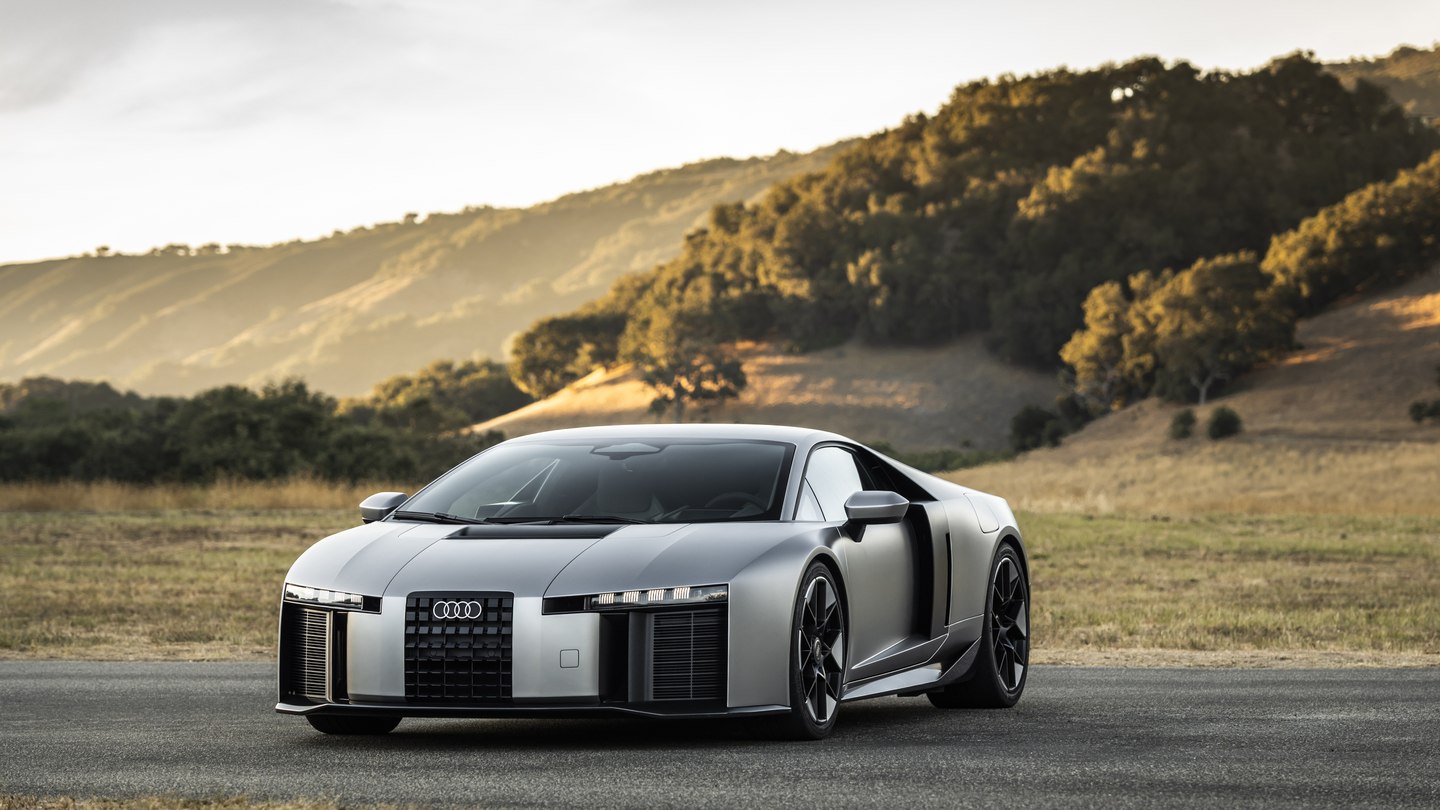
Put three reviewers in the same 987-horsepower Audi at the same Spanish racetrack and they’ll agree on the easy part. The Nuvolari is violent in a straight line and unshakable under braking.
MotorTrend, Evo, and Hagerty all drove pre-production cars at Jarama outside Madrid, and none of them is arguing about the speed.
They split on feel.
Steering weight, mostly. Brake pedals at walking pace. Whether a chassis this clever leaves the driver anything to do.
Those questions decide whether the Nuvolari is a landmark or a very expensive press release, and they’re the ones worth rounding up. This car isn’t really a product launch. It’s Audi stating, in 499 units, what it intends to be next.
Design first, because Audi insists on it

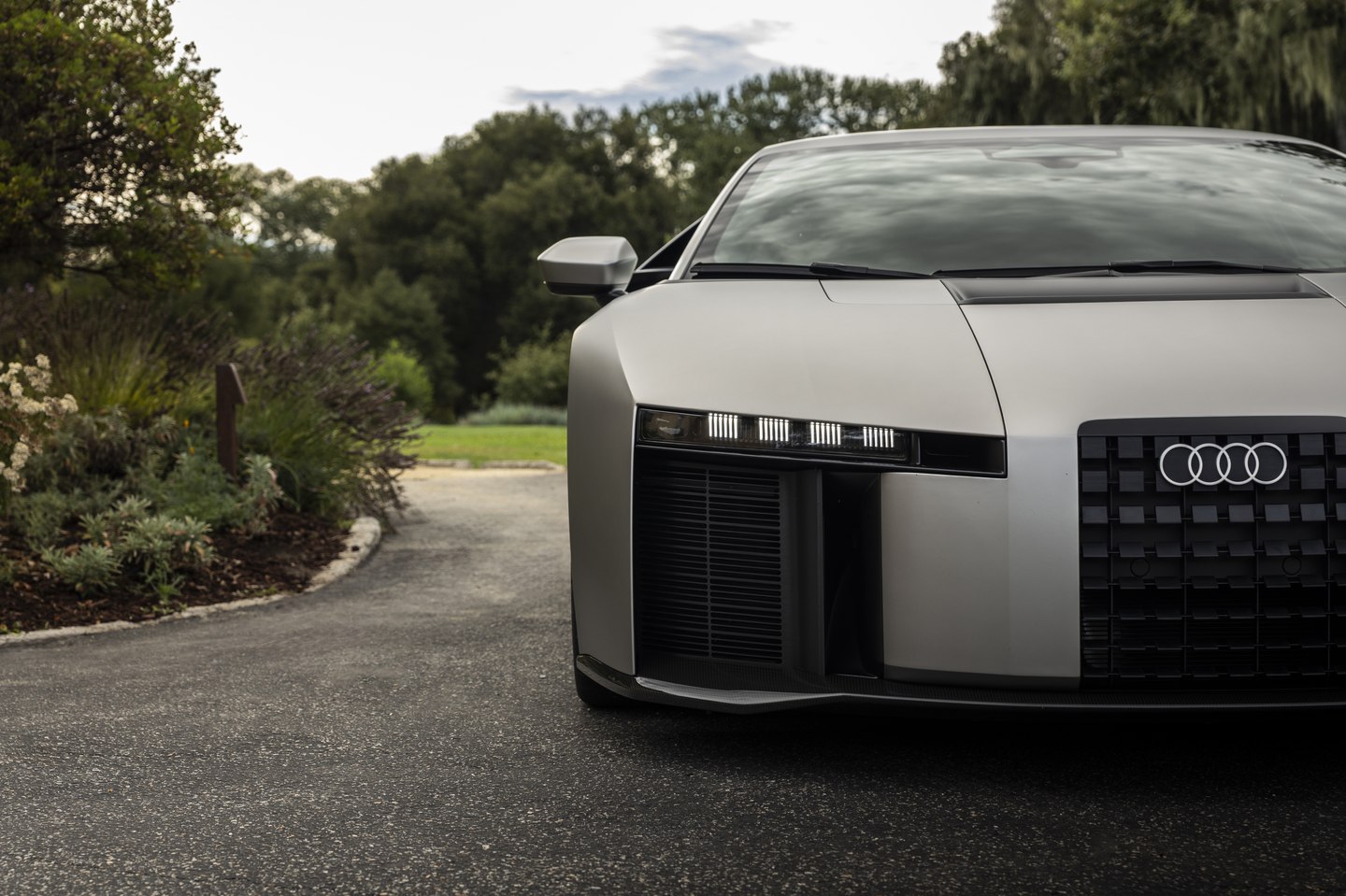
The Nuvolari is the first production car drawn under the design direction Audi calls Radical Next, penned under Massimo Frascella, and it looks like a decision rather than a compromise. Evo called it angular and monolithic, like it was milled from billet, and reached for the original TT as the last Audi with this kind of landmark boldness. Where the TT was soft Bauhaus arcs, this one is cut edges and taut surfaces over a mid-engine stance.
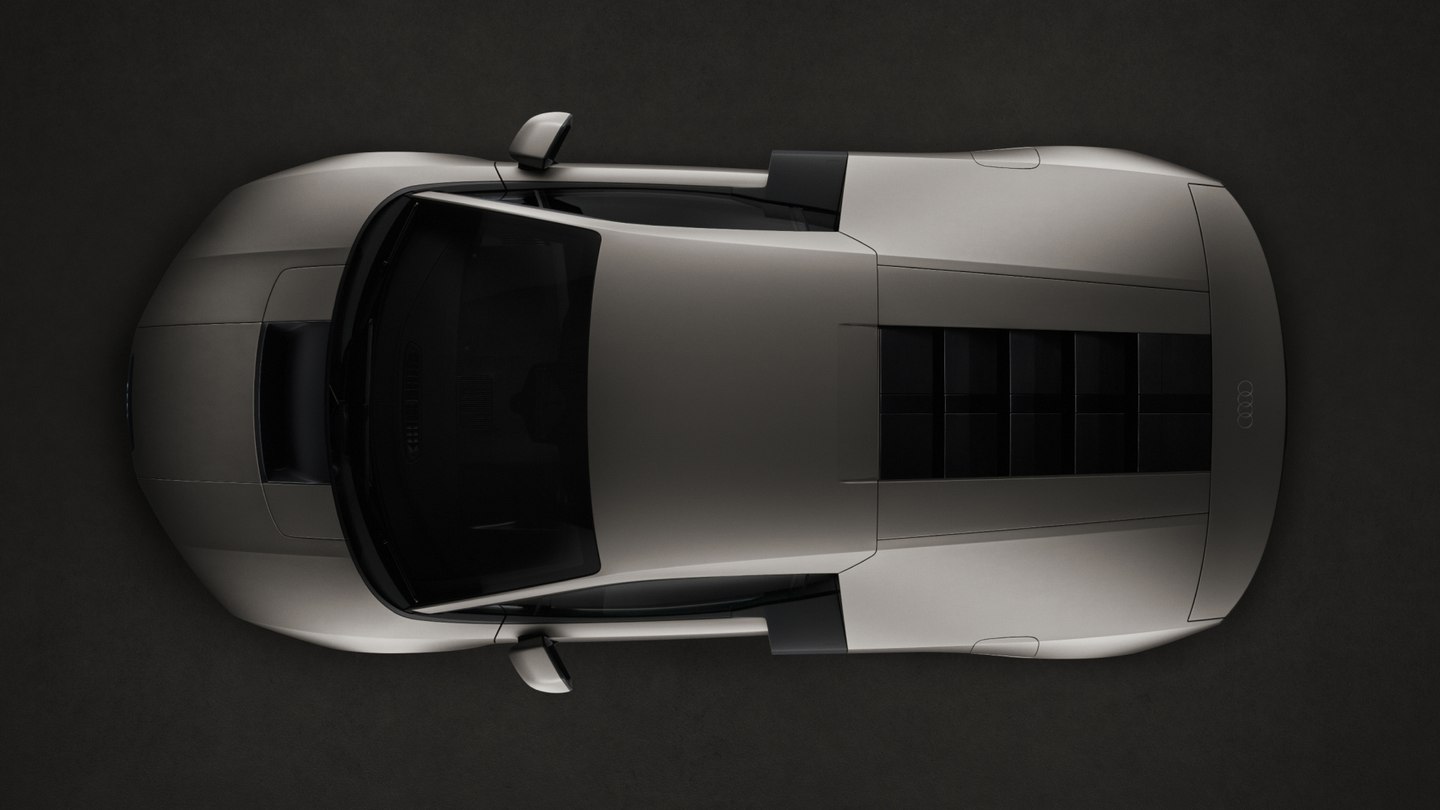
The body is carbon fiber over an Audi Space Frame, a first for the brand in production.
That skin is a real point of separation from the Lamborghini Temerario underneath, which wears aluminum. The launch color is Titanium, a satin silver shared with the Concept C show car and Audi’s Formula 1 machine, and the contrasting vertical frame at the nose pulls air through a central S-duct.
Technical chief Rouven Mohr, who ran Lamborghini’s R&D before crossing over, keeps the shape clean on purpose. “We explicitly did not want to build a hypercar,” he says. “That’s why there are no go-faster add-ons like flicks, splitters, and air dams blighting the very clean basic shape.” The rear wing deploys when needed and hides when it isn’t, good for up to 881 pounds of downforce with no double-decker spoiler parked on the tail.
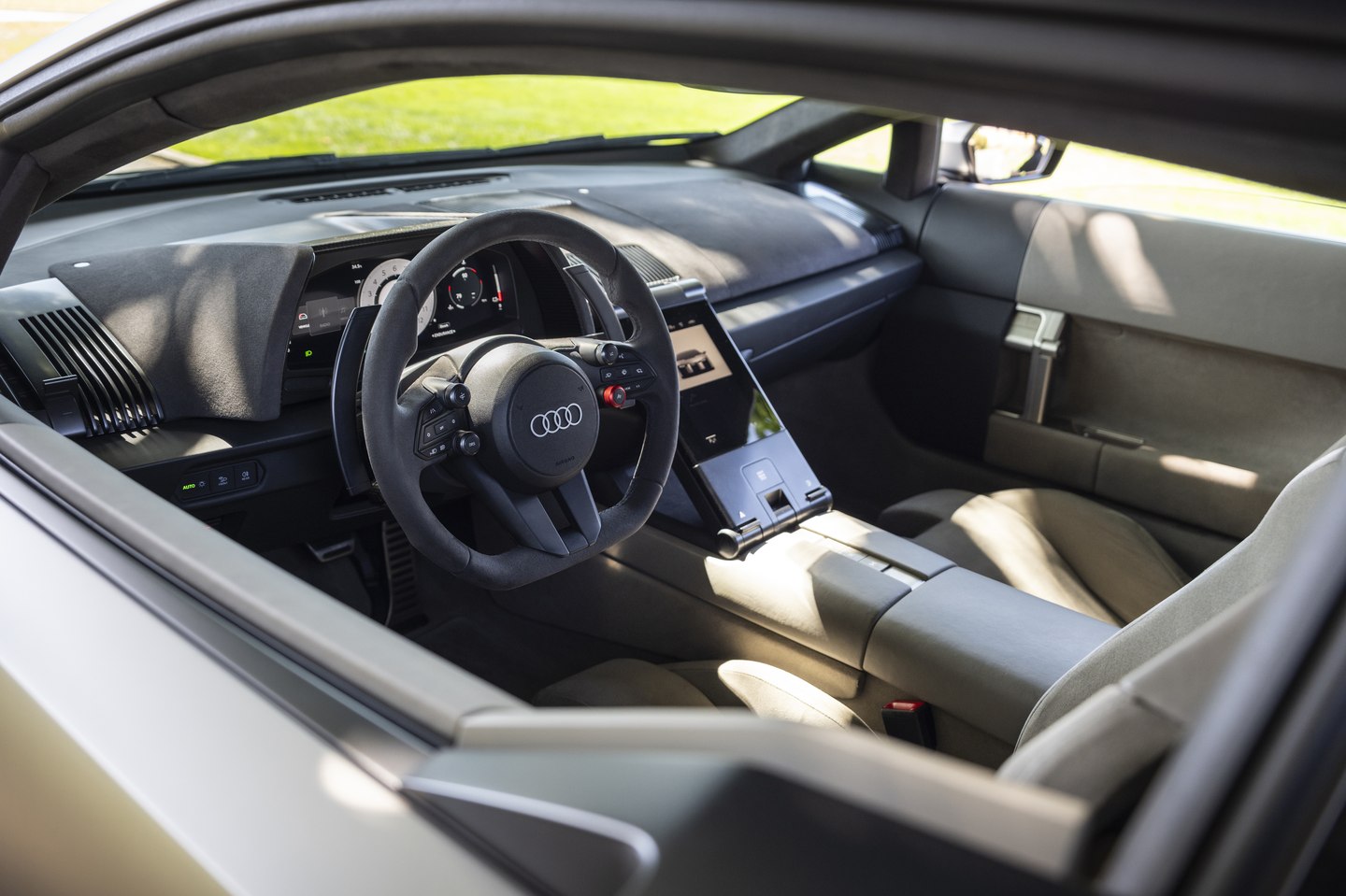
Inside, the cabin splits into a dark driver’s zone and a lighter Shadow Dune rear section, with carbon-shell seats and anodized aluminum framing the central display and the controls gathered around the steering wheel, everything else pushed out of the driver’s eyeline.
The drivers split here. Evo found it calm and precisely crafted, materials a class above the Lamborghini’s. Hagerty called the dashboard too bland for the money, the infotainment second-rate. Both readings fit the same austere cabin.
The hardware is a Lamborghini’s, retuned past it
Under the carbon sits the Temerario’s architecture. The 4.0-liter twin-turbo V8 is Lamborghini’s flat-plane-crank unit, worth 789 hp and 538 lb-ft on its own, revving to 10,000 rpm. Three axial-flux electric motors, 148 hp each, fill the front axle and the gap between engine and the eight-speed dual-clutch gearbox.
The retune is in the electricity. The motors contribute more under load than they do in the Lamborghini, and the battery grows from 3.8 to 7.3 kWh inside the same physical space, lifting combined output to 987 hp and 664 lb-ft.
Audi claims 0 to 60 mph in a shade under 2.4 seconds. MotorTrend, reading that claim against its own Temerario test numbers, figures the production car will beat it. Top speed is quoted above 217 mph, 124 mph arrives a claimed 6.8 seconds after launch under Audi’s stated conditions of a hot battery and a charge above 80 percent, and Hagerty’s spec sheet from the event put dry weight at 3,838 pounds.
The chassis brain is the part Audi wants credit for. Quattro Predictive Ride reads a 6D sensor at the car’s center, tracking acceleration and rotation in every direction, and works out what the driver is attempting before the tires report a problem. Torque splits shift front to rear and across the front axle. Individual brakes squeeze. The wing adjusts. The car leans into the answer.

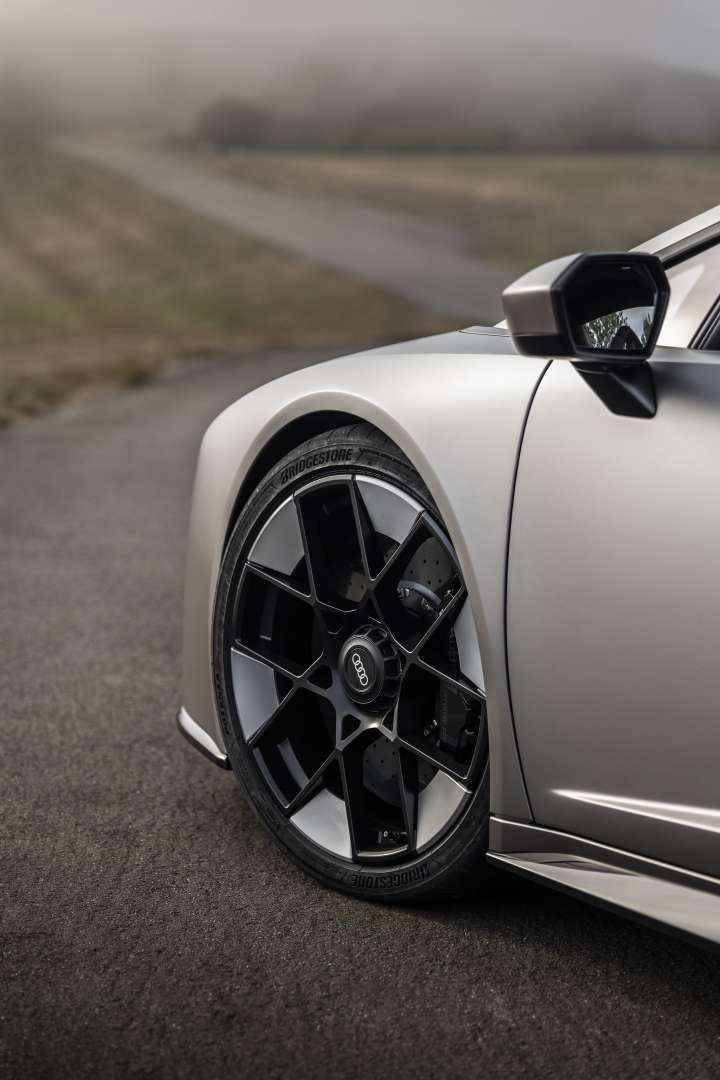
Underneath sits a choice both Evo and Hagerty circled: passive, manually adjustable KW dampers instead of the Temerario’s adaptive units. Hagerty liked the result, calling the ride less busy and more compliant than the Lamborghini’s. Evo wondered whether a system named Predictive Ride that can’t touch the damping is overselling itself.
Where the first drives agree

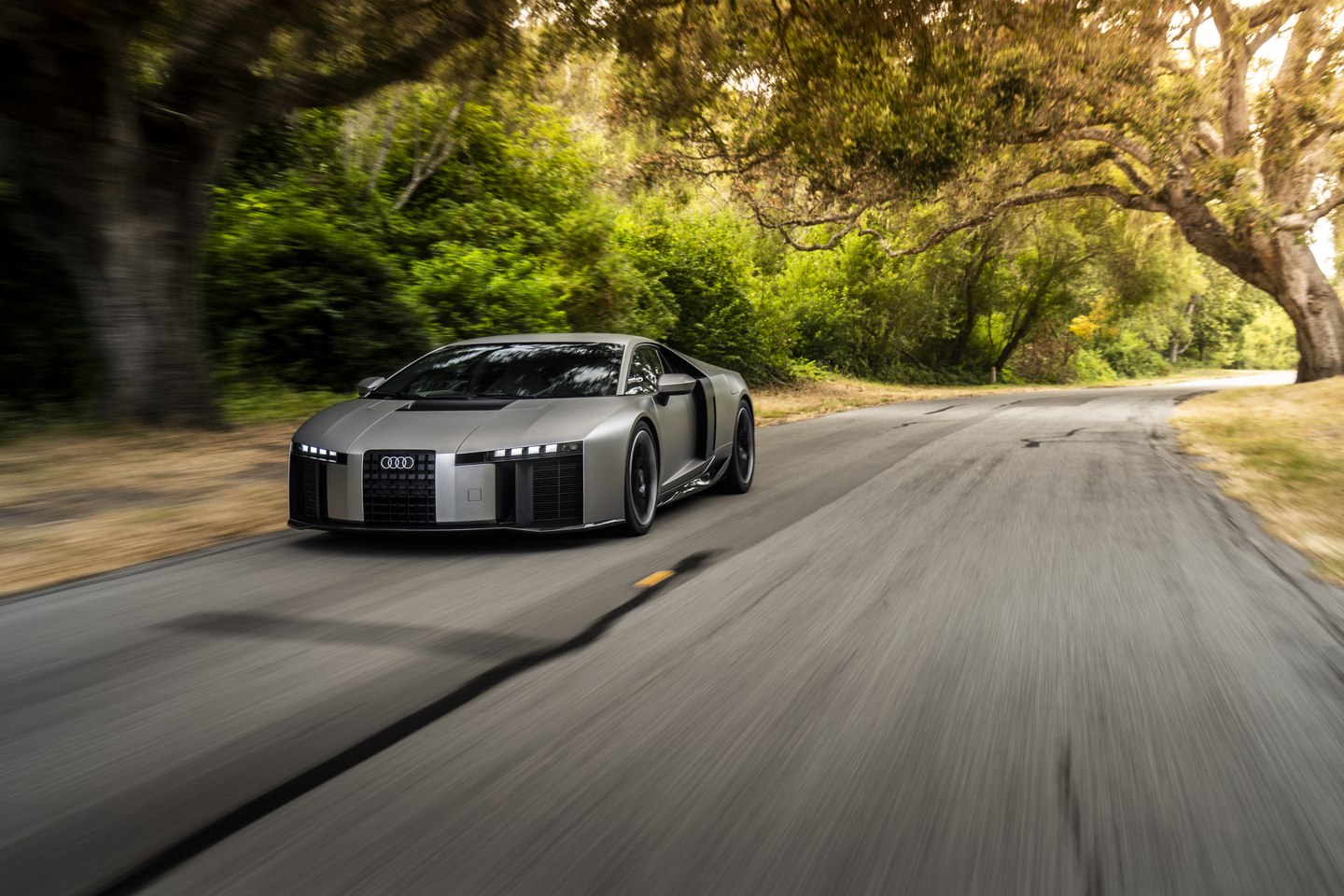
Start with the pace, because it’s absurd.
MotorTrend hit 186 mph in sixth gear on Jarama’s main straight, in Dynamic mode rather than the sharpest setting. Evo stormed toward 190. Hagerty’s Audi pro clocked an indicated 187.
All three describe the same elastic surge. The motors cover the low end, the V8 takes over, and the right technique is to resist shifting early and let it run to the redline, with the dual-clutch swapping ratios fast enough that nobody mentioned it twice.
The composure gets the same consensus. MotorTrend braked as late as it dared and found a car that squirmed slightly, then tracked straight and dove for the apex, its front end, in its words, rock solid and utterly reliable.
Hagerty called stability the Nuvolari’s major forte, its braking fuss-free, lap after lap.
Evo, the wave’s skeptic, still rated the Ceramic Pro brakes immensely powerful, a firm pedal with precise modulation that lets you brake deep into a corner. Few supercars stop like this, Evo wrote.
Then there’s the sound, where the agreement turns into a shared shrug. MotorTrend says the V8 sounds better here than in the Lamborghini, with less direct-injection clatter, but lands its verdict anyway: it shouts rather than sings. Hagerty calls it riotous rather than melodious. Evo splits the difference, since its road and track cars ran different silencing, and notes Audi hasn’t settled the production tune. On the most emotional line item a 10,000-rpm V8 owns, nobody’s sold yet.
Where they split
The steering is the first fault line. Evo felt light, fast-responding steering with a typically filtered feel. Hagerty found three calibrations running from a bit too light to a tad heavy, picked the middle one, and praised an adaptive quality that kept everything feeling under control. Same rack, two readings. The difference is probably what each driver wants steering to be: information, or reassurance.
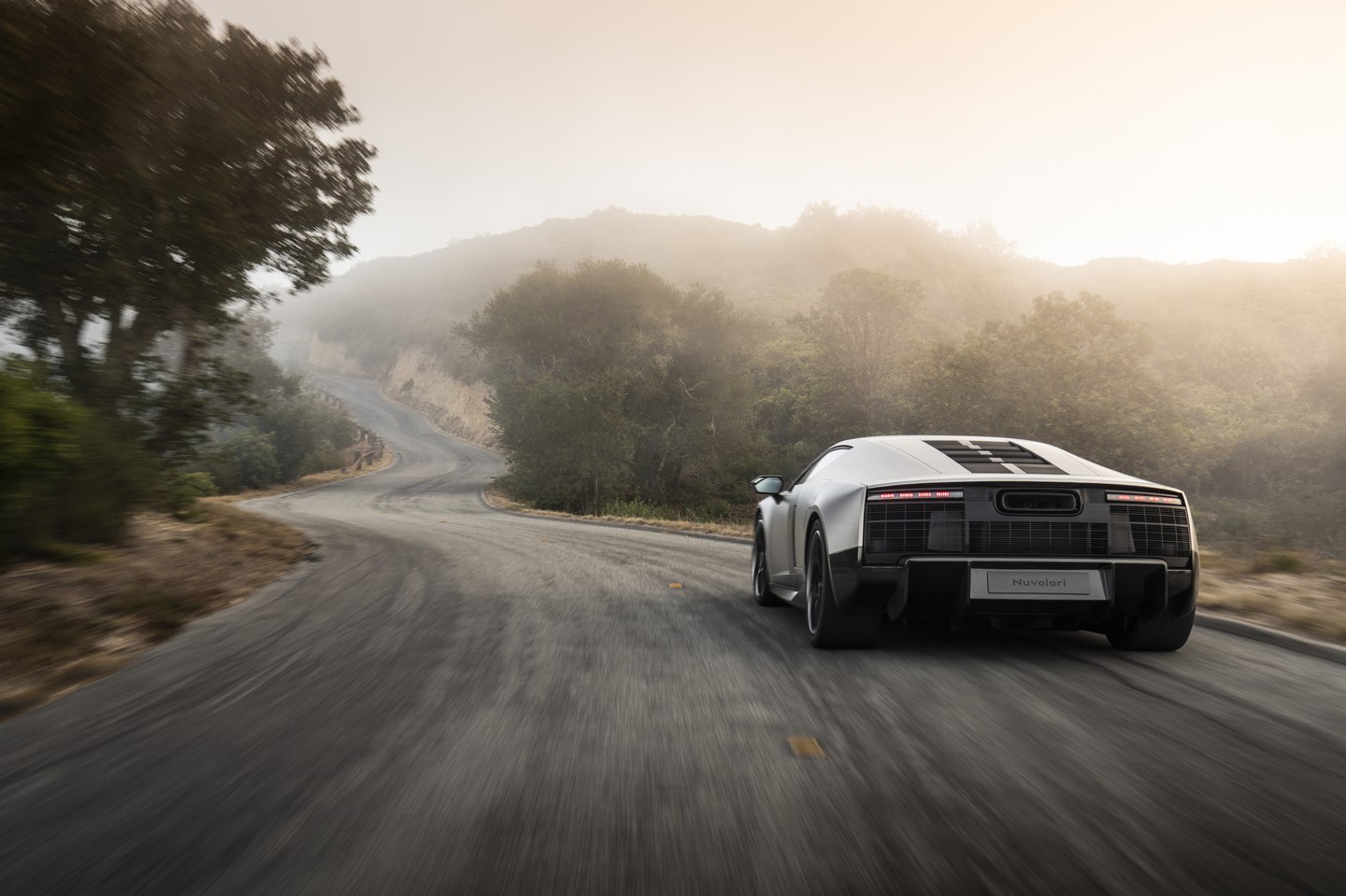
The handling balance splits wider. MotorTrend found a car that will power-oversteer smoothly and predictably, its traction control working through regeneration in fine gradients, and came away saying the systems make the driver feel part of the machine. Hagerty found playful, creamy breakaway in slow motion, a car that carves and pseudo-drifts without punishing a mid-corner lift.
Evo found the limit less generous. Turn-in stays encouraging, then fades into a neutral-to-understeer pattern, the drama delivered between the corners rather than through them. The comparison it reached for was Aston Martin’s Valhalla, which it says finds feel and playfulness inside the same torque-vectored formula.
Everybody’s road impressions carry an asterisk, since Audi ran the road legs at a managed pace with an engineer riding along. What leaked through anyway: Evo flagged the by-wire brakes as sharp and grabby at low speeds, their tip-in hard to judge in traffic, for all their might on track. Hagerty found the low-speed ride on broken pavement nothing to write home about, rear visibility close to nonexistent behind the B-pillars, and the thinly padded bucket seats, against expectation, comfortable.
What 499 cars are actually for
All 499 are spoken for. The German list converts to roughly $680,000 before options, the drive coverage estimates American cars around $700,000, and 61 examples get an R26 package tied to Audi’s F1 livery, one for each of Tazio Nuvolari’s 61 Grand Prix wins. Deliveries start in the first half of 2027.
The program’s speed explains the car as much as the car’s speed. The Nuvolari went from proposal to running prototype in 405 days, a sprint Evo links to a hard type-approval deadline under outgoing emissions rules. It exists because Audi reversed its electric-only course and needed a flagship with a combustion heartbeat, fast.
Mohr’s own comparison is the tell: in the Lamborghini, he says, “the driver sometimes feels like riding a bull. The Nuvolari is a less radical but no less rewarding piece of kit.”
Read the three drives together and that sentence is the whole car. Audi had Sant’Agata’s hardware and chose control over theater every time the two diverged: the clean shape, the predictive chassis, the brakes that never fade, the balance that defaults to stability. Evo wanted more edge and said so, in print, at length. MotorTrend and Hagerty drove the same temperament and called it confidence and involvement.

Both readings are in the car. Which one you’d pay for depends on whether you think a modern supercar’s job is to challenge the driver or to complete him. Audi has picked its side, and the Nuvolari’s design language and predictive chassis are already pointed downrange at everything that follows it. The 499 buyers aren’t purchasing the argument. They’re purchasing the answer.