
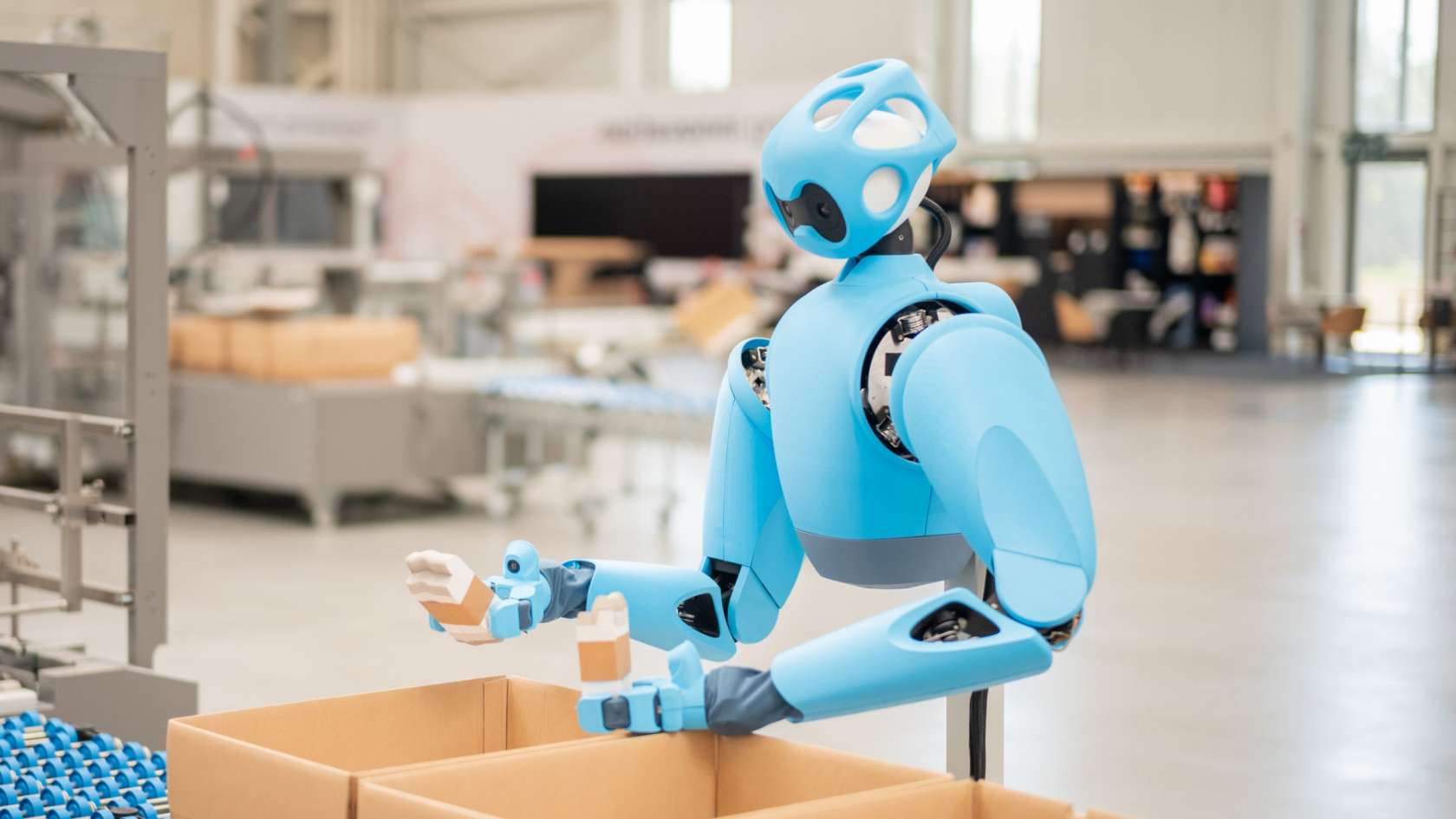
Most humanoid robots carry their strength in their limbs, motors stacked into shoulders and elbows until each arm is the heaviest part of the machine. AIR does the opposite. The young Swiss company Embodied AI, a spin-out from EPFL in Lausanne, has tucked the motors, gearboxes and electronics into the robot’s torso and run the arms on tendons, the way your own forearm pulls your fingers closed.
The result is a two-armed humanoid on wheels that can share a factory floor with the people already working there, no safety cage around it. Embodied AI unveiled AIR in Munich on November 6, at Humanoid Europe 2026, and the machine is already testing with global manufacturers.
A body designed like a body
Look at the proportions first, because they explain everything else. The torso is the machine room, rounded and solid. The arms hang light and soft by comparison, with almost no mass in them, so when an arm meets a person it gives way instead of pushing through.
That softness is the whole design brief. The company describes its formula as a soft exterior, low inertia, compliant joints and high-frequency sensing, and AIR was designed under ISO/TS 15066:2016, the technical specification that governs how collaborative robots share space with people. CE marking is planned for 2027, as Europe’s new machinery rules take effect across the continent.
Its backers describe a tendon-driven arm of 2 kilograms that lifts 5. A figure like that is why this robot can work a packing line for a full shift with no fence between it and the crew.
Wheels, and no apologies for them
And then there are the wheels, my favorite decision in the whole machine. AIR does not walk. Factory floors are flat, the company points out, and wheels are steadier than legs, so AIR rolls on a wheeled base and spends its engineering budget on its hands instead of its balance.
Every legged humanoid spends a fortune teaching itself not to fall over. AIR skips that tuition bill entirely.
First a person drives it, then it drives itself
AIR starts each new job the way a new hire does, except the teacher sits somewhere else entirely. A human operator runs the robot remotely through its first shifts, so it does useful work from day one while every run gets recorded, every grip, every placement, every small correction a person makes along the way.
Embodied AI’s own AI stack studies those recordings until the robot can run the task on its own, typically within a month. The operator stays within reach after that, covering anything the machine has not seen before. And what one AIR learns, the next one can use, so a task solved on one line does not have to be taught again on the next.

It is an apprenticeship model, and I find it more convincing than the demo-video model most of this industry runs on. The robot picks up its autonomy on a real line, doing real work, with a person checking its homework.
The stack already has a paying job
None of this learning stack is theoretical, and this is the part of the story I keep coming back to. The same AI already runs in Embodied AI’s two-arm industrial cell on a customer’s production line, doing paid work today. In paid pilots with large manufacturers, including a leading consumer electronics maker and a global automotive and industrial supplier, the company reports an average task success rate of 95 percent.

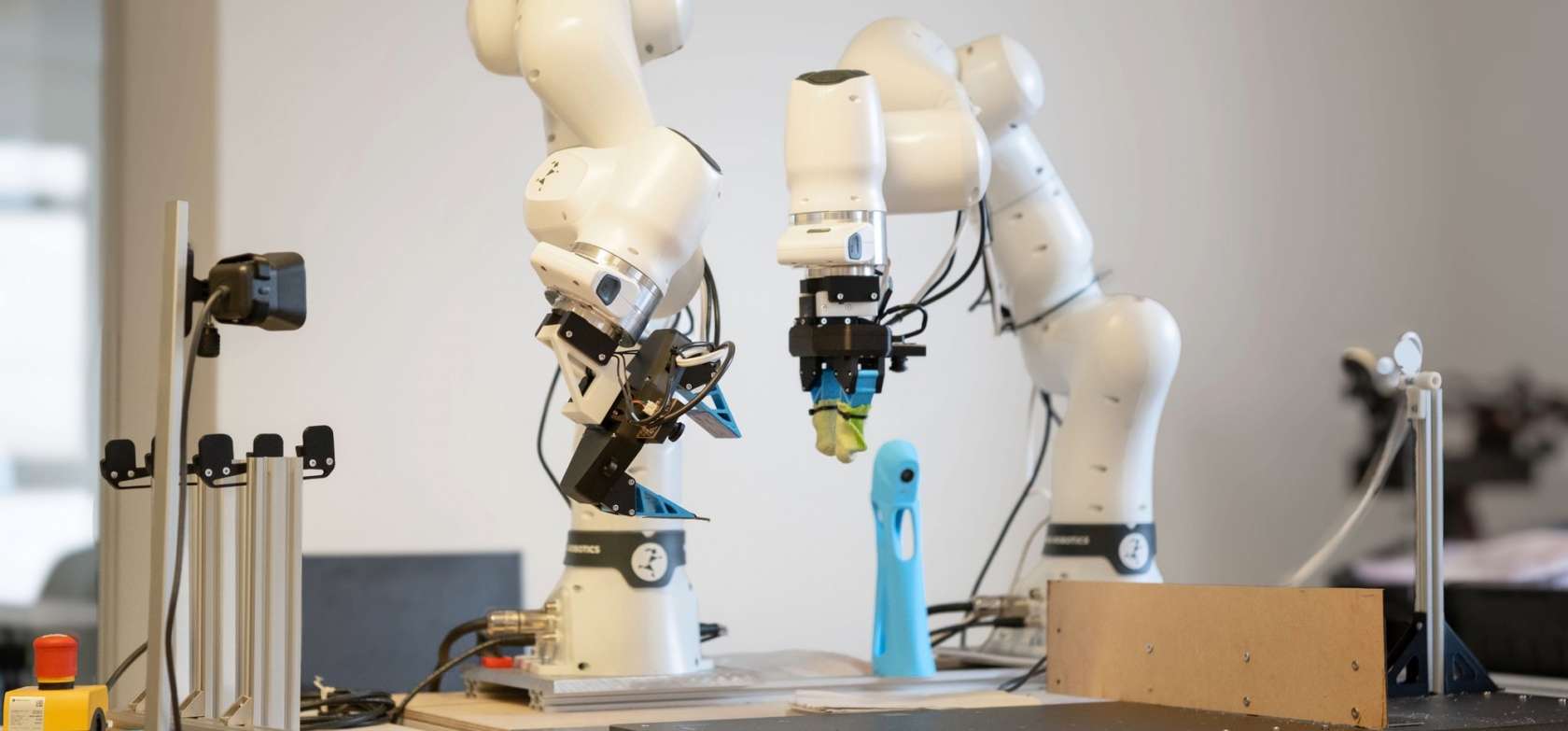
The sharpest proof: that electronics manufacturer had already tried five funded startups on a cable-handling task. None of them hit the targets. Embodied AI’s system met all of them, reaching 98 percent reliability against a 90 percent goal.
On the strength of that work, the company has signed contracts with major OEMs around the world and is planning scaled production. Depending on the task, it says, one AIR can handle the workload of up to three people per shift, which is the arithmetic that gets a machine like this out of the lab and onto a purchase order.
Twenty-five people in Lausanne
The company behind the machine is almost implausibly small. Embodied AI has 25 people. It went from research to an industrial humanoid in nine months, and did it, in its own words, on a fraction of what the big humanoid programs spend.

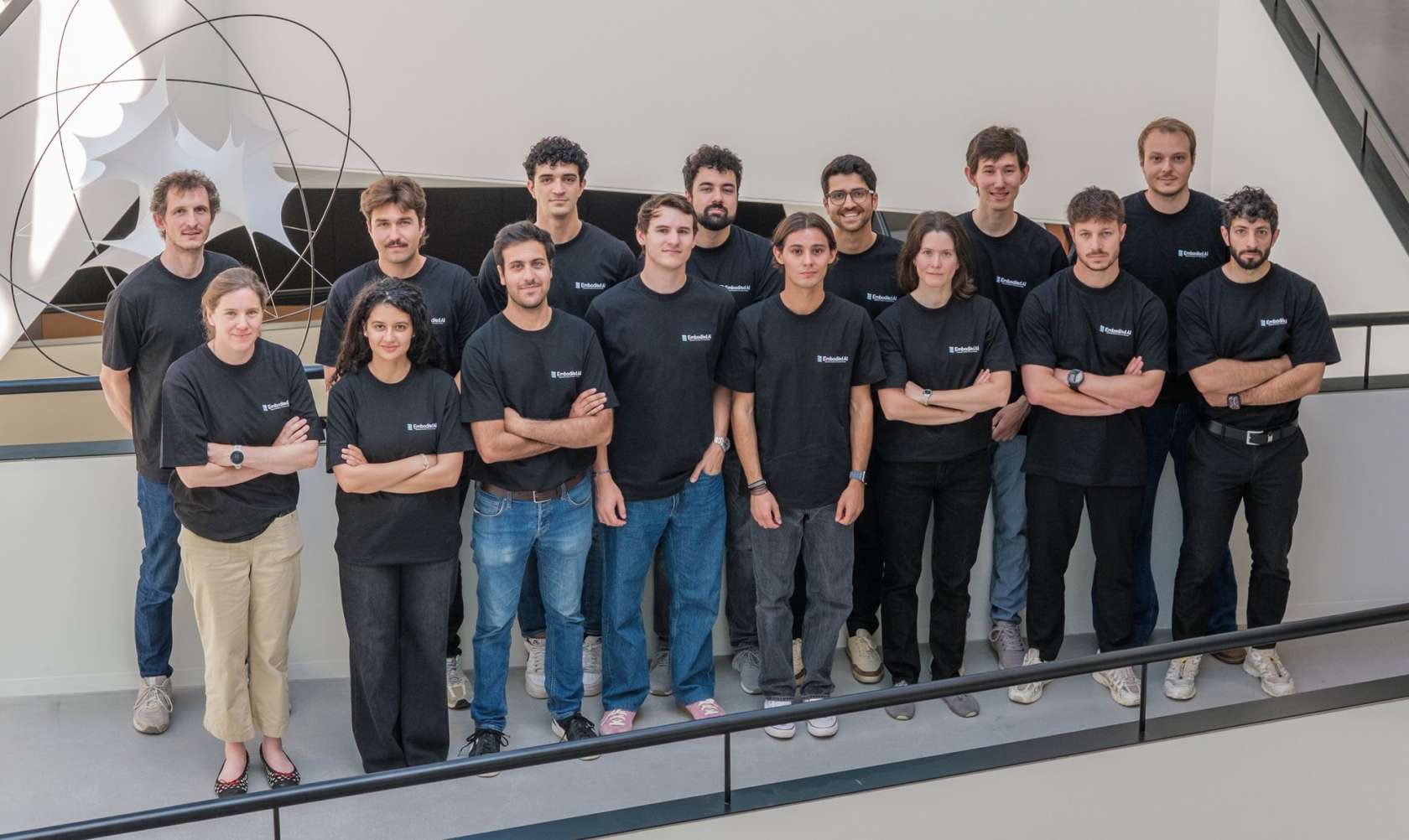
Co-founder and CEO Francesco Stella is 28, and the arm design grew out of his PhD at EPFL. He has also researched at MIT’s CSAIL lab. His co-founders, CTO Kai Junge and COO Max Polzin, are robotics PhDs with Cambridge, ETH Zurich and EPFL between them, and Polzin previously led technology at Seervision, the Swiss startup later acquired by Q-SYS.
The backing is serious for a team this size. Faber led the first round, joined by TechShop, Look AI Ventures, Plug and Play and Vento. Headquarters sit in Lausanne, with a second office in Rome.
What you cannot order yet
Here is the plain limit, stated once. Embodied AI says orders for AIR open following the unveiling, but the company has published no price, no dimensions, no weight and no delivery schedule, so nobody outside its pilot partners can budget for one yet.
The tasks on its list are the unglamorous ones factories actually struggle to staff: kitting, packaging, SMT support and complex assembly, picking, placing, plugging and tool work. Deloitte and The Manufacturing Institute count as many as 1.9 million US manufacturing jobs that could go unfilled by 2033. That gap is the one AIR was built to stand in, and it is a gap measured in unfilled shifts, not in headlines.
Editor’s take
My take: the humanoid race has been a contest of who can build the most person-shaped machine. AIR treats the person shape as a starting point and then edits it, hard. Wheels for legs, tendons for muscles, the heavy machinery parked in the chest where a ribcage would keep it safe.
It will not win a beauty contest against the bipedal showpieces, and I suspect the team in Lausanne sleeps fine with that. A robot that learns your job in a month, from your own demonstrations, with no cage between you, is a colleague pitch. The showpieces are still looking for one.