
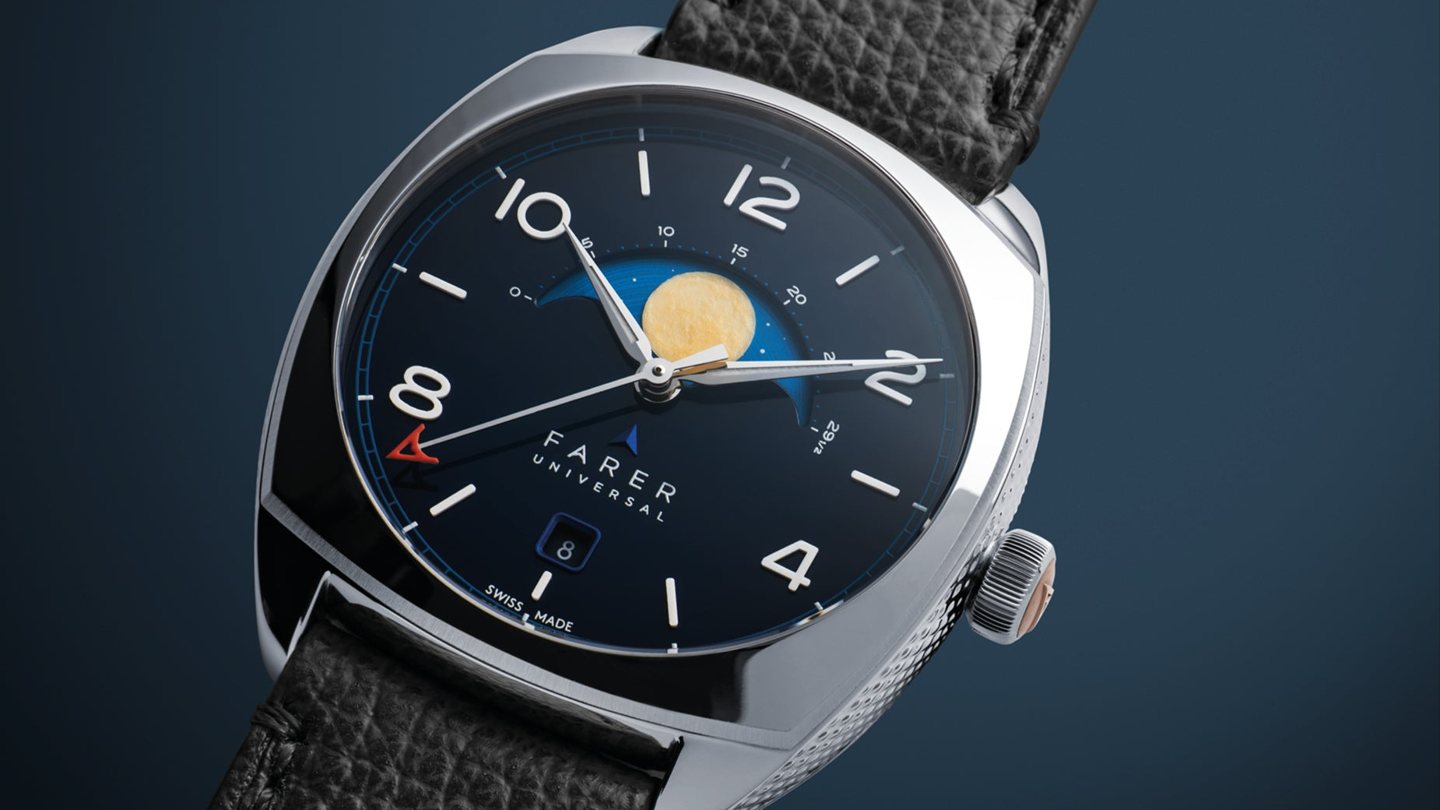
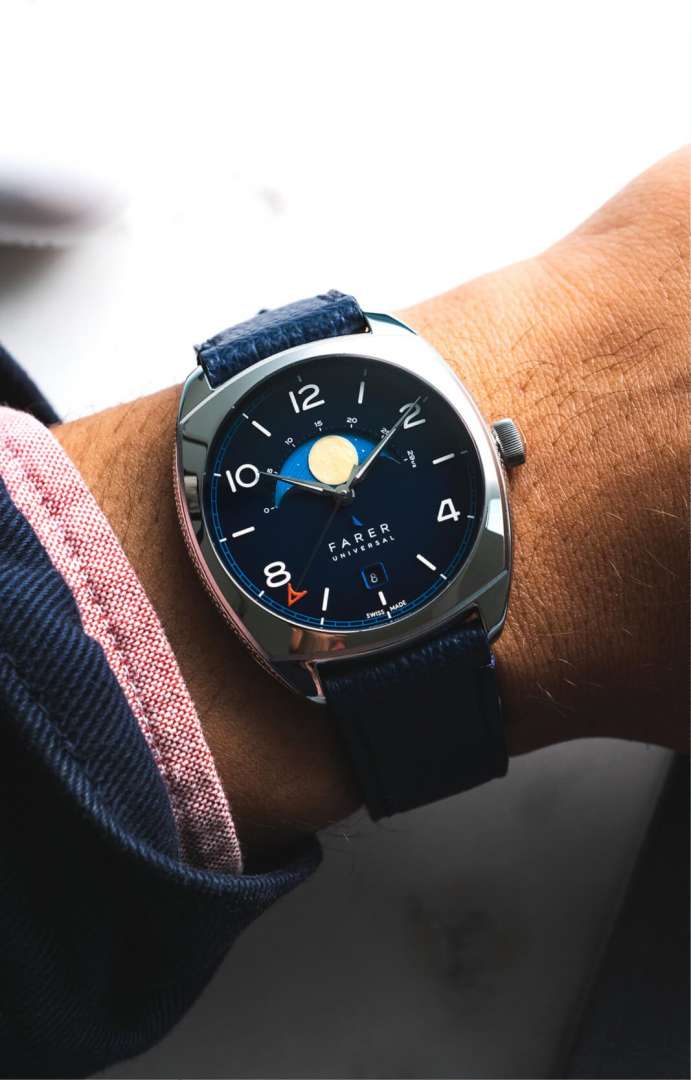
The Halley is Farer’s hand-wound moonphase, a 38.5mm cushion case in polished steel wrapped around a midnight blue gloss dial with a date window at six. Its moon isn’t printed.
Farer paints each moonphase disc by hand in Switzerland, laying a textured yellow moon into a starry sky on the disc, and sells the watch for $2,242 on a leather strap through its own store.
The hand-wound Sellita inside keeps the case at 10.5mm thick and skips the rotor entirely, so winding it becomes part of the morning. The reserve runs about 45 hours, though, so a second missed morning leaves a stopped watch waiting on the dresser, hands frozen at whatever hour the spring gave out.
The moon disc is painted by hand
Farer’s painters build the disc around two moons set into a starry sky, and each moon carries a hand-applied surface textured to echo the lunar landscape. The yellow has a natural source rather than a paint chart, borrowed from the way a low moon actually looks.

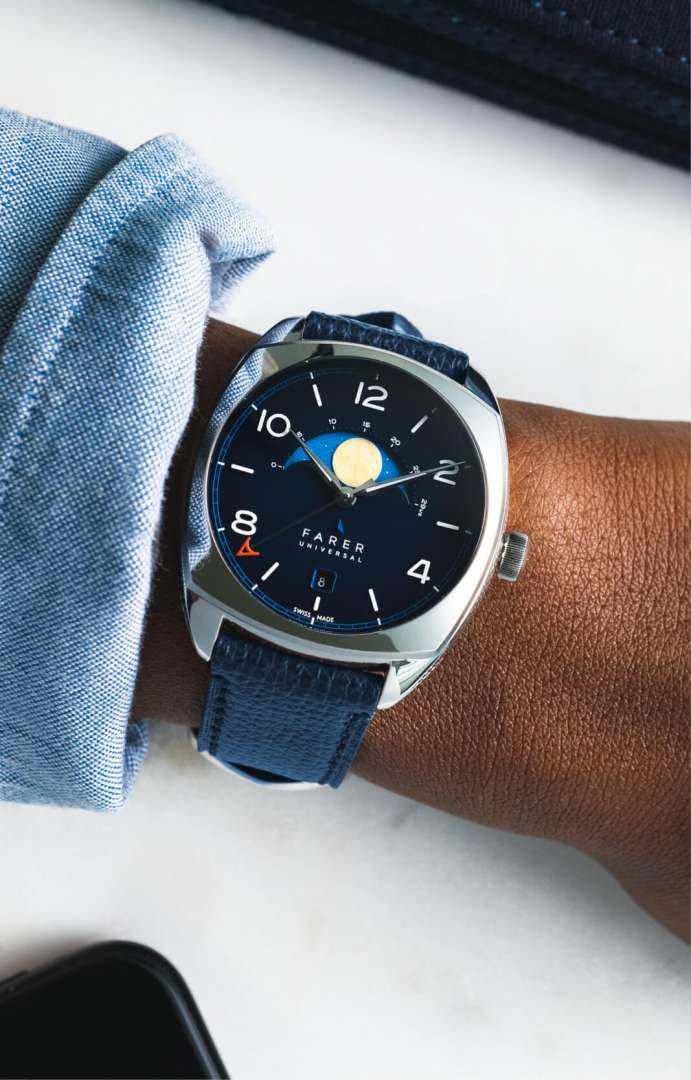
A moon seen close to the horizon loses its blue light through the atmosphere, and the warmer yellow and red tones are the ones that reach the eye. Nothing on the disc is flat print.
Around the aperture, the numerals and batons are molded from Lumicast, a composition of ceramic and Super-LumiNova, and the polished lance hands carry luminous fill of the same grade. The seconds hand ends in a burnt orange tip shaped as the Farer A, the same arrow the brand stamps into its crown cap.
A cushion case with a bronze-capped crown
The case measures 38.5mm across and 43.8mm from lug to lug, cut from 316L marine-grade stainless steel and polished, with a brushed chamfer circling the bezel. A grain twist pattern is machined into the flanks, the crystal is curved sapphire with a multi-layer anti-reflective coating on its underside, and the rounded crown wears a solid bronze cap insert stamped with the Farer A.

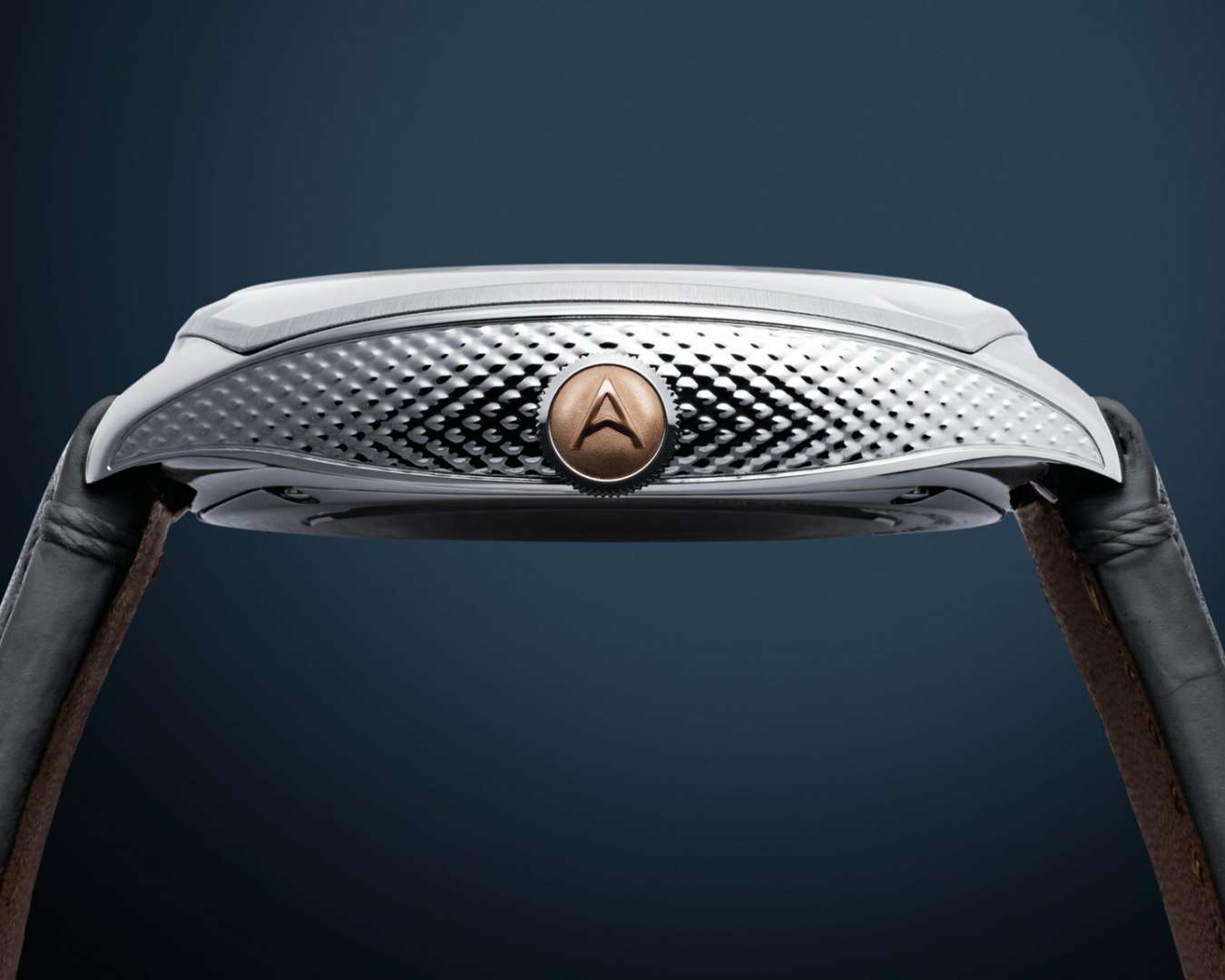
Water resistance stops at 50 meters. It shrugs off splashes, not swims.
The Sellita inside is wound by hand
Through the sapphire caseback sits the Sellita SW288-1 in Elaboré grade, its blue screws and bespoke bridge carrying an embossed Farer pattern across the movement. It beats at 28,800 vibrations an hour, holds 18 jewels, and runs about 45 hours from a full wind, with the date and moonphase on quickset and a hacking seconds hand for precise setting.

No rotor crosses the view. The movement is the display.
After dark, the moon glows back
The moons are painted in Super-LumiNova, so the aperture keeps glowing after the lights go out, matched by the molded Lumicast numerals and batons that ring the midnight blue dial. The hands carry the same luminous fill.
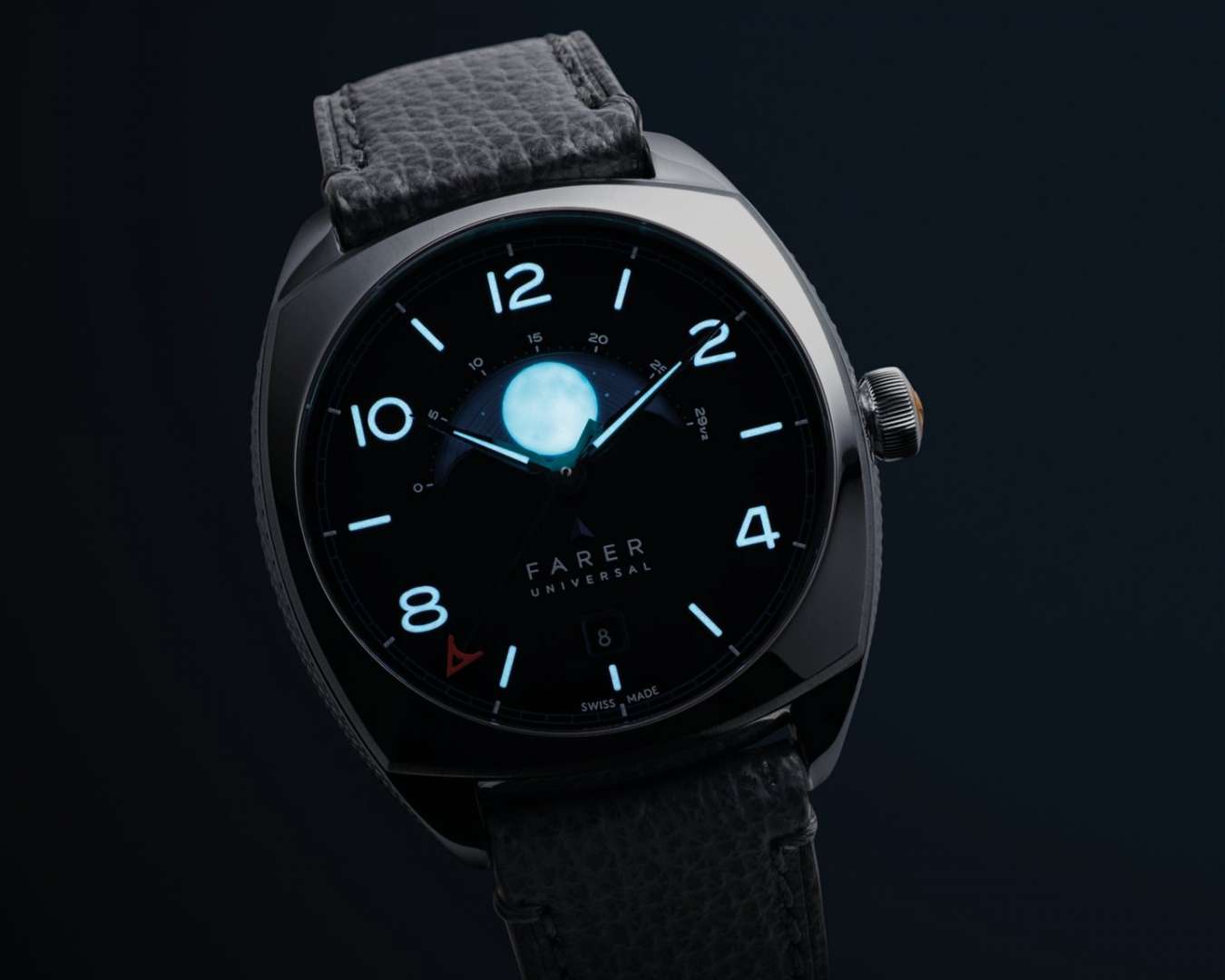
Most moonphase dials go quiet at night; this one doubles its show after dark.
Buy the Halley if you want a moonphase with a visible human hand in it, a painted sky instead of a printed one, in a case sized the way dress watches used to be sized. Skip it if hand-winding feels like homework, since this movement asks for a wind every day or two.
For everyone in between, the Halley runs $2,242 on leather or $2,269 on the Milanese bracelet, direct from Farer, and the name reaches back to Edmond Halley, who mapped the southern stars and predicted his comet’s return in 1758. He never saw it return.