
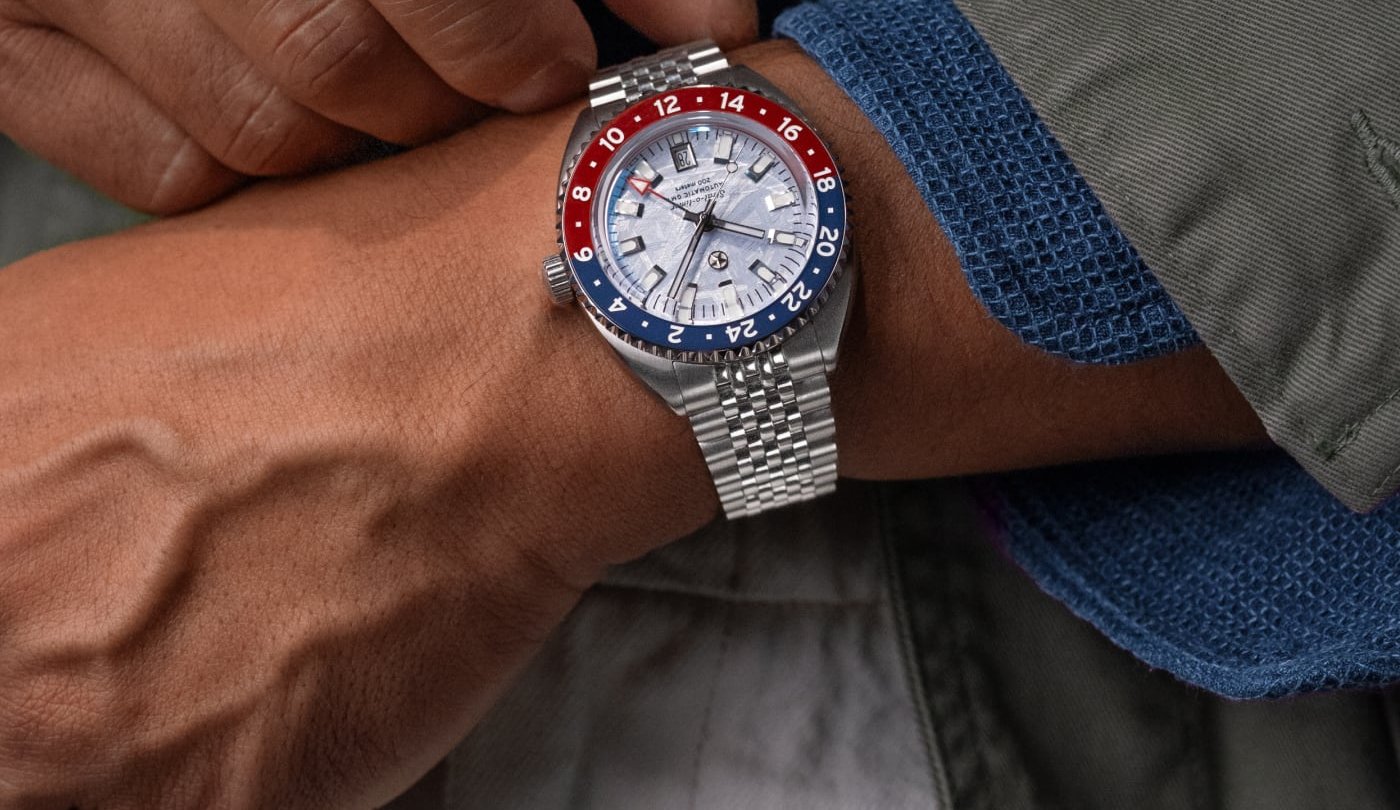
A fragment of the Muonionalusta meteorite sits where a dial should be, sliced thin, etched and tinted icy blue. Jack Mason’s Strat-o-timer GMT Triton Meteorite builds its whole face from that iron, and no two examples share the same crystalline pattern under sapphire.
Meteorite dials usually arrive on watches costing several times more, because cutting stone-metal this thin wastes material and time. Here the price lands at $1,449, inside a steel GMT with a red-and-blue ceramic bezel, and the run stops at 200 pieces for the world, each one assembled and regulated in the United States.
Iron from before Earth, cut thin enough to tell time
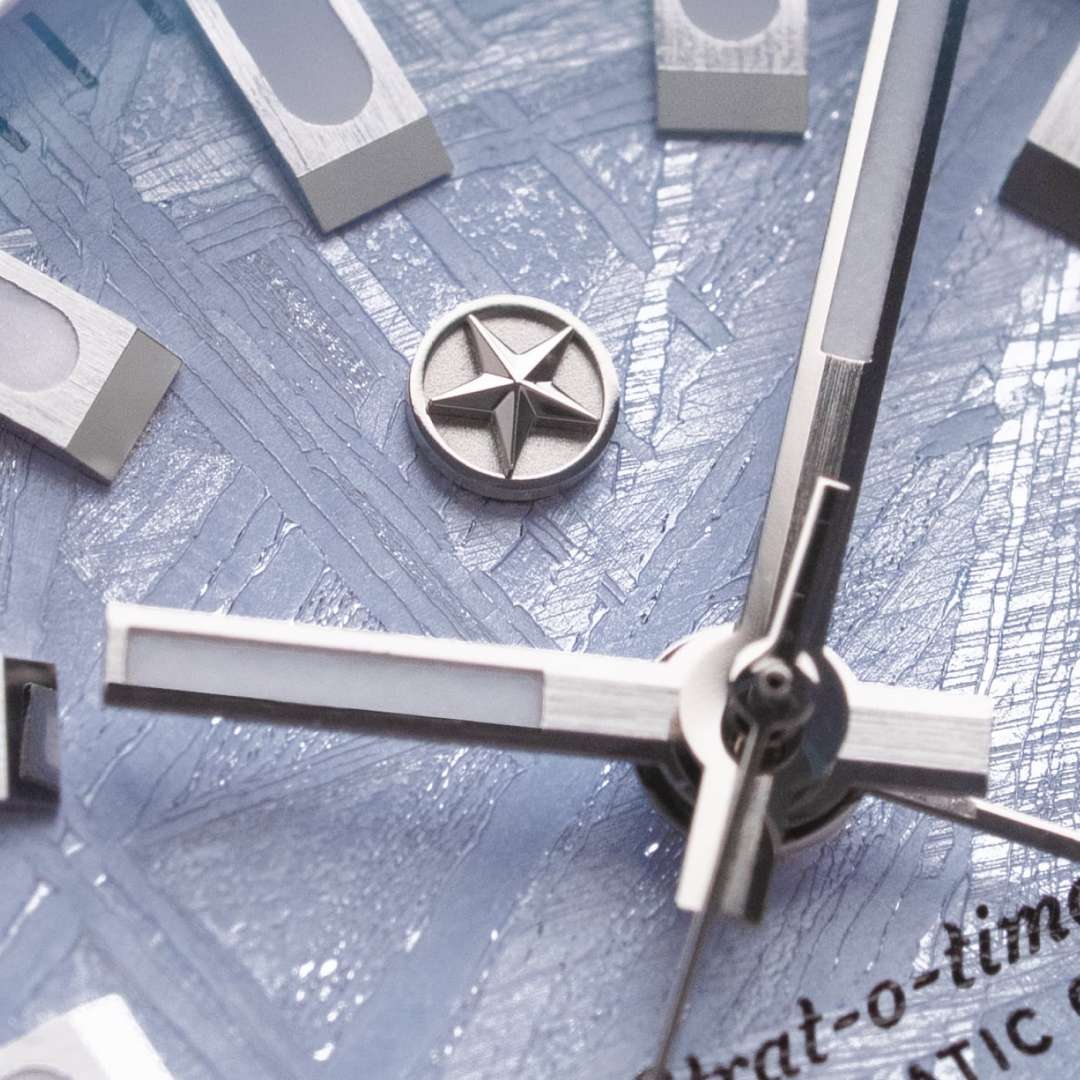
Each dial starts as a fragment of the Muonionalusta meteorite, a body the brand dates at 4.5 billion years old. Workers slice the iron thin, acid-etch it and polish it flat, and the crystalline pattern survives.

Stone and iron dials punish sloppy machining, because the material chips where brass would bend and cracks where a printed dial would flex. Yield rates stay low for every brand that attempts them, which is why meteorite usually signals a flagship price rather than a mid-range one. Brands that survive the process charge for the failures as well as the successes, and the finished dials carry that cost in their price tags wherever they land.
Every dial is a fingerprint. The etched lines cross like frost.
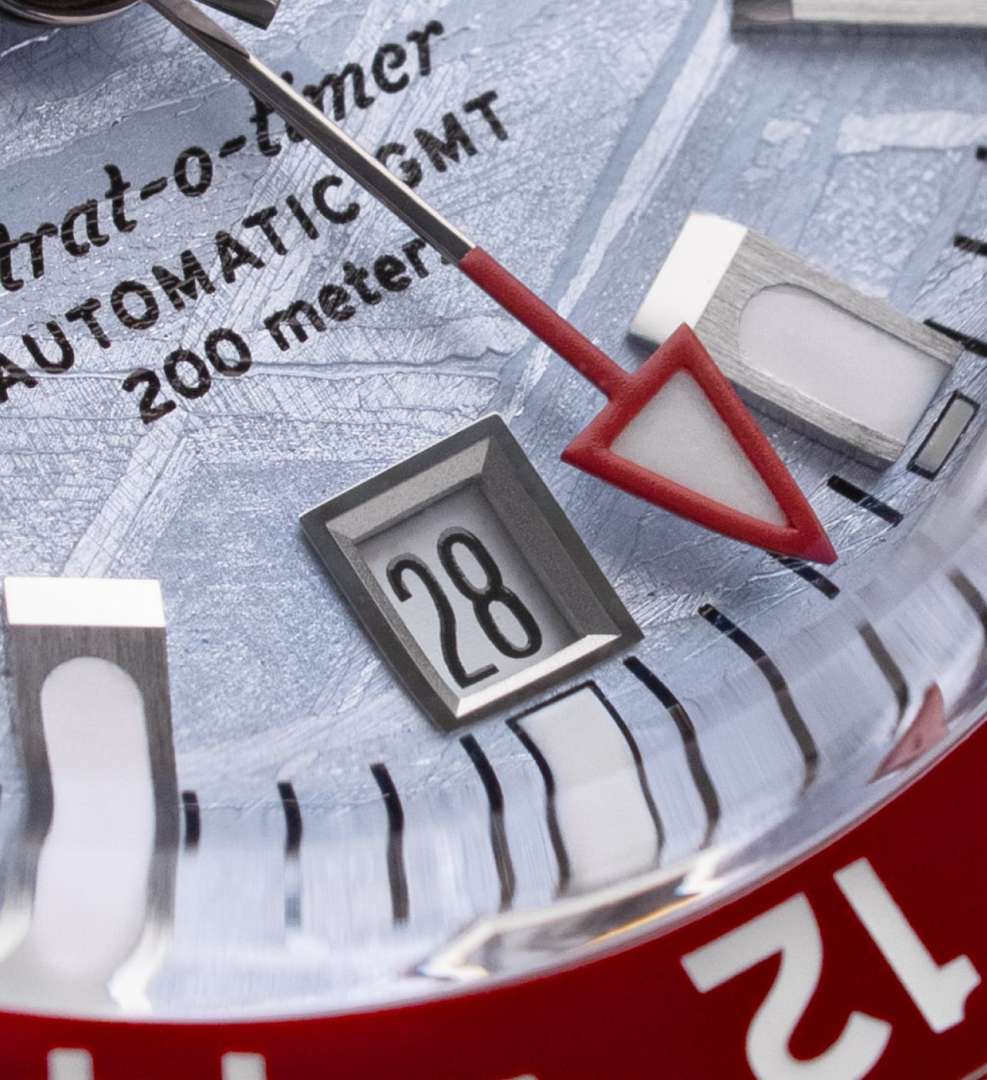
An icy-blue tint settles over the iron and cools the whole watch down, setting the pale dial against a saturated bezel. Applied markers stand proud of the surface with deep pools of lume, and a red GMT hand arrows across the pattern without hiding it. Date sits at 6 o’clock in a framed window, small enough to keep the iron in charge of the view.
A flyer GMT that jumps its hour hand
Miyota’s 9075 automatic gives the watch traveler manners, since its local hour hand jumps in one-hour steps from the crown. The 24-hour hand keeps home time untouched while the movement never stops running.

Flyer GMT movements stayed rare below two thousand dollars for years, because the jumping-hour mechanism costs more to build than a simple GMT hand. Miyota’s 9075 changed that math for small brands, and Jack Mason was one of the first brands to receive the caliber. The caliber also freed them from office-GMT compromises, where the GMT hand moves and the hour hand stays put.
Jack Mason regulates every movement in-house to plus or minus five seconds a day. The spec sheet adds 24 jewels, a 28,800 beat rate and a 42-hour reserve behind a custom branded rotor.
Two time zones ride the dial at once, home time on the 24-hour hand and local time on the main hands, with a date window parked at 6 o’clock. Nothing about the layout shouts, and the red hand does the shouting instead, one arrow of color against the pale iron. Travelers read the watch at a glance in an airport, which is the whole job, and the layout never makes them count markers twice.
Assembled in the USA. Regulated in the USA, too, and the sapphire caseback shows the regulated work.
Cushion case, ceramic bezel, nine clicks of clasp
A cushion case carries the dial at 40mm across and 13.2mm thick, brushed on top and mirror-polished along its curved sides. Sapphire covers the dial and the caseback both.
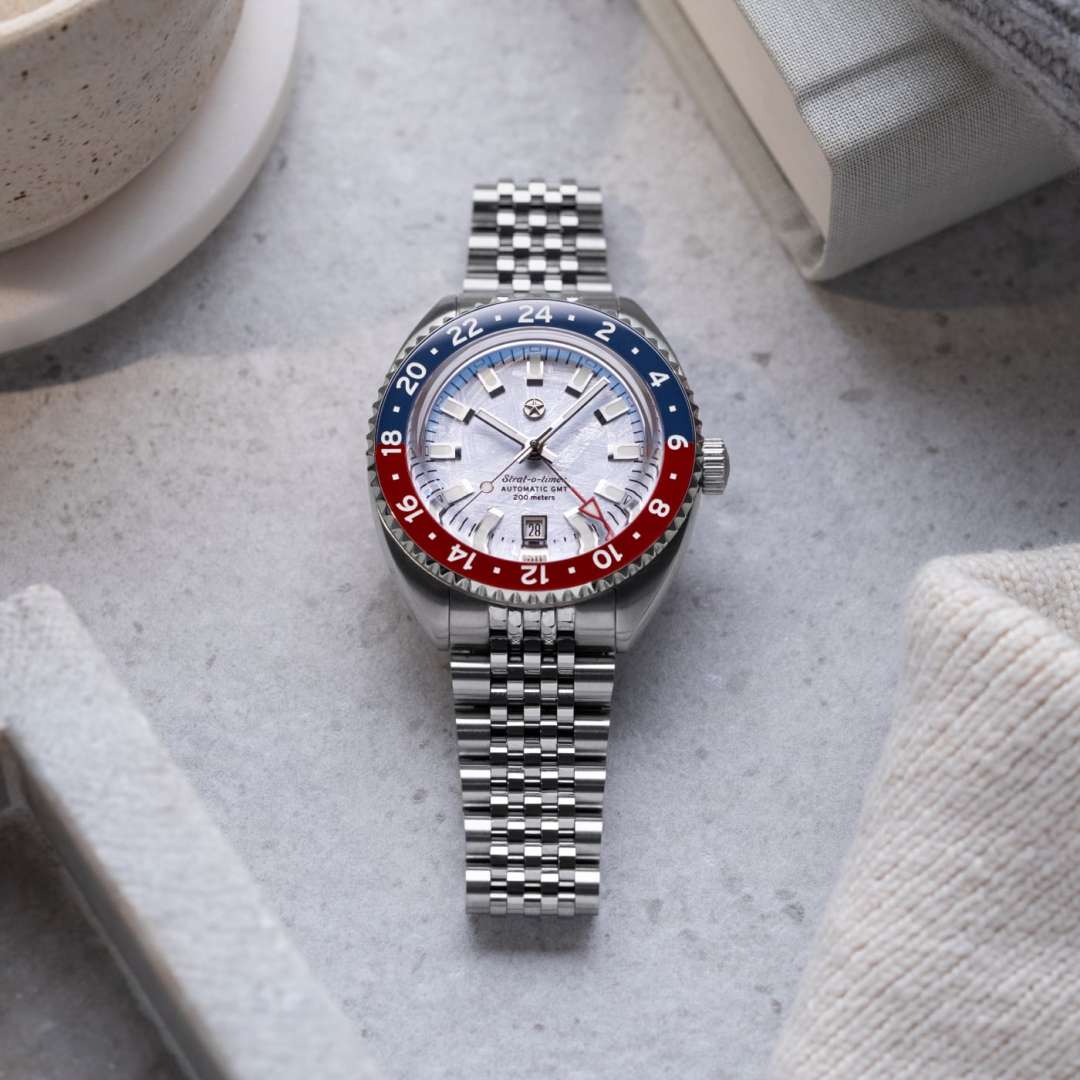
The 48-click bezel turns in both directions with a two-tone ceramic insert, red over blue, and its markings carry the same BGW9 lume as the hands and markers. In darkness the top of the watch glows blue, bezel markings included, and the dial stays readable at a glance. Blue glow in darkness, white markings in daylight, and the insert shrugs off the scratches that chew up aluminum bezels within a year of daily wear.
Steel links taper from 20mm to 16mm, with solid end links that release without tools. Nine levels of micro-adjustment hide inside the clasp, so the fit changes on the fly, mid-flight included.
Ownership details lean practical over precious, since the crown screws down, the rating holds at 200 meters and the crystal shrugs off the scratches daily wear delivers. This is a limited edition built to be worn on trips, not stored as a trophy between them. A watch built for airport runs and hotel sinks has no business fearing either, and this one is built exactly that way. Trips are the test it was built to pass.
At 160 grams on the bracelet, the watch carries real heft for a steel GMT. The cushion case spreads it wide across the wrist instead.
Shipping starts the week of November 23 at $1,449 direct, and 200 pieces won’t stretch far past the collectors already watching this brand. Travelers who cross zones weekly get the strongest case here, a true GMT with a dial older than every ocean it will ever cross. That combination, ancient iron over modern mechanics, is the pitch and the product at once.