
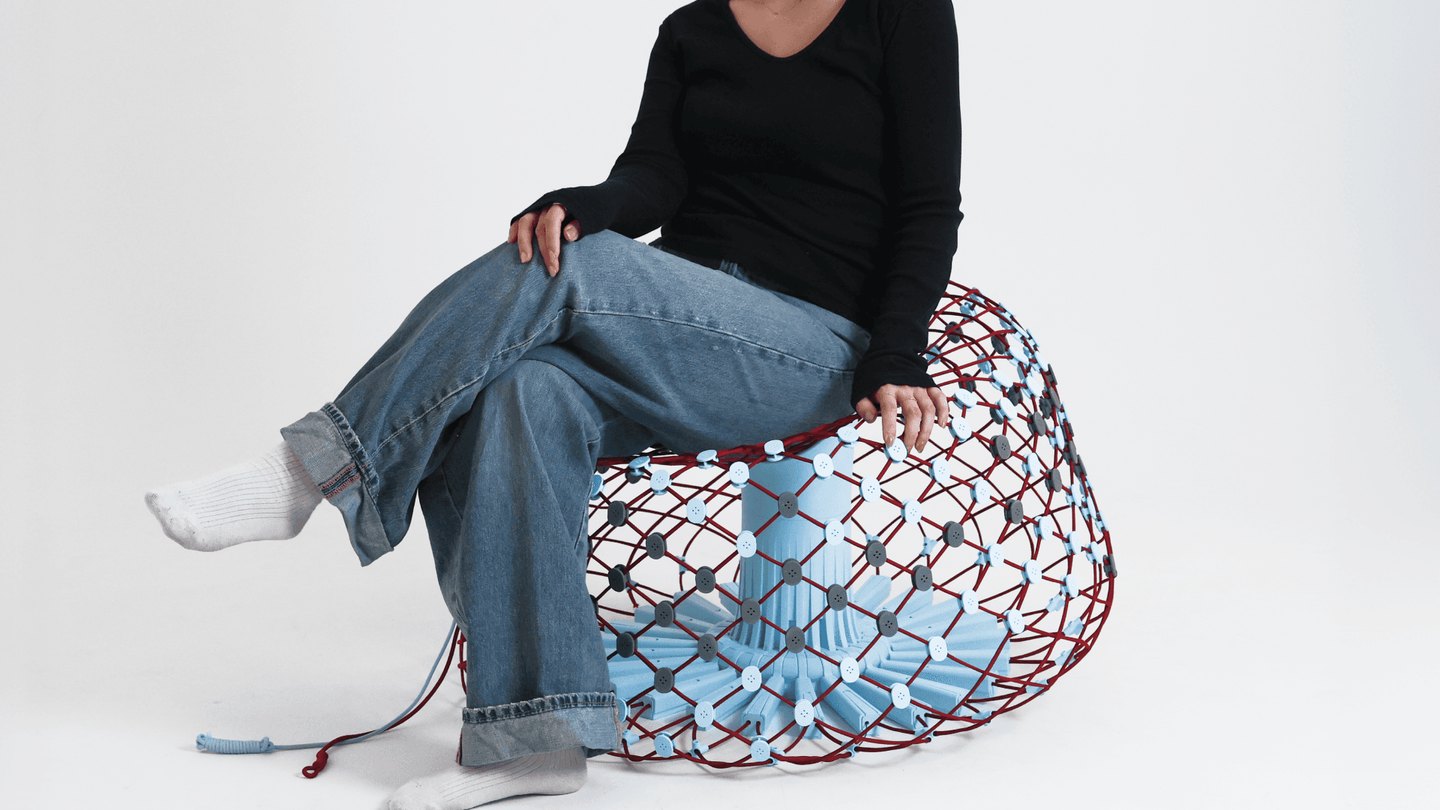
Flat-pack furniture usually means boards, dowels, and an afternoon on the floor with an Allen key. Jisu Yoon’s Re-Flat Pack Sofa V1 skips all of that. Folded, it stands as a woven column 250 mm across and 1,430 mm tall. One pull, and it opens into a lounge seat.
Yoon is a designer working between Seoul and Lausanne, and this seat is her study in how little a lounge chair actually needs. There’s no foam in it. There’s no rigid frame hiding under upholstery either.
The woven surface is the structure, and it’s also the cushion. The whole piece weighs about 7 kg, light enough to carry under one arm.
One pull and the column becomes a seat
The mechanism borrows from an umbrella. A central guiding cord runs through the piece, and pulling it draws the woven body down and out until the seat takes its shape. Run the motion the other way and the seat gathers itself back into the column.

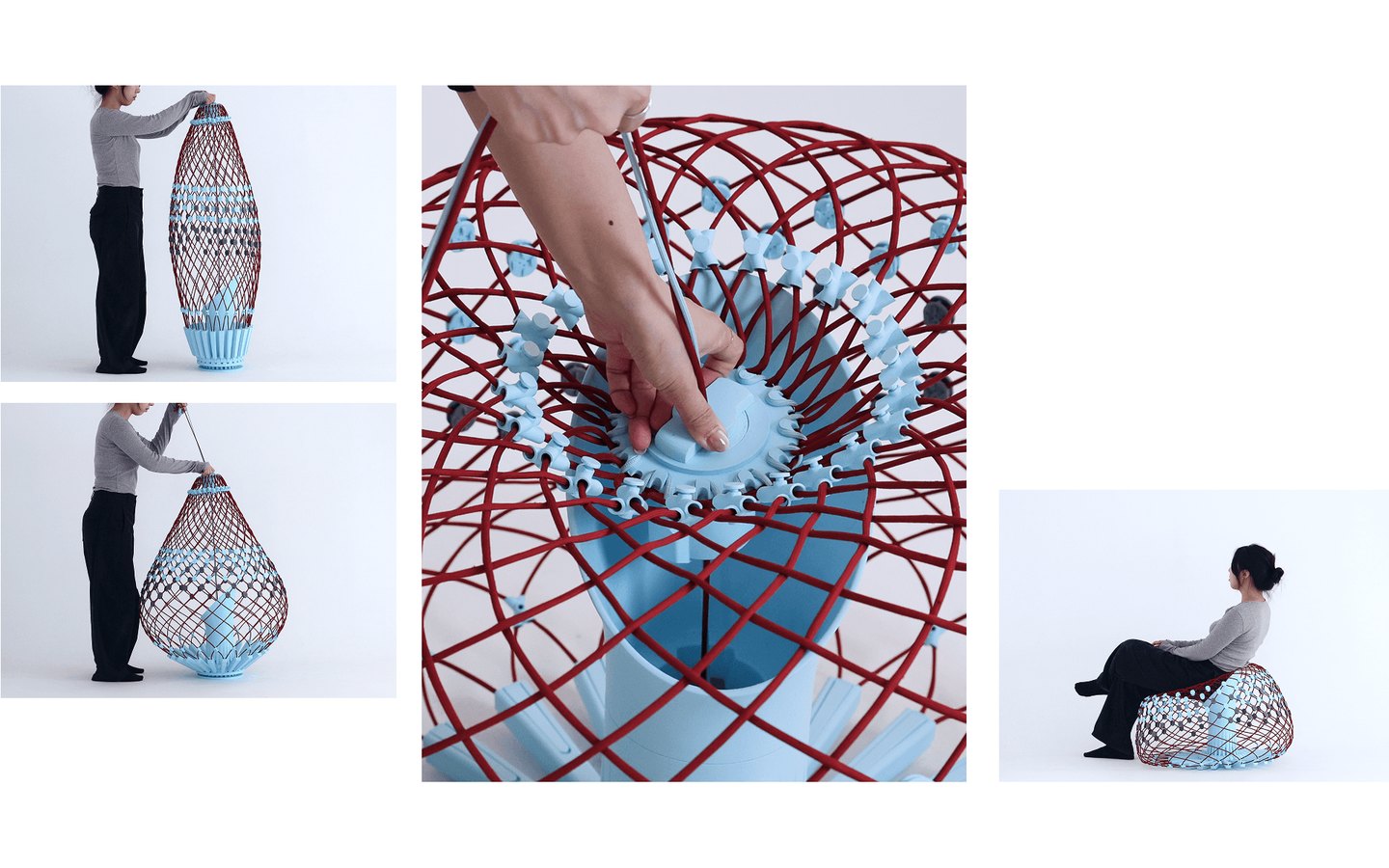
A 3D-printed hub at the center regulates the wire tension and locks the open shape. Nothing clicks into a frame. The form holds because every strand pulls against the rest, and the hub is where that tension gets balanced.
Open, the seat measures 700 mm across and 600 mm tall.

Yoon’s own film runs the full cycle in under a minute. Column, pull, seat. Then the reverse, and the seat is a column again, ready to stand in a corner or a closet.
A folded footprint that small changes the storage math. The seat doesn’t need a spare room, a garage, or a friend’s loft between uses. It stands in a corner. It stands where a floor lamp stands.
The cushion is the frame
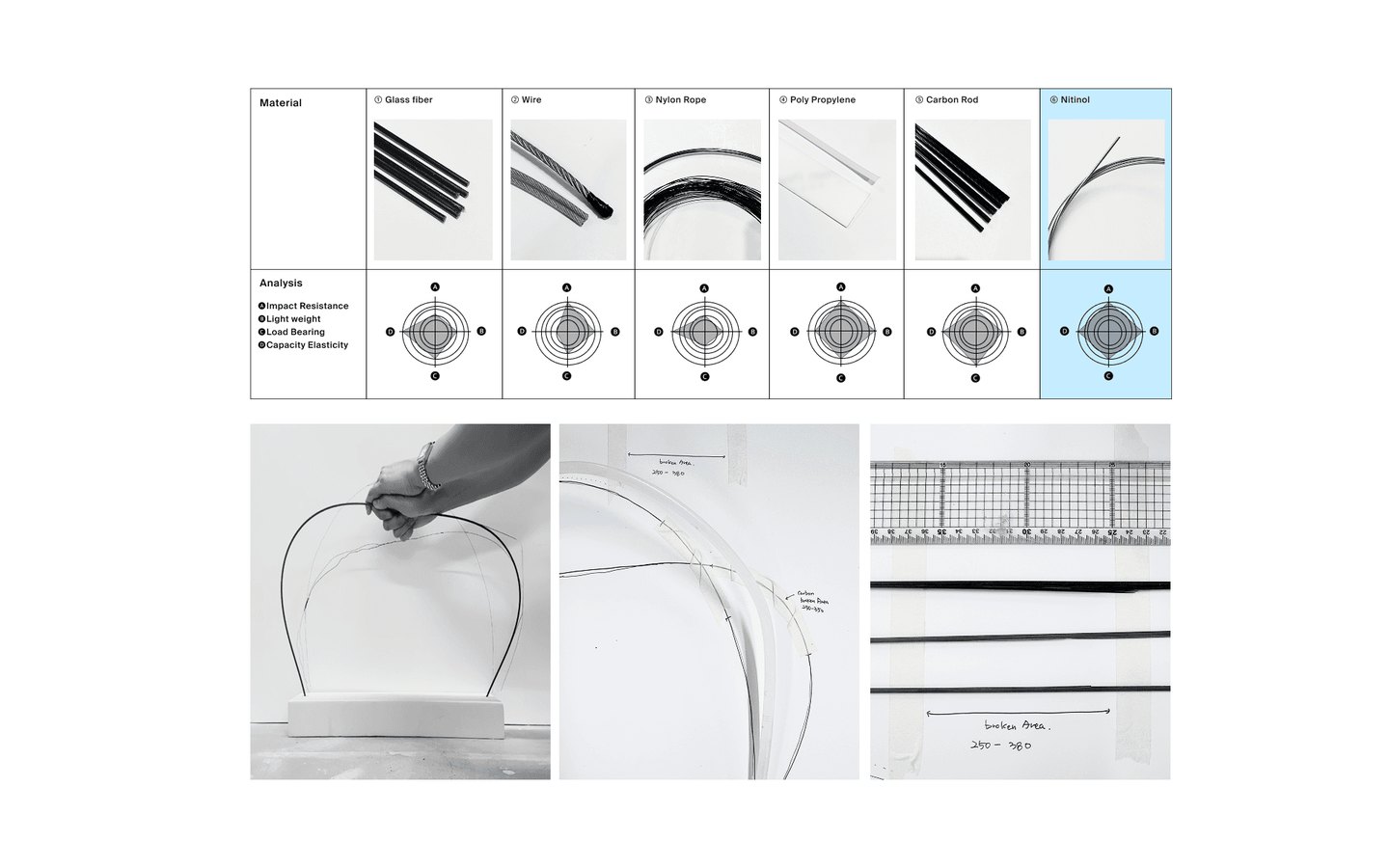
The material doing the work is nitinol, a nickel-titanium alloy that springs back after it’s bent. The same alloy shows up in medical stents and in aerospace work. Yoon uses its superelasticity the way other seats use foam, as the layer that gives under weight and recovers when the weight leaves.
Foam is why sofas ship in boxes the size of wardrobes. A cushion has to be thick to work, and that thickness is dead volume in a truck, in a warehouse, and in the truck again on moving day. Yoon started from packed volume. If the soft layer could also be the frame, and the frame could fold flat, the box could shrink to almost nothing.
It wasn’t the first material she tried. Glass fiber, steel wire, nylon rope, polypropylene, and carbon rods all went through bending and load tests first, one snapped or sagging candidate at a time.
The research and prototyping took 1.7 years.
Woven by hand and held by tension
Each nitinol wire runs inside a fabric cord, and the cords are woven by hand into the net you sit on. The deep red weave isn’t decoration laid over a structure. It’s the structure, every crossing tied into the next.
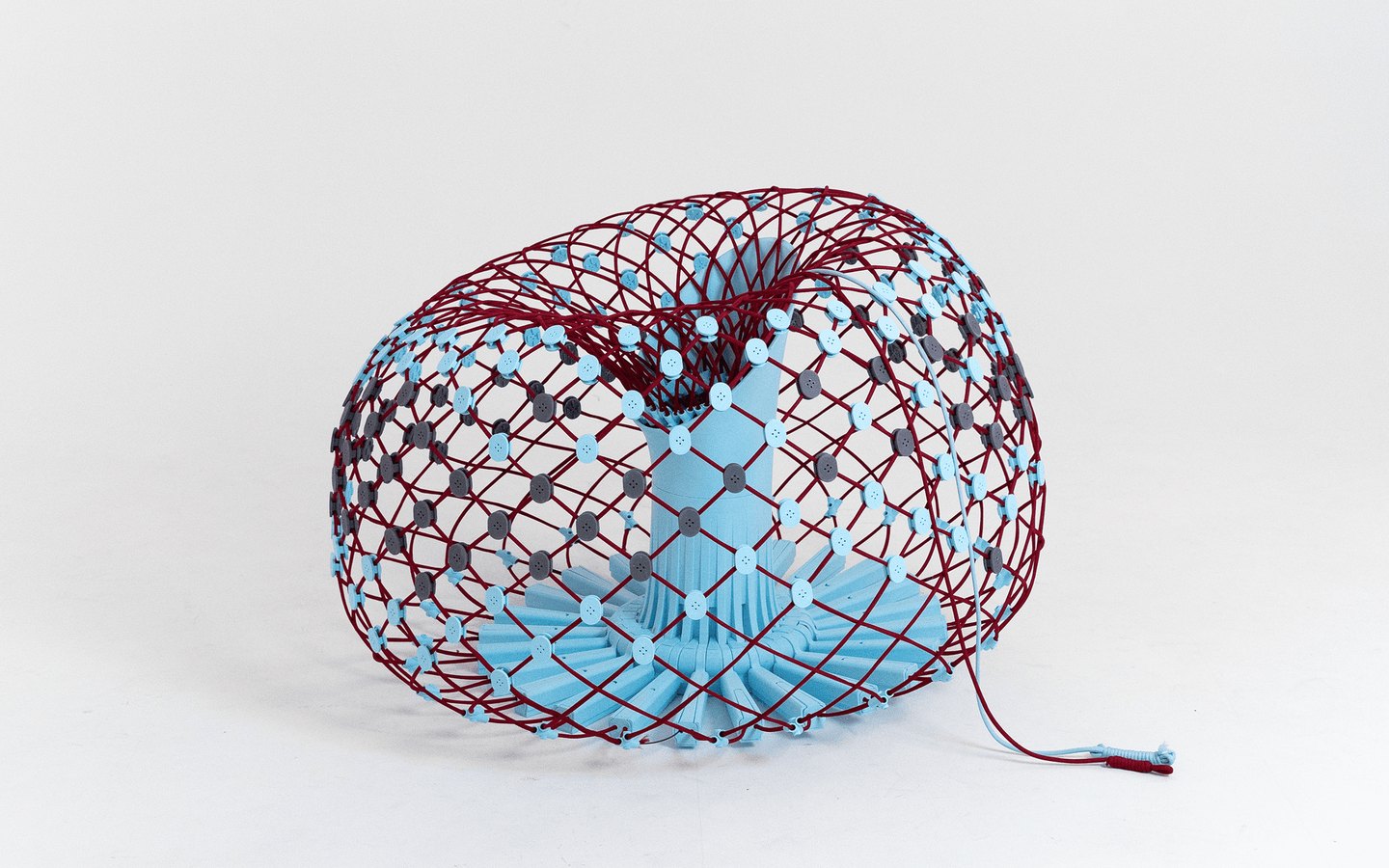
3D-printed joints connect the strands throughout the weave, and the hub and base are printed parts as well. There’s no adhesive anywhere in the piece. Mechanical connections and collective tension hold the form, so a damaged section can come apart and go back together instead of writing the whole seat off.
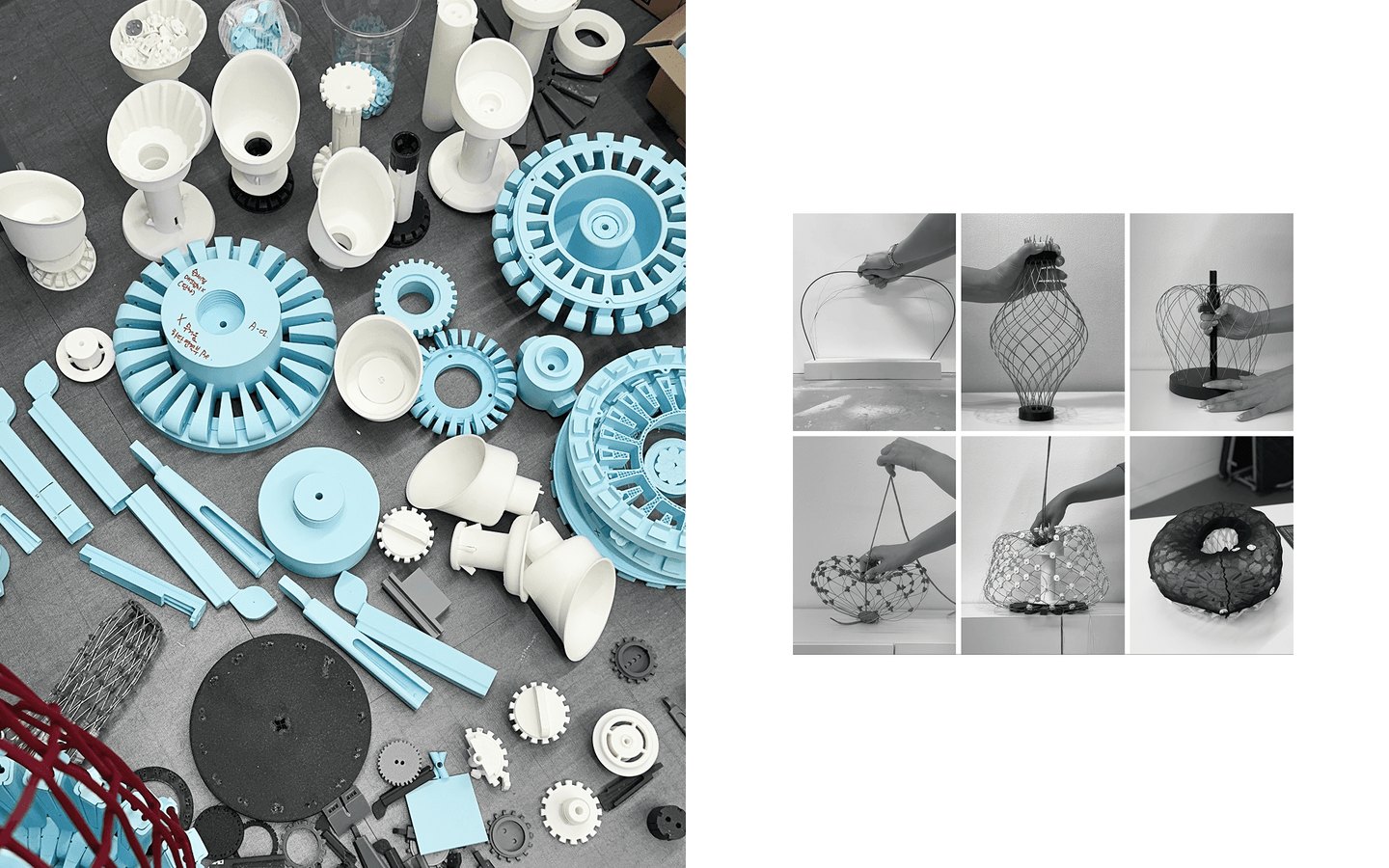
The pale discs at the crossings are those joints, blue and gray buttons threaded through the red net. They’re the working hardware, not trim. Nothing here is hidden.
That open construction gives the seat an odd, appealing look, part hammock and part basket, with the pale blue column showing through the weave. Sit down and the mesh spreads the load across the whole net instead of a few springs or a slab of foam. It looks like an object first and furniture second, until somebody sits in it.
Still a proof of concept and Yoon says so
Yoon calls V1 a full-scale proof of concept, and she’s plain about where it stands. The sofa’s been user-tested with a person weighing about 60 kg. Long-term durability and safety for a wider range of users still require further validation, and development is ongoing.
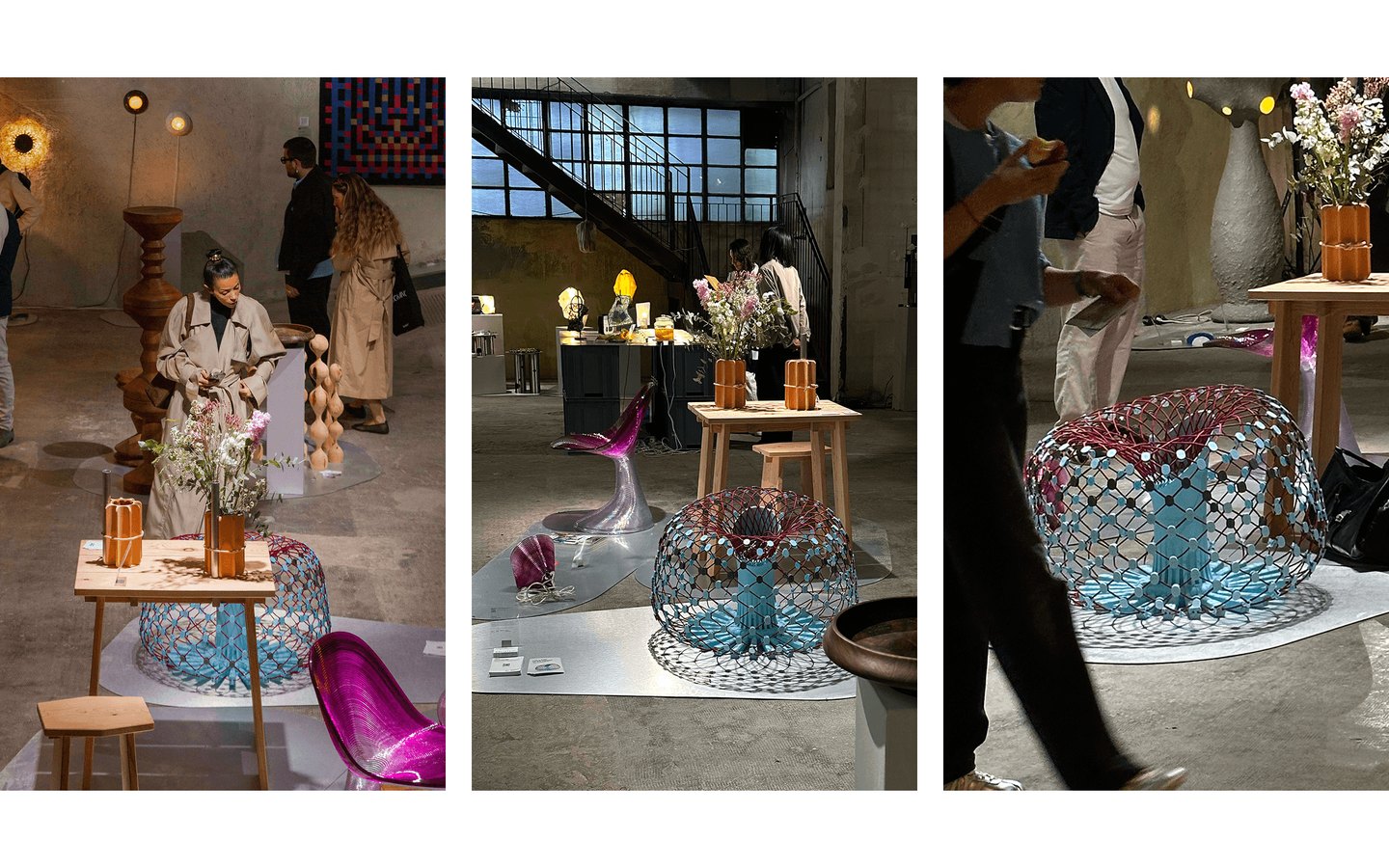
The work has still traveled widely. It was a finalist for the Korea+Sweden Young Design Award, showed at Design Korea 2025, and went to Milan Design Week 2026 in No Space for Waste at Fabbrica Sassetti in the Isola district. It also won the Couch and Sofa category at the SIT Furniture Design Award 2026.
There’s no price attached to any of this, because there’s nothing to buy yet.
V1 is in the name for a reason. It’s the first full-scale version, and the durability work is still ahead of it.
Most flat-pack design asks the buyer to supply the labor and then live with the result for a decade. Yoon’s version asks the material to do the work instead. A seat that folds back into a column changes what a small room can hold. It changes what moving house feels like too.
Whether the weave survives ten years of nightly use is the open question, and Yoon hasn’t answered it yet. The idea itself is already standing in the corner, taking up 250 mm of floor.