
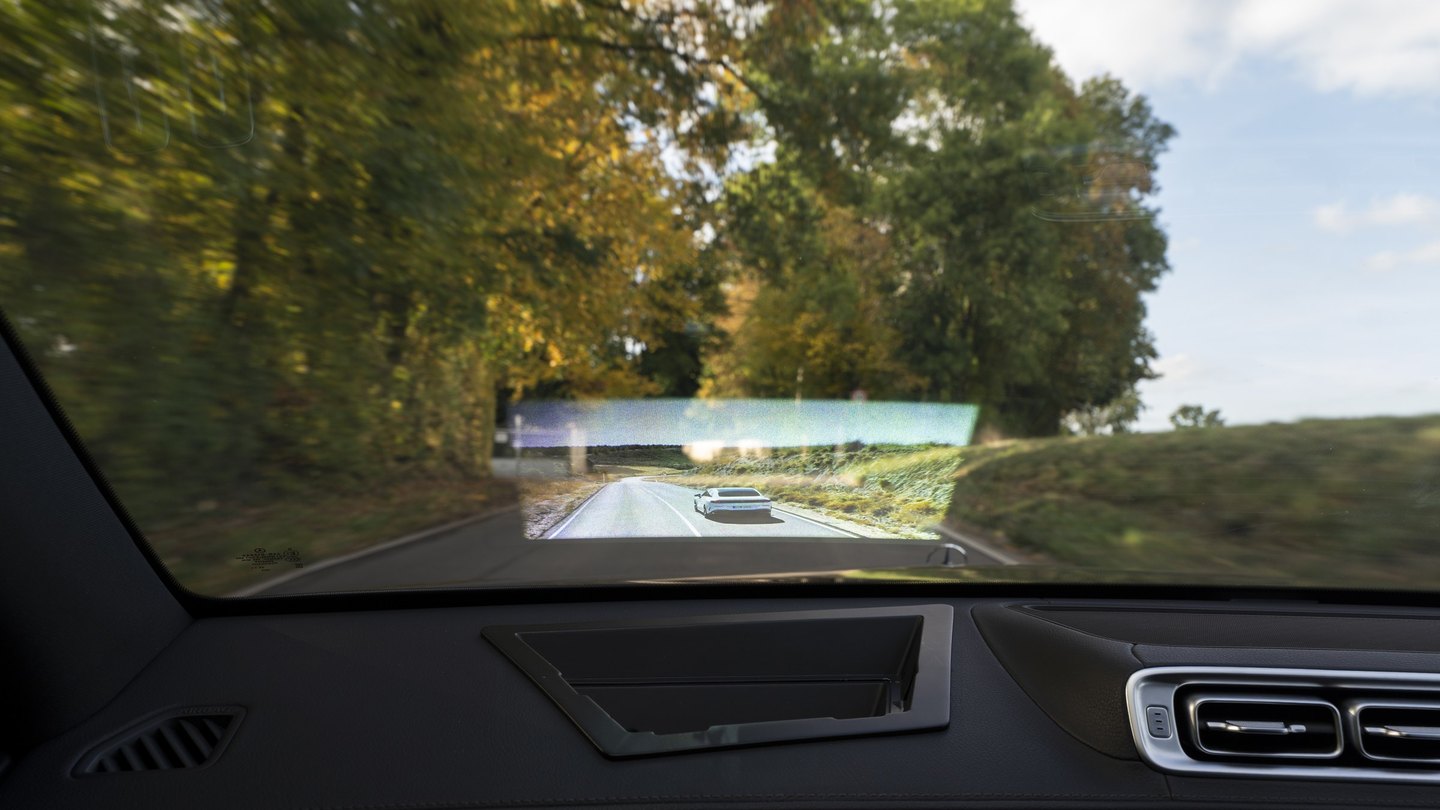
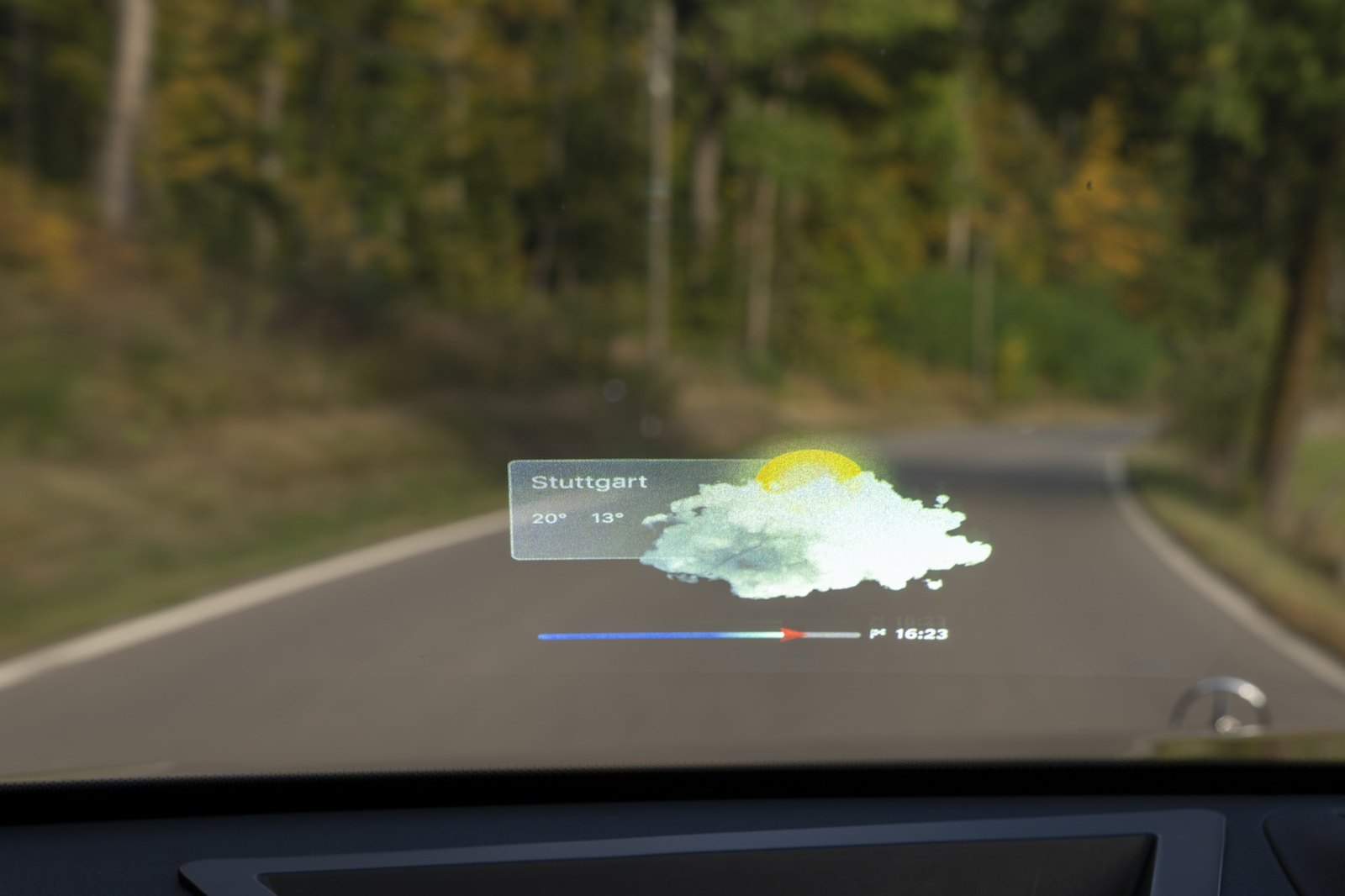
The most striking screen in the Mercedes research car at Sindelfingen isn’t a screen at all. A projector hidden in the instrument panel throws its image onto the windshield, a transparent film laminated inside the glass catches the light, and the picture floats over the road ahead until the system switches off and the glass goes clear again.
Mercedes-Benz calls the concept the Holo Display, and it showed the technology on November 3 alongside LED displays built into side and rear windows and a new 800-volt Power Converter.
Every piece of it stays in development, with no production promise attached.
A film inside the glass does the displaying
The film carries holographic optical elements, tiny structures that selectively reflect the exact wavelengths the projector emits.

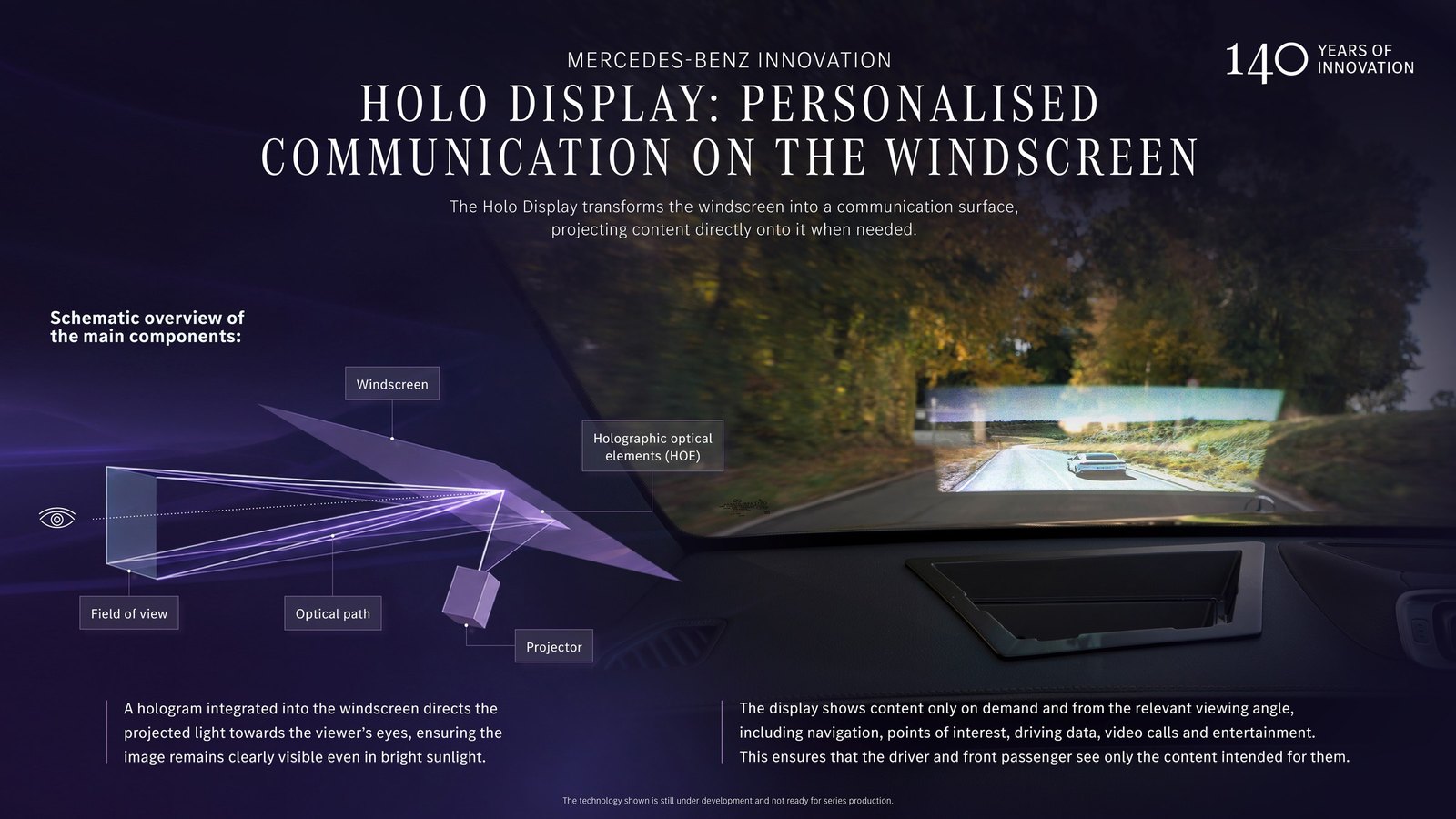
That selectivity concentrates the light toward the viewer’s eyes, which is how the image stays readable even in direct sunlight instead of washing out like a conventional head-up display. Engineers on the programme describe the elements as super-small mirrors, a handy picture of how the film steers light toward one seat and away from the other. Nothing in the glass glows on its own.
Kill the projector and the display vanishes, so the windshield keeps its clean, unbroken look the rest of the time, a design choice as much as an engineering one. The prototype ran in a right-hand-drive S-Class on the Sindelfingen research site, playing video at a fraction of its maximum brightness.
Mercedes captions every photo of the system with the same warning: the technology shown is still under development and not ready for series production.
The passenger watches a film the driver can’t see
Viewing angles split the audience. The film returns each image only toward specific seats, so the driver can’t see what’s playing on the passenger side of the glass, and the passenger can’t see the driver’s information either.

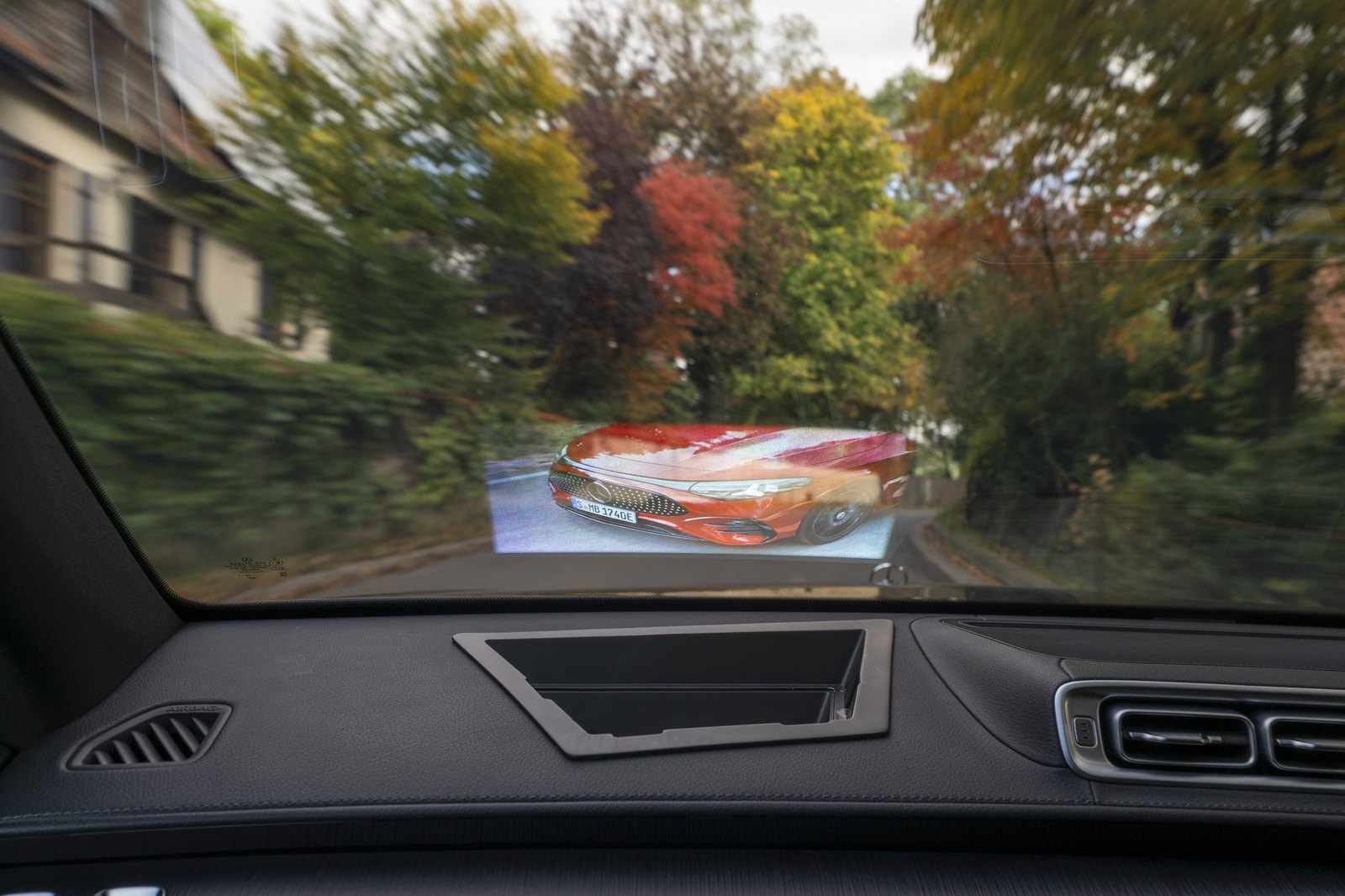
The display also stays off by default, which keeps the driver’s forward view exactly as it was before the projector woke up. That split opens the use list up. Mercedes names navigation, driving information, points of interest, video calls and films, all appearing only when needed and only for the person they’re meant for. Picture a passenger following a film across the lower half of the windshield while the driver sees nothing but road and a small navigation prompt.
The cabin keeps its wood, leather and metal, too, because the display never asks for a bigger slab of glass on the dash.
Mercedes frames the idea as a reply to its own screen race. The Hyperscreen already stretches pillar to pillar in production cars, and the Holo Display explores what happens when the next surface isn’t a panel at all, but the window the driver already looks through.
The other windows learn to talk to the road
A second programme, Intelligent Display in Glass, laminates LED elements directly into the window composite. Mini LEDs suit large areas such as the rear window, where they can show brake lights, warning symbols or traffic information to the drivers behind. Micro LEDs handle the fine work. Mercedes also shows the side glass carrying a personalised image for an owner walking up to the car, a greeting instead of a gauge.
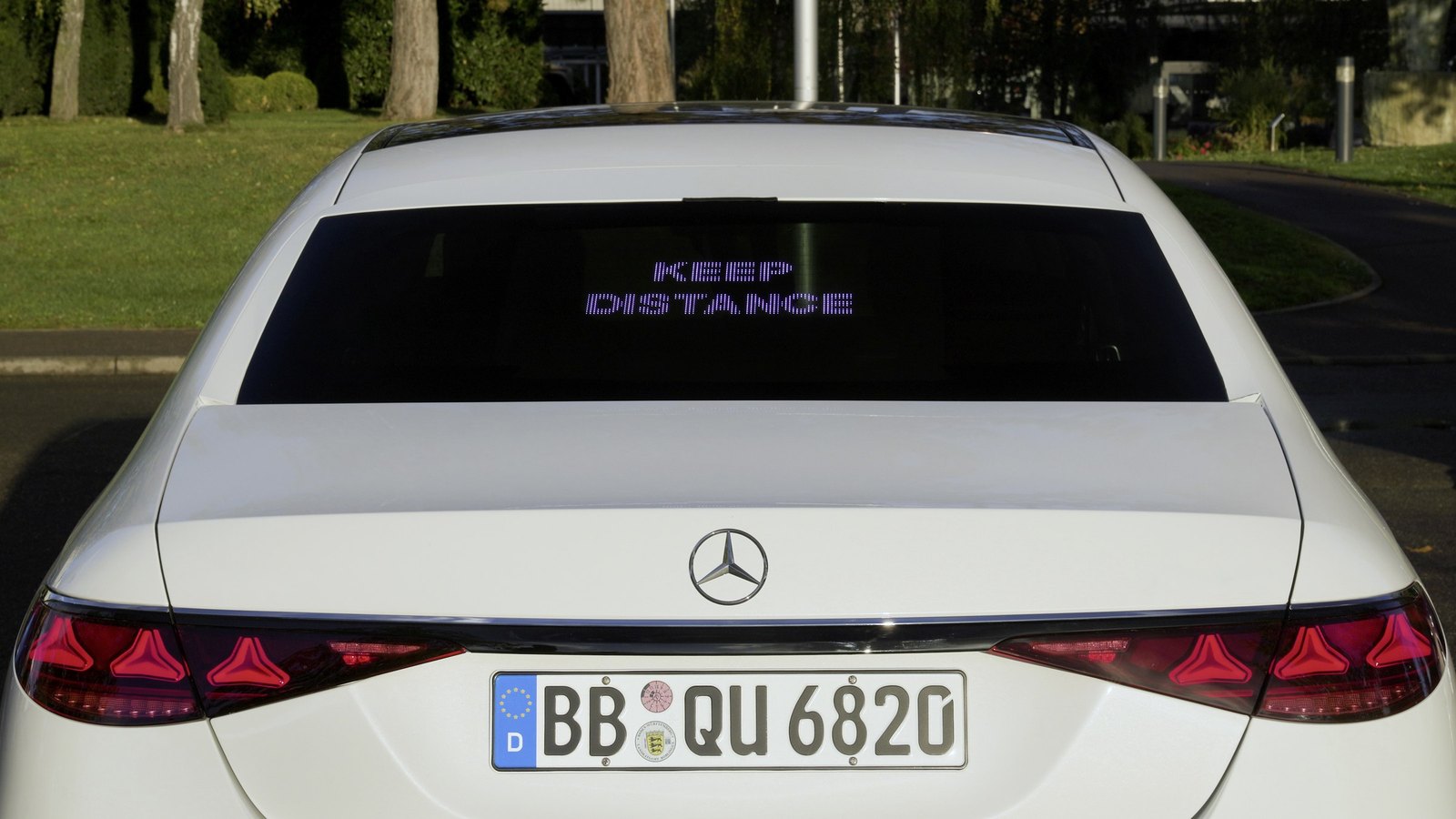
Their higher resolution suits smaller areas and animations, and Mercedes shows side windows carrying details such as charging status for anyone walking up to the car. The rear window of the white test sedan spells out KEEP DISTANCE in blue letters, and other demonstrations flash a warning triangle and a pedestrian symbol.
When nothing needs saying, the elements stay almost invisible inside the glass, so the car’s design never carries a billboard it isn’t using.
A power converter hides under the display story
The third technology works out of sight. The Power Converter uses programmable micro-converters to manage the energy flow of individual battery cells and hold a constant high-voltage output of up to 800 volts, whatever the cells’ state of charge or age. The current generation delivers up to 3 kW and supports AC and DC conversion plus bidirectional charging, so a future car could feed a home or the grid.
Decoupling the voltage from the battery layout would let engineers design packs and motors with far more freedom. Ida Wolf, who leads development innovation at Mercedes-Benz AG, frames the work as precision and proven engineering rather than promises, a line the company repeated across the Sindelfingen presentation.
Mercedes is blunt about the timeline for all three programmes. The technologies are under development, they aren’t customer-facing features and they don’t announce series production in any model. The design thread still runs through everything shown at Sindelfingen. Displays that appear only on demand, glass that communicates without permanent graphics and power electronics that hide their complexity all point the same way: the next Mercedes interior may look calmer than the current one, even while it does far more.
No model, no date and no price attach to the Holo Display yet.
What Mercedes has shown is a direction, and it’s an elegant one: the biggest screen in the car could turn out to be the window that was always there.