
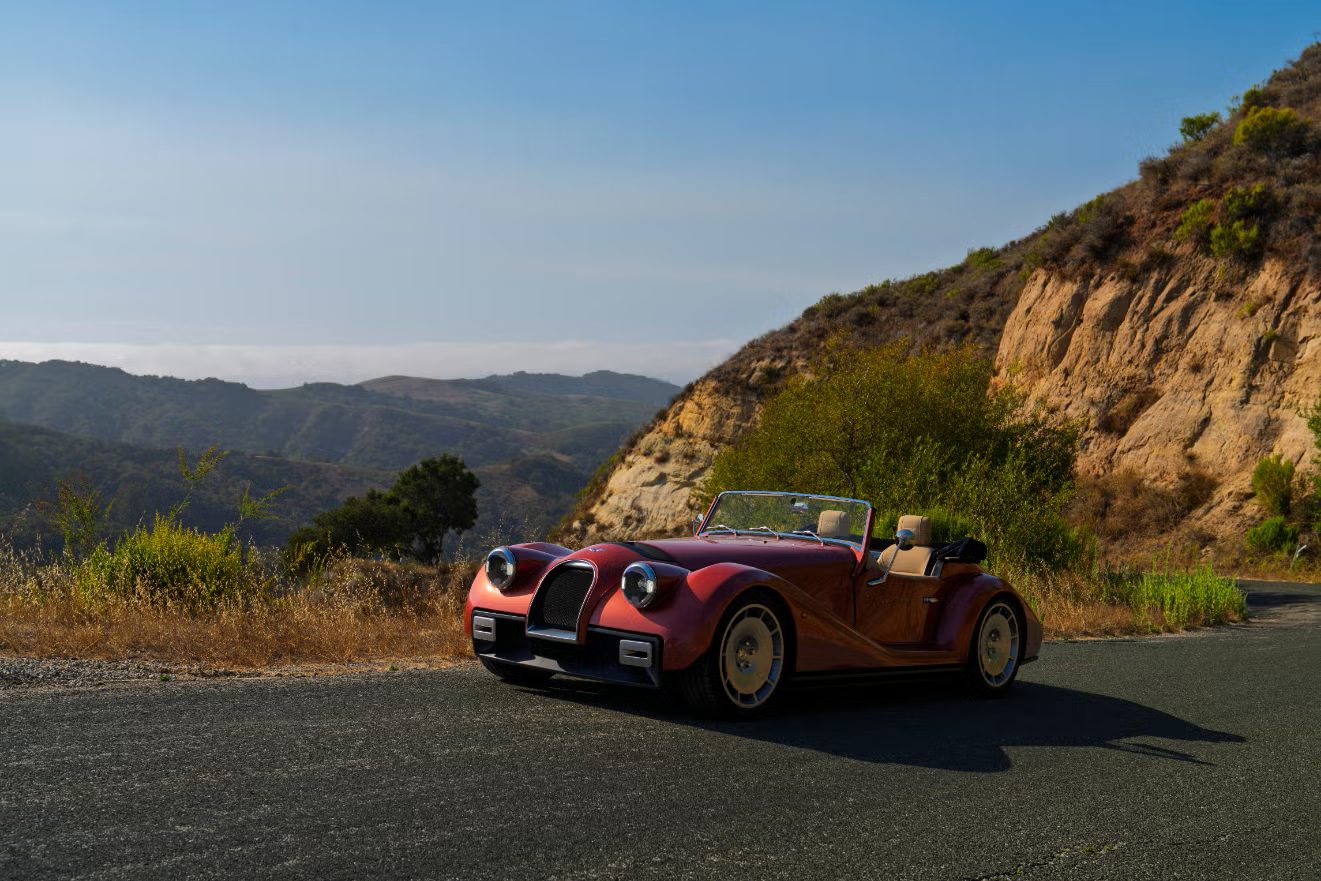
Morgan hasn’t sold a flagship in the United States for more than fifteen years. The Supersport ends that absence, and it arrives as a different car from the one Europe gets.
The American car trades the European six-cylinder for a BMW four, keeps the weight at 2,520 pounds and starts at $119,995 before options. It’s hand-built in Malvern, on the same Pickersleigh Road line Morgan has used for generations.
Orders are open through Morgan’s US dealers, with fewer than fifty commission slots for the inaugural 2026 model year. Scarcity here isn’t a marketing line. It’s federal law, and a production line that builds cars by hand.
Designed like 1936 never ended
The silhouette is pre-war and unapologetic: a long hood, sweeping fenders, round headlights and a rear deck that finally integrates a usable trunk, the first on a modern four-wheeled Morgan. Nothing about the shape chases the current decade.
Underneath sits a bonded aluminum chassis from Morgan’s CX generation, and over it an ash wood framework wrapped in hand-formed aluminum panels. The construction method reads like a museum exhibit. The torsional rigidity doesn’t.

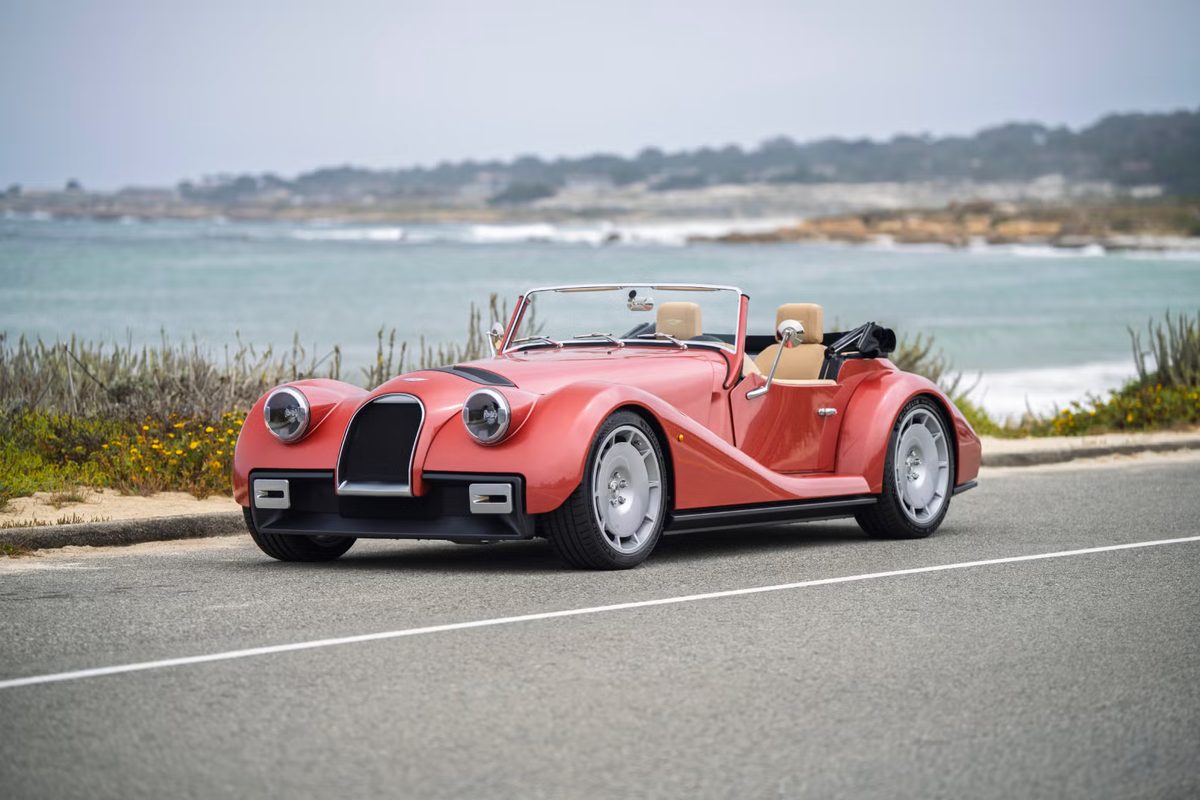
The paint catalog alone runs to dozens of no-cost colors before the special finishes begin, which tells you who this car is for. It’s specced, not selected.
The driving brief: light, not loud
American regulations shaped the powertrain. The US car runs BMW’s B46 2.0-liter turbocharged four with 255 horsepower and 258 pound-feet of torque, driving the rear wheels through a ZF eight-speed automatic.
Europe’s Supersport gets the 335-horsepower six, and there’s no use pretending the four is the enthusiast’s pick on paper. On the scale it makes its case: 2,520 pounds is Miata territory, in a car with twice the presence.
Morgan’s Dynamic Handling Pack comes standard on the American car, built around adjustable Nitron dampers. A limited-slip differential sits on the options list at $2,930.70, for buyers who plan to use the throttle as a steering input.
The compromise is the gearbox. There’s no manual, because the replica-car rules that let Morgan sell 325 cars a year in America reward the automatic. Purists will grumble. The law is the law.
The cockpit is the second design pass
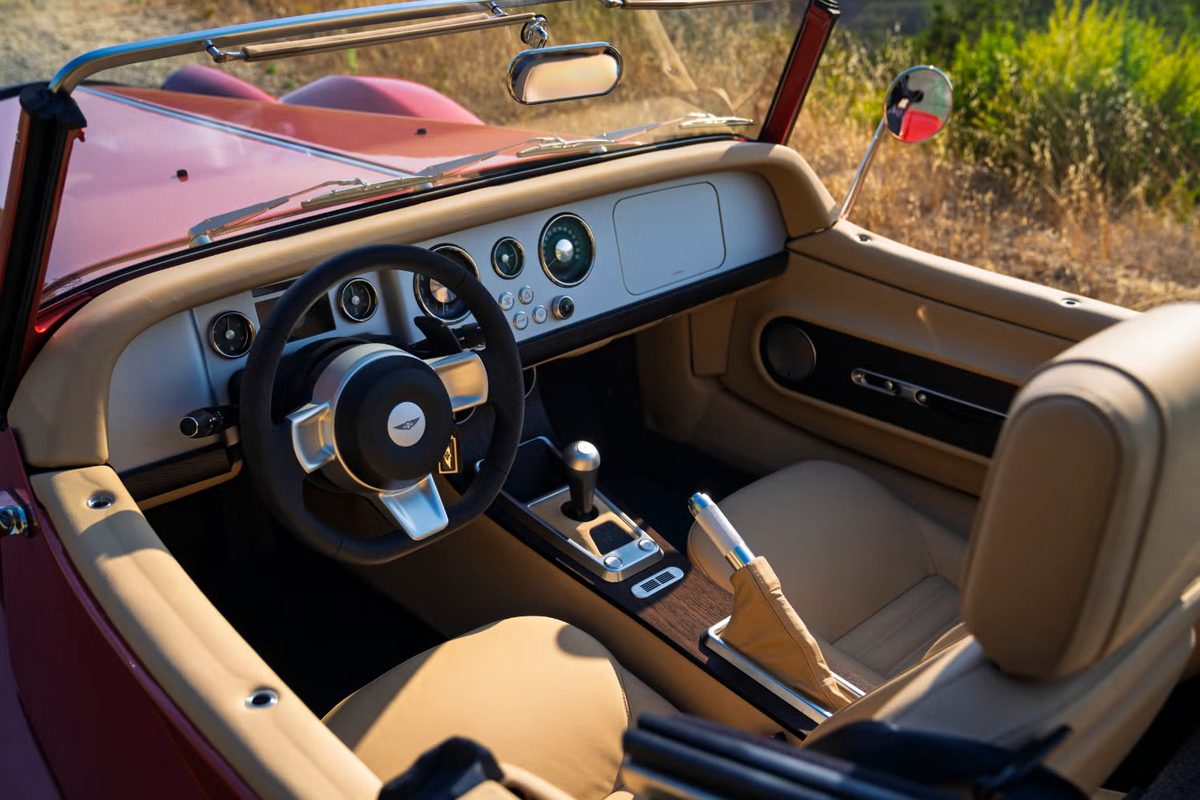
Analog Smiths gauges face the driver, because a Morgan cockpit that went digital would be a costume missing its point. Behind the vintage dials sit the modern parts: wireless phone charging, Bluetooth audio and an optional Sennheiser premium system at $4,508.78.
The options list is best read as a craft menu. Cockpit woods run from standard Ash Olive to Bog Oak, American Walnut and two marquetry patterns at $1,872.39, and a photographic build record of your own car costs $814.59.
The roof choice is the same kind of decision. A black mohair folding hood is standard, colored mohair runs $1,120.93, and the carbon-composite hardtop that replaces it weighs 43.4 pounds and costs $5,252.72.
The Plus Four question
Every Supersport buyer will be asked why they didn’t save $35,000 and take the Plus Four, which starts at $84,995 on the same bonded-aluminum platform with the same 255-horsepower engine. The Plus Four even offers the six-speed manual the Supersport can’t.
The answer is in the brief. The Plus Four is a narrow-body traditionalist with high-arch wings and a rear-mounted spare; the Supersport is the wide-body flagship, with fuller fenders, larger wheels, integrated aerodynamic diffusers and the handling pack as standard equipment.
One is a tribute. The other is the current case for what a Morgan can be.
Speccing one is half the ownership
The standard wheel is an 18-inch Superlite alloy; the 19-inch Multispoke costs $1,555.85 and the forged 19-inch Aerolite $3,607.02. An active sports exhaust adds $3,757.31, heated seats $526.02, and a Comfort Plus seat with pneumatic bolster adjustment $901.76.
Inside, two-tone upholstery is standard, pebble-grain leather starts at $871.70 and soft-grain leather runs $2,122.13 in colors from Rich Tan to Aubergine. Door roundels cost $619.96 plain and $745.20 with your number on them.
Almost nobody will order the base car. Morgan knows this, and prices the menu so the average Supersport leaves Malvern as a portrait of its owner.
Even the aftercare is specced like coachwork: paint protection film at $2,254.39, an indoor cover at $601.17 and an outdoor cover at $676.32. And every figure on the US list excludes duty, sales tax and destination charges, so the $119,995 headline is a starting point in both directions.
The car debuted at The Quail during Monterey Car Week in August, with assembly following that month and the first customer cars reaching US soil in September. At $119,995, against a European price roughly $20,000 higher, the American Supersport is the rare import that arrives cheaper than it sells at home.
Morgan built its name on cars that treat driving as a craft rather than a commute, and the Supersport is that idea with modern bones: designed twice, once in aluminum and ash, and once in the way it moves. America waited fifteen years for a Morgan flagship. It was worth the paperwork.