
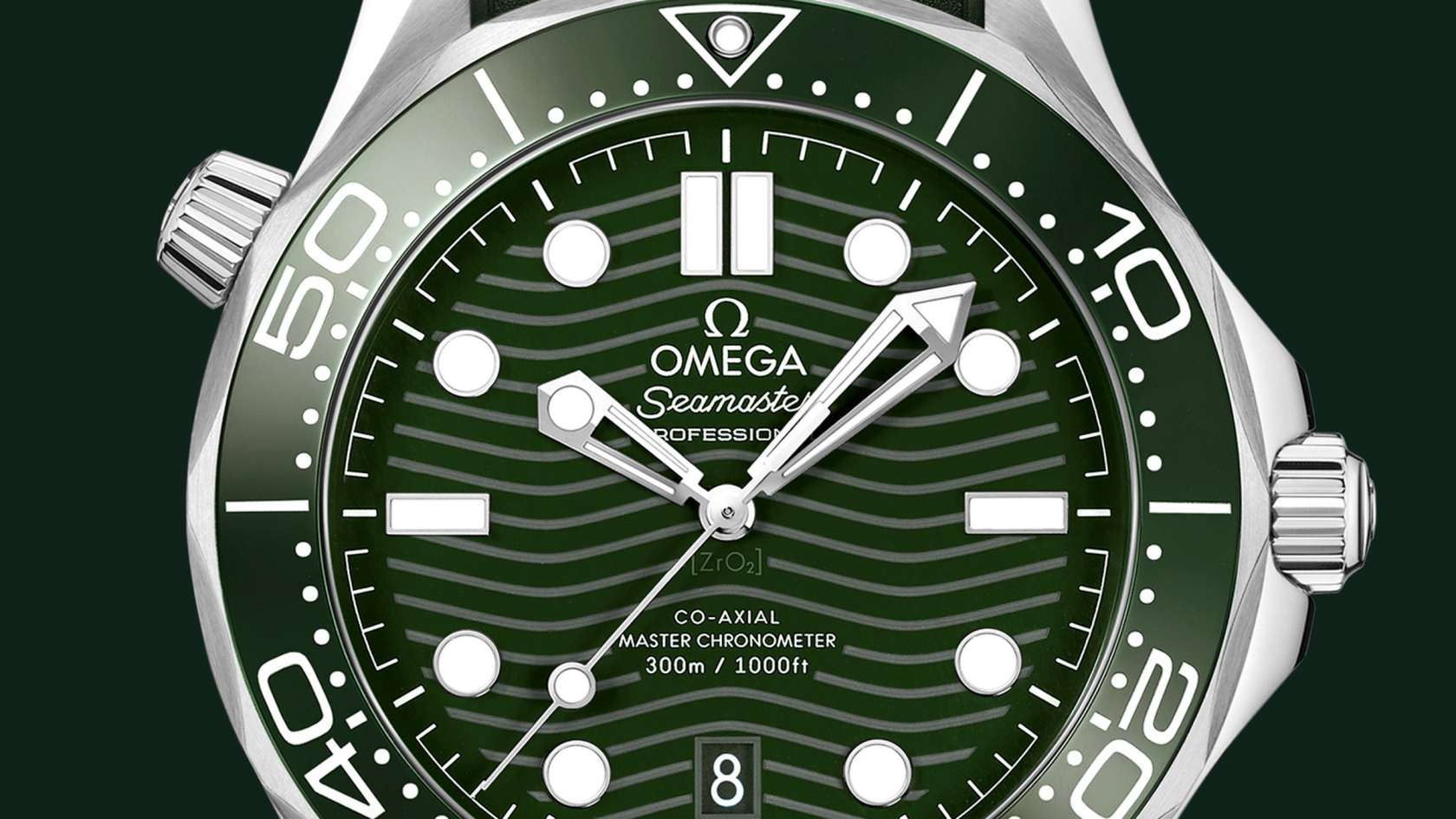
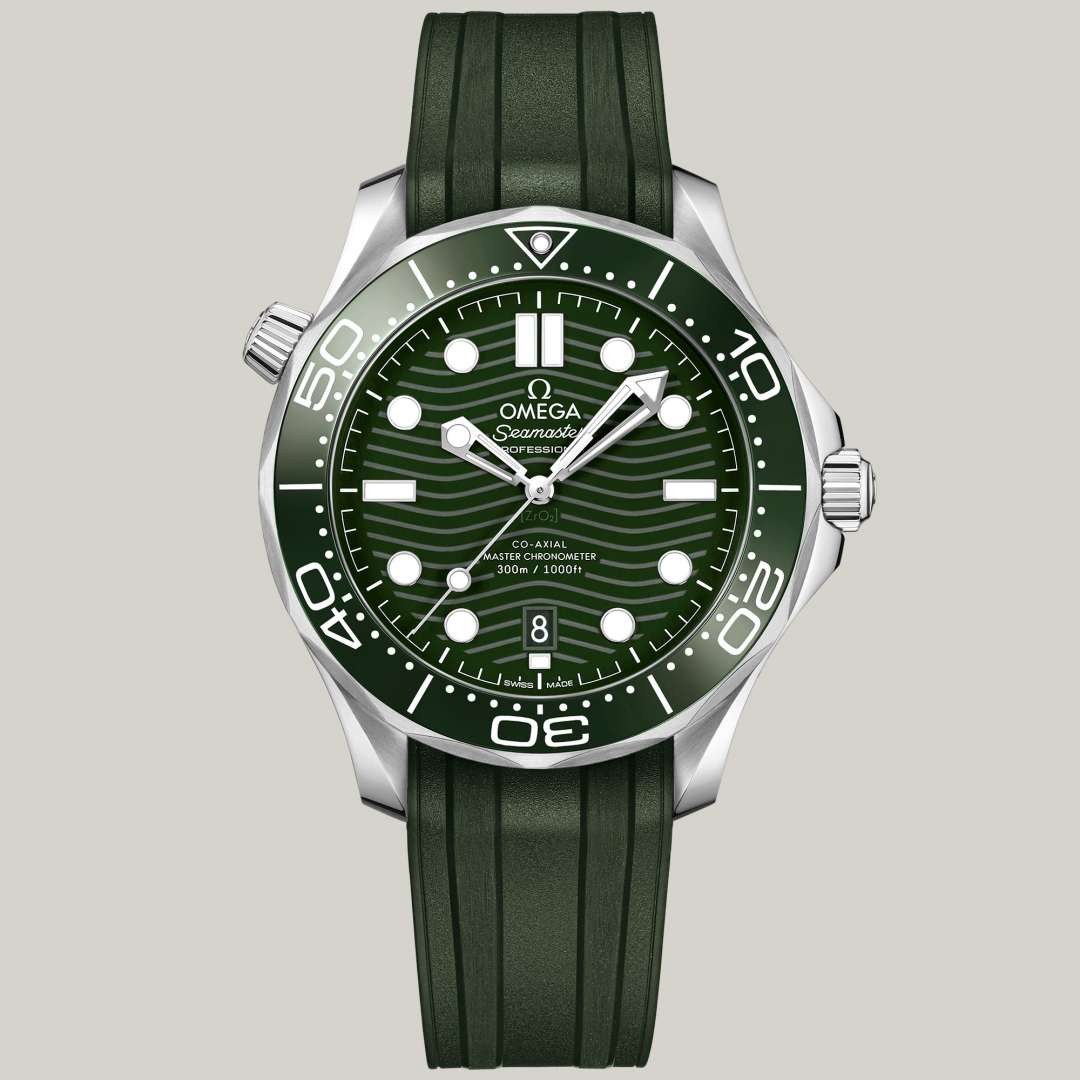
Green dive watches usually cheat toward teal or black. Omega’s Seamaster Diver 300M in green does neither. Omega cuts its dial from polished ceramic, a true deep green from edge to edge, and at $6,300 on an integrated rubber strap, this is the version of the watch that treats color as the design itself rather than a trim option.
The reference is 210.32.42.20.10.001, a 42 mm steel case around Omega’s Calibre 8800. The hardware underneath is the standard Diver 300M kit, proven over three decades. What changes the watch is how far the green travels: dial, bezel, strap, even the waves cut into the dial’s surface.
One ceramic, three surfaces
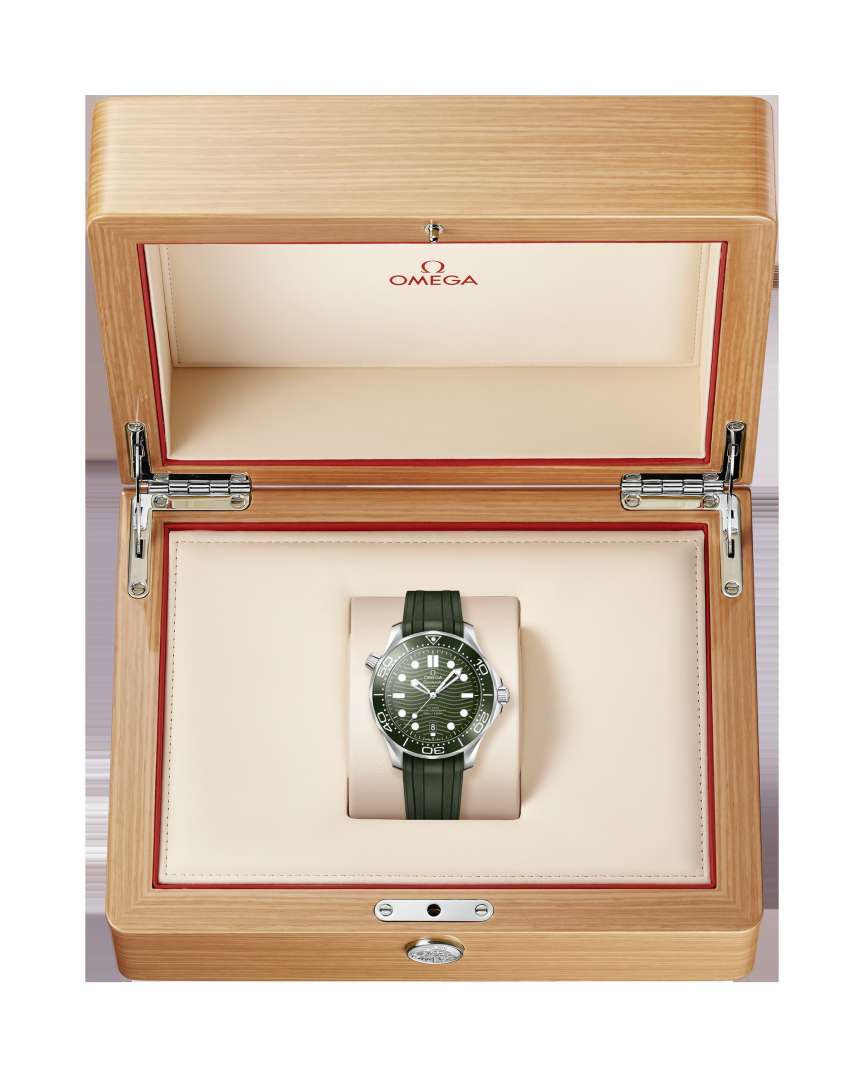
Start with the dial. It is polished ceramic, zirconium dioxide on Omega’s spec sheet, and the wave pattern is laser-engraved in positive relief, raised off the surface instead of printed flat under a clear coat. Light refuses to sit still on it. As the wrist turns, the green moves with the waves, darker in the troughs, brighter along each crest.

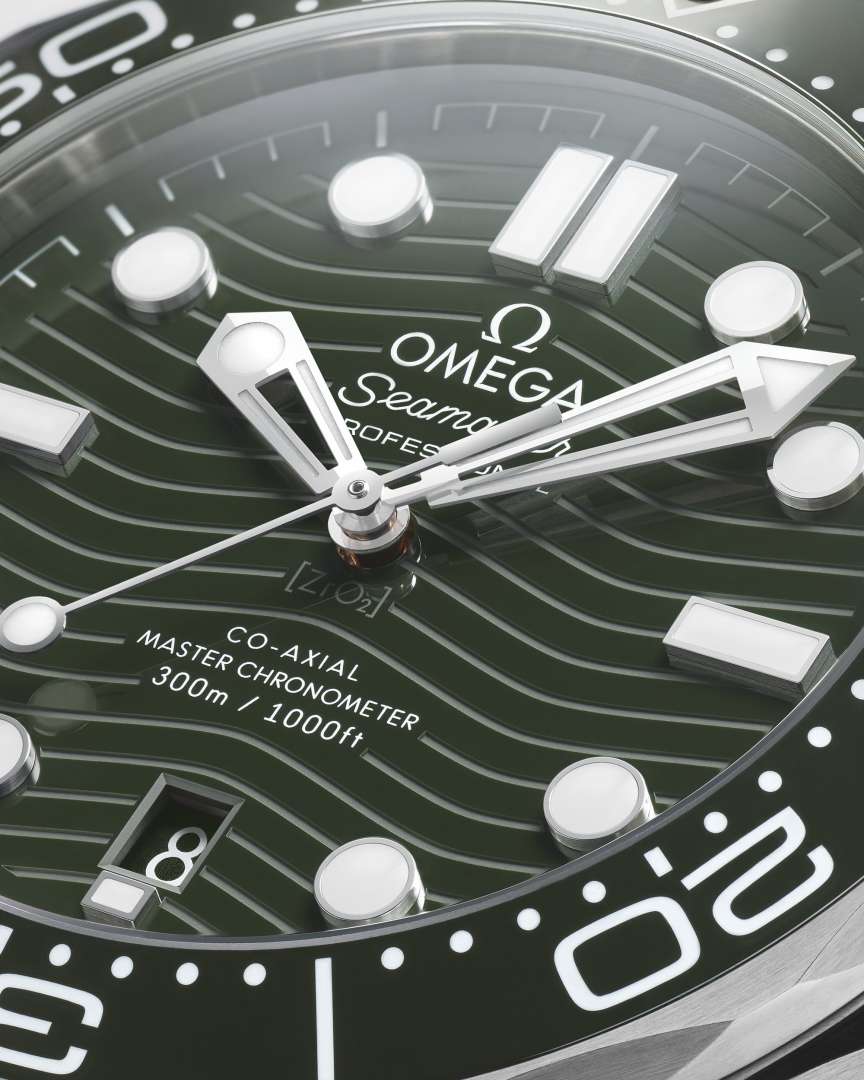
The bezel insert is the same green ceramic, so dial and bezel form one continuous surface. Over it all sits a domed sapphire crystal, anti-reflective on both sides. The face ends up with a wet look, like it just came out of the water it was built for.
The details hold up at macro distance. Applied indexes stand proud of the ceramic on little polished feet, the skeleton hands leave the wave pattern visible beneath them, and the date window at 6 o’clock is cut clean through the waves instead of printed over them. Nothing on this dial is an afterthought. The waves sit in positive relief, laser-engraved into the ceramic instead of printed on it, so they catch light at the same angles as the indexes.

The strap is part of the design
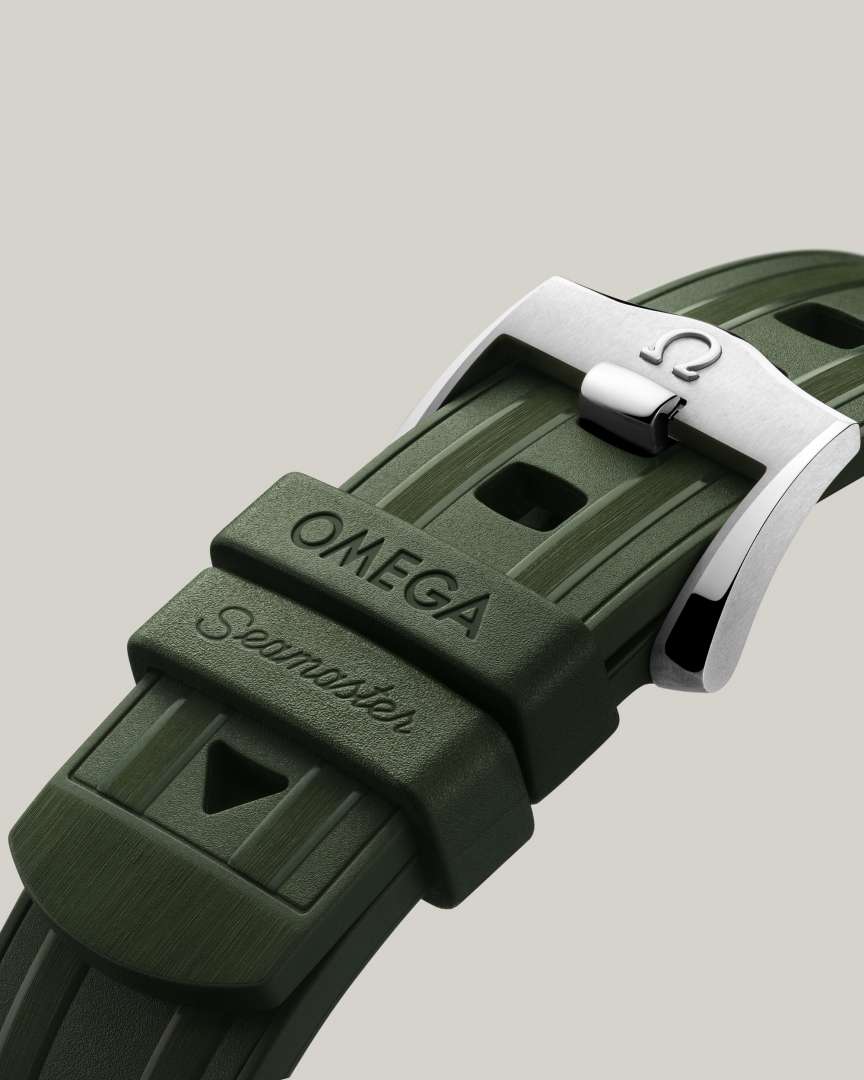
The green rubber strap integrates straight into the case instead of hanging off the lugs, so the color runs unbroken from bezel to wrist. It closes with a pin buckle, the way Omega specifies it. The case is 13.56 mm thick, 49.93 mm from lug to lug on 20 mm lugs, and the whole watch weighs about 114 grams.
In The 1916 Company’s hands-on review, that strap is the one real trade. It runs stiff where it meets the case, which keeps the head planted on the wrist, and it turns spongy against the skin once it gets wet. Integration has a feel, and this is it.
The one break in the silhouette is functional. The manual helium escape valve at 10 o’clock sticks out of the case flank, a protrusion the design never asked for. Saturation divers need it. Everyone else sees it, standing proud of a clean case line.
The working kit around it is unchanged and proven. The bezel turns one way, the crown screws down, the rating is a full 300 meters, and Omega backs the watch for five years. None of it changed to make room for the color. This is a dive watch that can genuinely dive, styled like it would rather be photographed.
A movement finished to be looked at
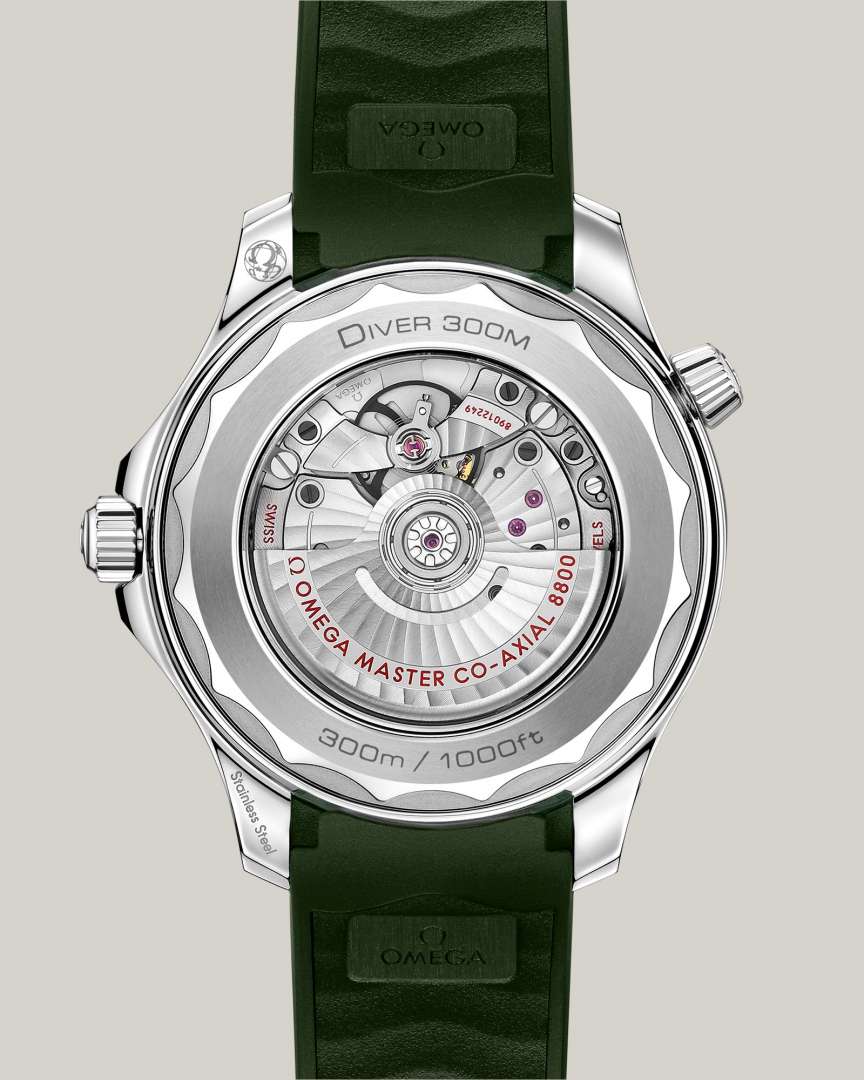
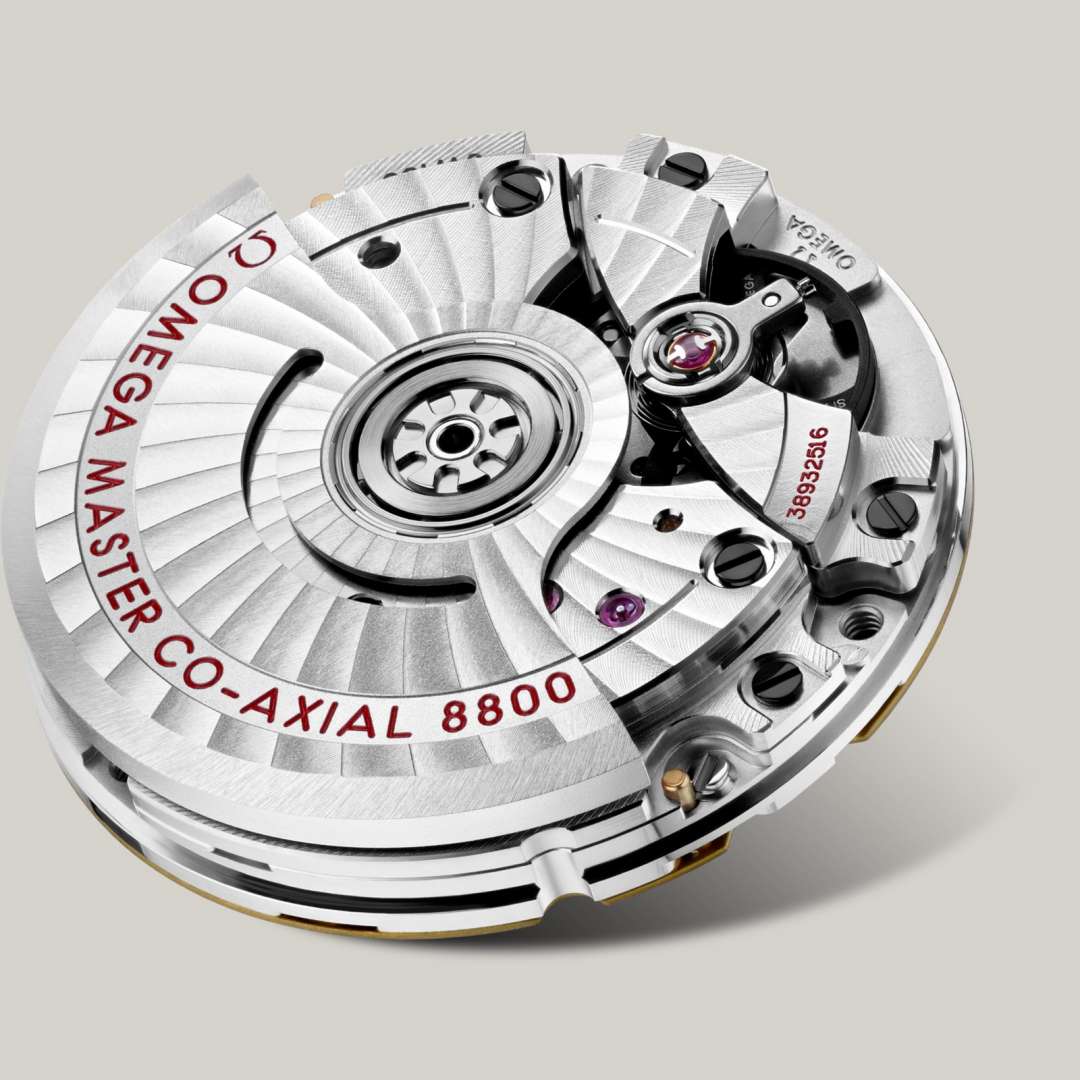
Turn the watch over and the design argument continues behind sapphire. The Calibre 8800 is Omega’s in-house automatic: Co-Axial escapement, free-sprung balance with a silicon balance spring, 55 hours of power reserve. It runs at 3.5 Hz and holds 0 to +5 seconds a day under METAS Master Chronometer certification, tested as a finished watch rather than a bare movement.
It is also certified against magnetic fields of 15,000 gauss, the sort of exposure that stops lesser movements near a laptop speaker. The rhodium-plated rotor carries Geneva waves in arabesque, decoration with a purpose: it is why the caseback is glass at all.
What green does to a 1993 silhouette
The Diver 300M line goes back to 1993, and this generation arrived in 2018, ceramic dial, restored wave pattern and all. Green joined the range in 2022. Most colorways keep the silhouette a tool watch first and a color second. Green reverses the order. The shape is still the lyre-lugged diver Omega has sold for three decades, yet the color arrives before the shape does.
Black, blue, and white versions of this same watch exist, and each one keeps the ceramic quiet. Green is the colorway where material and color are the same decision, which is why this is the version that gets talked about.

Editor’s take
My read is simple: if you are buying one Diver 300M, buy this one. The black and blue versions are correct, and correct watches get forgotten on the wrist. Green gives the same 300-meter hardware a face with a point of view, and the relief waves keep it interesting at the distance a watch actually gets looked at, across a table.
The stiff strap and the proud helium valve are the costs, and neither one outweighs what the color does. At $6,300 it also undercuts the same watch on a steel bracelet at $6,700, and the rubber suits the green better anyway. Divers get their tool. Everyone else gets the better-looking watch.