
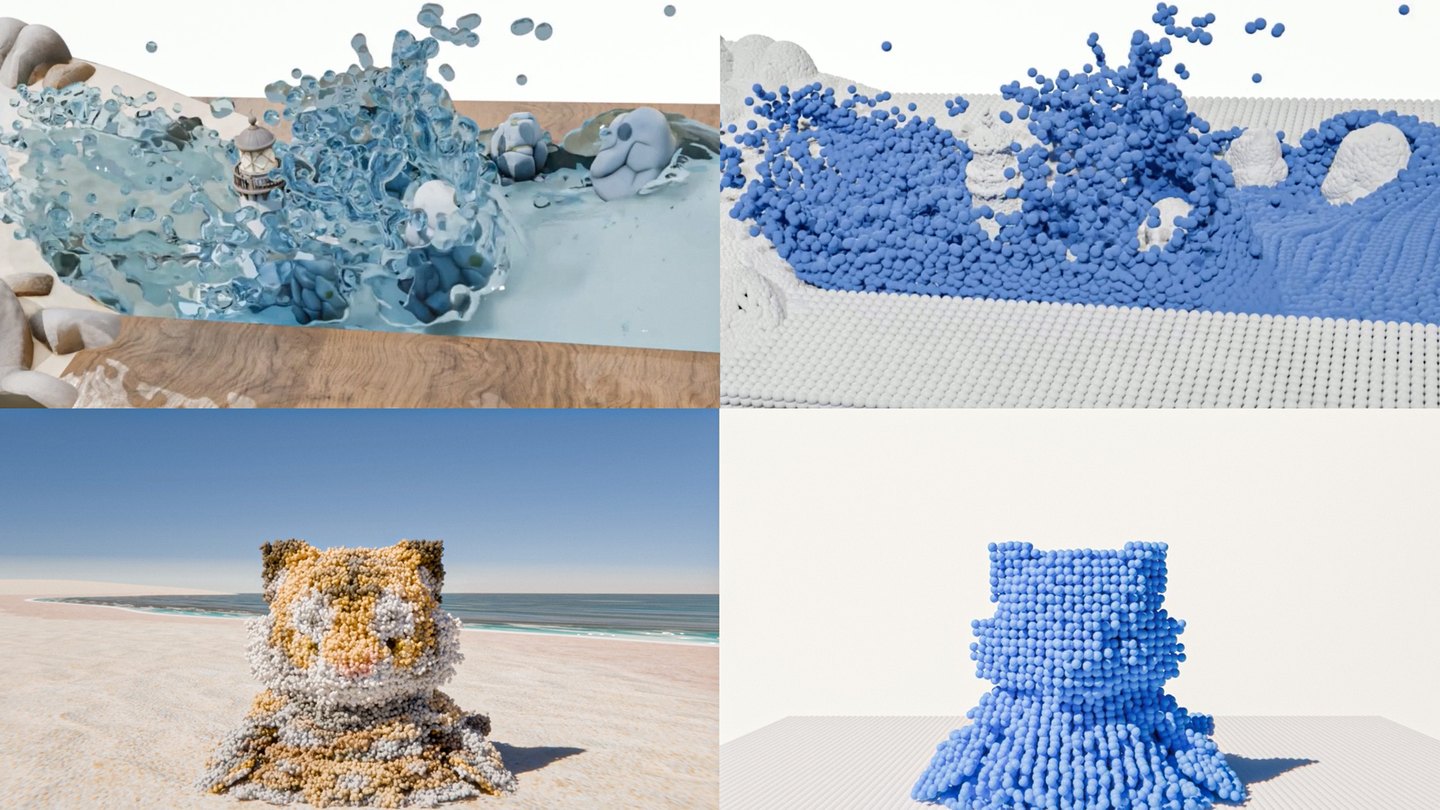
Design a soft robot gripper and the hard part is not the gripper. It’s the sand. Soil shifts under a fingertip, grains pile and slide, and the software that predicts any of it is slow, specialized and separate from the tools that handle water, cloth or rubber. Every material gets its own solver, written by hand and tuned by experts.
WorldParticle discards that whole shelf. Built by researchers at MIT, the University of British Columbia and a string of partner labs, it’s a single AI model that learned how particles move, and it spends that one skill on sand dunes, splashing water, folding proteins and everything in between.
For anyone who designs physical things, simulation is the toll booth between a sketch and a prototype. A model that covers the whole bench changes what gets tested, and how fast a team finds out whether an idea survives contact with the physical world.
One model, every material it has been shown, and several it hasn’t.
Everything becomes particles
The system starts by breaking the world down. A wave, a rubber valve, a chain of protein: each becomes thousands or millions of tiny three-dimensional particles, and WorldParticle tracks every particle’s position and velocity through space and time.

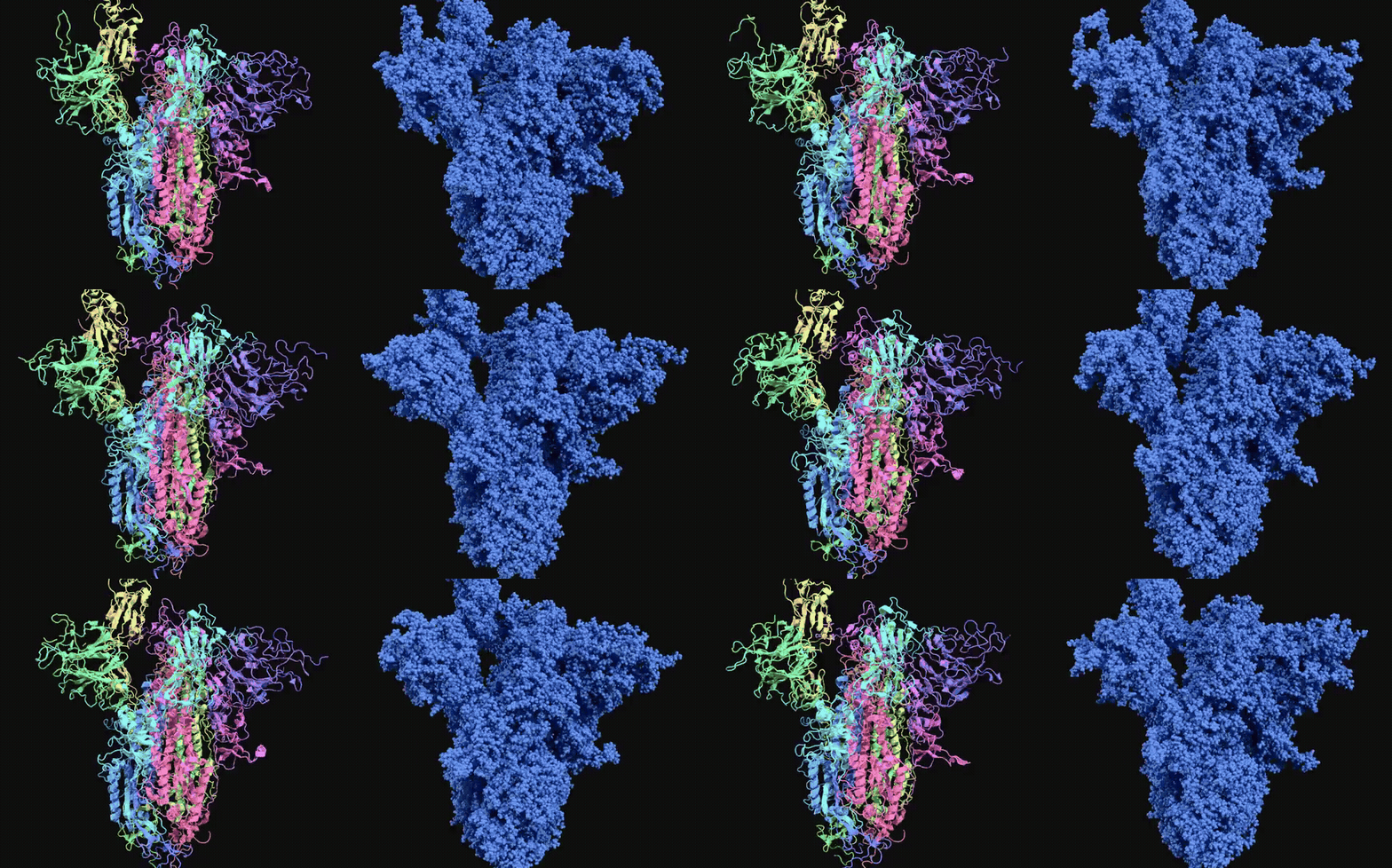
That particle view is called a Lagrangian representation, and simulators have used it for decades. What’s new is who does the math. A neural network reads the particles’ positions and physical properties, then predicts the next frame of the simulation, placing every particle one step further along its path. In effect, it’s a physics engine that was trained rather than written, and the training is a one-time cost, paid before the first simulation ever runs.
Because the representation never changes, the material can. Sand and protein arrive as the same kind of input, so one architecture handles both.
MIT says the system has been validated across diverse phenomena, from microscopic protein motion to macroscopic physical simulation, and it reports higher accuracy than numerical simulation methods across all six of the categories the team tested.
It learned the rules instead of being handed them
A traditional simulator is programmed with a governing equation for each material, and writing those equations is the slow, expert work at the center of the field. Each equation covers one material under one set of conditions, and a new material means starting the math over with a specialist who knows that material’s physics well enough to encode it.
WorldParticle’s network learns to solve governing equations in general instead, picking up the rules from examples the way a language model picks up grammar from text alone.
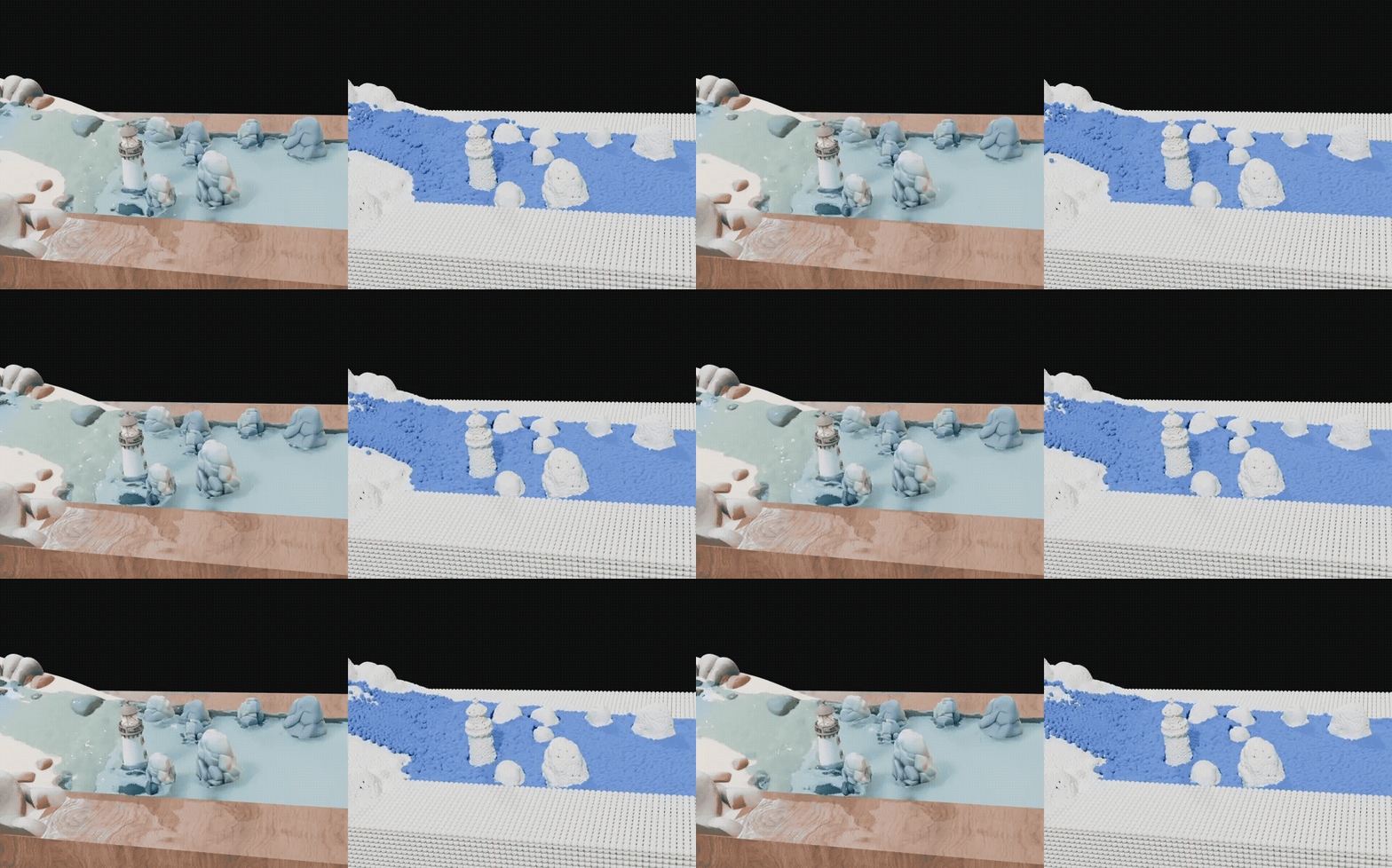
Outside forces get their own handling. Before each step, the system separates forces like the impulse of a wave slamming into a seawall, makes its prediction, then folds those forces back in to correct it. That separation is how the model walks into materials and conditions it never trained on and still behaves.
Scale comes from compression. An object can break into millions of particles, far too many to track one by one, so the system merges them, squeezing the count down while holding onto the fine detail of how the whole thing moves. The project page claims million-particle simulations at interactive frame rates.
“We want to have a GPT moment for simulation,” says Peter Yichen Chen, a former MIT postdoc now at the University of British Columbia. He co-led the work with MIT postdoc Minghao Guo, and UBC graduate students Caoliwen Wang and Siyuan Chen share the lead authorship.
What it means in the design studio
Picture the loops this shortens. A soft robot team prototyping a gripper needs to know how sand or soil will move under it before anyone cuts hardware. A materials lab hunting a new compound needs behavior it can screen on a display first. A product team needs a prototype that fails on screen, where failure is cheap, instead of in tooling.
Those are three different industries waiting on the same bottleneck, and the bottleneck has never been the imagination in the room. It’s been the week the simulation queue takes to answer a single question.
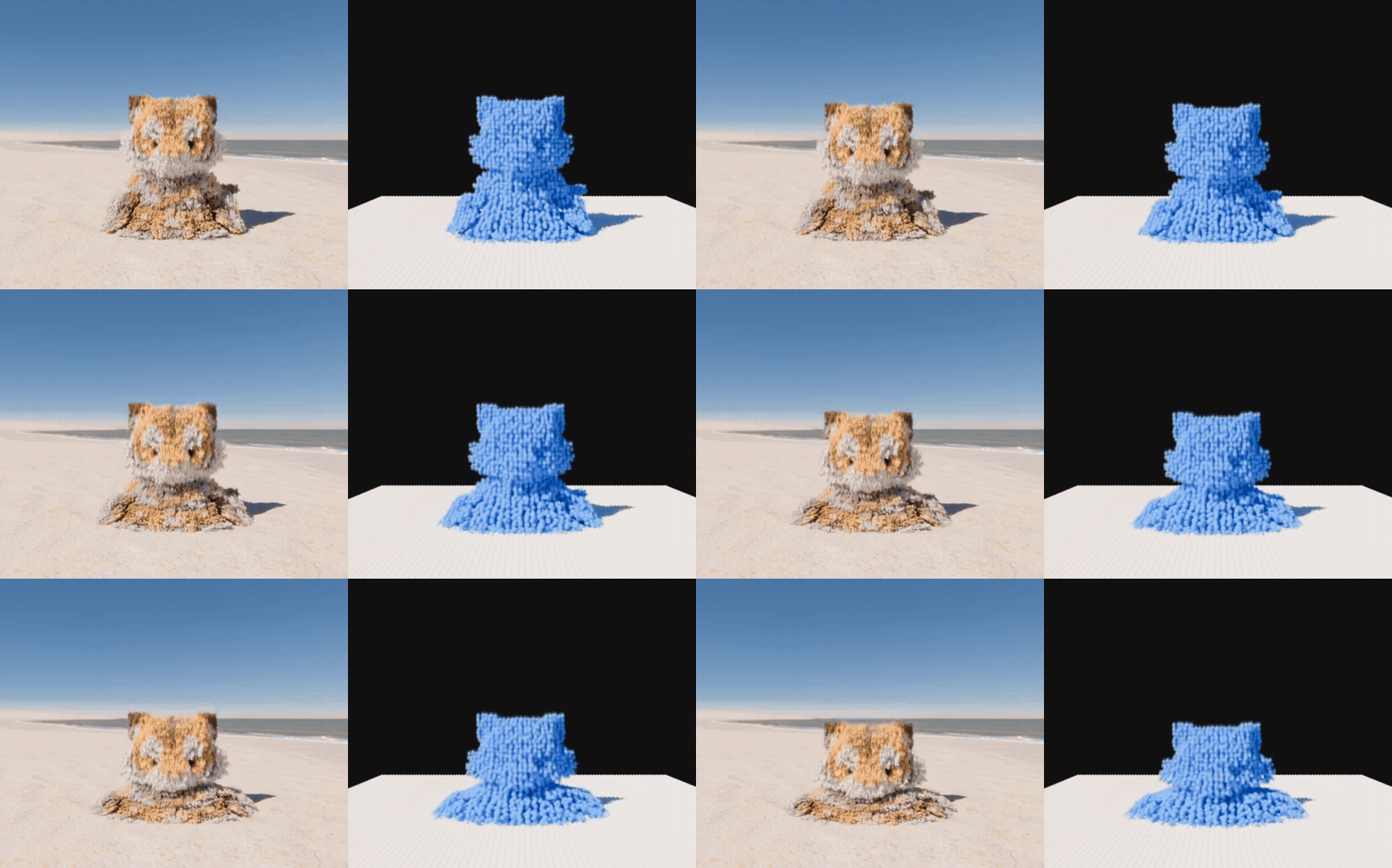
The results MIT reports are pointed. WorldParticle captured a granular object collapsing into a pile while baseline methods left sand particles floating in the air.
Proteins moved faster still. The system modeled protein structures changing over time about 100 times faster than numerical simulators, Guo adds.
The team’s paper tests six categories, named in its abstract: cloth, elastic solids, Newtonian and non-Newtonian fluids, granular materials and molecular dynamics.
Wojciech Matusik, the MIT professor who leads the Computational Design and Fabrication Group at CSAIL, is on the team, alongside collaborators at Georgia Tech, Inria, Meta, the University of Pennsylvania, the University of Utah, UCLA and the University of Hong Kong.
The researchers’ own list of next targets runs from soft robot manipulation and RNA evolution to the merging of galaxies, with new materials discovery as the long-term prize. It isn’t a product. There’s no price and no release date, and the work goes to SIGGRAPH Asia 2026 while the team builds toward a general-purpose simulation pipeline for scientific discovery.
the tools on the bench shape what gets designed. A simulator that treats sand, water and protein as one problem doesn’t just shorten the wait. It changes which ideas get tested at all.
Worth watching, then, is not the demo reel. It’s the first product that reaches a prototype review having already failed a hundred times in particles.