Two days, 217 lots, and not one of them went home unsold. Phillips in Association with Bacs & Russo closed The Geneva Watch Auction XXIV at the Hotel President on November 8 with $112.3 million on the board, the highest total any watch auction has ever posted and the first live watch sale in history to break $100 million.
Six months ago, Phillips set the record at $96.3 million in the same city. This weekend it beat its own mark by $16 million, drawing 2,121 registered bidders from 69 countries into a fight over lots that averaged more than $500,000 apiece.
Twenty-four world records fell across the two days. Seventeen lots cleared $1.2 million. And one living watchmaker took home a third of the money.
The Régence ran the room
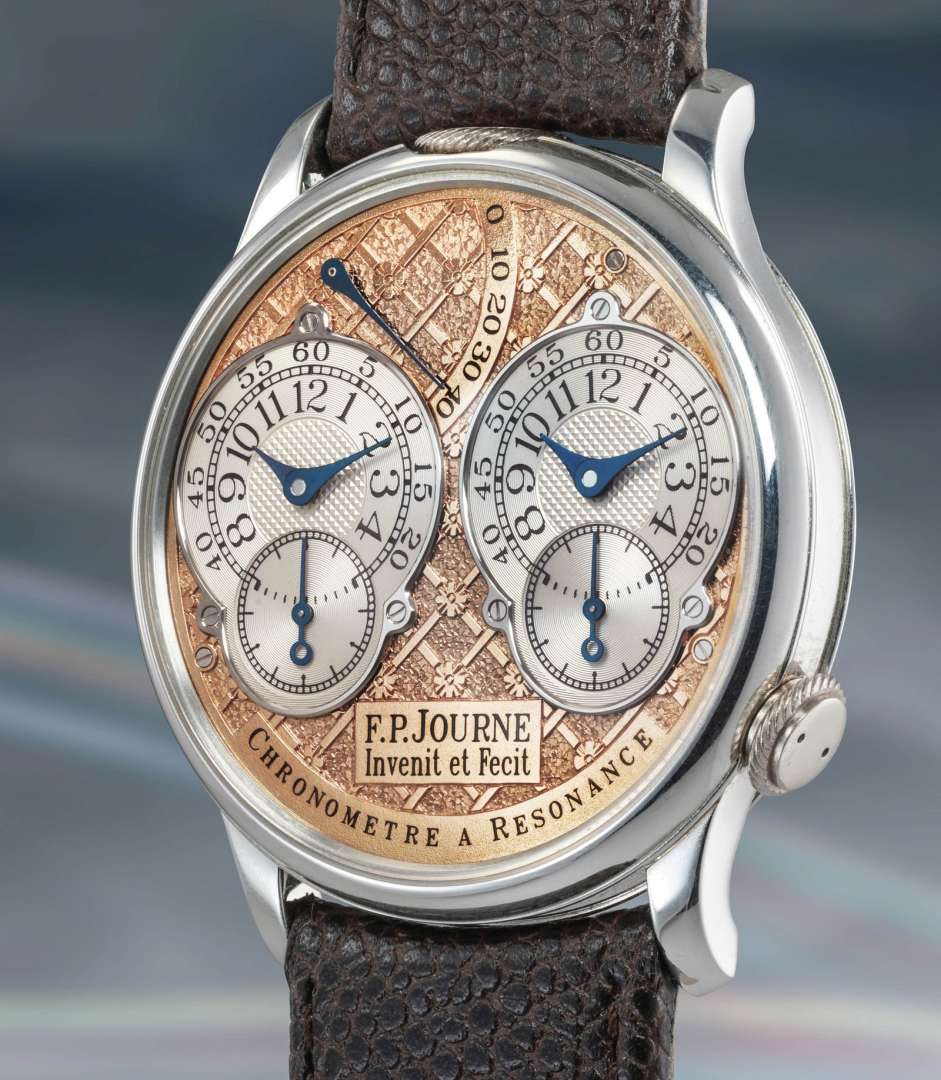
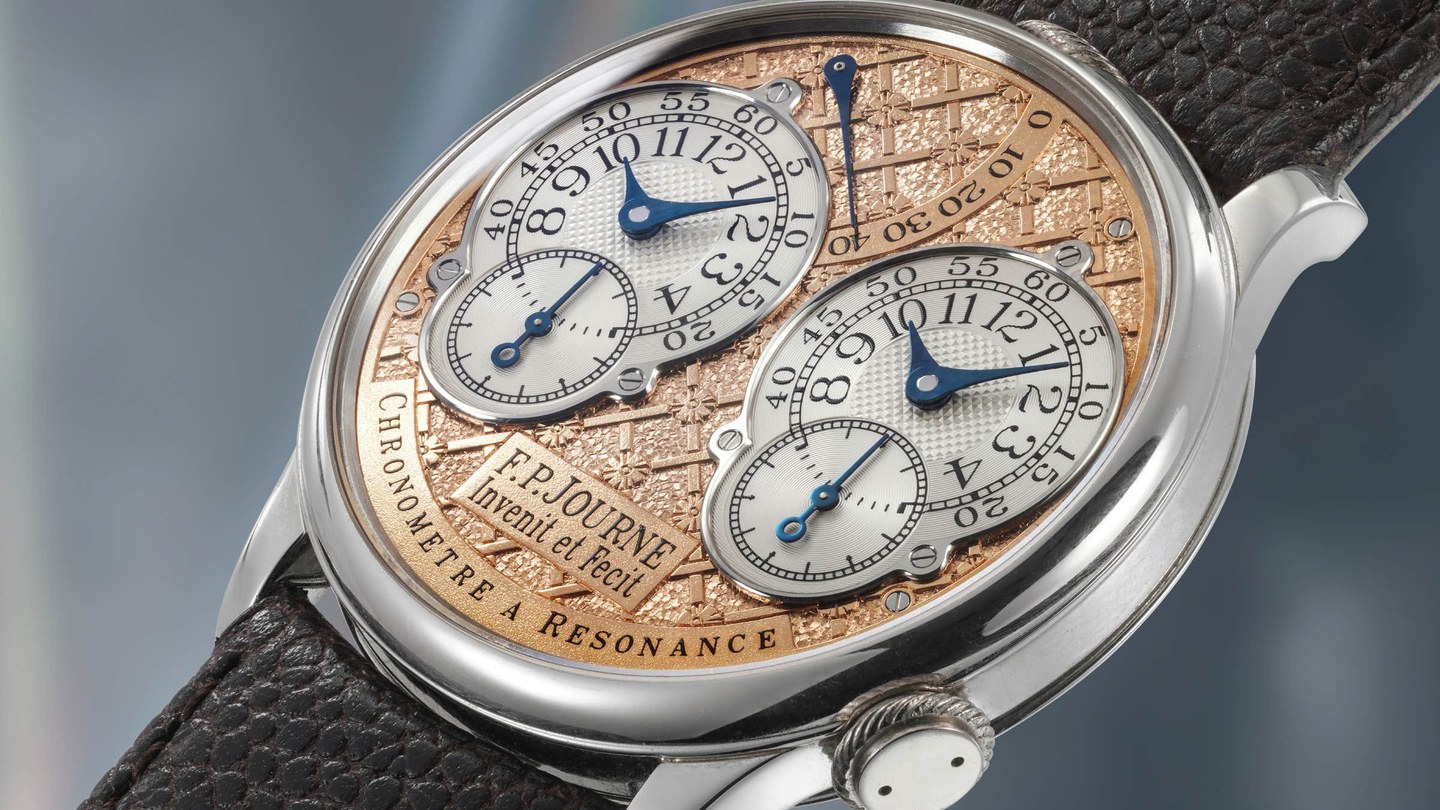
Lot 7 was an F.P. Journe Chronomètre à Résonance from 2002, known as the Régence, in a 38mm platinum case. Its dial is shiny pink gold, engraved by hand in the lozenge pattern of the French Régence, and it’s the only one of its kind. Journe made three Résonance watches with engraved Regency dials for the Geneva retailer Les Ambassadeurs. One stayed with him. One wears yellow gold. This one wears pink, with a shiny finish none of the others have, and cutting a single dial took the engraver roughly two days. The lozenge pattern copies early 18th-century French motifs, each one cut by hand.
Phillips printed an estimate in excess of $1.21 million and the room ignored it. When the bidding settled, the Régence had made $10.6 million, the top price of the sale. It also made this the fifth straight Phillips live auction with a watch above $10 million, a streak no sale room had ever put together before this run.
Under the dial sits the calibre 1499 in brass, from the short early run when Journe’s movements were brass rather than gold. The watch surfaced at the brand’s own 20th anniversary Résonance exhibition in Geneva in 2020, shown as a centerpiece of the first years, and it arrived with its authenticity certificate from that show.
Journe took a third of the sale
Thirteen F.P. Journe watches crossed the block. Together they made $38.8 million, a third of the sale, and the depth ran well past the headline lot.
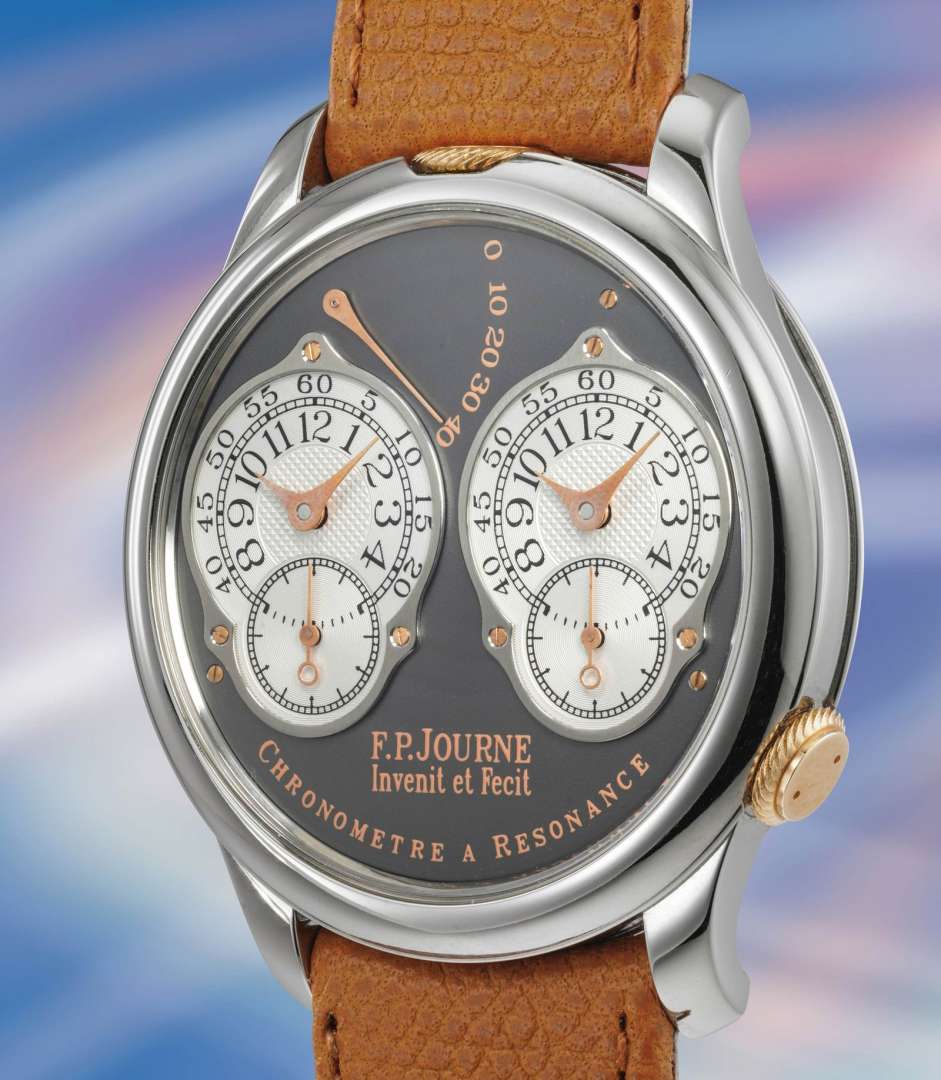
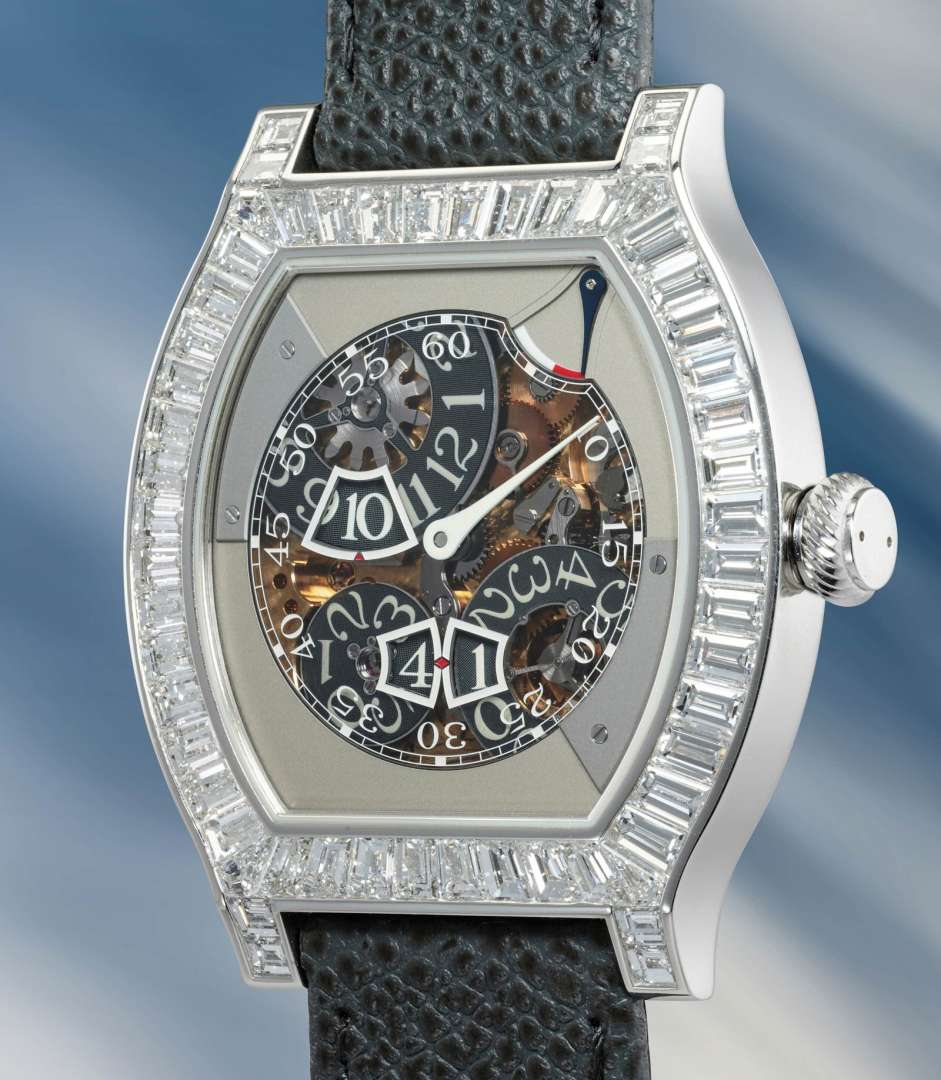
A titanium Chronomètre à Résonance made for the Tokyo boutique in 2007, one of twelve, brought $7.5 million. The diamond-set platinum Vagabondage III brought $6.2 million. And the pre-production Résonance numbered 022/99R, built in 1999 before the model had officially launched, brought $6 million, a figure most brands would happily headline an entire sale with.
Keep going down the list and it doesn’t thin out: a Tourbillon Souverain at $2.56 million, a Tokyo anniversary chronograph at $1.55 million, an Octa Calendrier at $1.43 million. Harry Winston’s Opus One tourbillon, built with Journe, set an Opus series record at $1.7 million. One brand, founded in 1999, outgrossed most complete watch auctions on its own.
Steel, 33 millimeters, $7.65 million

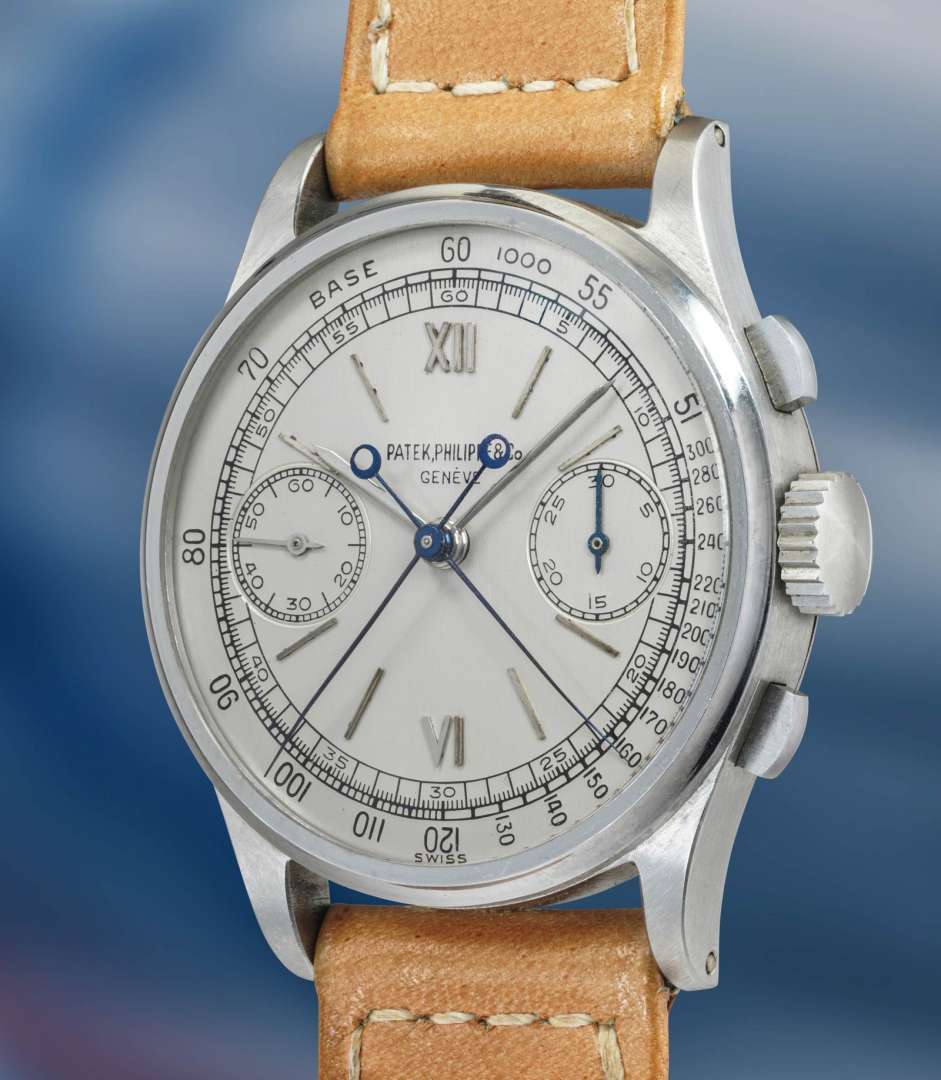
Second place for the weekend belonged to a watch with no precious metal in it at all. Patek Philippe’s reference 1436 is a split-seconds chronograph from 1945, cased in stainless steel and measuring 33mm across. Patek built roughly 140 examples of the reference over 33 years of production. In steel, exactly two are known to survive in their original configuration. On this early example, the crown itself works the split-seconds mechanism. This one kept a crisp case, hard enamel dial scales that still read sharp, and a movement Phillips believes has never been dismantled since it left the workshop in 1945.
It sold new through the Henry Stern Watch Agency, Patek’s American importer, in May 1949. On Saturday it made $7.65 million, a world record for any split-seconds chronograph. Steel did that, at 33mm, in a catalogue full of gold heavyweights.
Patek’s bench held up behind it, with a steel reference 530 and a gold 1518 perpetual calendar chronograph at $1.37 million each. The asymmetric reference 3424, designed by Gilbert Albert and shaped like nothing else Patek made in the period, reached $900,000, and the depth ran all the way down a catalogue that stayed strong long after the headline lots had gone.
A clock from 1924 beat every Cartier ever sold
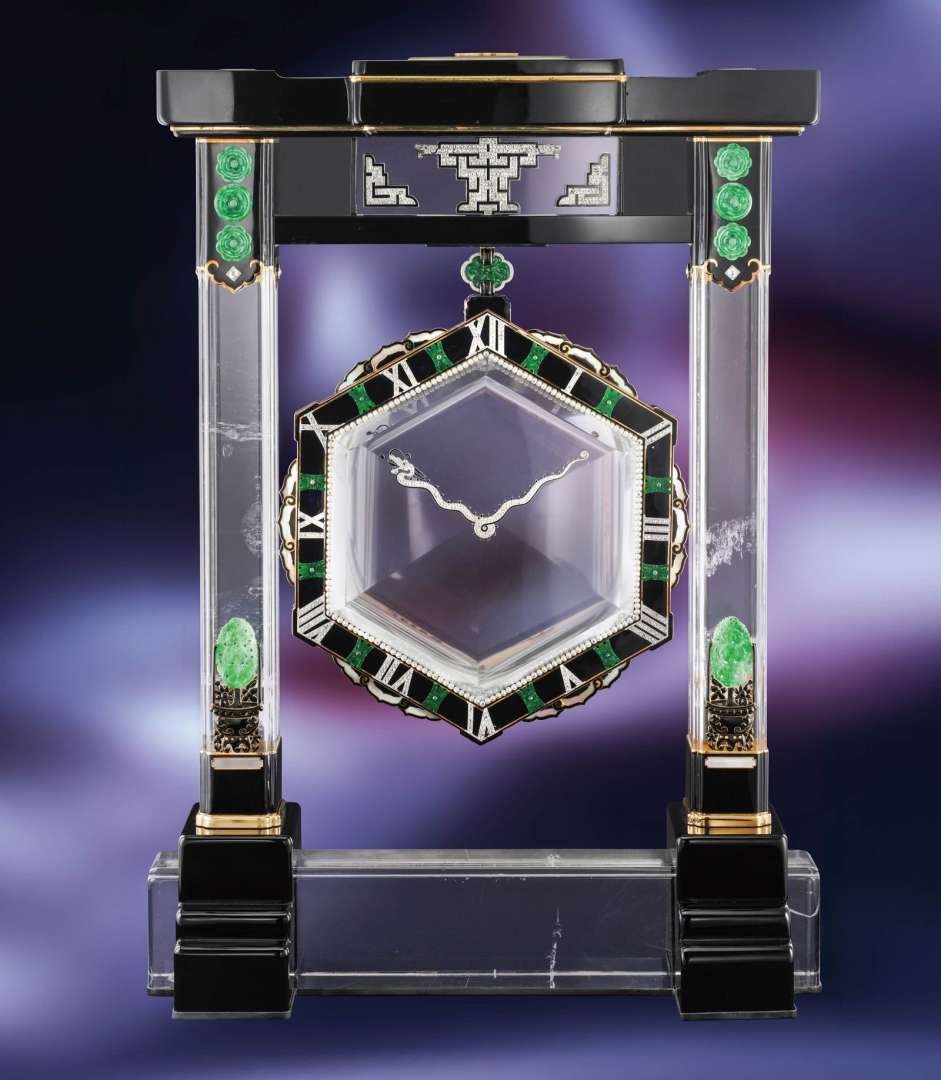
Lot 220 wasn’t a watch at all. Cartier’s Portico Mystery Clock No. 4 dates to 1924, one of six Portico clocks the maison built, and it’s the only one whose dial is a hexagon cut from rock crystal, suspended in a frame of onyx, jade and diamond-set enamel. The hands float across the crystal with nothing visible driving them. That was the trick a century ago, and it still stops a room.
The clock hadn’t appeared at auction since 1996. It returned at $5.9 million, a world auction record for any Cartier timepiece, wristwatch or otherwise.
The million-dollar club had 17 members
Rolex’s best results came from fresh discoveries and old collections. A yellow gold reference 6062 “Stelline,” newly surfaced and acquired from its original owner in Japan, made $2.85 million. The 14k gold reference 6241 Daytona “John Player Special” made $2.3 million. A square reference 3830 “Verga” made $1.55 million, a world record for a non-Oyster Rolex chronograph, and the fifteen chronographs in the Pucci Papaleo collection it came from brought $4.62 million together.
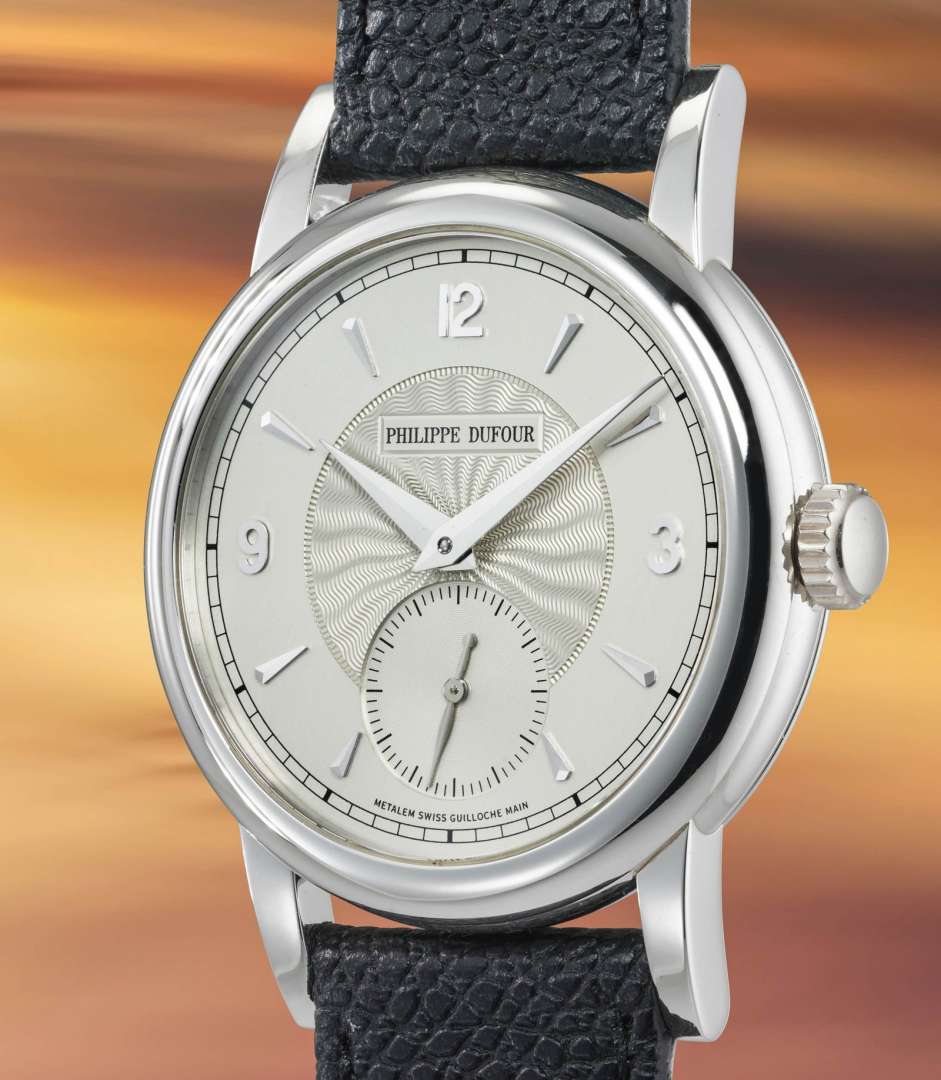
The independents closed the argument. Philippe Dufour’s platinum Simplicity made $2.4 million. Kari Voutilainen’s unique tantalum Vingt-8 Inversé made $1.86 million, a record for the reference. Roger Smith’s unique two-tone Series 1 made $1.1 million. Sylvain Pinaud’s Origine No. 2 made $745,000, more than five times its high estimate, to a bidder online.
What the room was really buying
Read the top of this sale as a map. The money didn’t chase logos. It chased makers: a living independent on top, hand-finishing behind him, steel rarities outselling gold. When 24 records fall in two days, the ceiling isn’t close.
Aurel Bacs, who ran the sale, put it in plainer terms. “As a twelve-year-old boy discovering vintage watches, I never imagined we would go from a few francs to hundreds, to thousands, to hundreds of thousands, and to millions,” he said. “I always believed that watches deserved a place on the Mount Olympus of collecting.” On this weekend’s evidence, they’ve got one.
More from the room