
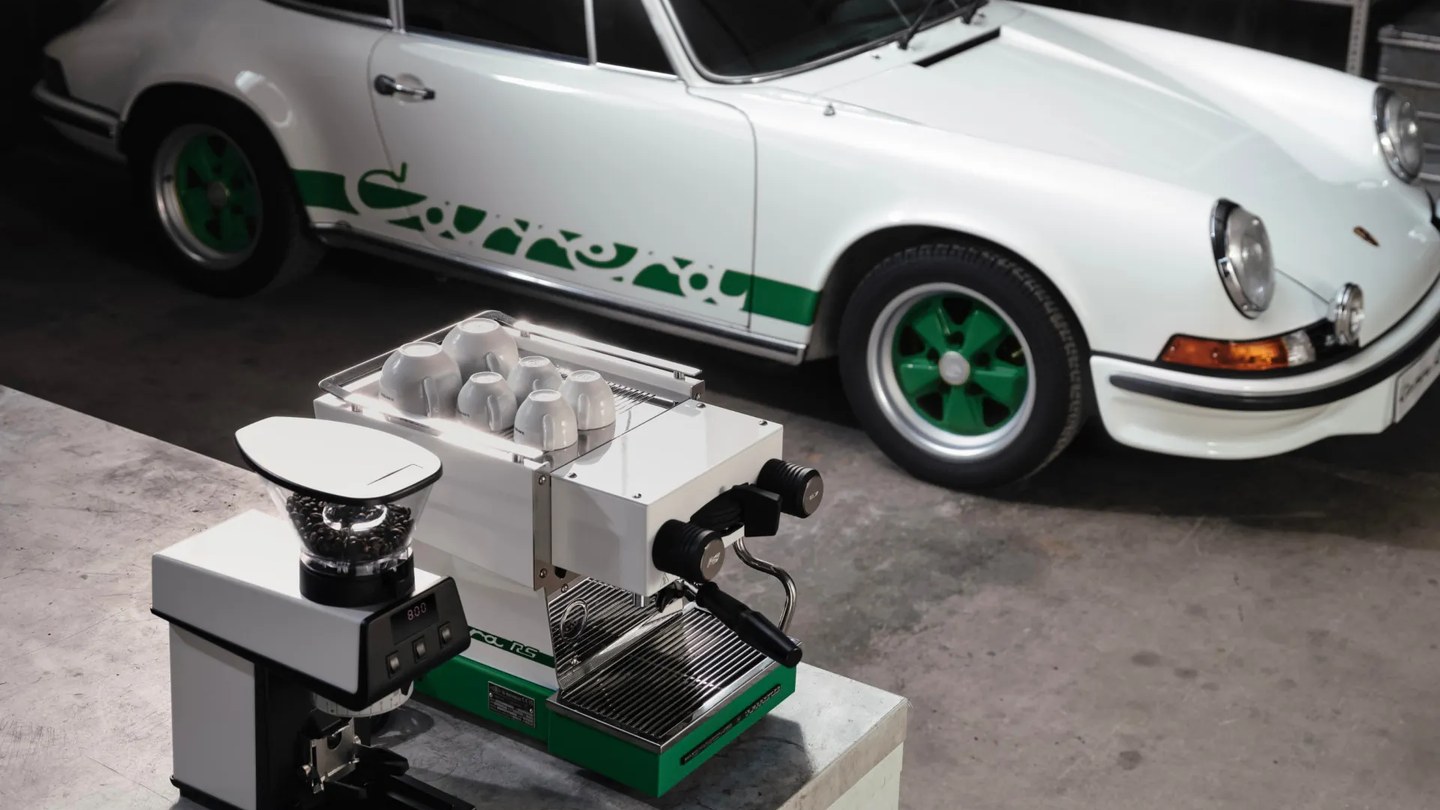
Some car shapes refuse to stay on cars. The ducktail on the 1972 Carrera RS 2.7 is one of them, a little kicked-up lip of bodywork that has been copied, printed, and tattooed for fifty years. Porsche has now put it on a kitchen counter, at roughly one-tenth scale, on top of an espresso machine.
The machine is La Marzocco’s Linea Micra, and the price is the first joke: $7,911.
That number is doing double duty. A standard Linea Micra costs roughly $4,000, so the Porsche treatment adds close to $4,000 for paint, badges, and a production cap. Whether that trade makes sense depends entirely on how you feel about the car, which is exactly the point of the exercise.
For anyone who missed the original sermon: the RS 2.7 was a 1972 homologation special, built so Porsche could take the 911 racing. Porsche needed 500 road cars to qualify. Demand ran past three times that. The ducktail was functional, the first rear spoiler fitted to a production Porsche, there to keep the rear end planted at speed.
The RS 2.7 treatment
Three color schemes carry over from the 1972 car. Grand Prix White with green accents and Tangerine with black accents are the two sold in the US, where the shop calls them Vipergreen and Blood Orange. Germany gets a third, Grand Prix White with blue, and it is the rarest of the set.

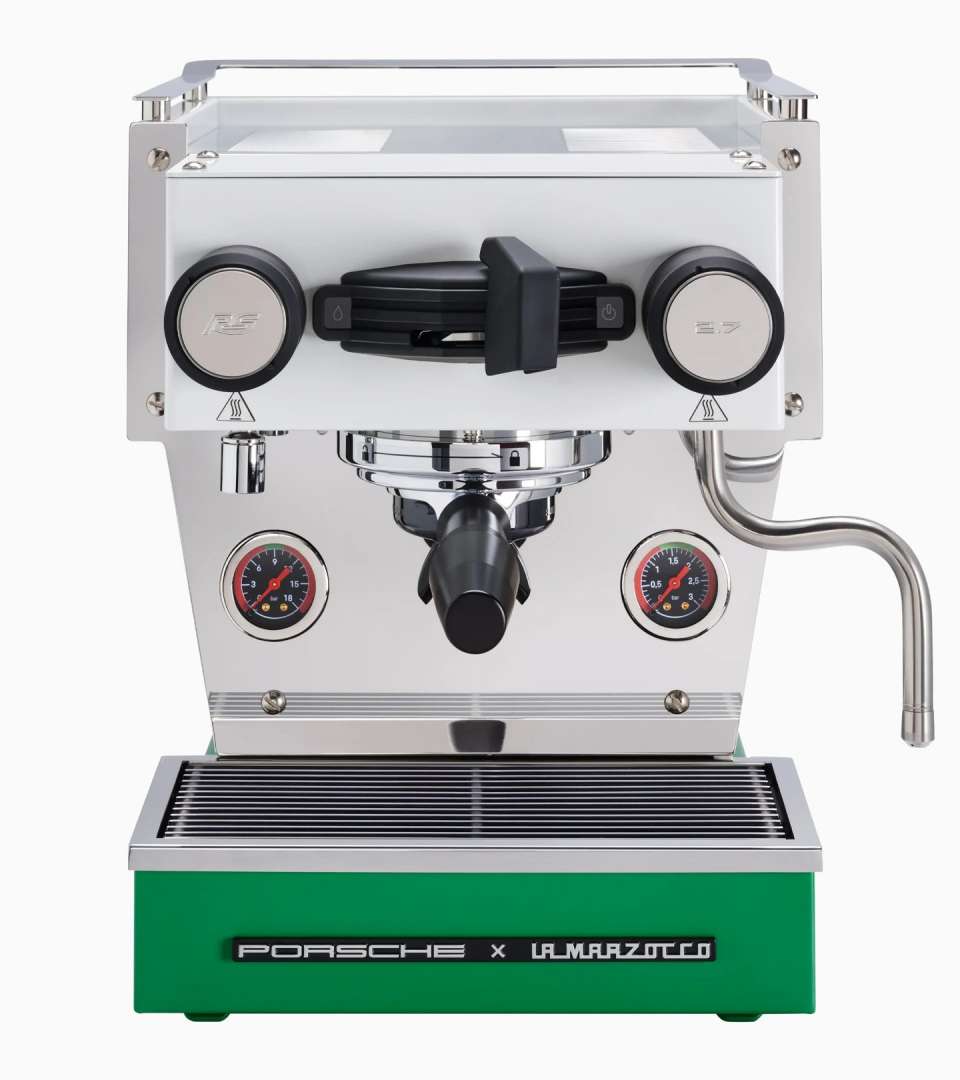
Each color is capped at 911 machines. Germany’s blue run stops at 150.
The ducktail is the cup tray. On top, the raised rail that warms your cups follows the spoiler’s curve, so the most useful flat surface on the thing is also its signature. Carrera RS lettering runs down the side panels, the pressure gauges pick up the car’s red and green instrument markings, and the black handles carry laser-engraved RS and 2.7 caps.
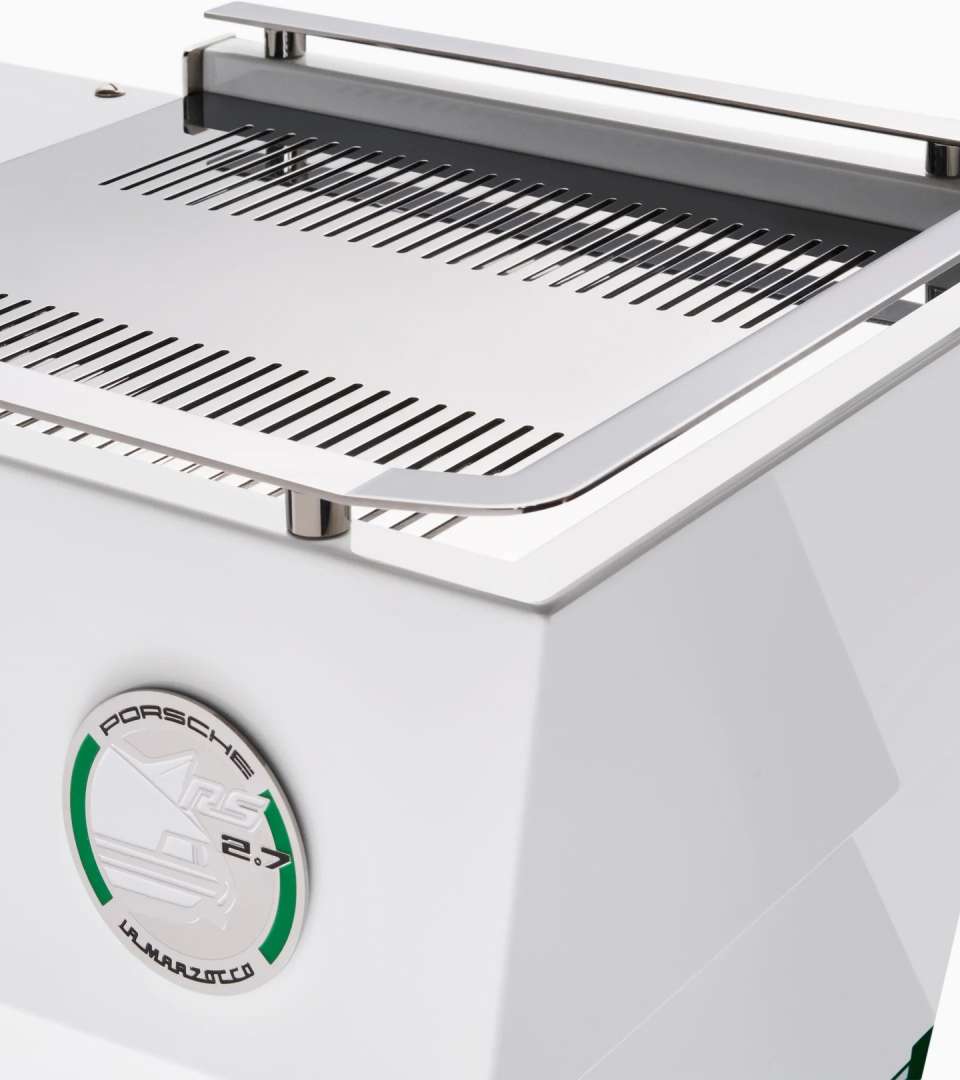
There is a magnetic RS 2.7 badge and a numbered plaque, because of course there are.
None of this changes the espresso. All of it changes the room. A Micra is already a handsome, compact box of brushed metal; in Tangerine over black it stops being an appliance and starts being the thing guests ask about.
Underneath, a working Linea Micra
Strip the livery and the hardware is La Marzocco’s home machine at full strength. Separate boilers handle brewing and steam, so a shot and a pitcher of milk can run at the same time, and PID control holds the brew temperature steady while you work.
The paddle on top flips a microswitch. It looks mechanical and feels mechanical, but extraction still comes down to your prep: dose, distribution, tamp, and knowing when to cut the shot.
The portafilter converts between single-spout, double-spout, and bottomless setups with a swap of parts.
Its steam wand is insulated, LED lights wash the drip tray, and the water tank holds two liters and slides out for filling. La Marzocco’s Home app adjusts temperature, sets the machine to wake before you do, and drops brew pressure for a gentler extraction.
The matching Pico grinder costs $2,125 on its own. It keeps three grind settings in memory, adjusts steplessly, holds the portafilter on a magnetic fork, and closes its own hopper. Machine and grinder together come to $10,036 before tax, and yes, I did add it up twice.

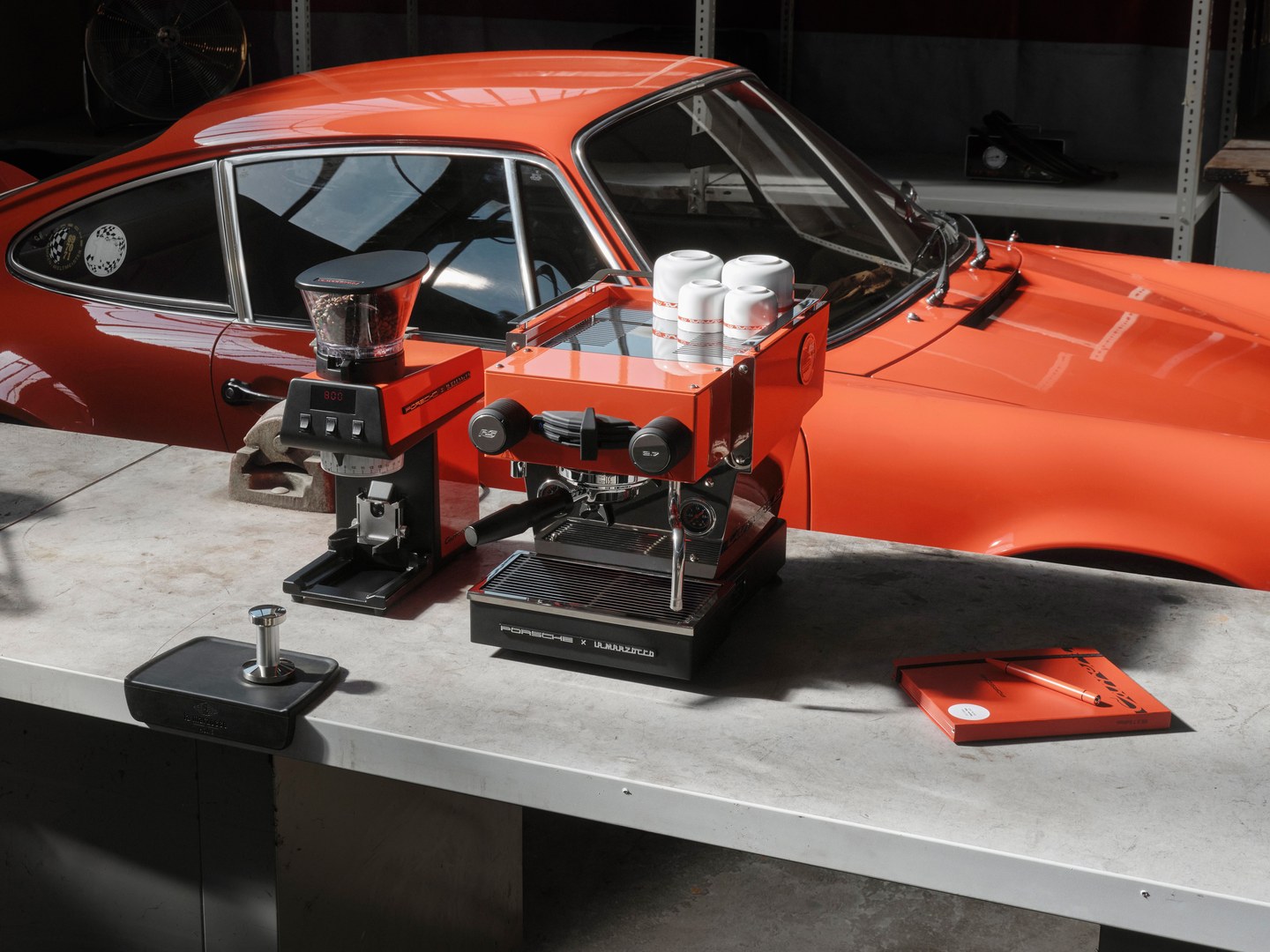
In the crate you get a stainless tamper, two filter baskets, both spouts, a blind filter, cleaning detergent, and a 350 ml milk jug. The grinder, to be clear, is a separate purchase.
On the counter it asks for Micra space, which is not much. This is La Marzocco’s compact home machine, sized for real kitchens, and that is what keeps this from becoming shelf art. It gets used every day or it gets in the way.
What the premium actually buys
The machine anchors a full collection. There is a 1:18 scale model of the RS 2.7 at $485, an espresso cup set at $105, a coffee aroma tin at $135, and barista towels at $69. Porsche is selling the whole shelf, not just the machine sitting on it.
This is the second Porsche and La Marzocco machine. The first, a Martini-liveried edition at about $7,000, sold out in eight hours. Eight. Whatever you think of the math, the audience for these is real and it moves fast.
Here is the plain limit. The premium buys color, provenance, and a number on a plaque. It does not buy better espresso, because the Micra underneath is the same machine La Marzocco sells for roughly half the money.
So the call writes itself. If the RS 2.7 is your car, or the car you would buy first with lottery money, this is a daily luxury in the truest sense: a sculpture you use every morning. Everyone else should buy the standard Micra, keep the change, and put it toward very good beans.
The ducktail, it turns out, looks good at counter height.