
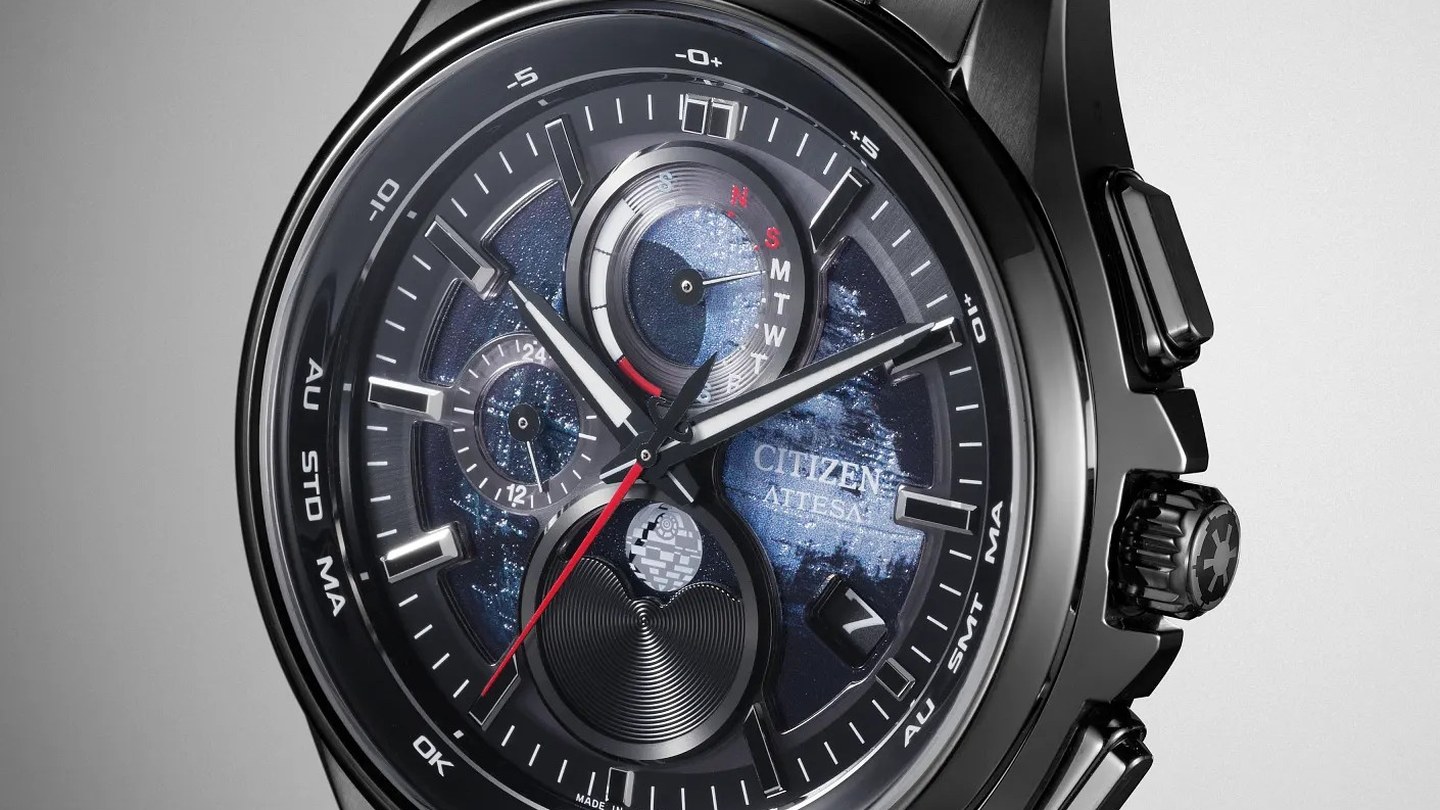
A moonphase is the most theatrical complication in watchmaking: a painted moon on a slow disc, there for poetry, not information. Citizen’s Attesa Death Star Phase Model keeps the disc and swaps the poetry. At six o’clock, where the moon belongs, sits the second Death Star, still under construction, waxing and waning on the lunar cycle in printed steel-grey panels.
It sounds like a novelty. The hardware underneath isn’t. Inside the blacked-out case sits Citizen’s H874, a light-powered, radio-controlled caliber with a perpetual calendar and world time, and the whole run is capped at 1,500 pieces at $1,500. The engineering is the part I’d buy; the Death Star is the part I’d show people.
A battle station where the Moon belongs
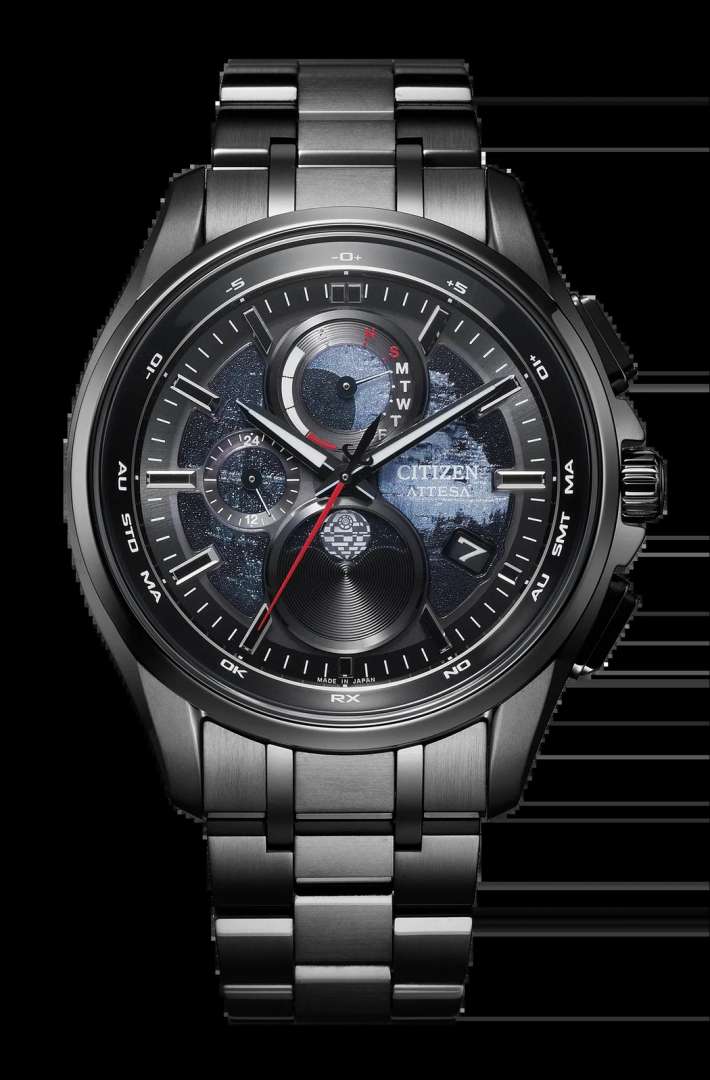
Citizen builds the station in 3D inkjet printing, layering the surface detail onto the moonphase disc so the superlaser dish and the unfinished hull read at wrist distance. Around it, the dial is a starfield in deep blue-black, broken up by a day subdial at twelve, a 24-hour register at nine and a date window at half past four. A single red seconds hand crosses all of it, the only color on the watch.

The swap works because the moonphase was never a working instrument. Nobody navigates by it.
It’s the one complication a watchmaker can hand over to pure storytelling without losing a function, and Citizen spends it on the most recognizable silhouette in science fiction.
The trade is legibility, and I’ll state it once. Four subdials, a date window, a world-time chapter ring and a starfield share 41.5 millimetres, with two broad hands crossing the lot. You’ll take a second look to read the time, and the red seconds hand does the quick-glance work alone. On a watch built to be stared at, I’ve made my peace with the bargain.
The astronomy runs itself
The part I keep coming back to is the Luna Program. The H874 calculates the moon’s phase on its own, so the station in the window is always the right age, with no setting ritual and no reference table.

It’s the rare licensed-watch feature I’d want on a watch with no license at all.
A hemisphere switch flips the display for the Southern Hemisphere, where the moon’s phases run in mirror image, a detail most moonphase watches don’t bother with at any price. Radio control pulls the atomic time signal and corrects the watch by itself, the perpetual calendar tracks month lengths and leap years, and a power reserve indicator keeps score of the charge.
Power comes from light, Citizen’s Eco-Drive recipe, and a full charge runs the watch for two and a half years in power-save mode. No battery swaps, no winding rota, no moonphase corrections. You set this watch once, and it keeps its own astronomy from there.
The case is black titanium, the price is not Swiss
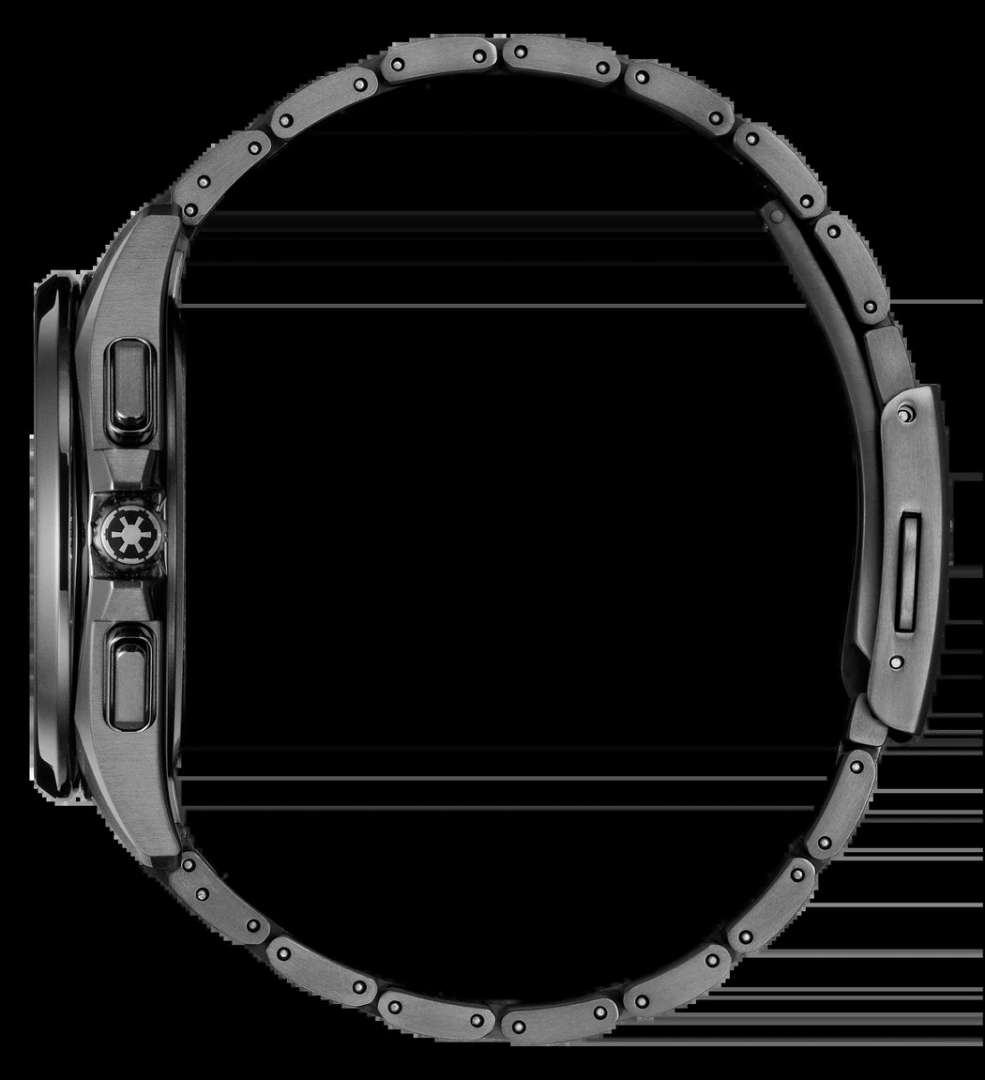
The case and bracelet are Citizen’s Super Titanium under a black DLC coating, and the blackout is total: hands, markers, chapter ring, clasp, all of it dark. The case measures 41.5 millimetres across and 10.8 thick, sealed to 100 metres under an anti-reflective sapphire crystal. The bracelet closes on a fold-over clasp with push buttons, and the crown carries the Imperial cog, stamped small enough to miss.

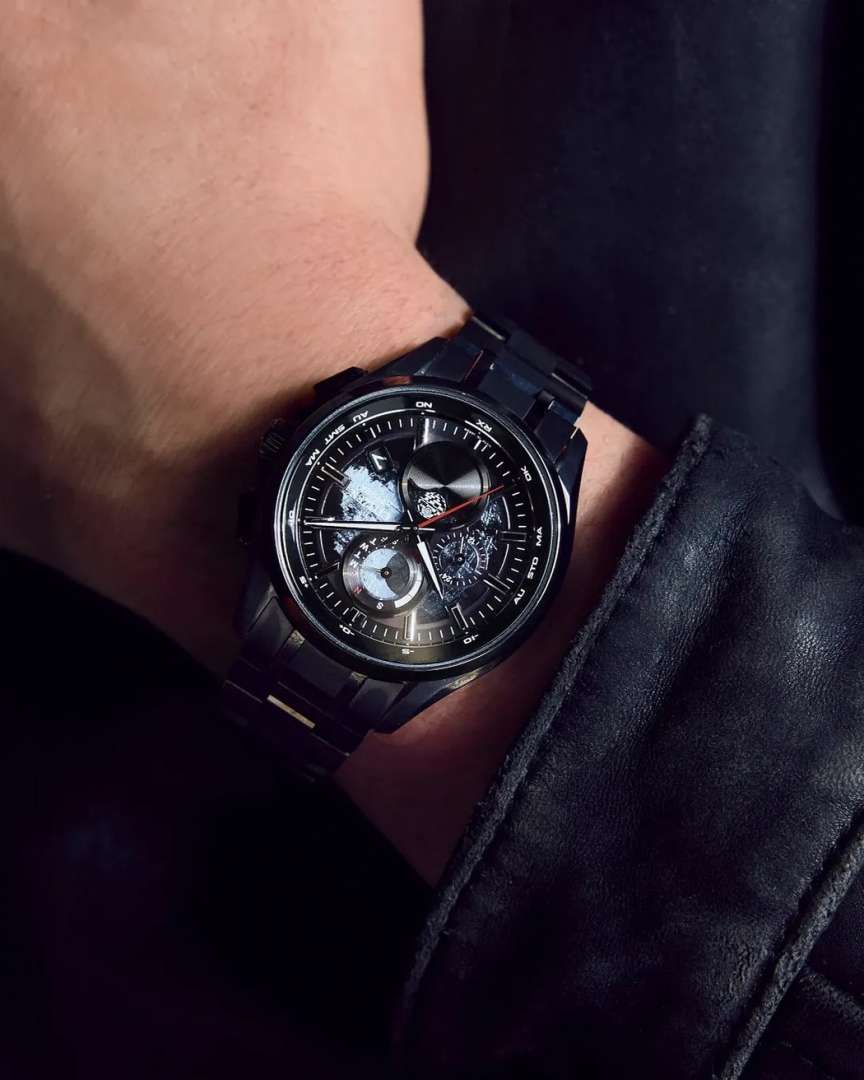
Titanium keeps the whole thing light on the wrist, and at 10.8 millimetres it slides under a cuff without a fight. It wears like a travel watch, because that’s what the world time and radio sync underneath make it.
Now the arithmetic. A Swiss mechanical moonphase with a perpetual calendar attached starts at several times $1,500, and it arrives with winding duties, setting rituals and a service bill on a schedule. Citizen sells the same information, self-correcting and light-powered, in coated titanium, for the price of a respectable diver. The license isn’t the expensive part of this watch. The complication stack is, and it’s priced like Citizen forgot to charge for it. That gap is the story here.
1,500 pieces, then the run ends
Japan got the watch first, on November 5. Citizen’s US store lists it now at $1,500, with bracelet sizing at checkout and a five-year warranty behind it. When the run sells through, Citizen stops. No second batch appears in the announcement, and the cap is the model’s whole point.

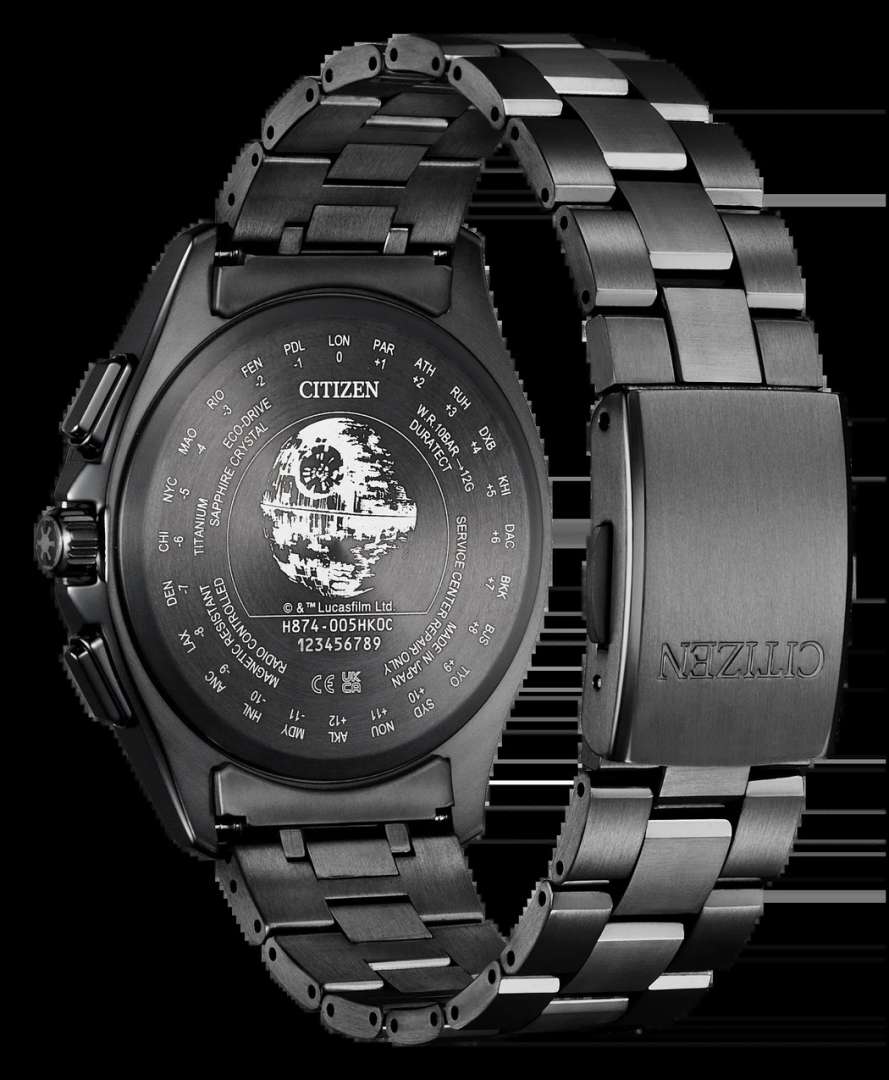
Flip the watch over and the engraving budget shows. The caseback carries the Death Star in etched detail, ringed by the world-time city codes the H874 syncs to, with the serial number stamped below. The watch ships in a special Star Wars box, because of course it does. Restraint was never the brief.
Once the 1,500 are gone, the secondary market takes over the pricing, and limited Attesas with this much hardware don’t tend to get cheaper with age.
If you want one at list, the window is the launch window.
Most licensed watches are costume jewelry with a movement dropped inside. This one is a serious travel watch in costume, and there’s a difference.
I’d take the black titanium, the self-running moonphase and the cap of 1,500 over another Swiss badge at three times the money.