
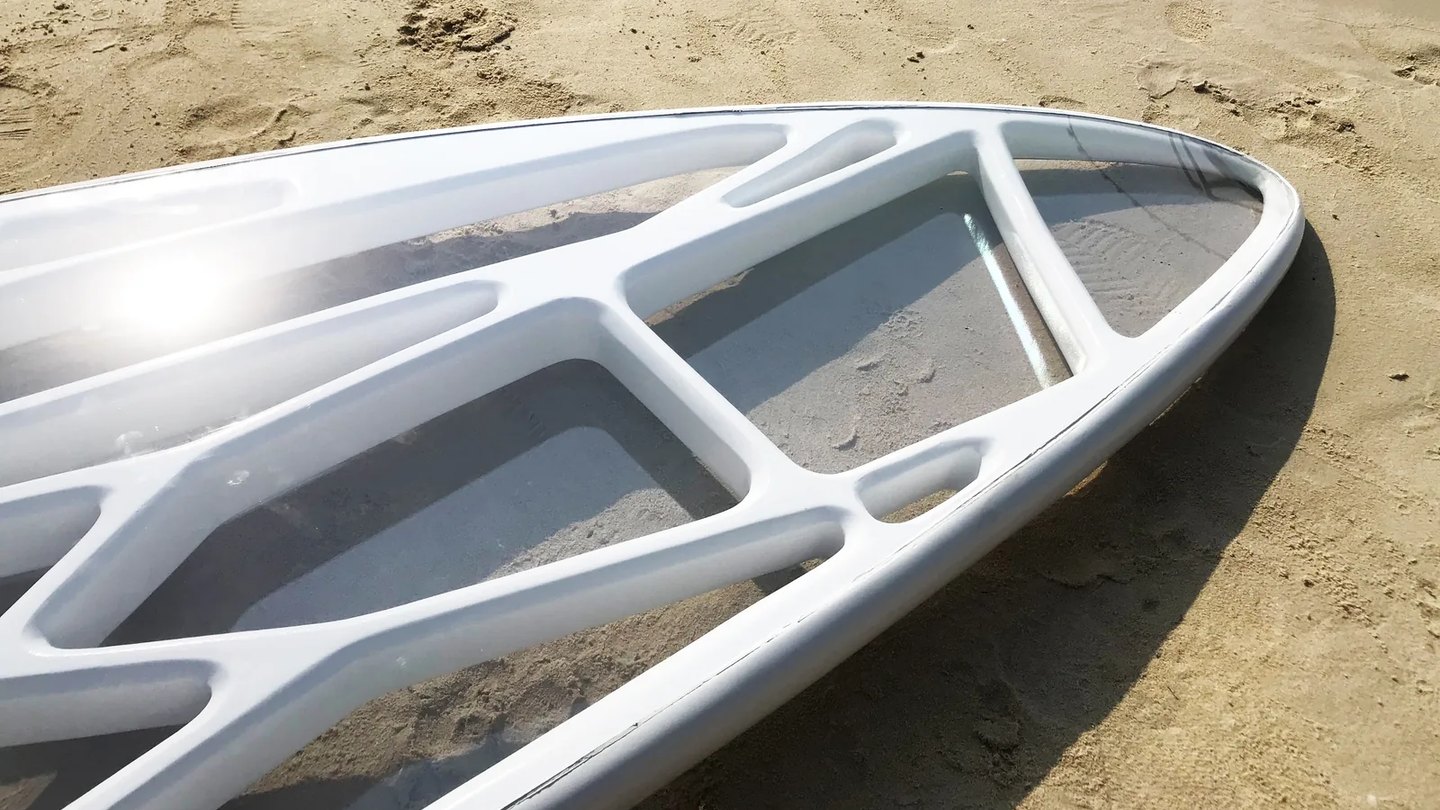
A surfboard spends its life hiding the one thing its rider came for. You stand on a slab of foam and fiberglass, and the water, the reef and the fish moving below stay on the other side of the deck. Igor Dzukovski filed that arrangement as a design flaw.
Dzukovski is an industrial designer based in Dubai, and he came to surfing as a beginner who fell hard for it at the first wave. Beginners ask beginner questions. His was structural: what could a board do if the design work went into the structure instead of the surface?
Surfboards usually innovate on the skin. New graphics, new finishes, new artwork laid over the same foam core, season after season. Dzukovski’s research pushed the other way, toward a material that could bring a genuine benefit and an extra experience with it, and toward a board whose structure does something a graphic never can.
Sunlight on water, turned into structure
The starting point was sunlight breaking up on the surface of the sea, all that scattered light moving at once. Dzukovski wanted the effect inside the object, so the board is built as a transparent sandwich over a lattice of carbon fiber. The clear panels carry the view. The lattice carries the load, and the water underneath does all the decorating.

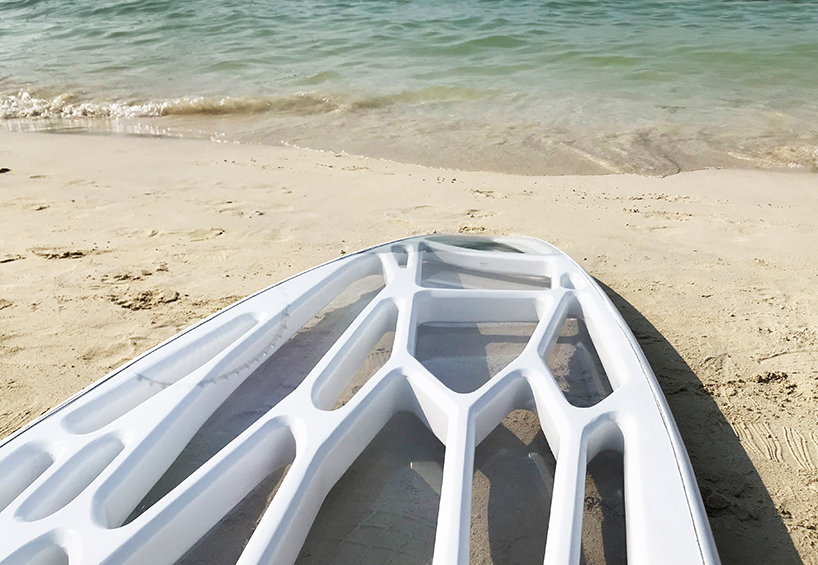
Paddle out, look down, and the deck gets out of the way.
Through the clear panels, a rider watches the flora and fauna moving under the surface while the board is under way. Dzukovski aimed the design at paddle surfers and classic surfers, riders traveling at a pace that leaves time to look around. Speed was never the brief.
A sandwich construction normally hides its logic: two skins take the bending loads, a core keeps them apart, and everything structural stays out of sight. Opening the core into a lattice flips that arrangement. The structure becomes the view, and the view only works because the ribs are strong enough to stare at.
The decoration changes every second, and it’s never the same twice.
It also changes what the board is for. On a reef pass or a slow paddle over clear water, the ride runs in two directions at once, forward across the surface and straight down into it. The board stops being a platform and starts behaving like a frame.
A lattice does the work a foam core usually does
Construction started with a blank milled by a robot. From that blank, the lattice core was cut and finished, then laminated in carbon fiber prepreg and closed with the transparent skin.

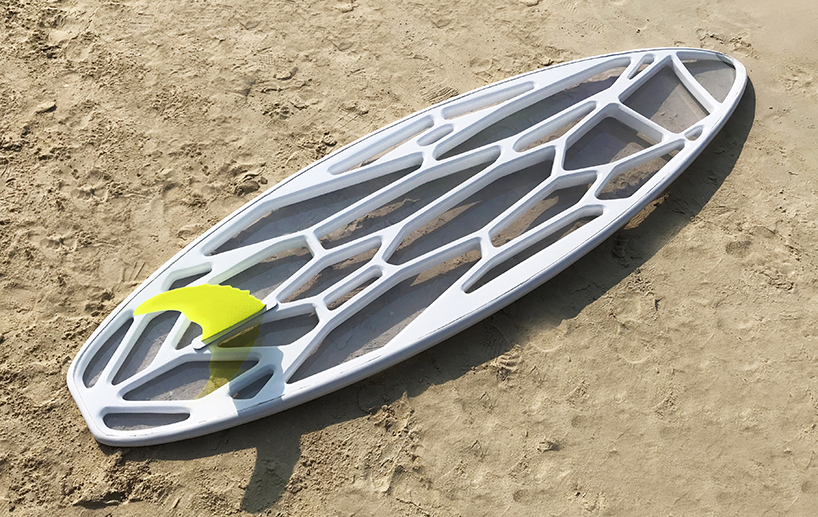
Prepreg arrives already carrying its resin, so the layup cures into a single rigid shell. Every opening in the deck is structural first and a window second, which is why the ribs branch and merge instead of running in straight lines.
Carbon fiber prepreg is what aircraft and racing parts use when stiffness has to arrive with almost no weight attached. Here, that stiffness buys the empty spaces.
Milling sets the geometry before a hand ever touches the board. The openings follow its curves exactly, and the finishing work after the cut is what turns a machined lattice into something closer to bone than to a grid.
The clear skin carries a double duty of its own. It seals the lattice against the sea and stays clear enough to read the bottom through, so the panel material had to be picked the way a lens gets picked, for what passes through it.
The deck you stand on is mostly openings, so the lattice is the standing surface as much as the frame. That’s the trade at the center of the design: the board gives up the familiar, forgiving feel of a solid deck and pays the rider back in sightlines no solid deck can offer.
Then comes the fin.
Even the fin was molded alongside the board as a single piece of the composition, and in Dzukovski’s own photographs it wears a fluorescent yellow finish. Against the white lattice and the clear skin, it’s the one loud note on the whole board.
The finished board, named Tidal Wave, went on show in the Serbian Pavilion at Expo 2020 in Dubai and at Downtown Design in 2021. It’s stayed a prototype, a single board built to prove a construction rather than to start a product line, and Dzukovski files the project under marine design and composites, which is exactly where it belongs.
The board also sits inside a wider marine practice. Dzukovski’s studio works across speedboats, electric vessels and transportation concepts, and the same instinct runs through the portfolio: proportion and material first, decoration last. Tidal Wave is the smallest object in that line of work, and the clearest statement of it.
As surfing equipment, it asks a rider to trade feel for sight, and plenty of surfers will pass. As design, the trade settles the argument. The ocean stops being a surface you ride on top of and becomes part of the object itself.