
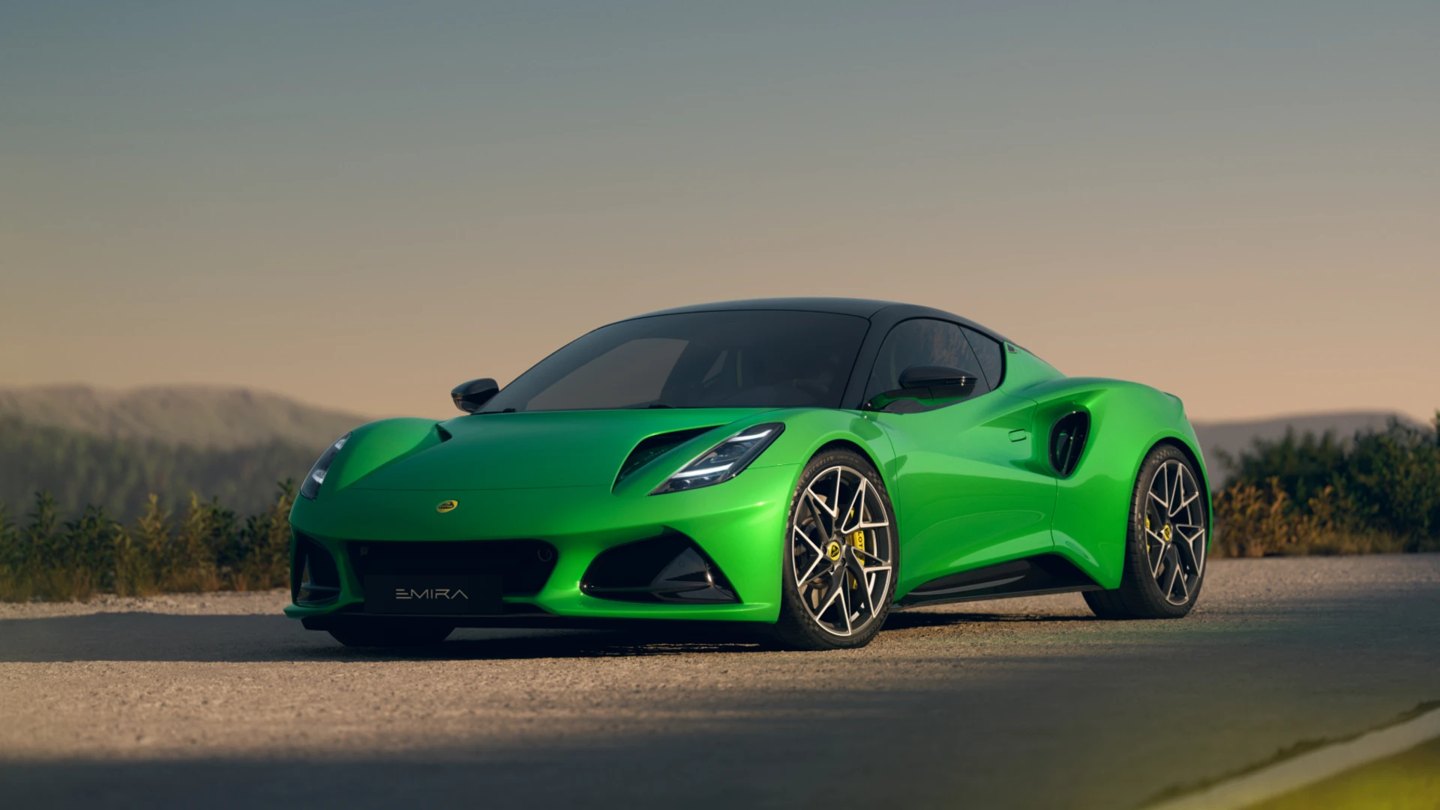
Lotus drew the Emira around its engine, cabin pushed forward and rear haunches pulled tight over the back wheels. For 2026, that shape splits into two distinct sports cars. The choice comes first, before any option gets ticked.
The V6 SE keeps a supercharged V6 and a standard six-speed manual, while the Turbo brings in an AMG turbocharged four with an eight-speed dual-clutch in its place. Both cars are hand-built at Hethel, both stay mid-engined and rear-driven, and both wear the same low roofline, though the hardware underneath sends them down two very different roads. The announcement redraws the range around that choice, and the rest of the lineup follows from it.
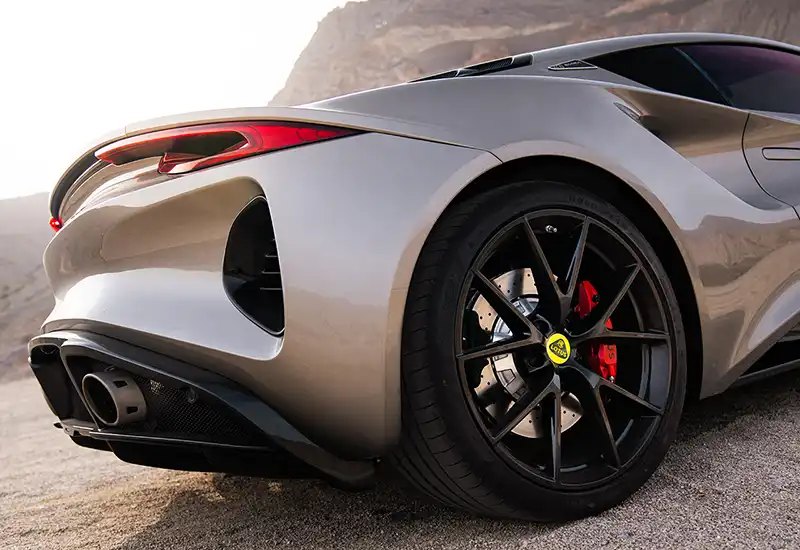
Zinc Grey, red calipers and a low, clean profile
In Zinc Grey, the V6 SE arrives as standard. Red brake calipers show behind 20-inch forged wheels.

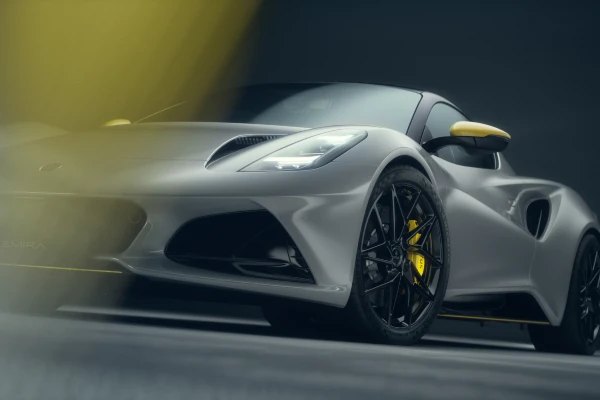
Buyers who want more theater can add the Racing Line, which lays pinstripes along the front splitter, the side sills and the rear of the car. The accents match the brake calipers, the optional mirror caps and the stitching inside the cabin, tying the whole car together in one color, the same treatment carried across the mirror caps and the stitching inside.
The V6 SE keeps the manual at the center

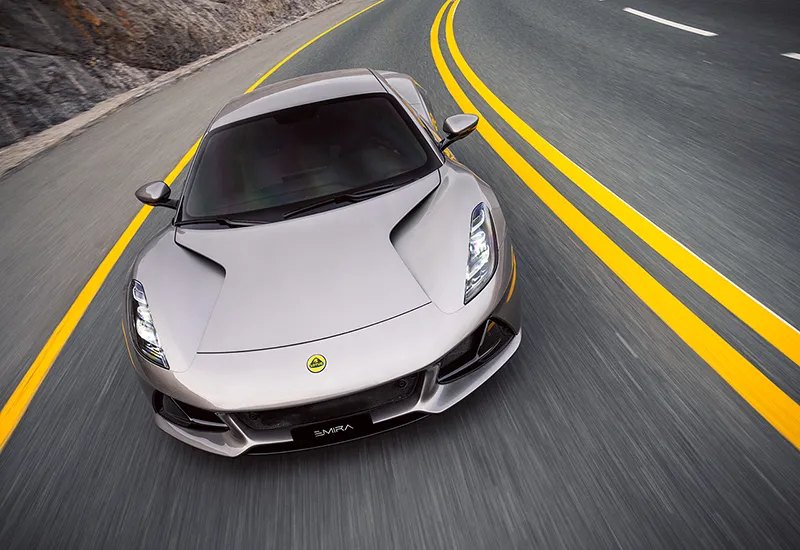
Under the rear deck sits a 3,456 cc supercharged V6 making 400 hp, paired with the six-speed manual and a limited-slip differential as standard equipment, and that pairing defines the car’s whole character. Lotus quotes 0 to 62 mph in 4.3 seconds, though the manual’s real work happens between the numbers, in the shift the driver chooses, the revs held through a corner and the throttle rolled back on as the road straightens.
An automatic stays on the options list for buyers who want the V6 without the third pedal. Most buyers won’t take it, and Lotus knows it.
The Turbo takes the dual-clutch route

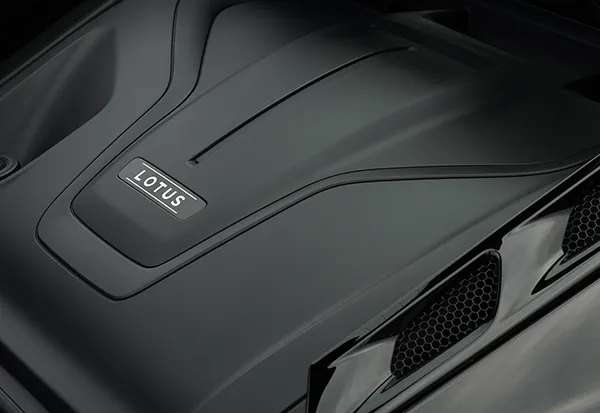
For the Turbo, Lotus swaps the V6 for a 1,991 cc AMG turbocharged four-cylinder with an eight-speed dual-clutch, and it gives up almost nothing for the exchange. It reaches 62 mph in 4.4 seconds, one tenth behind the V6 SE.
That’s the one trade this lineup asks a buyer to weigh, involvement against pace. A clutch pedal worked by the left foot pulls the driver into every mile, while the dual-clutch simply removes the pauses between gears. Neither car apologizes for the answer it gives.
Hethel hardware under both cars
Feel comes first here. Both cars steer through a hydraulically assisted rack and ride on forged aluminum double-wishbone suspension at every corner, hardware carried on the light, stiff bonded aluminum architecture Lotus builds its sports cars around in Hethel. The choices are old-school in the best sense, made for steering feel and chassis balance long before they were made for fashion, and they explain why the Emira’s reputation rests on the road rather than the spec sheet.
Braking comes from lightweight two-piece discs, cross-drilled and slotted, with four-piston calipers working the front axle. The drive modes run from Tour through Sport to Track, and Sport sharpens the throttle, raises the stability threshold and the rev limit, then opens the exhaust valve fully once the needle passes 3,000 rpm. The setup favors feel over brute force.
A removable roof now sits on the options list for the V6 SE, and open-air driving joins the range without a second body style. The Turbo SE and the 420 Sport offer it too.
Inside, the daily kit runs deeper than the Emira’s early cars offered, with upgraded audio, auto-dimming mirrors, curtain airbags and electric folding door mirrors all on the standard list. The cabin still centers on the driver, with the gear lever or the paddles falling where the hands expect them, though the materials and the finish now carry the polish the car’s price has always implied at this level.
Standard equipment runs to autonomous emergency braking, lane departure warning, lane change assist, traffic-sign recognition and fatigue detection, all tuned to stay out of the driver’s way. None of it shouts. Keyless entry, cruise control, rain-sensing wipers and full LED headlights rated at 75,000 candelas round out the cabin.
Four models, two decisions

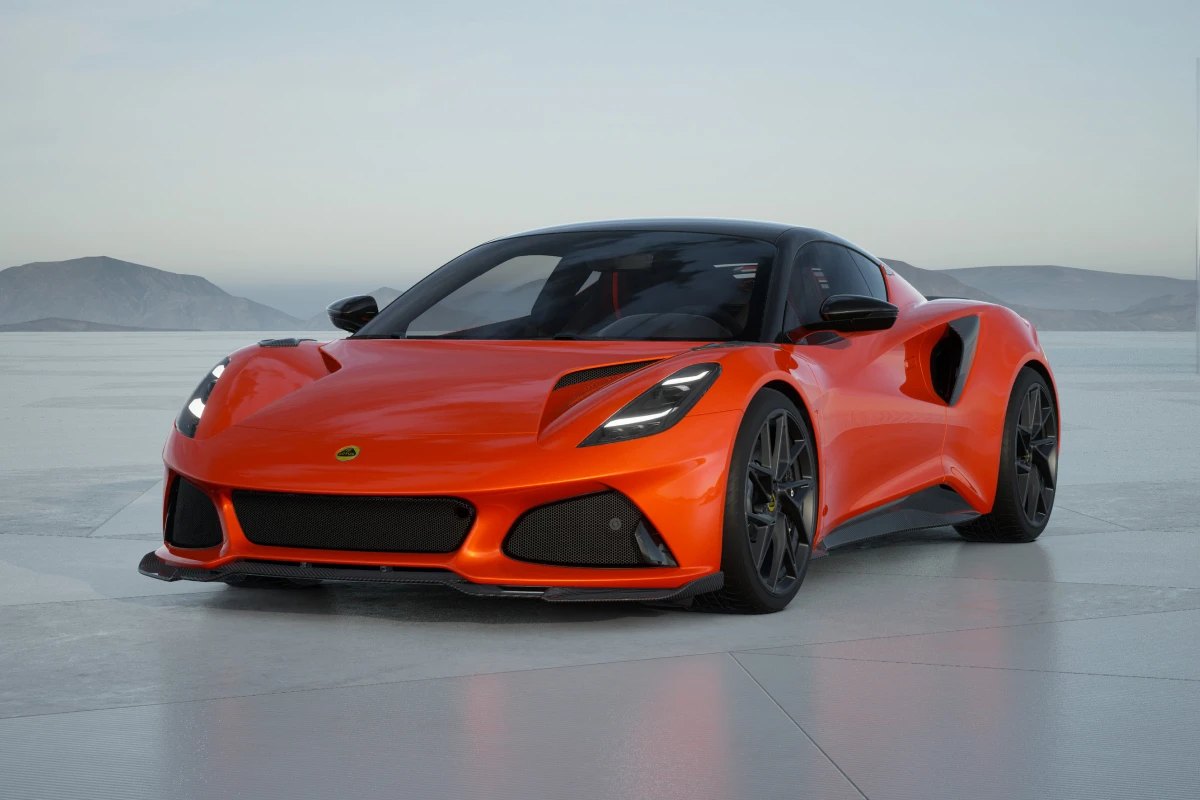
The wider lineup runs to four models, with the Turbo SE and the 420 Sport at the sharper end. Prices start at £79,500 for the Turbo and £96,500 for the V6 SE, with German pricing at €97,500 and €117,500.
The four cars share one silhouette and one factory, and the differences live in the details a driver touches every single day, from the first cold start to the last mile home. A gear lever or a pair of paddles changes the whole relationship. So does a supercharger’s whine against a turbo’s surge, or gray paint against yellow pinstripes laid over Zinc Grey. Hethel builds all four on the same line, by hand, in Norfolk.
Buy the V6 SE at £96,500 if a manual gearbox still shapes your weekends, because the supercharged V6 and the limited-slip differential make it the keeper of the two. The manual decides it. It’s the Emira in its purest form, and it won’t be repeated.
Buy the Turbo at £79,500 if dual-clutch pace suits your roads better. It keeps the same Hethel chassis, the same steering and the same Hethel hands for less money.