
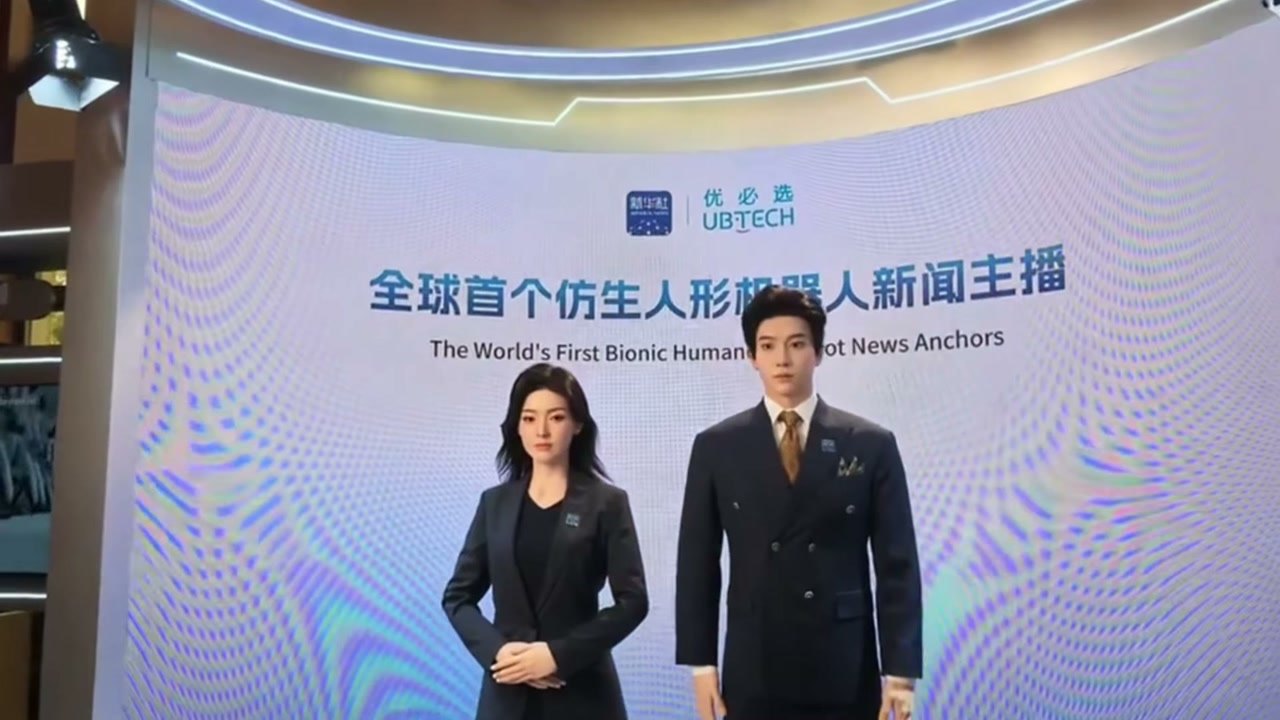
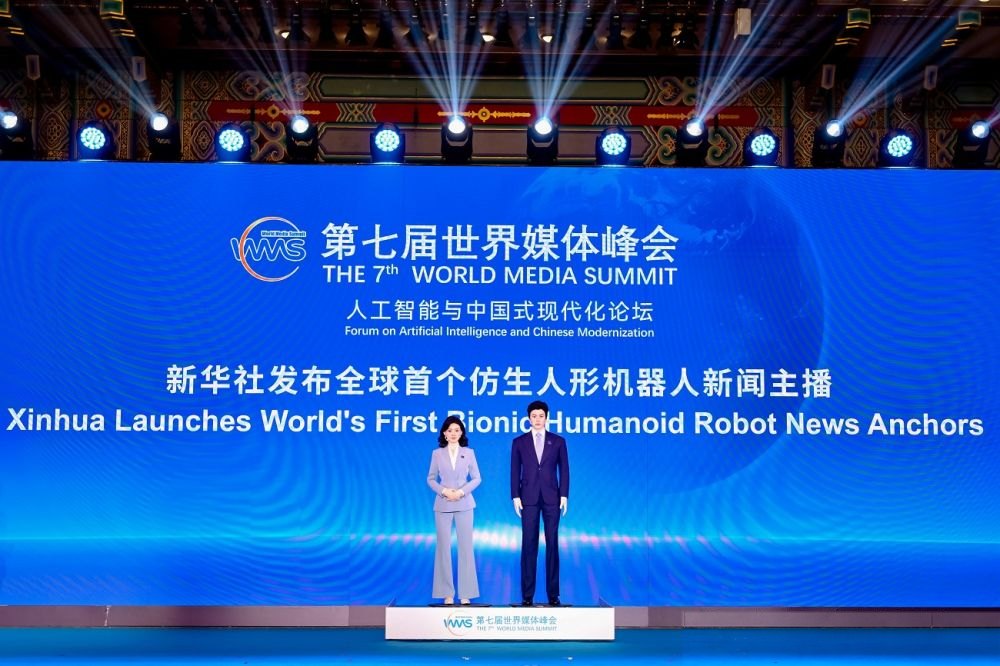
Two robots stood on a stage in Beijing last week and read the news to the people who run the world’s media. No screen, no hologram, no avatar stitched together in a render farm, nothing between the audience and the machines but a podium. Xinyan greeted the hall, nearly 500 delegates from 112 countries and territories, and delivered the forum’s opening report, with Xinyu beside her in a black double-breasted suit.
Xinhua built the pair with UBTECH Robotics, bills them as the world’s first bionic humanoid robot news anchors, and owns the rights to both outright.
The unveiling came on November 5, at the Forum on Artificial Intelligence and Chinese-Style Modernization, inside the Seventh World Media Summit, which Xinhua co-hosts with the Beijing municipal government. Both anchors stand at 1:1 human scale and were custom-built for news scenarios, and Xinhua holds complete independent intellectual property rights to the pair.


The face is the assignment
Start with the design credit, because it explains the whole project. Zhang Yimou served as chief image designer and led the embodied visual design.
A news agency that wanted a technical flex would have led with joint counts and torque figures, and Xinhua led with a film director.
His team worked from camera aesthetics and the demeanor of a television presenter, tuning the faces the way he described at the summit: “We refine facial expressions, eye movements, lip shapes … to achieve a calm tone, poise and eye contact.” He said the pair are there to assist news anchors and add new experiences to the broadcast, not to take the desk away from anyone. It is a casting note, not an engineering one.

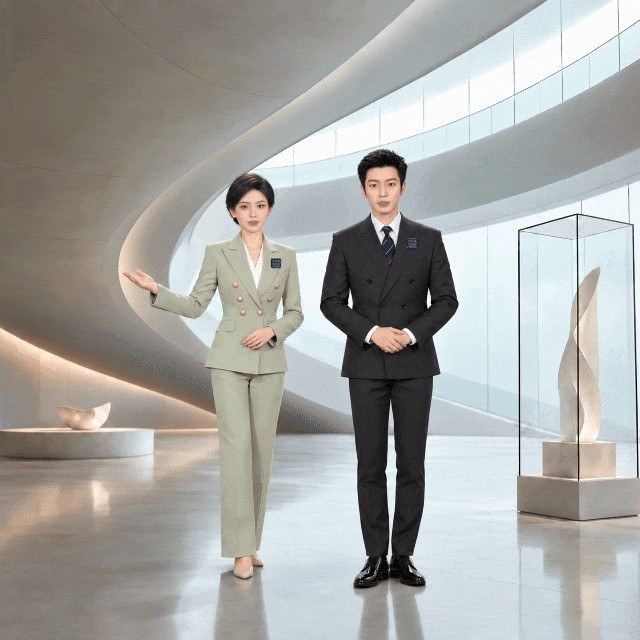
UBTECH supplied the bodies and the stack inside them: bionic skin, embodied-intelligence hardware, the robot operating system, an emotional large model, and complete-unit manufacturing, all of it the company’s proprietary full-chain technology. The release lingers on micro-expressions and on lip movement that stays aligned with the broadcast rhythm, the two details a camera punishes first.
What those faces say traces back to a closed shelf.
Both anchors connect through a technical interface to Xinhua Yudian, the agency’s AI current-affairs agent, announced on June 26 and built on Xinhua’s own authoritative corpus. UBTECH founder Zhou Jian describes the chain as brain, expression and control: the system retrieves reviewed, authoritative information in real time.
Read that as a design decision, because it is one. A generative model improvises, and improvisation on live news is how a presenter ends up stating things nobody checked. The Yudian link keeps the words coming out of the bionic face tied to copy an editor already cleared, which is the agency’s whole answer to the hallucination problem.
Qian Tong, director of Xinhua’s New Media Center, calls them a new editorial job. Their tasks are information presentation, multilingual output and real-time interaction with audiences, in support of the editorial staff. Journalists and editors stay at the center of the newsroom, and the anchors do not write a word of what they present.
Xinhua has run this experiment before, in two dimensions. Its 2018 AI anchor, built with Sogou, was a synthesized video of a real presenter, and viewers clocked the limits fast: a mouth that moved on one side, expressions that barely changed. The face belonged to a real presenter, composited and re-voiced. A physical body answers a different brief. It can stand in a lobby, turn toward a question, and hold a room.
The next stage is public, not televised. Xinhua plans to put the pair to work in museums, schools and government buildings, and Zhou’s list runs wider: research bases, city reception venues, overseas cultural exchanges, reporting tied to deep-space exploration. None of it carries a date.
And then there is everything the launch did not say. No height, no weight, no word on whether these faces were modeled on real people, no list of the languages they speak, no price, no production run, no count of how many were built, no broadcast slot, no word on operating time or on when a human steps in, and no independent test of any of it. The technical layer of this story is undisclosed.
Editor’s take
My take: the humanoid race has spent two years arguing about factories and living rooms. The machines we cover mostly head for a production line, Embodied AI’s AIR among them, tendon arms and a wheeled base built for paid work. Xinyan and Xinyu head somewhere stricter, the one job where the face is the entire interface and the audience grades it in seconds.
Television has always been decided on the face. These two were designed by a man who has spent a career deciding what faces do on camera, and that, more than the machinery under the skin, is the story I am watching.