
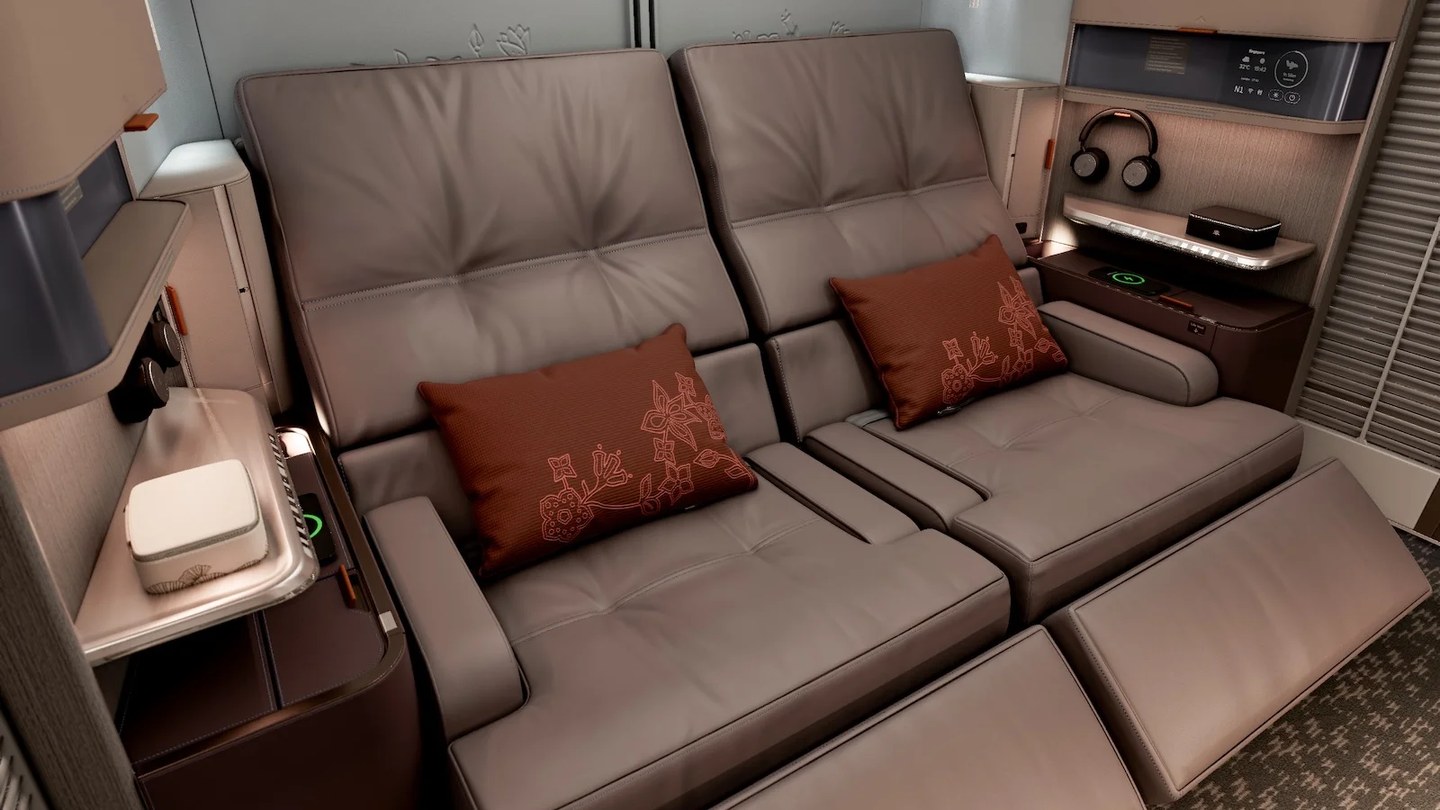
Eighty inches long, sixty inches wide. Singapore Airlines publishes those two numbers for the double bed at the centre of its new first class cabin, and they land somewhere familiar: a queen mattress at home measures exactly the same. The airline bills it as the largest double bed in commercial aviation.
DLMag walked through the full suite reveal this morning, doors, wardrobe and all. This piece stays with the bed: how two separate seats become one sleeping surface, and why the join is the clever part of the design.
The centre pair is the one part of the cabin built for two.
Two seats that move as one
Each centre seat starts as a 23-inch-wide armchair in Poltrona Frau leather. Drop the armrests and each cushion runs a full 30 inches across, so the pair presents one continuous 60-inch width, two singles sharing a single footprint.
The seat adjusts in pieces underneath its occupant. Electronically adjustable side wings close in around the shoulders, upper and lower lumbar support firms up the back, and the leg rest and ottoman move independently, so the chair can be tuned long before it ever lies flat. All of it works inside an 89.5-inch seat pitch.
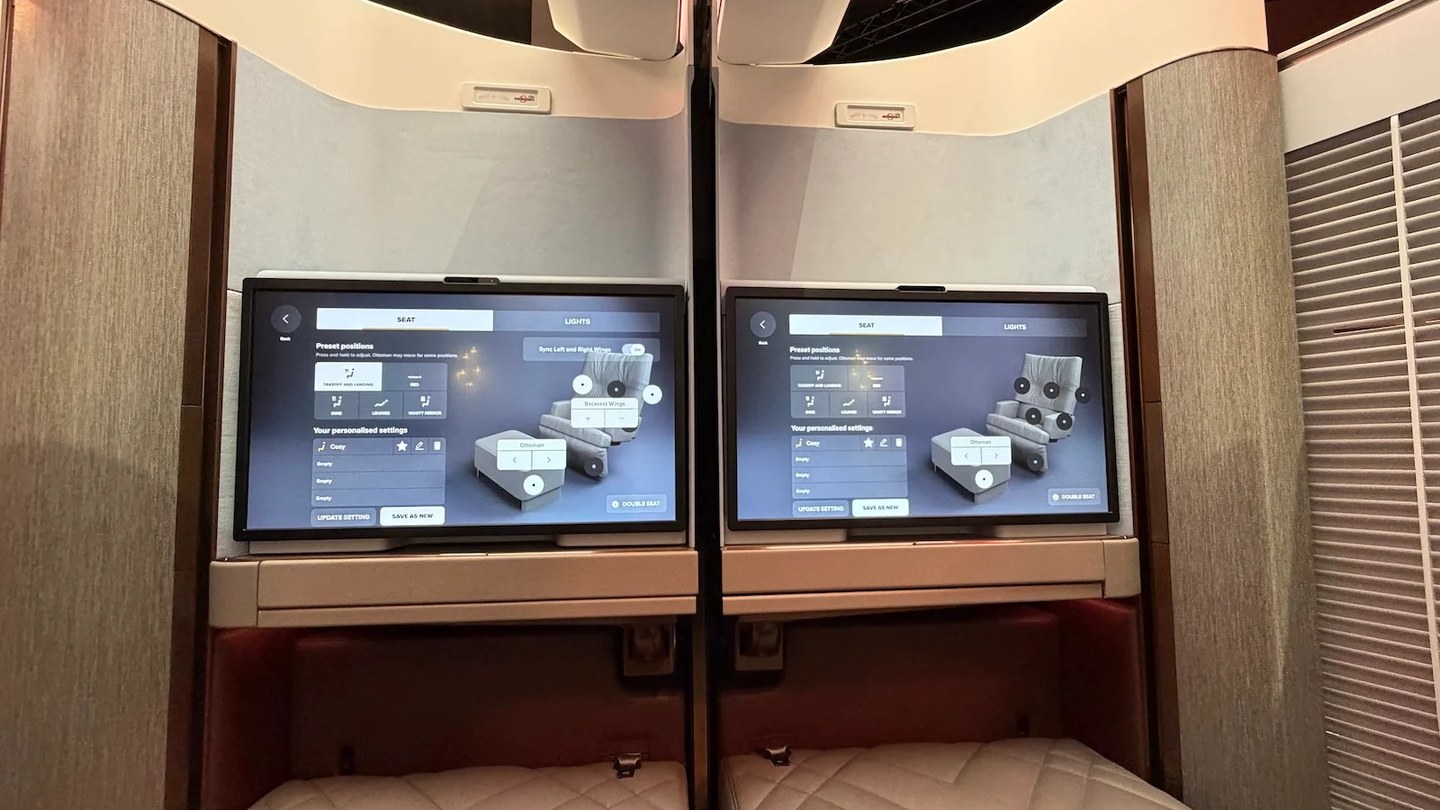
The two seats move in tandem, and the controls sit on the 32-inch screens in front of each passenger. One interface drives both halves, so a couple reclining after dinner settles at the same angle. A smaller touch panel carries the running details, flight time remaining, the weather at the destination, even whether the washrooms are free, and the system remembers each traveller’s preferred seat positions and lighting from one flight to the next.
Company stays optional. A fully retractable divider splits the pair back into two suites on request, and each side keeps its own curved door, its own screen and its own aisle, so two people can share the bed and still board, dine and sleep on separate schedules.
Dinner works the same joined-up way. Singapore Airlines calls it buddy dining: a bi-fold table spanning 27 by 22.5 inches opens in front of each seat, drinks land on a cocktail tray beside each cushion, the ottoman at the foot becomes the second chair, and two people eat face to face, feet resting beneath their own 32-inch 4K screens.
Power is shared the same way. A wireless charging pad, USB-C ports and a universal AC outlet sit within reach of each seat; the 777-9 suites add a USB-A port.
Dressed like a bed, not a seat
Crew make the bed up properly. A mattress topper comes from Paradies, the German bedding specialist, built on a breathable spacer fabric that cushions the surface and moves heat away through the night.
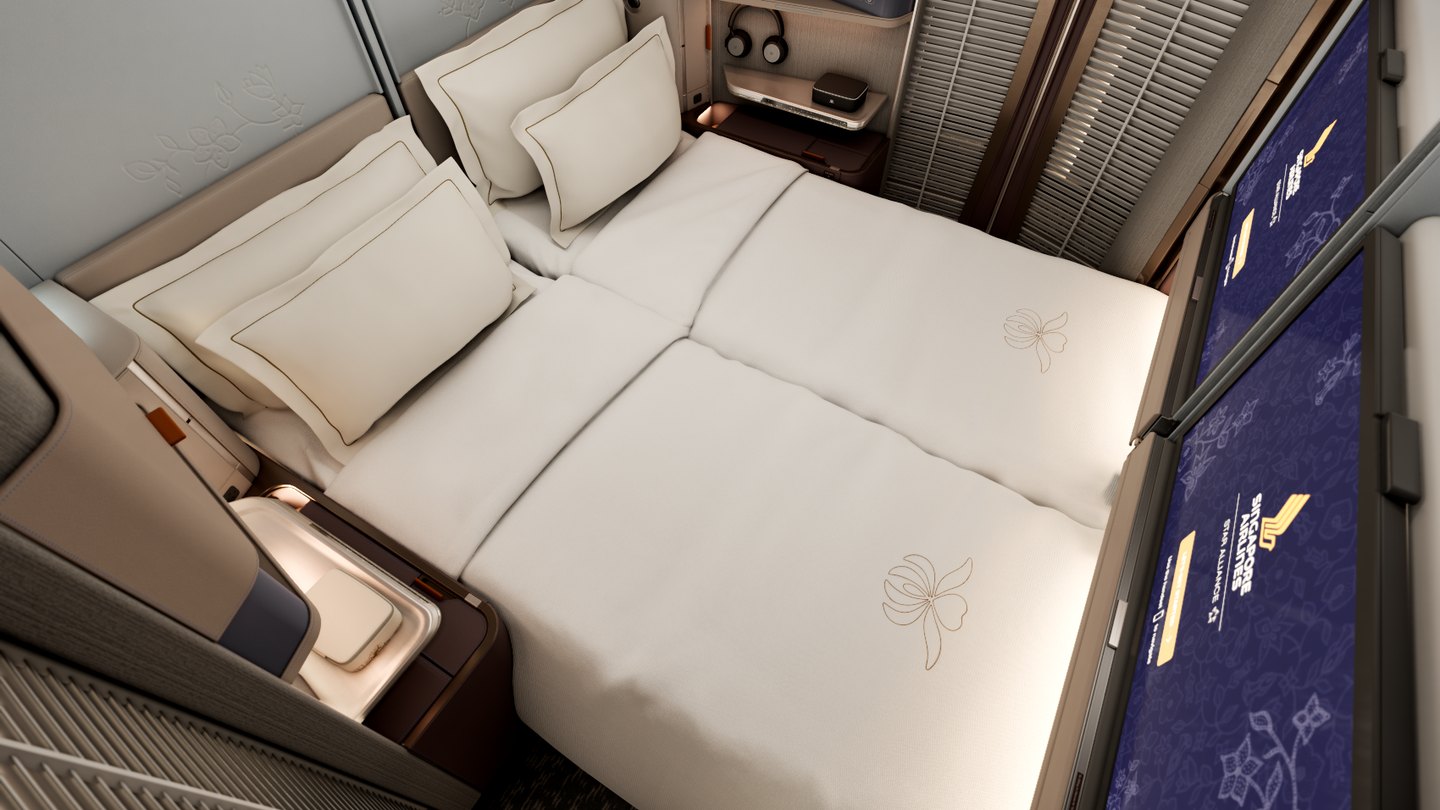
Over it go 100% cotton linens, a duvet and a choice of pillows. A plush cushion embroidered with the batik motif and a cloud-soft day blanket finish the dressing, the batik picked up again in the suite’s soft wall panels. The crew lays it all once the seat has run flat.
Sound stays personal at pillow level. The screens carry the KrisWorld entertainment system in 4K, with spatial audio running through Bang & Olufsen wireless headphones, or a passenger’s own Bluetooth set, so one half of the bed can finish a film while the other half sleeps.
The window suites sleep on the same 80-by-30 recipe. The centre pair simply doubles it.
The cabin it anchors
PriestmanGoode designed the suite, the London studio’s first project for the airline, and Collins Aerospace builds it. Curved sliding doors close off every seat, and SIA credits the curves with creating a greater sense of privacy, exclusivity, and spaciousness inside each suite. The studio took the same thinking to the aisle itself, which curves around the suites instead of running straight, softening the space around every seat.
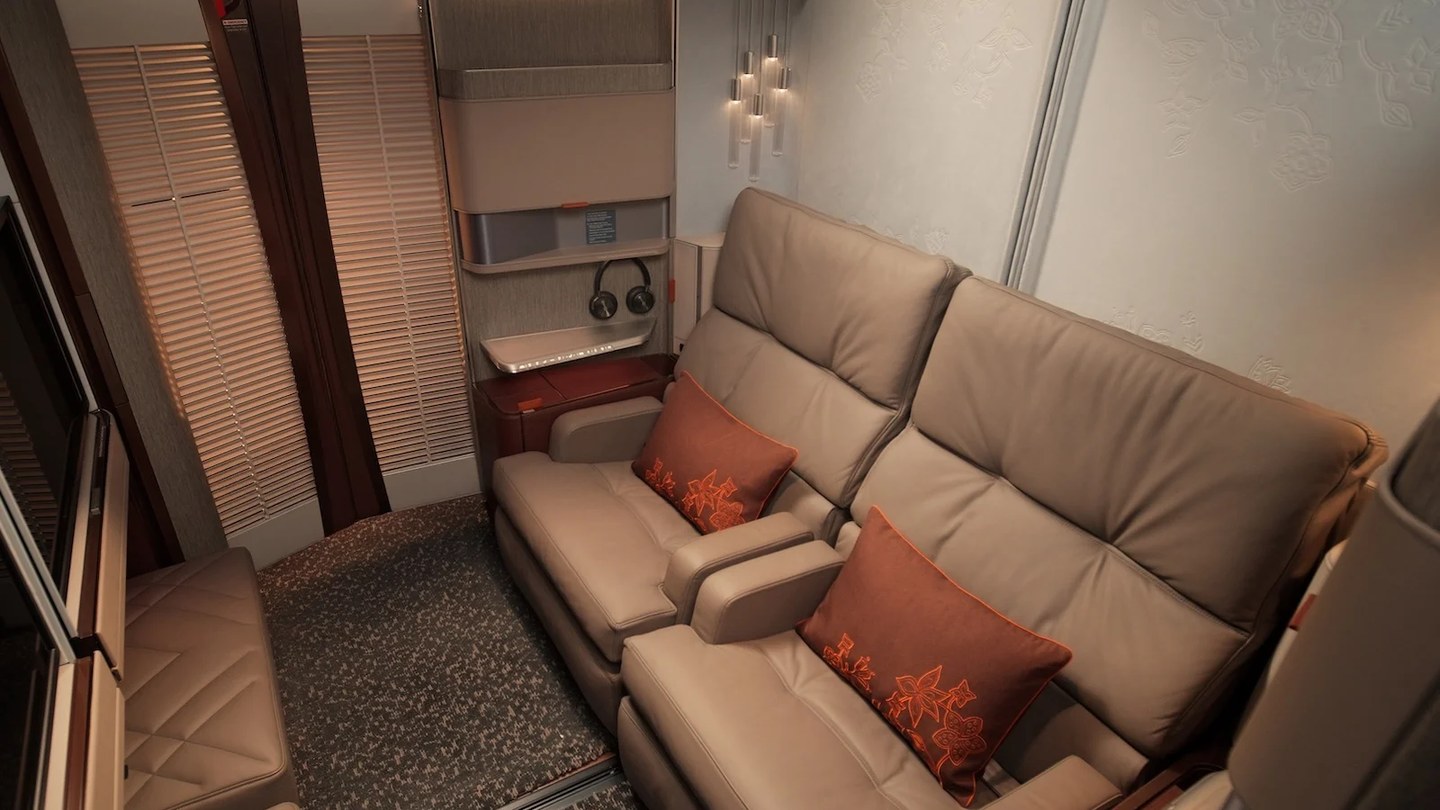
Ben Rowan, a director at the studio, points to the finish: “Every bespoke detail of the new First Class, from batik-patterned wall panels in each suite to unique seat mechanisms, has been refined over years of collaboration.” The batik on those panels was developed for Singapore Airlines, embroidered into the suite rather than applied as surface decoration.
The bed anchors a cabin programme priced at more than S$2 billion, roughly $1.56 billion, spanning 41 Airbus A350s due for retrofit and the incoming Boeing 777-9 fleet, 72 aircraft in all. All four cabins renew under the same spend.
First class itself rides only on the 777-9 and the ultra-long-range A350-900ULR, in a 1-2-1 layout: six suites on the Boeing, four on the Airbus, which gains a first class cabin for the first time. The products were shaped by research with more than 5,000 frequent travellers, customers, staff and industry experts.
Entry into service starts in the second half of 2027, progressively rather than in one fleet-wide swap, and the A350 retrofits run to the end of 2030.
The 777-9s arrive as new aircraft. The A350s are existing jets going back into the shop.
The business class cabin behind it has drawn the louder reaction this week, and DLMag covered the airline standing by that cabin’s grey palette earlier today.
Up front, the pitch is quieter. Two seats, one bed, and dimensions any mattress shop would recognise.