

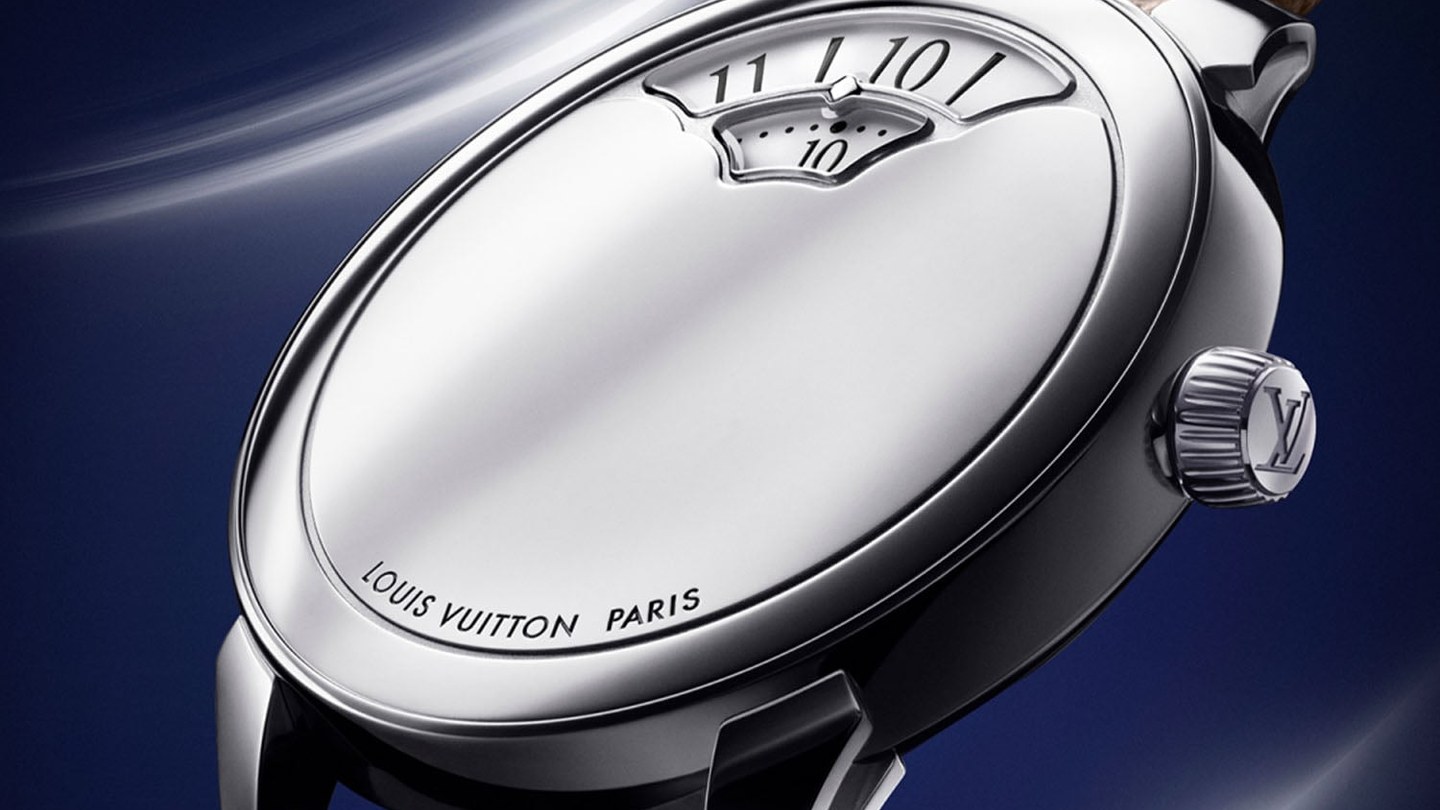
There’s no dial on this watch. No hands either.
Louis Vuitton’s Tambour Convergence tells time through a small arched window at the top of its case, where two discs drag past, one for the hours and one for the minutes. It’s a guichet, a format from the 1920s, and Louis Vuitton brought it back last year in pink gold and platinum.
The format had been asleep for decades. Cartier revived its Tank à Guichets, Audemars Piguet answered with the Neo Frame, and suddenly the window watch is a category again. Louis Vuitton’s version stands apart in one respect: the case is round, where most guichets run rectangular, and the discs drag instead of jumping, so time slides. It never snaps.
Now it comes in steel.
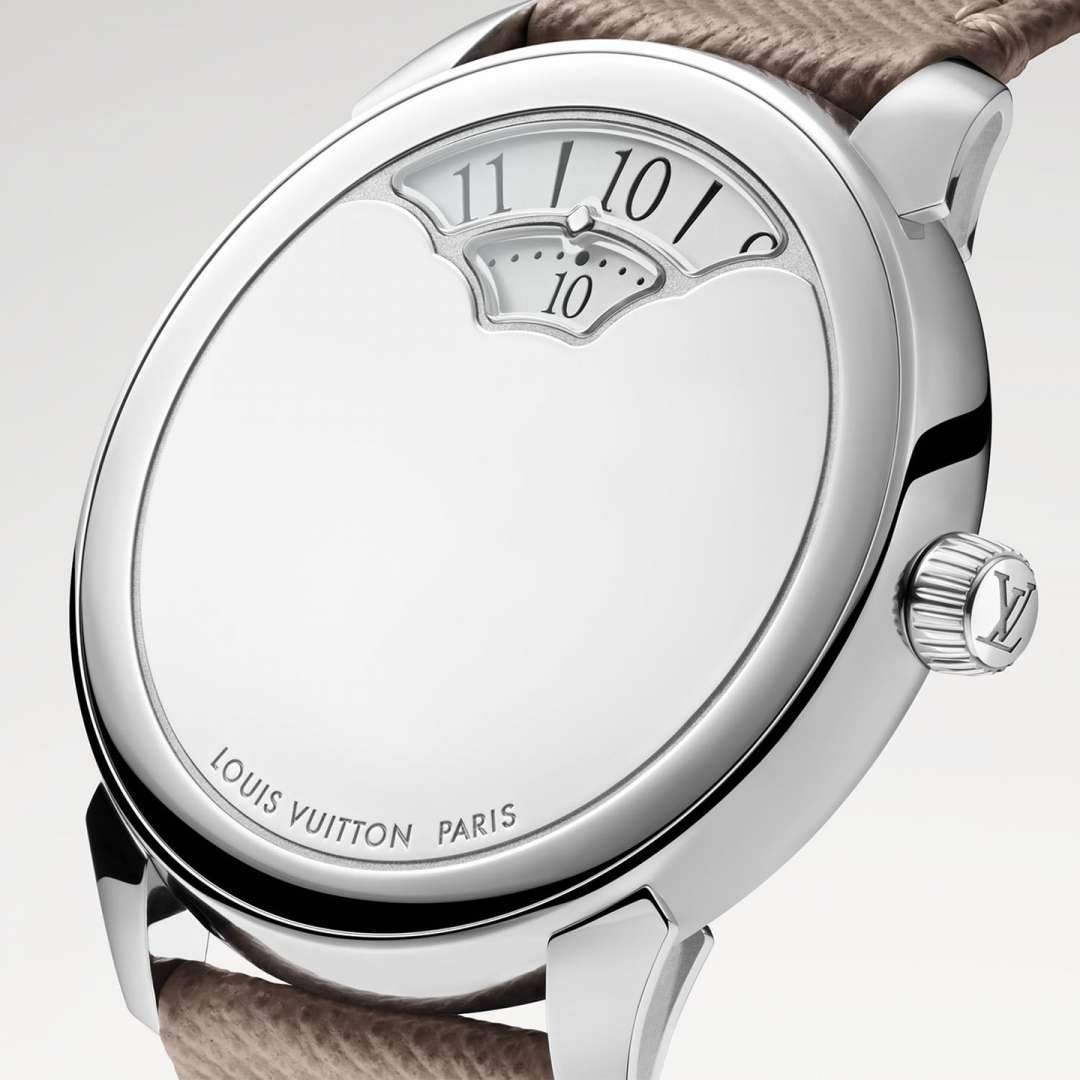
Hard enough to stay polished
A mirror polish is the worst finish to live with. It shows every scuff, and on ordinary stainless steel, which rates around 150 to 220 Vickers of hardness, a polished case starts collecting scratches within weeks.
Louis Vuitton’s answer is a hardened alloy, the same ultra-pure grade used in medical implants, given a patented surface treatment that takes it to 1,130 Vickers. That’s nearly six times harder than standard steel, and it sits just below high-tech ceramic on the scale.
So the finish that usually dies first gets armor. The case, crown, and the outer faces of the lugs are polished by hand at La Fabrique des Boîtiers, the house’s own casemaker, and polishing this hardened steel takes about three times the work the same finish needs on gold. Inside the hollowed lugs, the inner faces are micro-blasted instead, a soft contrast against all that shine.
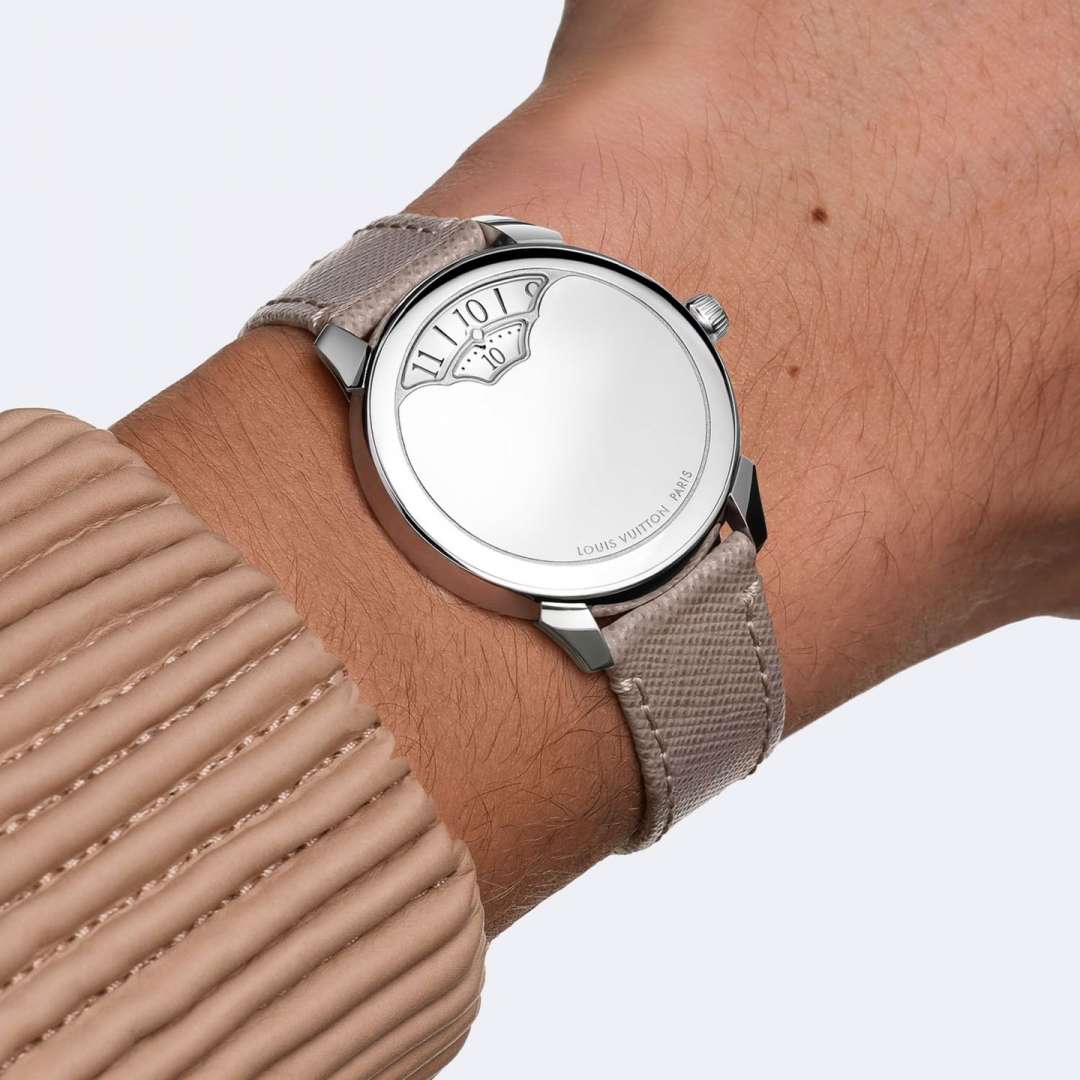
Thirty-seven millimeters across and 8mm thick, the case itself is small and exact, water resistant to 30 meters. It wears like a dress watch because it’s one.
The shape is the Tambour’s signature drum, the case form Louis Vuitton has built its watch line on since 2002, shrunk here to dress proportions. Everything about this watch is restraint: no bezel clutter, no dial furniture, just a polished drum and one window.
The movement underneath
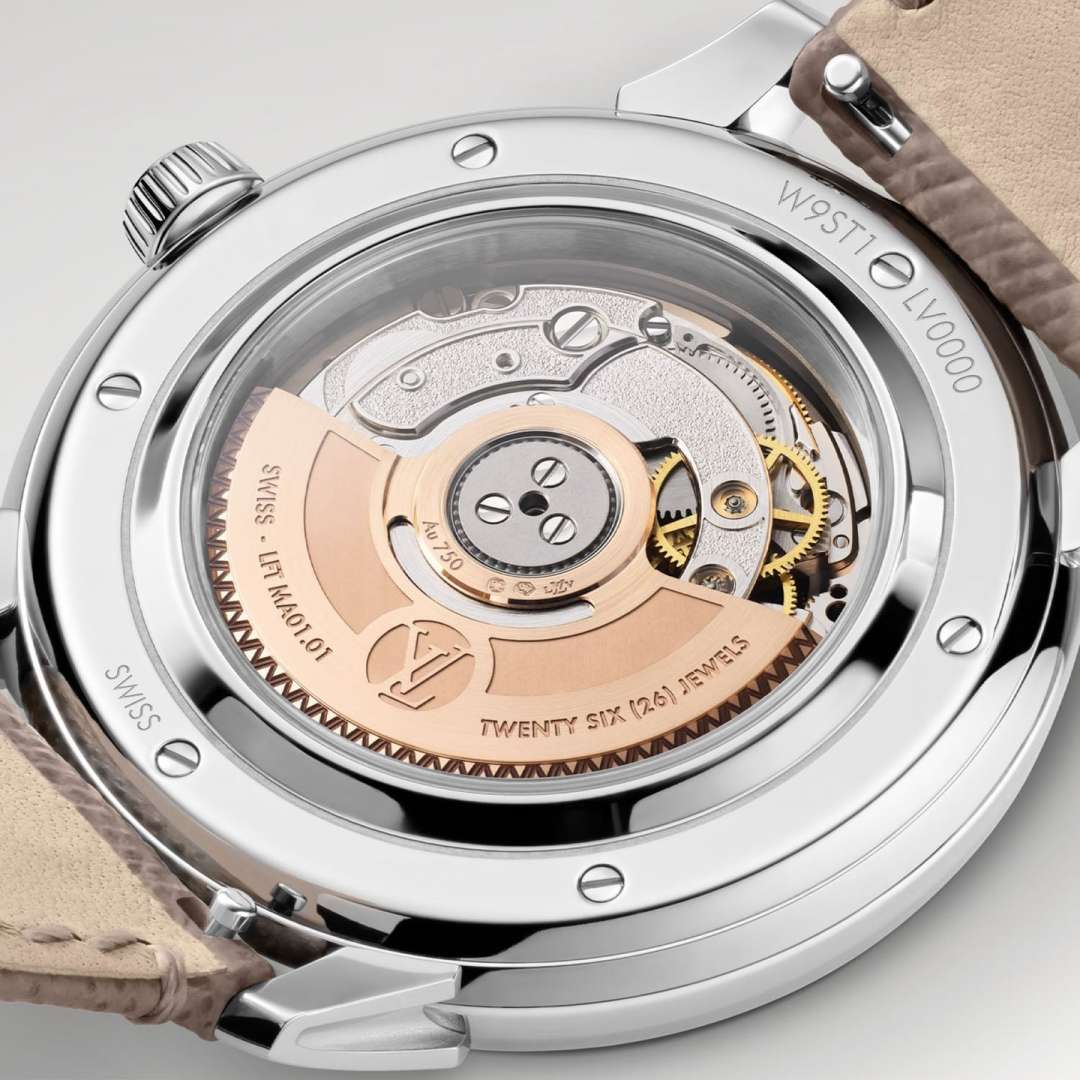
Through the sapphire caseback sits the caliber LFT MA01.01, the first time-only automatic movement designed and made entirely by La Fabrique du Temps, the house’s Geneva movement workshop.
It runs at 28,800 vibrations per hour on 26 jewels, holds 45 hours of power reserve, and winds through an 18-karat pink gold rotor. The discs it drives are satin-brushed brass with a rhodium finish, black-printed numerals, tuned to the cold tone of the case.
It runs to 201 components, with a free-sprung balance and finishing you can inspect through the back: sandblasted bridges, perlage on the mainplate, polished bevels, and colorless jewels set where you’d expect magenta rubies. For a watch with no dial to look at, the view from behind does a lot of the talking.
Grey Saffiano calf leather carries the strap, with a hardened steel pin buckle.
One more first sits behind the watch: the Convergence was the first guichet conceived entirely at La Fabrique du Temps, and its caliber also serves in the house’s Spin Time collection, so the movement carries a life beyond this one case.
What $25,200 buys, and what it doesn’t
Louis Vuitton lists the watch at $25,200. Run the comparisons, because the guichet field is small enough to price straight.
The pink gold Convergence it follows costs $37,000, so the steel watch undercuts its own sibling by $11,800 while keeping the same movement and the same case shape. Against the wider field, the gap grows: Audemars Piguet’s Neo Frame jumping hour lists at $71,200, and Cartier’s Tank à Guichets starts around $47,700 in precious metal. The Louis Vuitton is the cheapest serious guichet on sale right now, by a wide margin.
What it doesn’t buy you: water resistance worth the name, a bracelet, or a dial to glance at. Thirty meters is splash territory. Reading dragged discs takes a beat longer than reading hands. Every time. That’s the window display’s real cost.
I think that’s the trade, and I’d take it. A guichet has never been about reading time fastest. It’s about a watch that keeps its face to itself.
One buying note: Louis Vuitton sells this reference in store only in the US. No cart, no checkout. You go to a boutique, which for a $25,200 watch is arguably the correct way to buy one anyway.
The Mirror Steel is the third Convergence, not the first. That 2025 launch pair ran a mirror-polished rose gold model beside a platinum one set with 795 diamonds, and a hand-guilloché gold variant followed. Steel was the obvious gap in that line, and it’s the version most people will actually wear. Permanent collection status means no countdown and no waitlist theater.
If the gold one tempted you and the price stopped you, this is the same watch with a harder skin and $11,800 left in your pocket. That’s the version I’d buy.


