

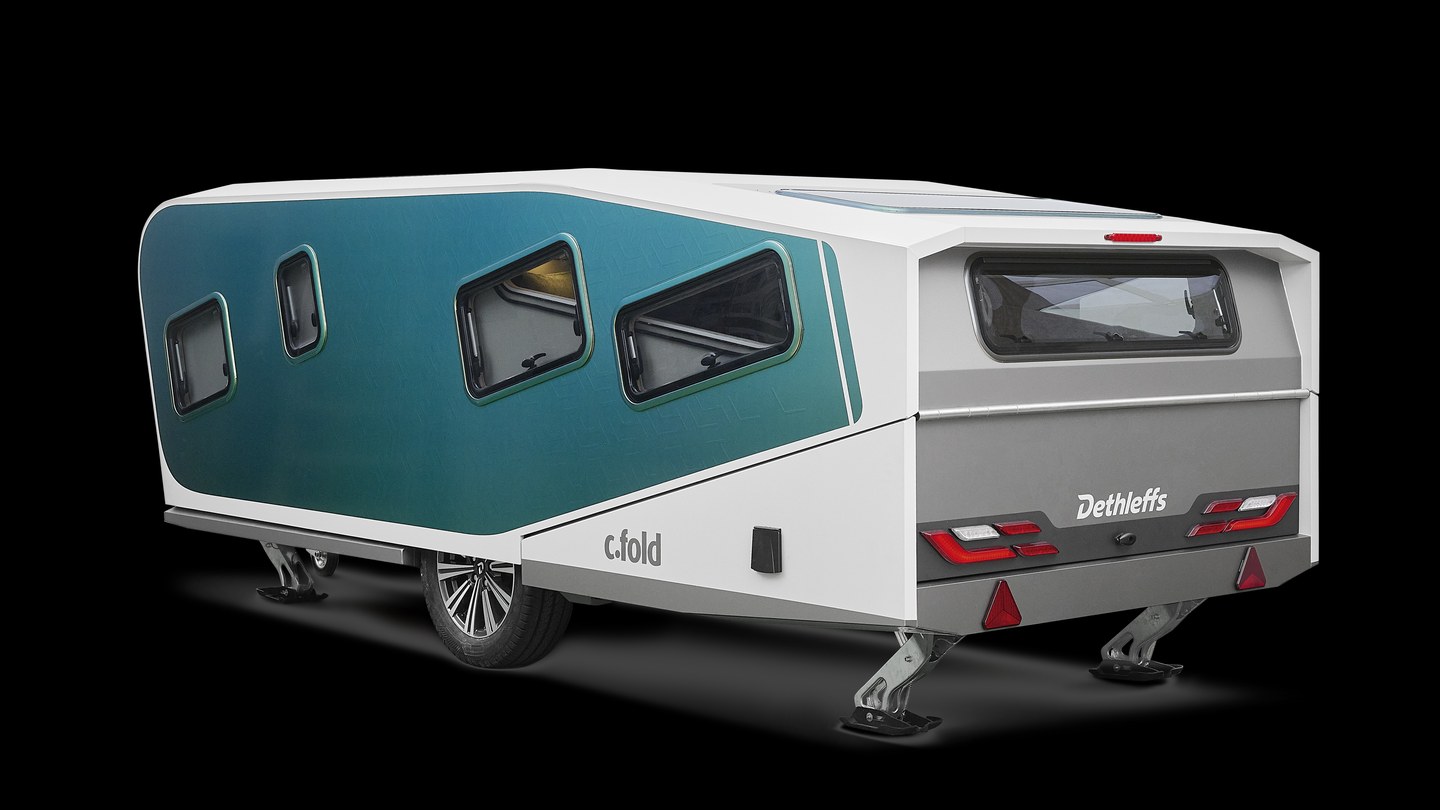
Monika and Peter Marchart spent decades touring Europe behind a caravan, then they switched to an electric car and watched a charge that used to carry them 249 miles give out at 124. The trailer was the problem. Half the car’s range went to dragging a tall box through the air, so the Marcharts took the problem to Dethleffs, and Dethleffs built them an answer.
The answer is the c.fold, and there’s exactly one of it.
Dethleffs built it with its EHG Innovation Camp in Baienfurt, over more than a year, starting from miniature models Peter Marchart made at home. No price exists, no production run is planned, and the company has announced no decision either way. It’s a testbed that happens to sleep two. The Marcharts got a caravan shaped around their car, not the other way around.
Two heights, one shell
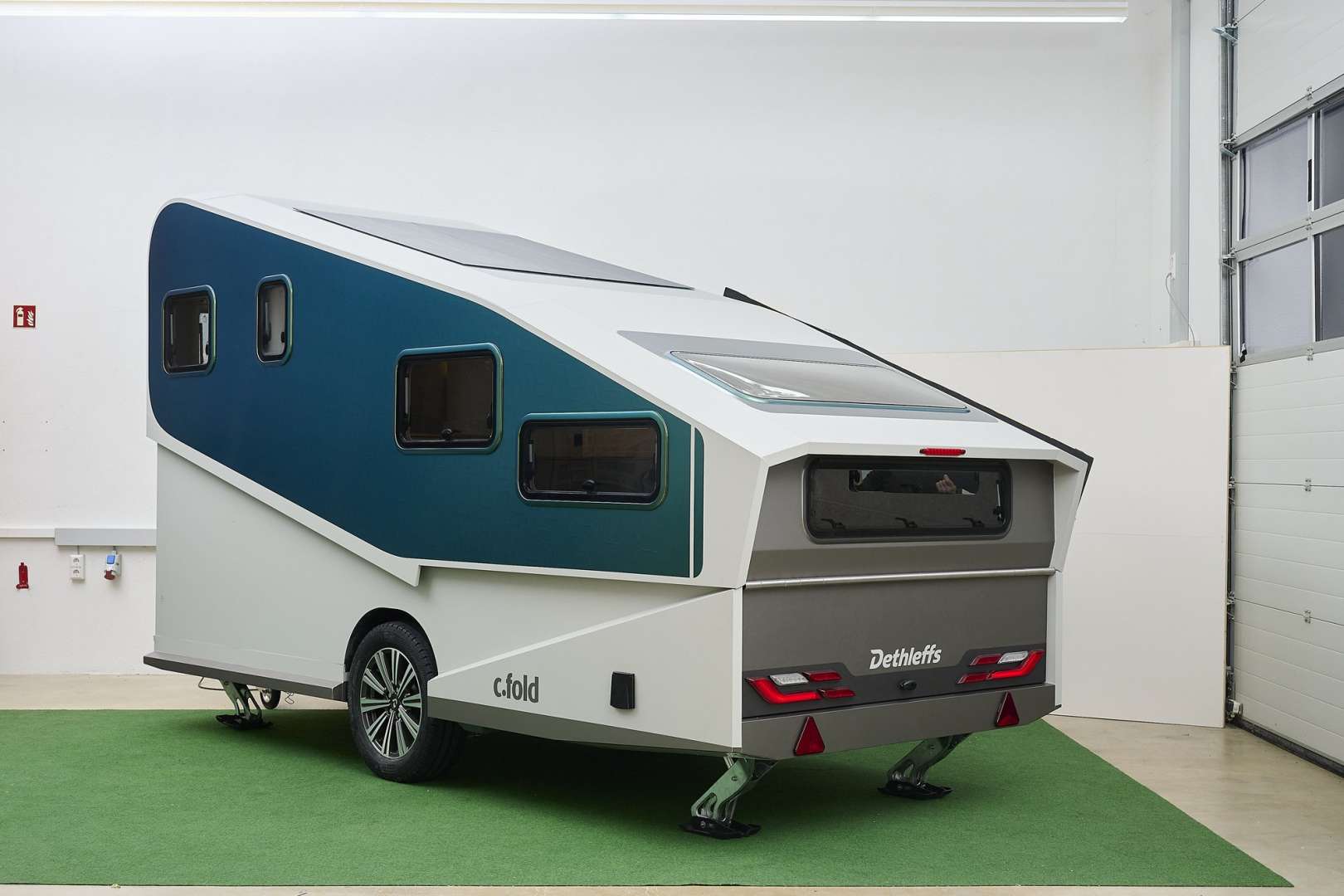
On the road the c.fold sits 5 ft 5 in tall, lower than most SUVs. The body splits across its middle: an upper shell that telescopes down over the lower half for travel, then lifts on a rear hinge at camp. A central cable-pulley system does the lifting, spindle motors finish the job, and the whole raise takes about 30 seconds from a button or the app. Every window sits flush in the wall, or the slide wouldn’t work.
Camp form gives the front of the cabin 6 ft 3 in of headroom. The raised shell also uncovers the windows and the skylight that travel mode keeps hidden, so the interior the Marcharts live in only exists once the roof goes up.
Honeycomb instead of a chassis
The body is Alucore, an aluminum-honeycomb composite, and rigid Alucore floor plates carry the structure, which deletes the conventional chassis with its longitudinal rails entirely. Insulation comes from recycled PET bottles, and the interior is lined in felt. The whole trailer, 18 ft long and 6 ft 3 in wide, weighs 1,709 lb in its current state.
Weight is the second half of the range problem, after drag. A trailer this light can sit behind smaller EVs and small gas cars alike, which is the entire point of building it for a couple whose car is electric. It also fits a home garage, where a tall caravan never could.
Air underneath, numbers on top
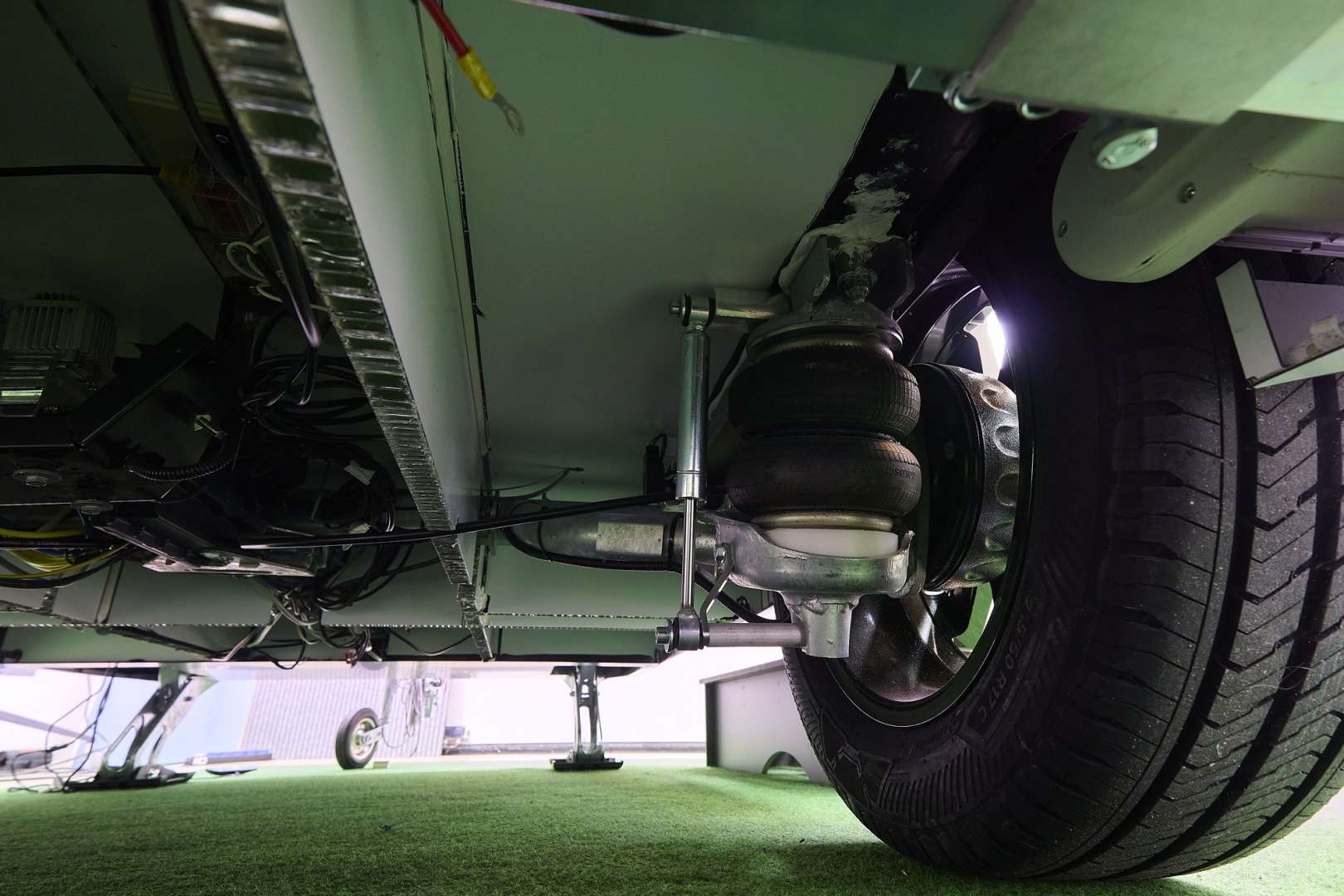
Underneath, a Goldschmitt air suspension adapted for the c.fold can drop the trailer lower still and weigh it through the app. A Reich Easydriver mover and electric steadies handle the campsite shuffling.
Dethleffs ran the shape through CFD analysis and claims the low shell can add up to 62 miles of range against a conventional caravan, a simulation figure, not a road result.
The road result arrived this month. Dethleffs registered the prototype and CARAVANING magazine drove it through the Allgäu behind a VW ID.4 GTX, holding at least 186 miles of range. The test recorded consumption of 22.4 kWh per 100 km with the c.fold against 36 with a conventional caravan. One caveat from the drive: the roof spindles were off the trailer, so the raise itself went untested.
A front room that folds into a cargo hold
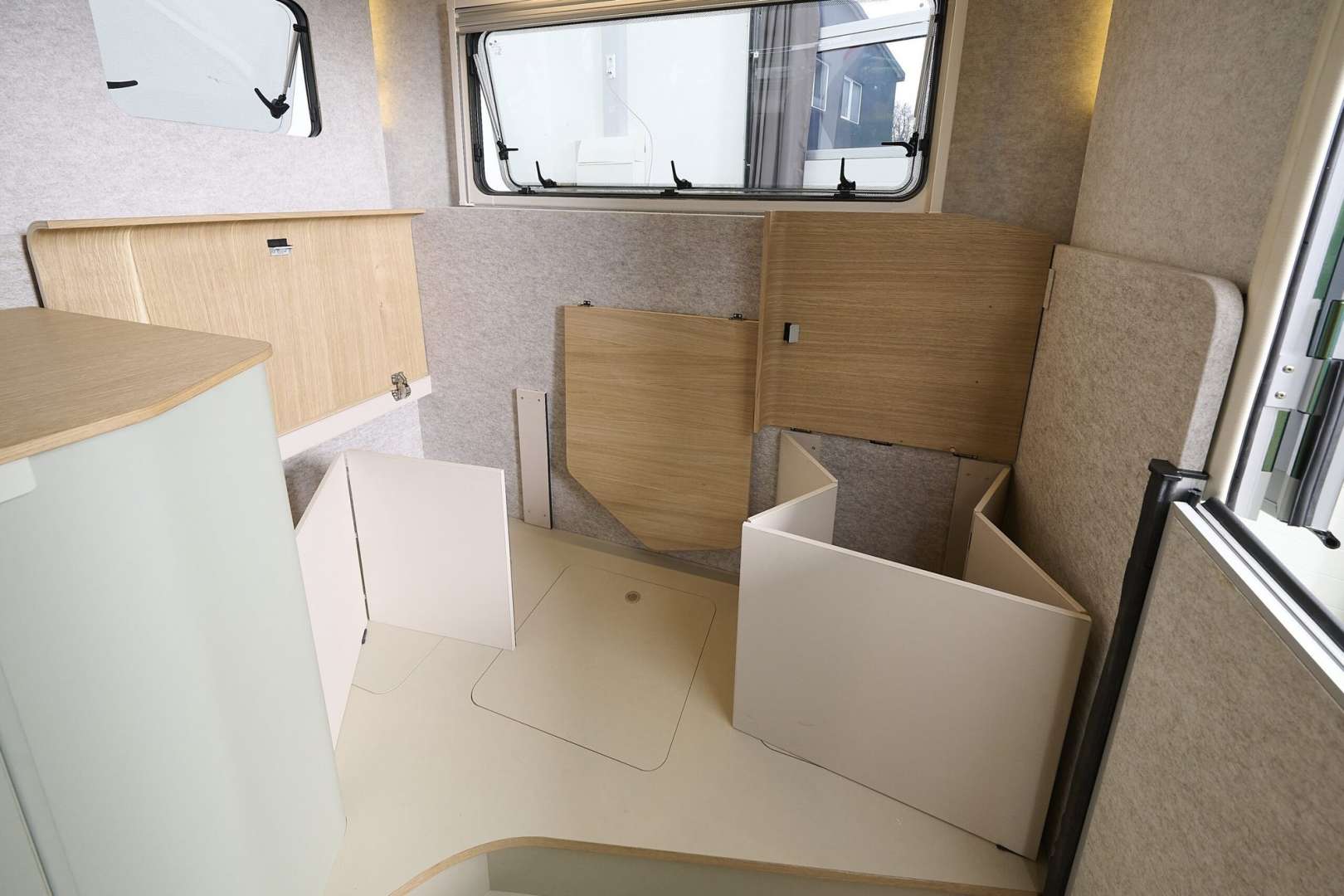
Inside, the front dinette seats two. Its table folds flat to the wall, the bench tops fold away, and the bench bases collapse accordion-style, clearing a cargo hold sized for two electric mountain bikes. That one room does both jobs the Marcharts need: breakfast at the front window, then bikes where the benches were.
The bathroom hides in a console
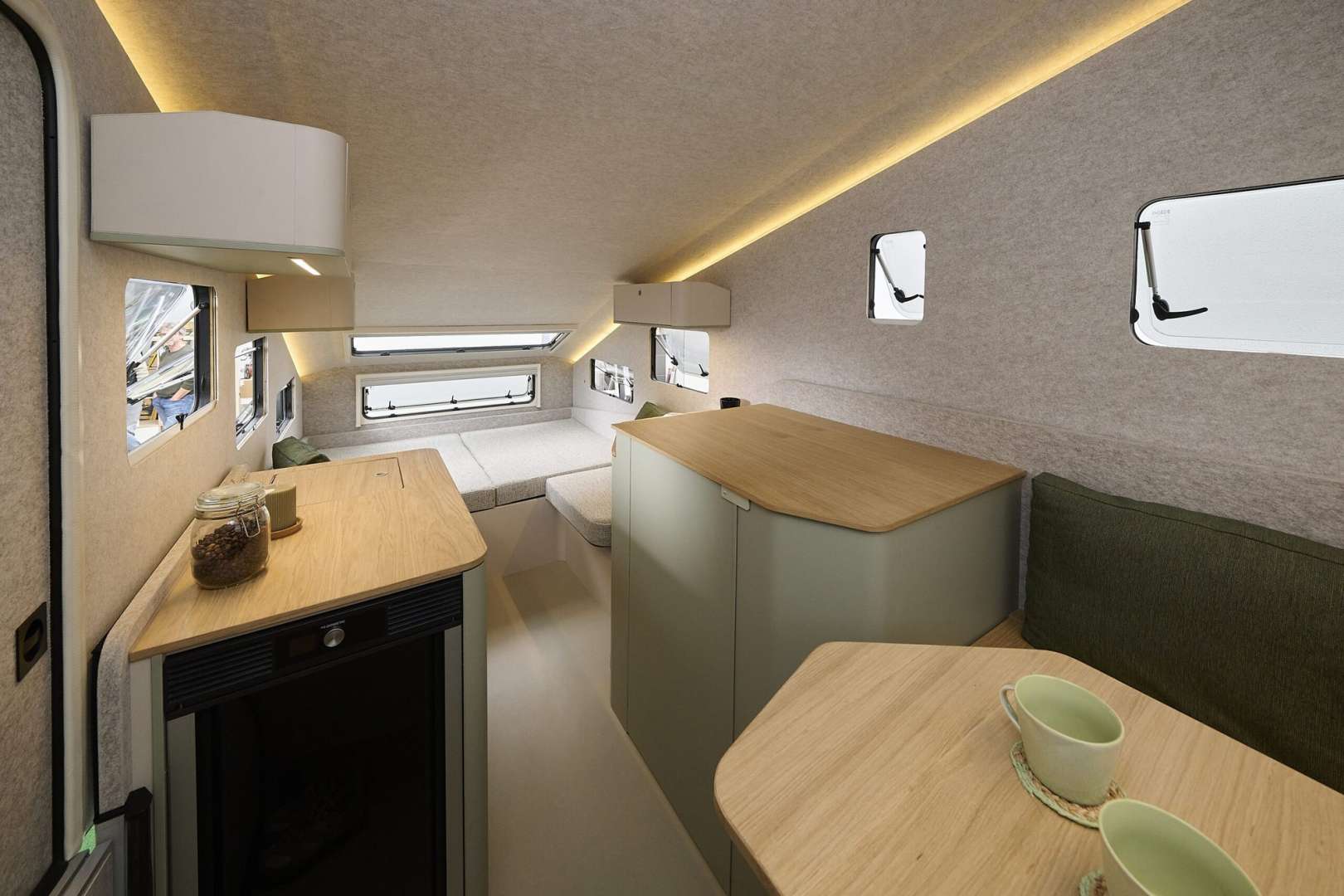
The bathroom is the cleverest piece of packaging in the trailer. At rest it’s a half-height console with a shelf top, sitting along the wall like furniture. The top lifts to the ceiling and pulls a wraparound fabric wall up with it, and the room inside holds a Clesana dry toilet and a sink. There’s no shower, the one plain trade the small shell demands.
Across from it, the galley keeps things simple: a sink under a flush lid, the fridge inside the doorway for outdoor access, and a portable induction cooktop that runs inside or out. There’s no gas anywhere aboard. Two 150 Ah lithium batteries, 300 Ah in total, a 2,000 W inverter, and 350 W of rooftop solar run the whole trailer, and hidden lighting traces the shell’s curve after dark.
A bed under the skylight
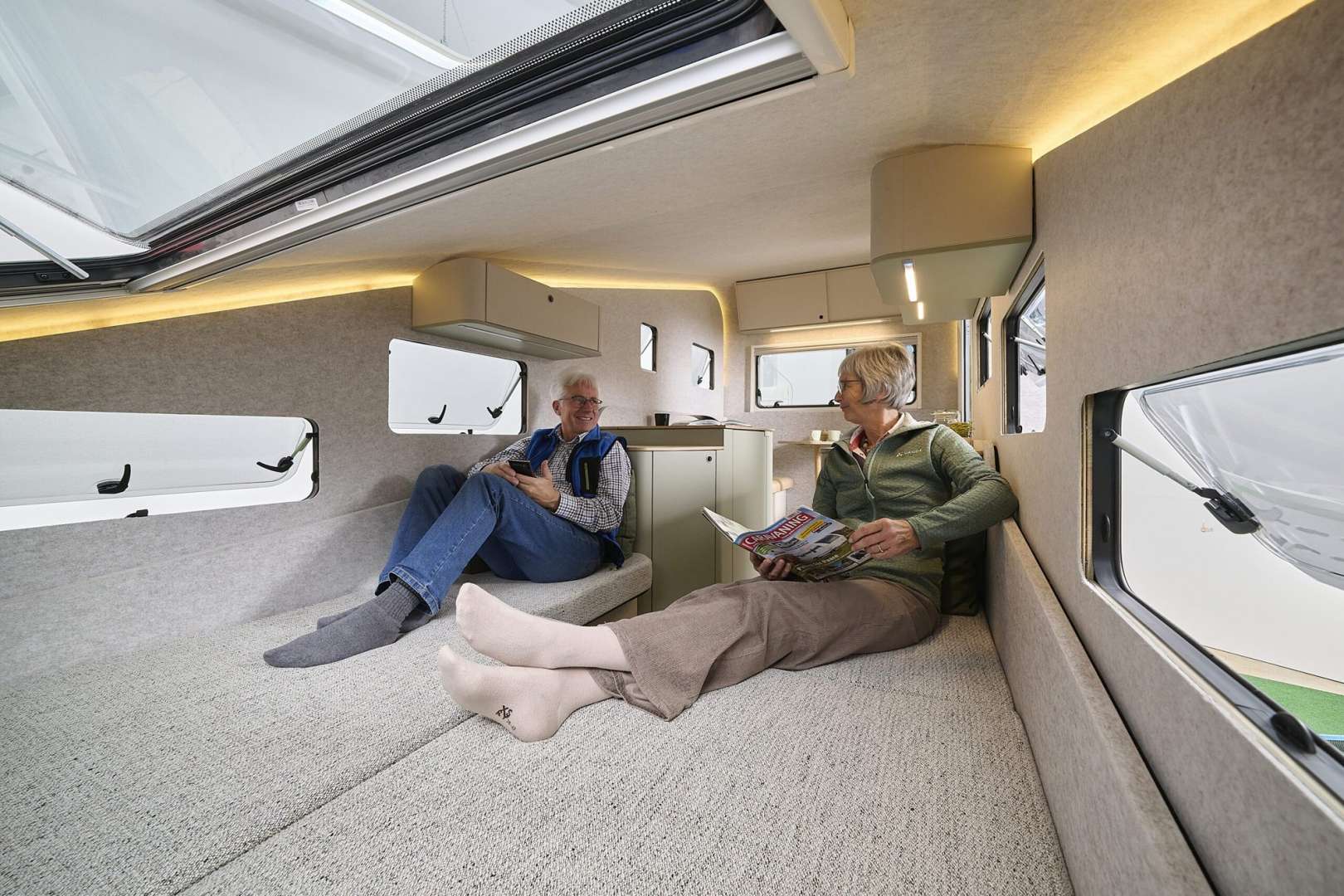
The rear is one fixed double bed, U-shaped and split at its front end, tucked under a skylight.
Headroom runs out toward the foot, so you sit up with your head toward the middle of the trailer. Overhead cabinets level themselves as the trailer moves, keeping dishes and provisions in place on the road.
Editor’s take
What I keep coming back to is the order of operations.
Dethleffs didn’t start with a trailer and electrify it. It started with a couple’s range anxiety and removed everything that caused it: the height, the chassis, the gas, the weight.
None of Dethleffs’ Destination Future studies has reached production, and the company promises only production-ready vehicles by 2028. If one study deserves to make that jump, it’s the one two customers specced from their own driveway. The c.fold solves a problem its owners can measure in miles.


