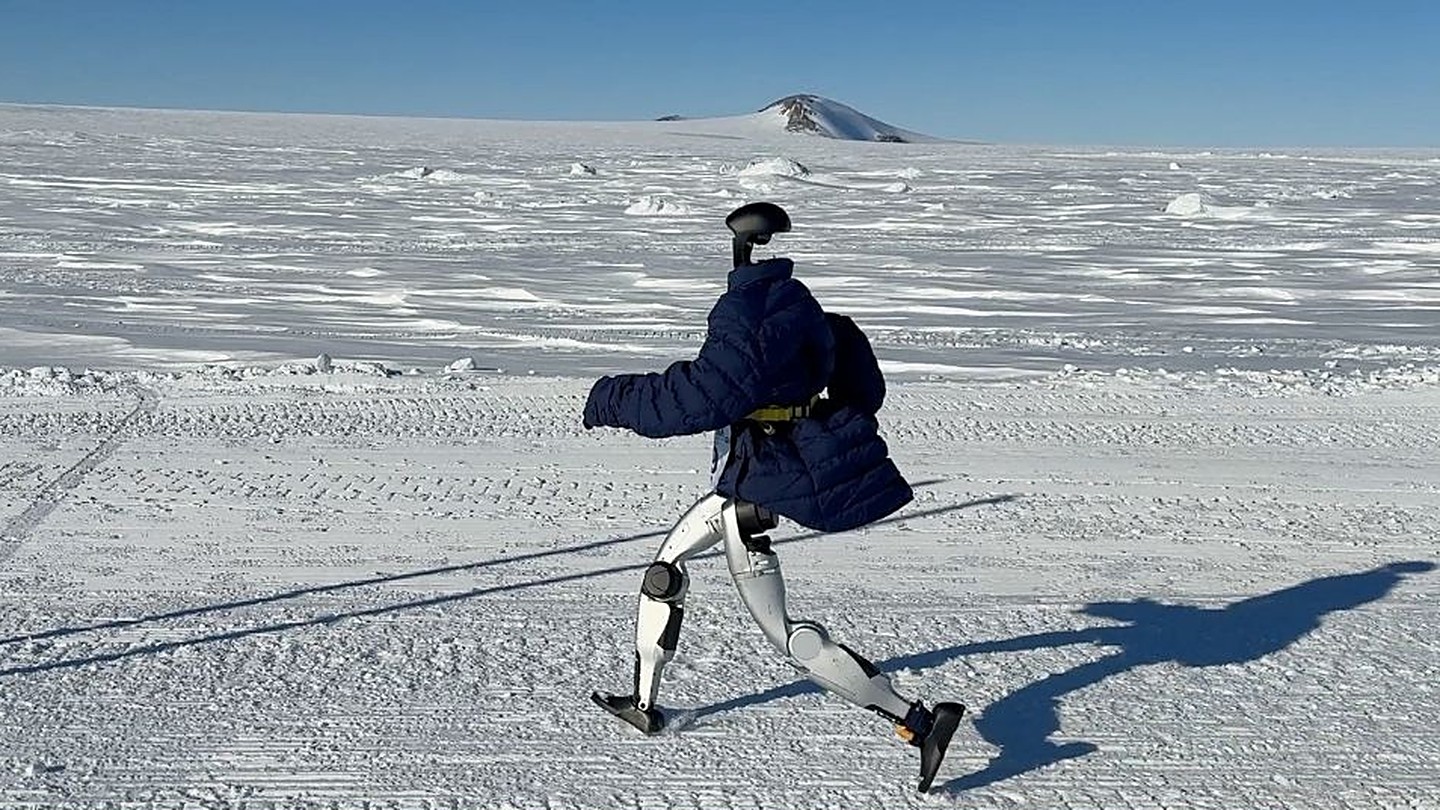
The strangest entrant at this year’s Antarctic Ice Ultra didn’t fly in for the scenery. Qestr, a silver-white humanoid robot, stood on the start line at Ultima Camp in Queen Maud Land at 1 a.m. on Sunday in a navy puffer jacket and a race bib, in air sitting at −24°C (−11°F). It had flown farther to get there than any human in the field.
Twenty-five human runners stood on the same line, entered for distances from 50 kilometers to 100 miles. The robot’s race lasted three kilometers.
Race organizer Oliver Wang confirmed Qestr as the first humanoid ever entered in the event. It won’t take the distance record home. It takes a different one: no humanoid has traveled farther to compete, and none has raced in cold anywhere near this deep.
An ultra at the end of the world
Getting there is the first event. The field gathers in Cape Town and flies in on a Russian-built Ilyushin Il-76, a four-engine freighter that lands on a groomed blue-ice runway near the camp. There’s no road in, no port, no second way to arrive. Every runner, every handler and one robot came down that aircraft’s stairs. The event is run by Runbuk, which stages endurance races on every continent, and this was the Ice Ultra’s third edition.

Ultima Camp sits at about 70° south in the Schirmacher Oasis, a strip of ice-free rock in Queen Maud Land. The course is a 4.2-kilometer loop on groomed snow, run again and again: 38 laps make the 100-mile distance.
The race anchors a five-day expedition. Between laps and recovery, runners visit an emperor penguin colony, walk an ice tunnel and sit in a sauna at 70° south. It’s the most extreme destination racing on Earth, and it’s planned like the expedition it is.
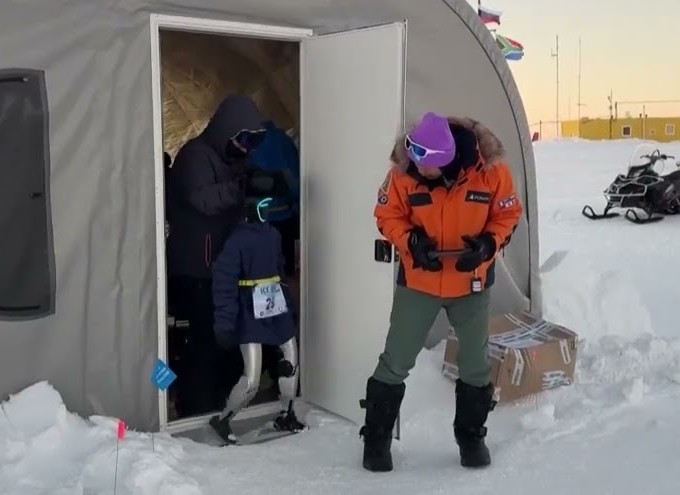
Qestr came through the same tent door as everyone else, bib pinned over the jacket it would race in, while handlers checked charge levels the way crews check a runner’s bottles and layers.
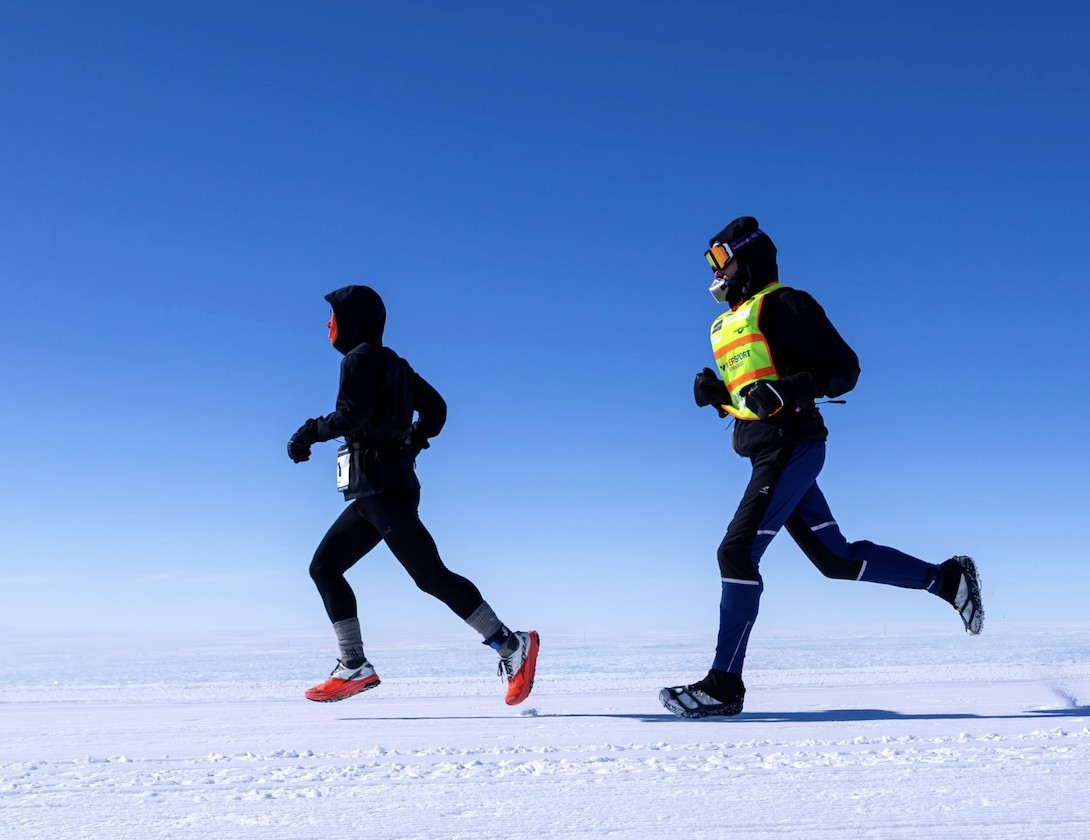
The humans set a high bar on the same loop. China’s Yusheng Ni won the 100 miles in 17 hours, 2 minutes and 24 seconds, cutting more than five hours off the course record he had set the year before. Canada’s Stephanie Case finished second overall in 17:31:39, the first woman ever to run 100 miles in Antarctica.
Three kilometers at 24 below
The start went off at 1 a.m., moved up to dodge incoming storms, under a sun that never left the sky. Qestr’s first kilometers surprised the people watching: the footing held on the ice, the balance held on the uneven surface, and the gait looked like running, not a demo walk.
Cold kills lithium-ion cells from the inside. As the temperature drops, the chemistry slows, capacity shrinks, and a pack that sips power on a show floor drains fast under a running load. Every cold-weather engineer knows the shape of that curve, and a running gait slides down it faster. The thermal jacket was there to slow exactly that drain, holding the machine’s own heat around the battery. It bought time. It didn’t buy enough.
The humans refueled the old way, at stops serving hot food and energy snacks through a night that never got dark. A runner can eat. A robot can only carry the charge it started with.
No official time was recorded. It didn’t fall. It ran out of electricity.
Humanoid robots have finished half marathons on closed city streets in mild weather, with handlers and swap crews nearby. Antarctica offers none of that. The gap between a spring road race and a 1 a.m. start at 70° south, where the nearest help is the tent you started from, is the whole story of where these machines stand.
Then it danced
Strip the jacket off and Qestr is the current show-floor humanoid: a black visor for a face, a pale shell over jointed hips and knees, a ring of light on the chest. The hands are simple mitts, made for waving at crowds. Nothing in the design plans for weather.
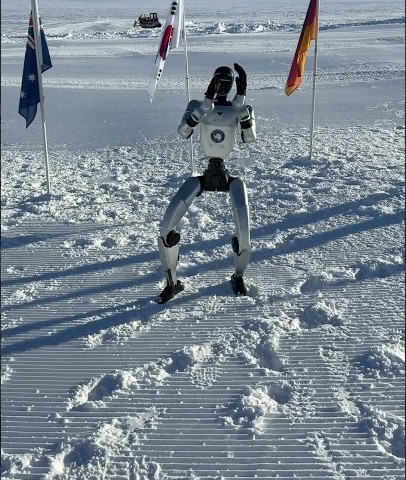
Every machine humans take to Antarctica gets redesigned for the place: ski-equipped aircraft, tracked tractors, batteries kept warm by engine heat. Qestr arrived as a city machine in a borrowed coat, and the weekend looks less like a failure than a first fitting.
And then, because a trip like this deserves a souvenir, the robot danced: arms up between the flags, knees bent, unbothered by the audience and by the cold it couldn’t run in.
That’s the part worth keeping. Humanoids have spent a decade on factory floors and trade-show stages, and this one crossed the planet to enter a footrace, ran three kilometers in the cold, and danced on the ice afterward. The next one travels with a battery that can take the weather. Until then, the humans keep the continent. The record books will file it as a DNF, with no time beside the name. The film tells a better story.