

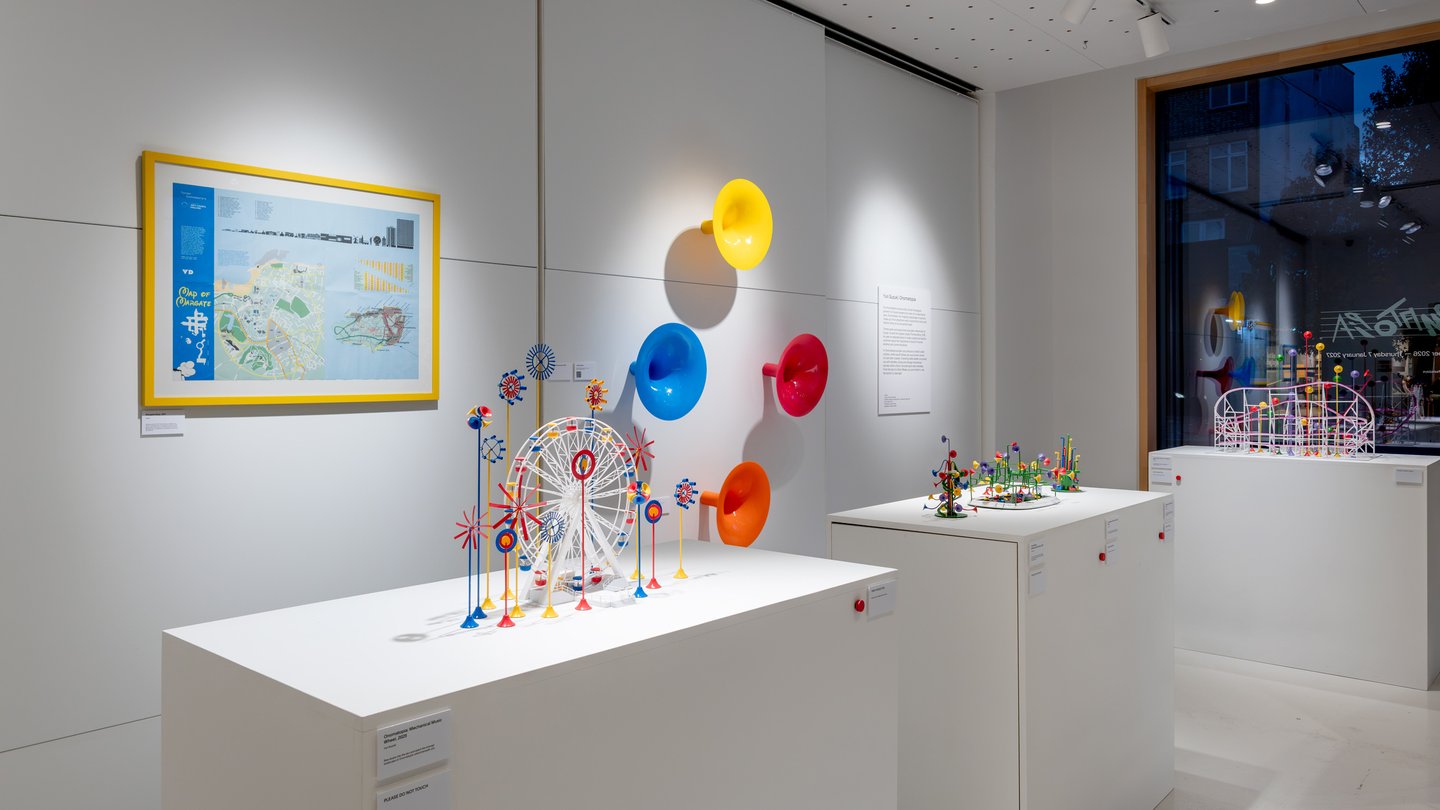
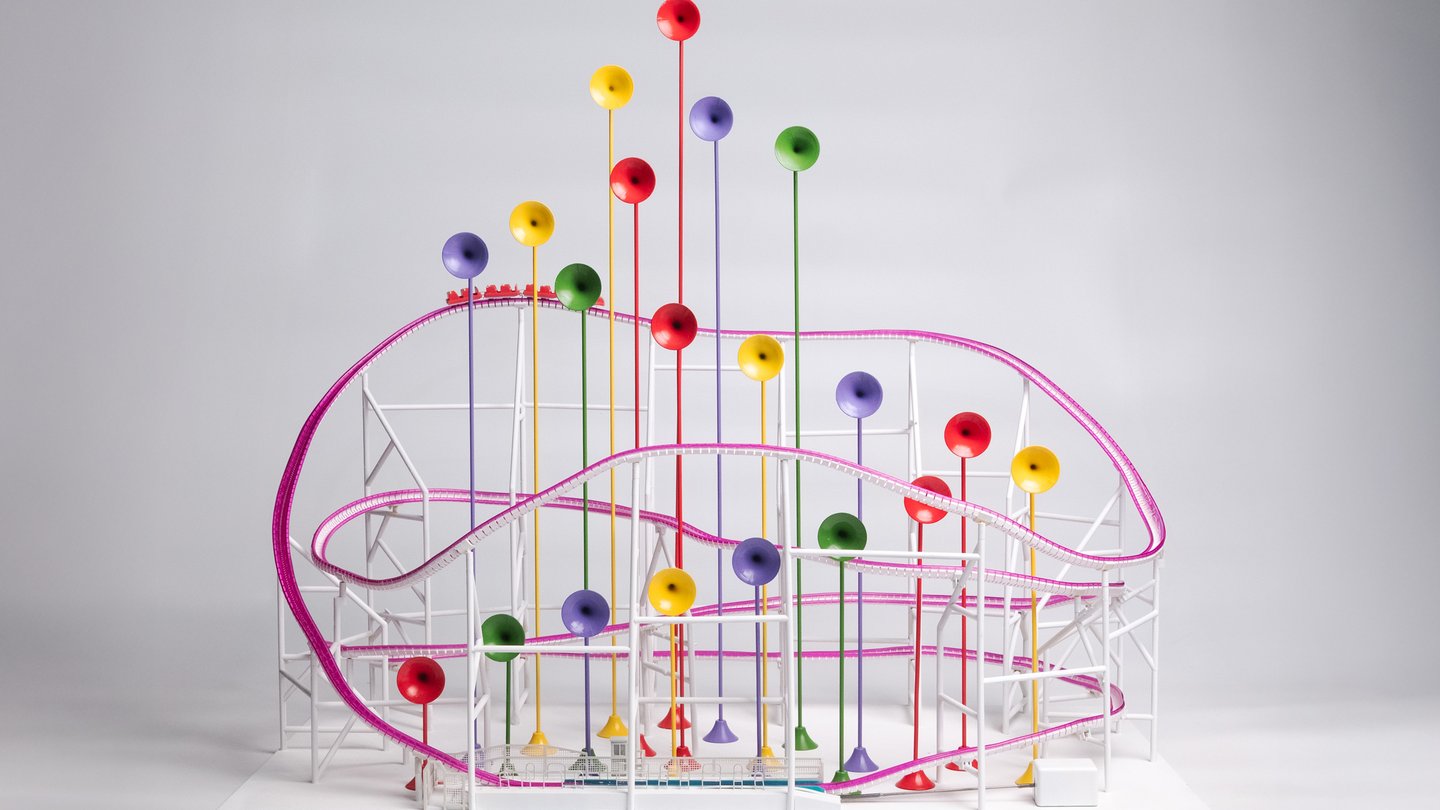
Onomatopia is an amusement park with no queues, no tickets and no ride you can board. Suzuki built it as a set of sound sculptures modeled on the classic attractions, Ferris wheels, carousels and rollercoasters reworked so their movement makes the music.
The pieces exist as painted models and gallery installations for now, in fairground reds, blues and yellows, built at table scale. The park itself stays imaginary, and Suzuki keeps adding rides to it.
Ferris wheels, carousels and coasters, rebuilt to make sound
A white Ferris wheel anchors the set, its cabins picked out in red, blue and yellow, ringed by pinwheels and horn-topped poles standing at fairground heights. Around it the smaller wheels carry discs, trumpets and target rings, each one a different voice waiting on a turn.
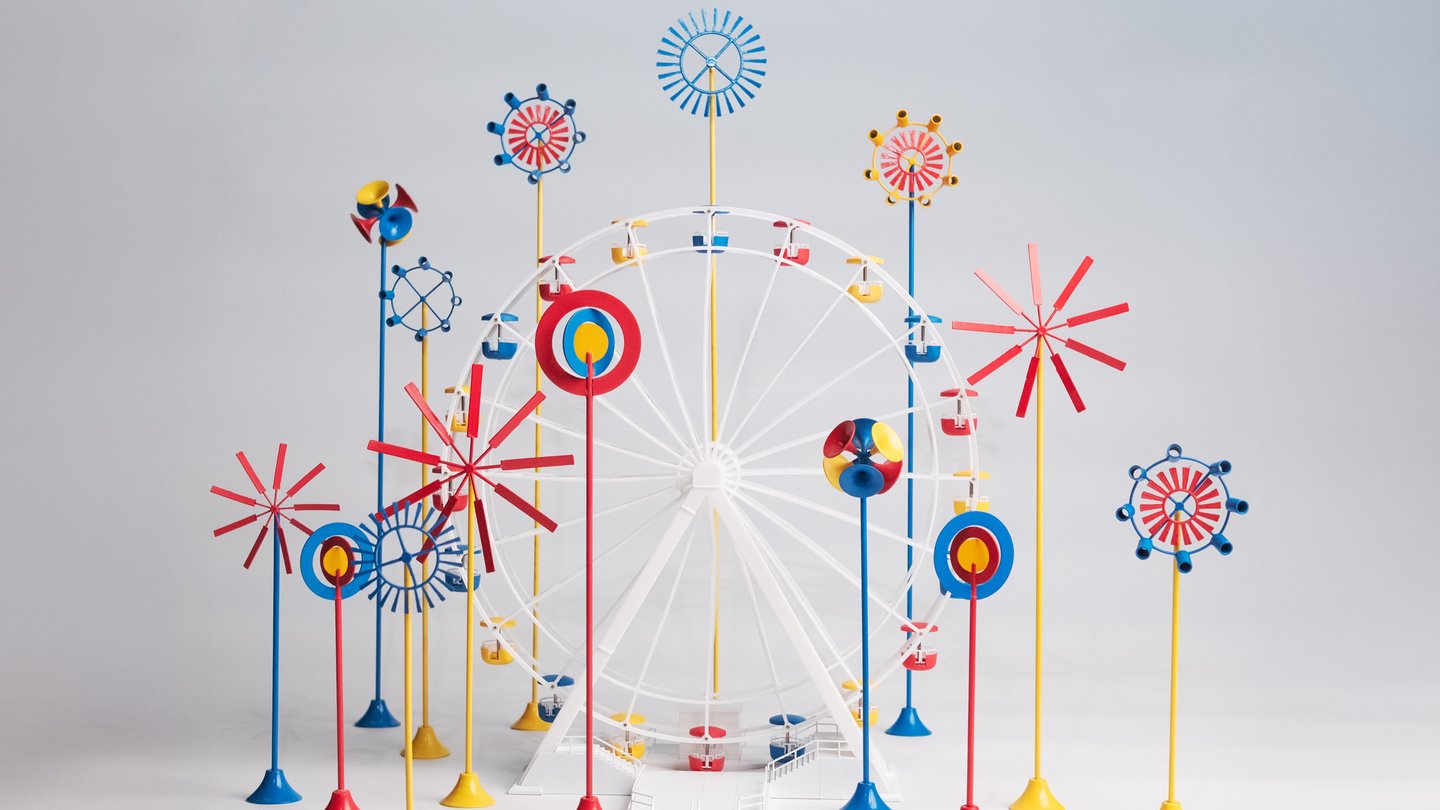
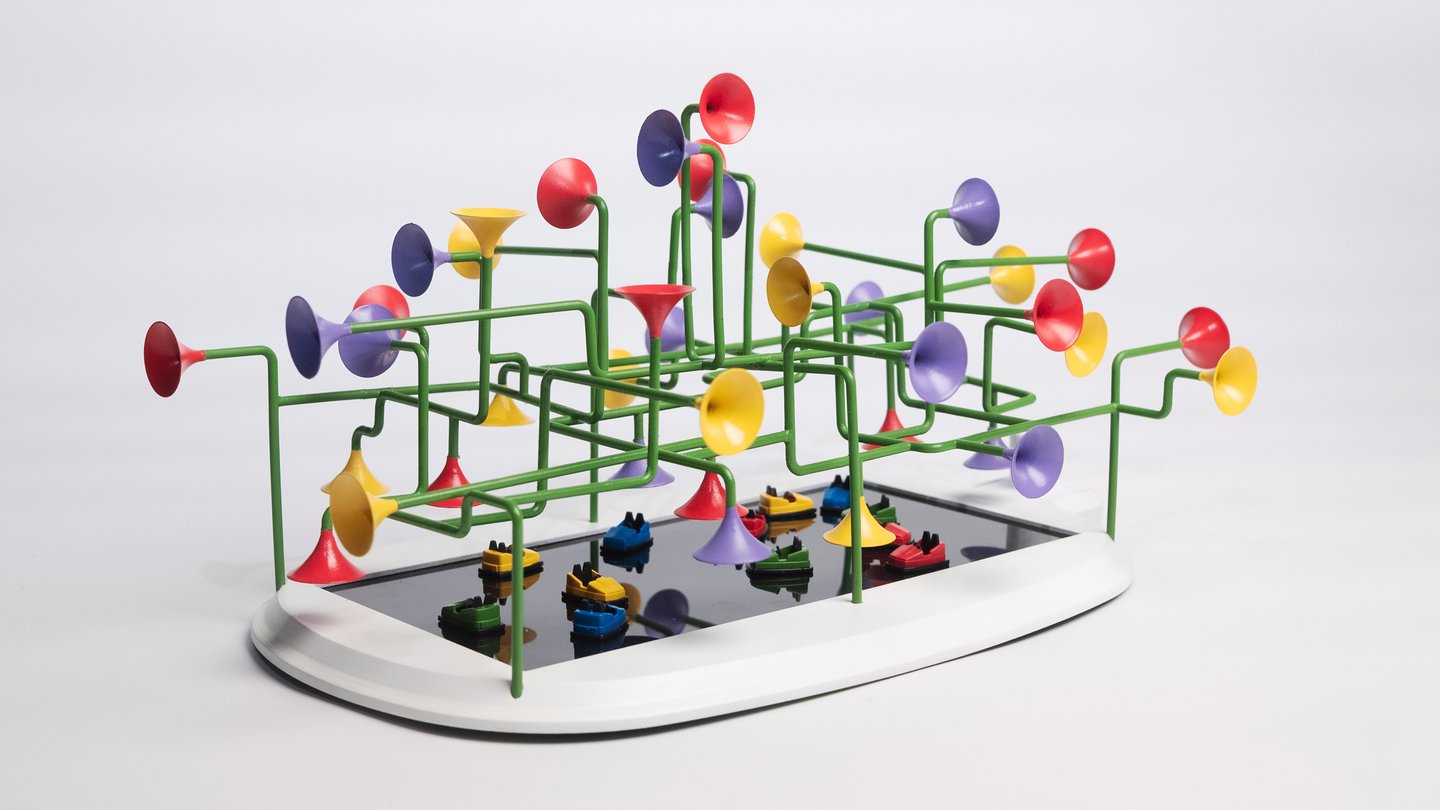
Horns do the talking everywhere else. They sprout from poles, curl off a spiral tower and hang over the bumper cars in green pipework, so every ride in the park gets a voice at its own pitch and height. Nothing in the set is decoration.
The music starts when visitors move
Each sculpture explores a different relationship between sound and physical movement, and the mechanics stay out in the open, all rotating structures, mechanical rhythms and moving parts. A push, a spin or a passing car becomes the performance, and the rhythm changes with every visitor who takes a turn. The tempo belongs to whoever shows up.
Suzuki writes the visitor into the composition rather than parking them at a rail, and audiences become part of the experience instead of observers watching someone else’s ride.
Sound arrives through the hands as much as the ears, since touch and play sit alongside listening in Suzuki’s scheme for how the park gets experienced, felt in the fingers as much as heard across the room.
Stand still, and the park goes quiet.
An imaginary park that keeps adding rides
Onomatopia stays unfinished by design, an evolving collection rather than a fixed set, with new sculptures, installations and environments joining the park as the idea grows. A wall of full-size horns in the gallery photographs shows the same idea at body scale.
The look stays nostalgic while the idea stays current: striped poles, primary colors and ride silhouettes anyone can read across a room, carrying sound experiments too strange for a black box. The fairground does the explaining, and the explanation needs no wall text.
Suzuki was born in Tokyo in 1980 and works between London and Margate, and his sound pieces sit in the collections of the Museum of Modern Art in New York, SFMOMA and the Design Museum in London. The exhibition record on his about page runs from Tate Britain to the Nam June Paik Art Center in Seoul.
It grows the way parks do.

The tradeoff shows in the gallery photographs, where plinths carry please-do-not-touch labels under work designed for touch, movement and shared handling. The park promises participation, though the room where most people will meet it asks them to keep their hands off.
Suzuki’s own text proposes spaces “that can be played, explored and experienced collectively”, and at model scale the proposal is easy to walk past. At full scale it changes how a park feels under your feet, and how a city block sounds at lunch.