

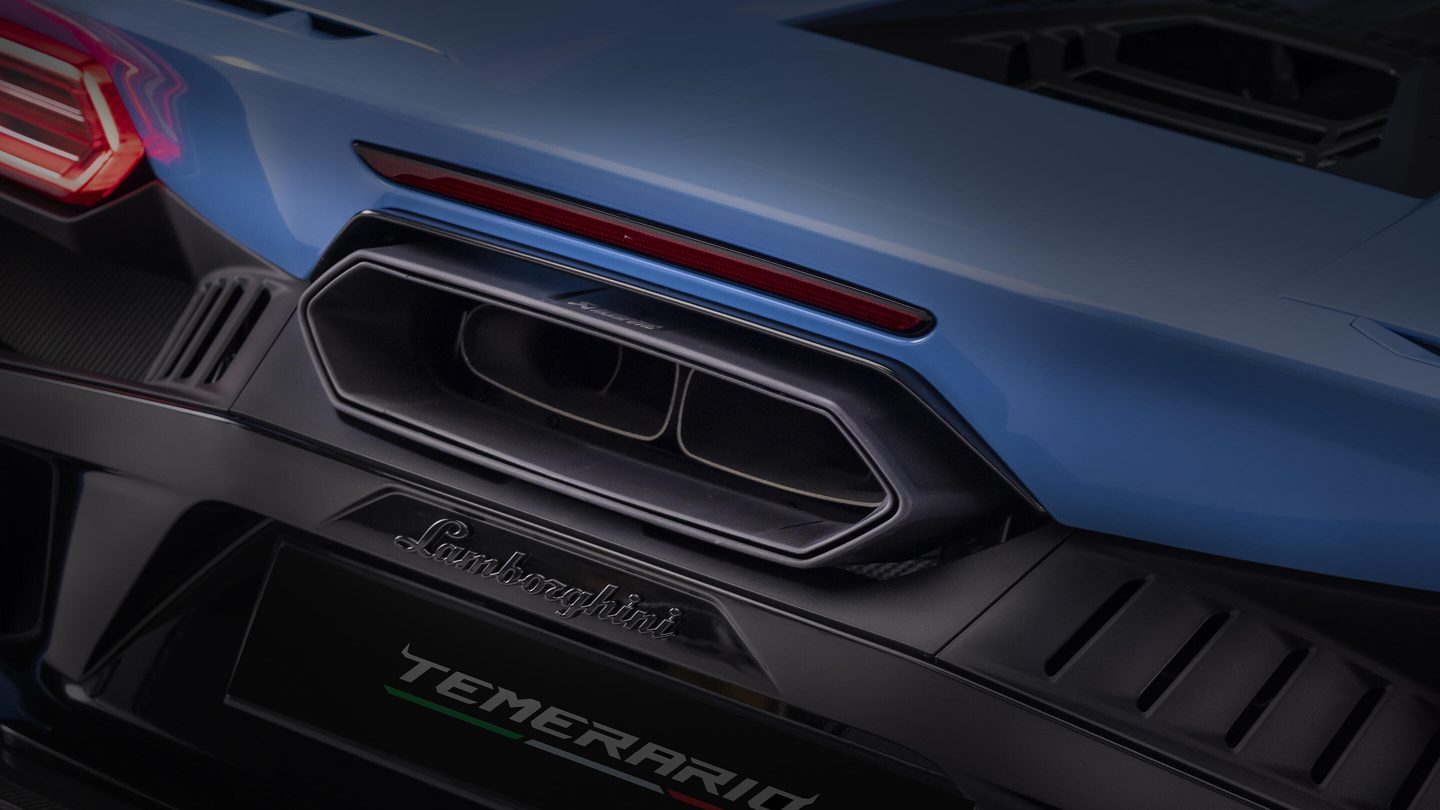
The Temerario’s twin-turbo V8 revs to 10,000 rpm, and its standard exhaust keeps that voice on a leash. Lamborghini has handed the job to Akrapovič, whose titanium system weighs 11.4 kilograms and lets the V8 speak at full volume.
Low, wide and drawn around the engine
Start with the shape, because the Temerario’s design starts there too. The car sits low and wide, its surfaces pulled tight over a mid-mounted engine, with hexagonal details repeating from the front intakes to the tailpipes at the rear.
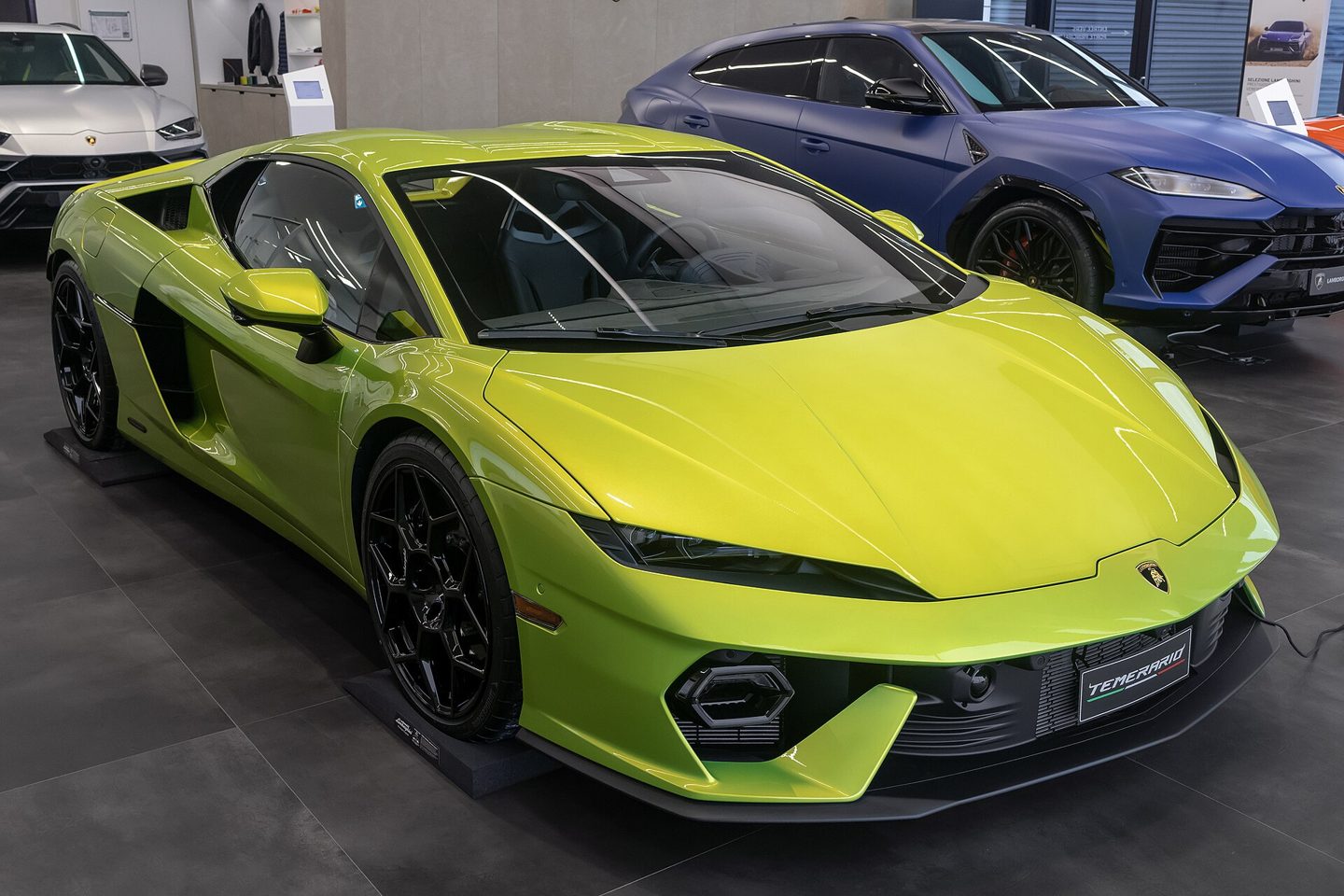
It’s a cleaner silhouette than the car it replaced.
The panels run smoother, the cuts sit sharper, and the rear deck leaves the engine’s hardware partly on show under louvres. That honesty suits this option well, because the Akrapovič system changes the one part of the rear design you hear before you see, the wide hexagonal outlet centered high in the tail.
Under the skin sits a 4.0-liter twin-turbo V8 designed and built in Sant’Agata Bolognese, paired with three electric motors. Together they produce 920 CV, and the V8 alone climbs to a 10,000 rpm redline that no rival hybrid V8 currently matches.
That engine is the design’s center of gravity in every sense. The deck height, the louvre pattern, the width of the tail, all of it packages a V8 that spins like a superbike engine, and the exhaust outlet sits high and central because the layout puts it there, not because a stylist wanted a centerpiece.
Ten thousand revs, driven hard
Numbers like that set the driving brief. This is a car you steer with your ears as much as your hands, shifting by sound on a back road, holding a gear longer than the dashboard suggests because the next thousand revs are the best ones.

The standard exhaust never quite delivered that soundtrack.
Akrapovič reworked the geometry and layout end to end, with larger-diameter tubing, custom manifolds and a silencer shaped for this engine alone. Gas flows freer, and the sound builds in stages, deep and full at low revs, then sharper and more incisive as the needle sweeps toward five figures.
Noise, vibration and harshness engineers tuned specific frequencies rather than chasing raw volume. The result is feedback, a tone that tells the driver where the revs sit without a glance down, which is exactly what a 10,000 rpm engine needs on a road that demands eyes up.
Heat gets managed too. Full insulation wraps the hot zones, so the titanium’s work doesn’t cook the components packed tightly around it in the engine bay.
There’s a discipline to the tuning worth noting. Loud alone is easy, and plenty of aftermarket systems stop there, drone on the highway included. A factory program can’t ship that compromise, so the calibration chases tone across the whole rev range, civil at a cruise, and it saves the full voice for the moments the driver asks for it with the throttle.
Titanium, finished like jewelry
Back to design, because that’s where this system earns its place on the options list. The full assembly weighs 11.4 kilograms, about 25 pounds, which is 12 percent lighter than the standard exhaust, and every component is hand assembled from high-grade titanium alloys.
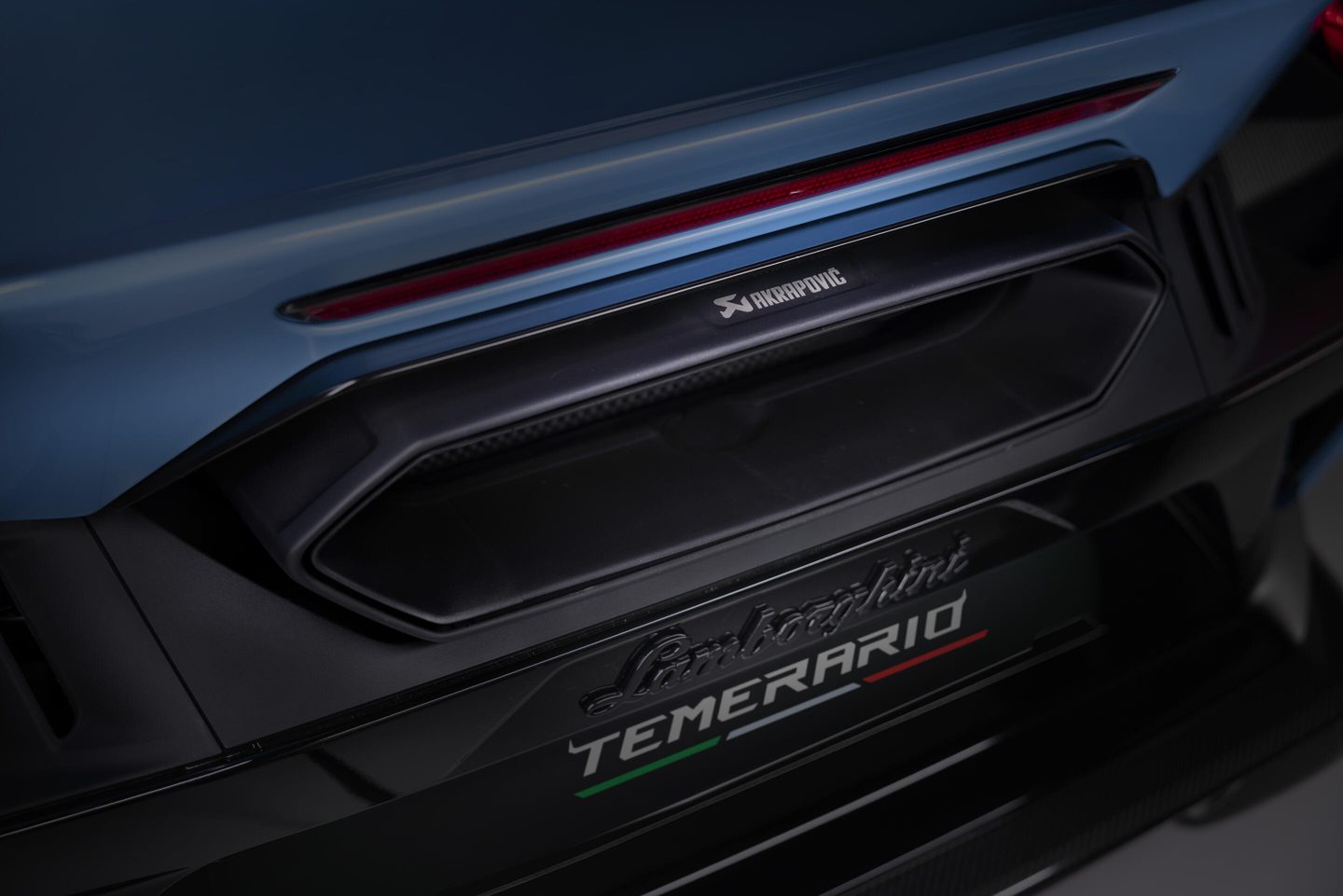
The valve housings are precision cast in Akrapovič’s own foundry.
The tailpipe finishes in black so it blends into the bumper, with the Akrapovič logo sitting on top where a following driver can read it at a light. It’s a small, confident detail, and it fits a partnership that started with the Urus and grew through the Huracán family, including the STO, the Urus SE and the Urus SE Performante.
Lamborghini sells the system through its Accessori Originali catalog. New Temerario coupés can be ordered with it fitted, and owners of cars already delivered can retrofit it, so the earliest buyers aren’t locked out of the upgrade. No price has been published yet.
Retrofit matters more than it might seem. The first Temerarios reached owners before this system existed, and an accessories program that only serves new orders would leave those cars, the ones already at cars and coffee and on track days, running the quieter standard pipes while later builds get the full treatment.
The system also carries forward. Lamborghini will offer it on the first derivative of the Temerario family, due to be revealed within days, so the titanium voice becomes part of the range rather than a one-off experiment for the launch coupé.
Expect the derivative to lean on it hard. An open car puts the exhaust note in the cabin with nothing in between, and a system tuned for tone over volume is the one you’d spec for that job.
Order it if the soundtrack is why you bought a 10,000 rpm V8 in the first place. The weight saving is a footnote at this level, three and a half pounds on a car of this power, but the voice is the daily experience, and this is the exhaust that lets the Temerario sound like its spec sheet reads.


