

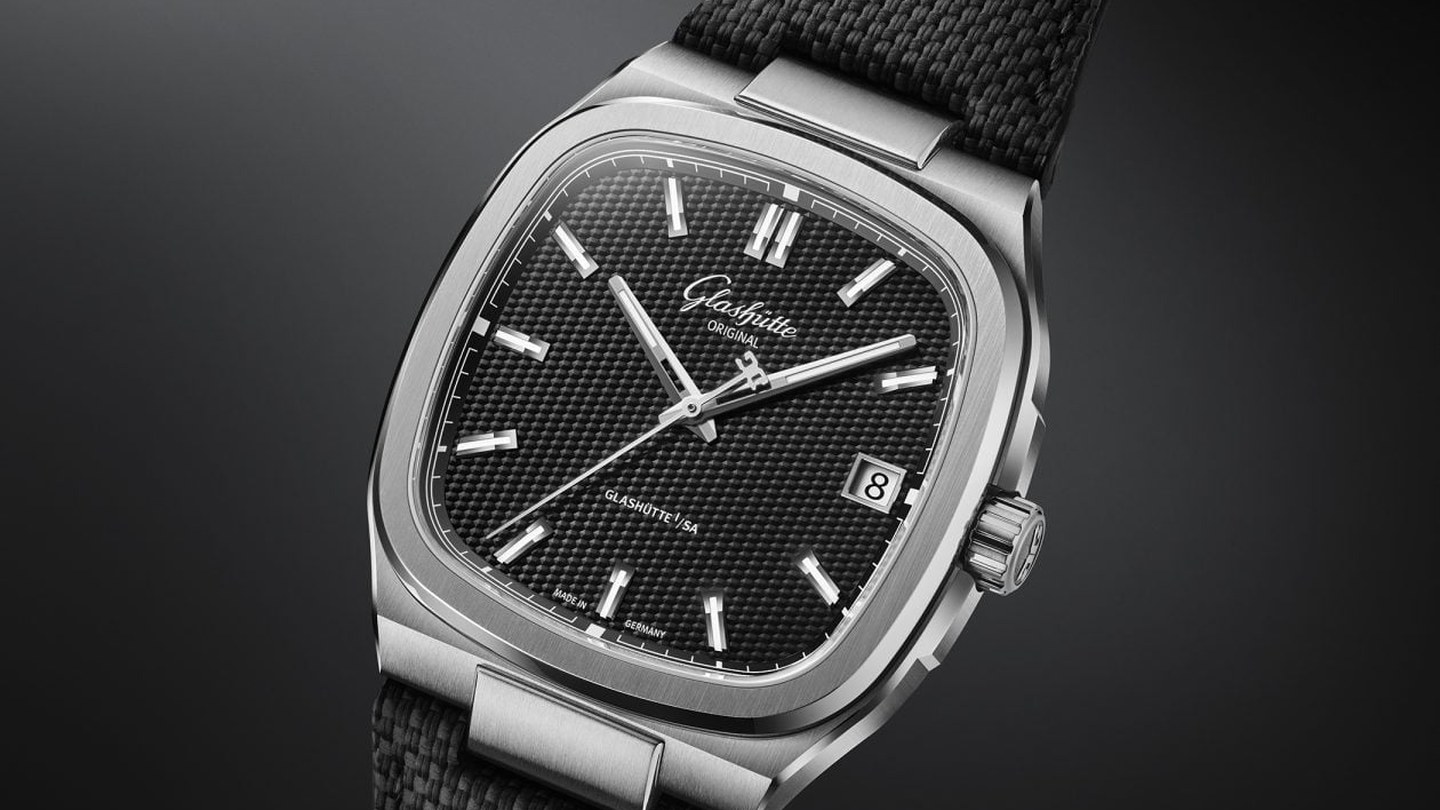
Glashütte Original has rebuilt its three-hand Seventies around a smaller case, a newer movement, and three dials named for the analogue gear of a 1970s living room: Stereo Panel silver after a hi-fi stack, Tweed Amp brown after guitar-amp cloth, Vinyl Record black after an LP. One embossed hexagrid runs across all three, the black watch stops at 500 pieces, and the headline change is a subtraction.
The Panorama Date is gone. In its place sits a small framed window at 3 o’clock, black numerals on white, and the dial gets its symmetry back.
The date window that made the line famous is gone
For decades the Panorama Date has been the house signature: two numeral discs turning level inside one wide window, legible from across a room, recognisable from across a street. Seventies Panorama Date carried the feature in the model’s name, and the whole dial arranged itself around that window, markers bending to its size. Shrink the window to a conventional slot at 3 o’clock, framed in metal, and the watch changes character before you have read a single specification.
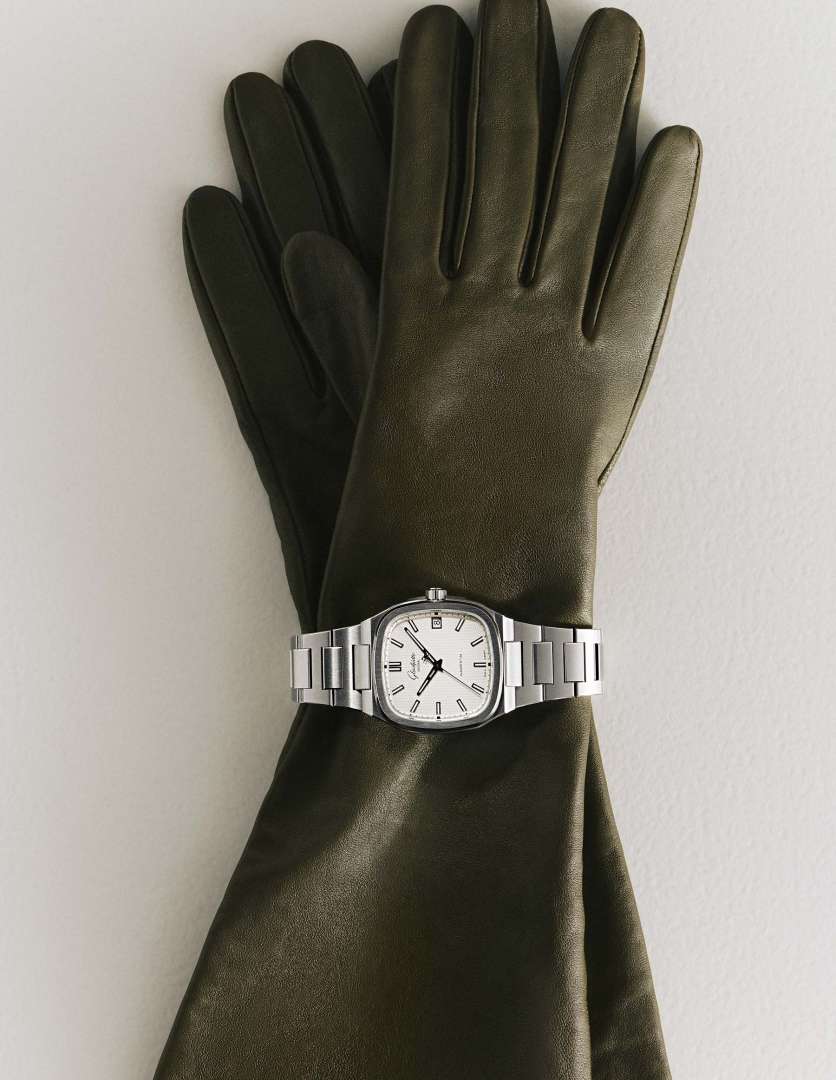
Call it a loss, because it is one: the big date was the most Glashütte detail on this watch, the feature nobody else in the segment builds, and a chunk of the old model’s charm went out with it. Buyers who loved that window will notice. What the trade buys is balance. Nothing on the new dial shouts, the markers sit in a clean ring, and the watch looks like a finished design, not a showcase for one complication.
One millimetre narrower and nearly two thinner
Stainless steel, 39 millimetres across, 9.6 thick, 43.7 from lug to lug. The old watch measured 40 by 11.5 with 46.4 between the lugs, so the shrink is real in every direction the wrist can feel.
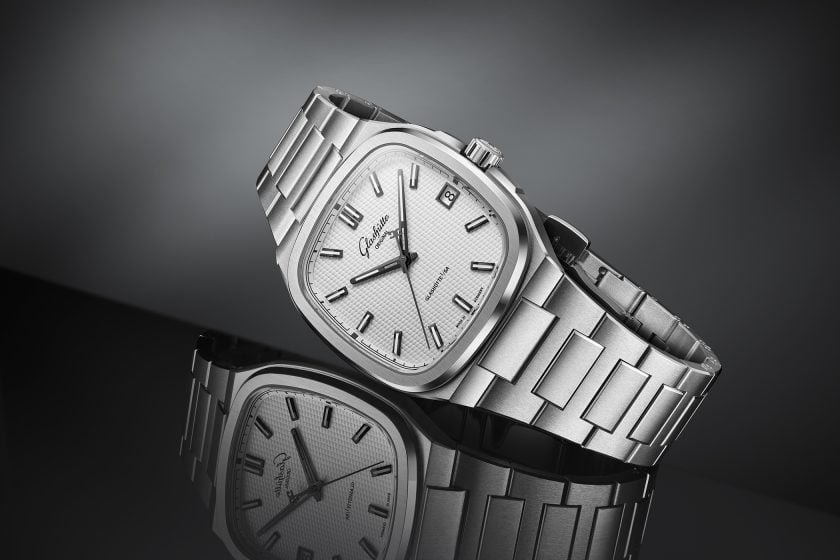
Satin and polished finishes alternate across the case. The crown screws down. Water resistance runs to 100 metres.
Stereo Panel silver takes its cues from a hi-fi front
Silver borrows the face of a 1970s hi-fi stack, all brushed order and straight lines, and the hexagrid in the dial catches light in rows as your wrist turns. Hands and markers are solid gold coated black, filled with Super-LumiNova, so the monochrome holds after dark. Nothing about it chases attention. Of the three dials this is the dressiest, the one that slides under a cuff, pairs with anything you own, and the one I’d hand a first-time Seventies buyer.
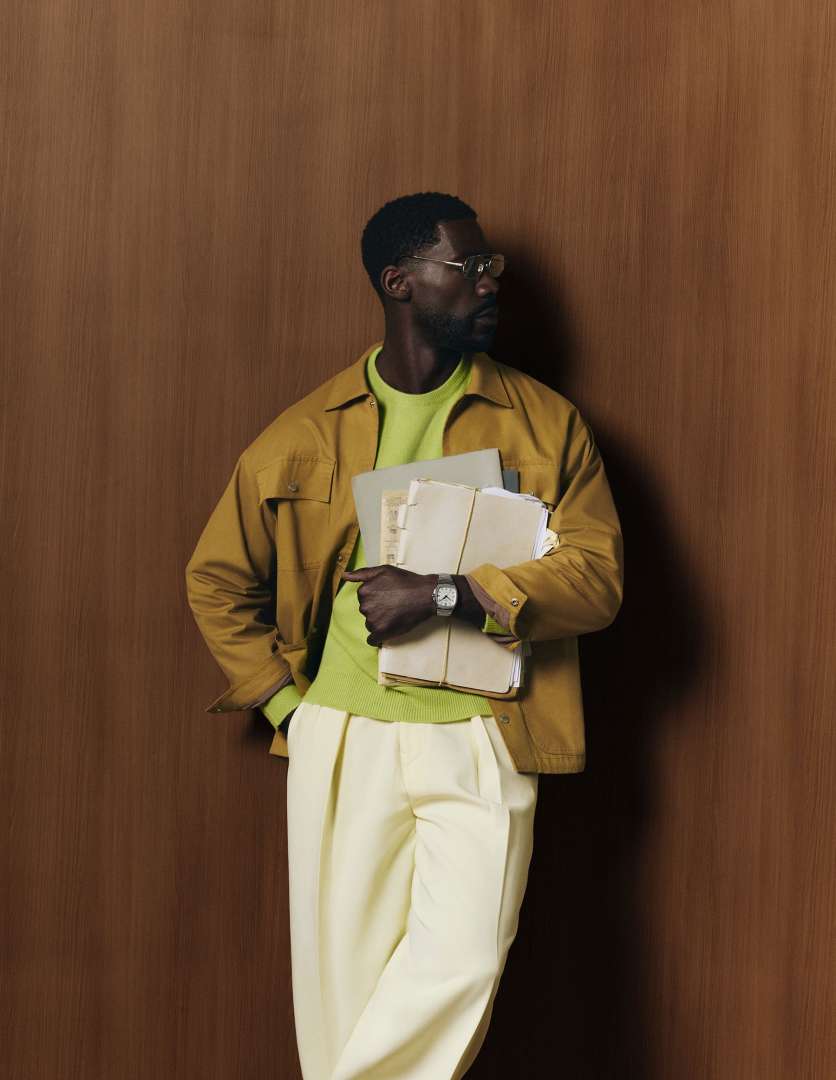
On the steel bracelet it wears as one cast piece of metal from lugs to clasp, no break in the line anywhere. Rubber changes the mood completely: quieter, meaner, more tool than jewel. Both looks work because the dial carries the personality and the case keeps its voice down, a division of labour the old 40-millimetre watch never quite managed with its taller case and louder window competing for the same glance.
Tweed Amp brown wears amplifier cloth on its dial
Brown takes the coarse cloth that covered the guitar amps blues players have sworn by for seventy years and presses that weave into a dial. At this scale the hexagrid stops looking machined and starts looking woven, close enough to touch.
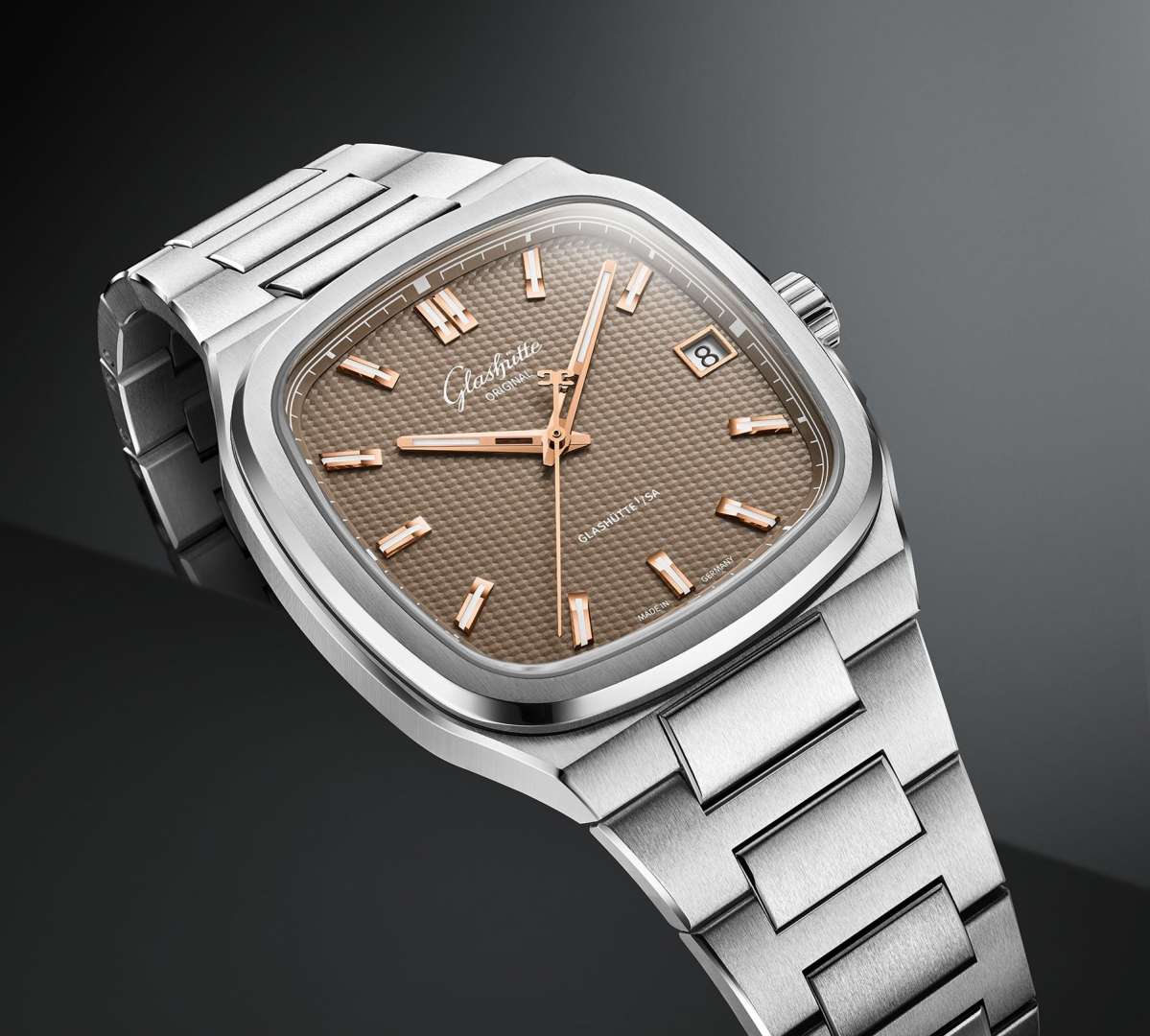
Hands and markers here are solid red gold, warm against brushed steel, a combination this segment rarely attempts. This is the one I’d pick, and it isn’t close. Brown carries the 1970s theme furthest without tipping into costume, the dial changes colour like fabric in the light, and the sand rubber strap in the box makes the watch feel styled by someone who owns records and plays them.
Vinyl Record black is the limited one
Black matches the satin matt finish of an LP, grooves suggested by the same hexagrid pressed darker, so the surface shifts as it turns in your hand. Obelisk hands and markers in solid white gold keep the face monochrome and sharp.
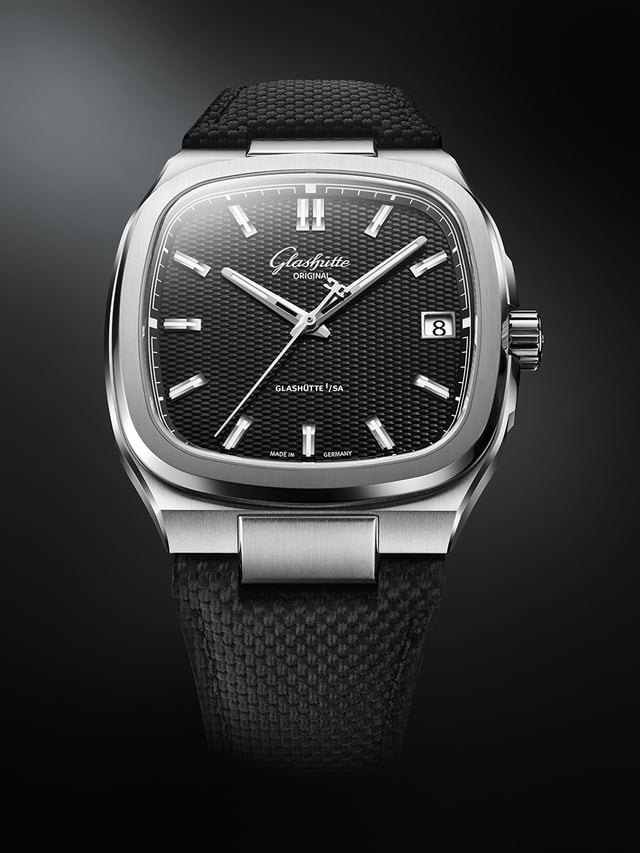
Five hundred pieces. Numbered on the case back. Both straps in the box.
Calibre 36 runs for a hundred hours
Power comes from the manufacture Calibre 36 in two finishes: a rhodium-plated 36-11 behind the silver and brown dials, a dark galvanised 36-10 behind the black. Each beats at 28,800 vibrations an hour, each runs 100 hours off one barrel, and each carries a silicon balance spring that shrugs off magnets and temperature swings alike.
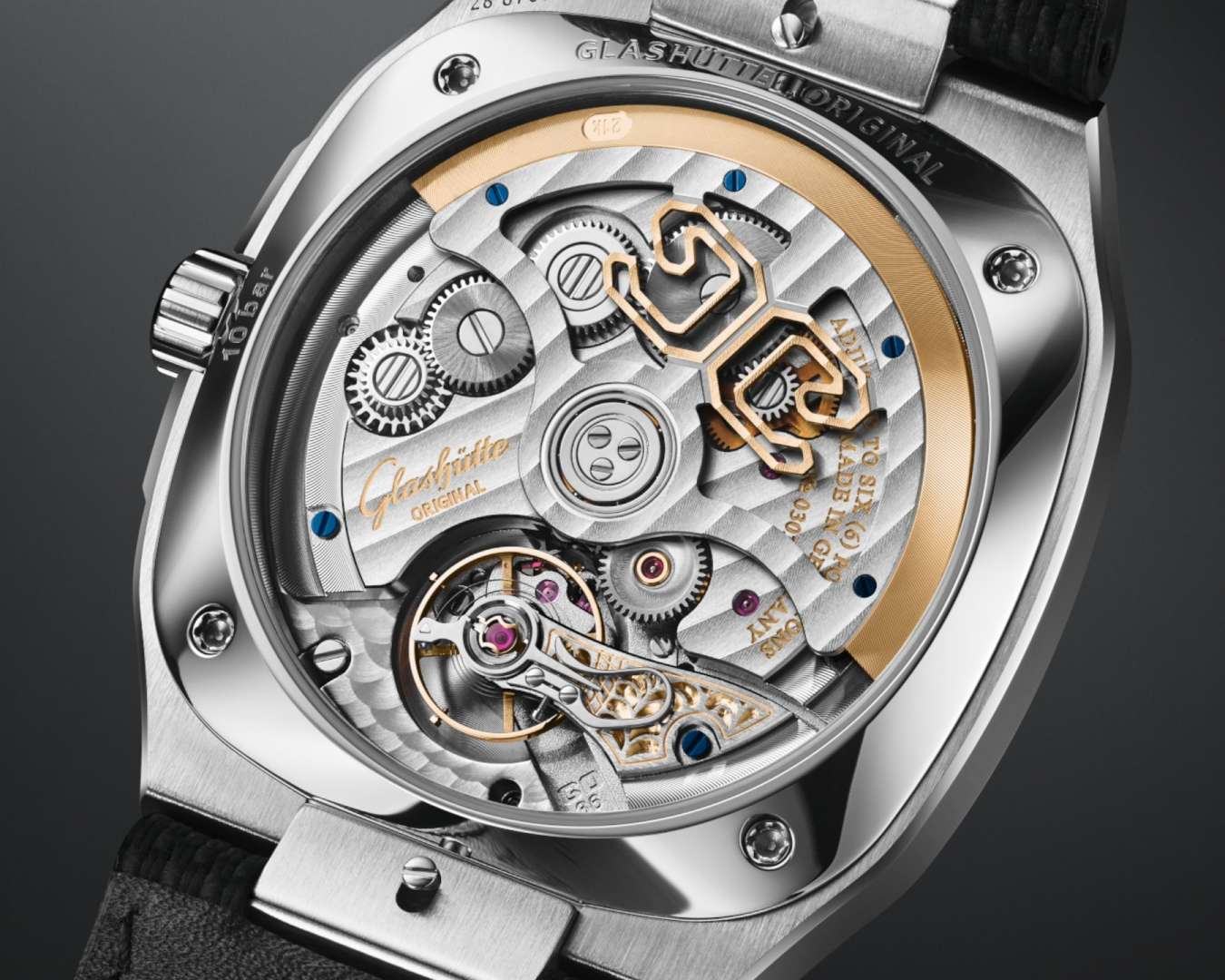
Turn the watch over and the sapphire back earns its place: a three-quarter plate in stripe finish, a balance cock engraved by hand, blued screws scattered through the bridges, and a skeletonised double-G rotor carrying a 21-carat gold oscillating weight. Compare the reserve with the Calibre 39-47 this movement replaces, which managed about 40 hours, and the new calibre more than doubles it while living inside a thinner case. Wind it Monday morning and it is still running Friday.
Groove Lock swaps the strap with no tools
Both strap options connect through Groove Lock, a patented system making its first appearance here.
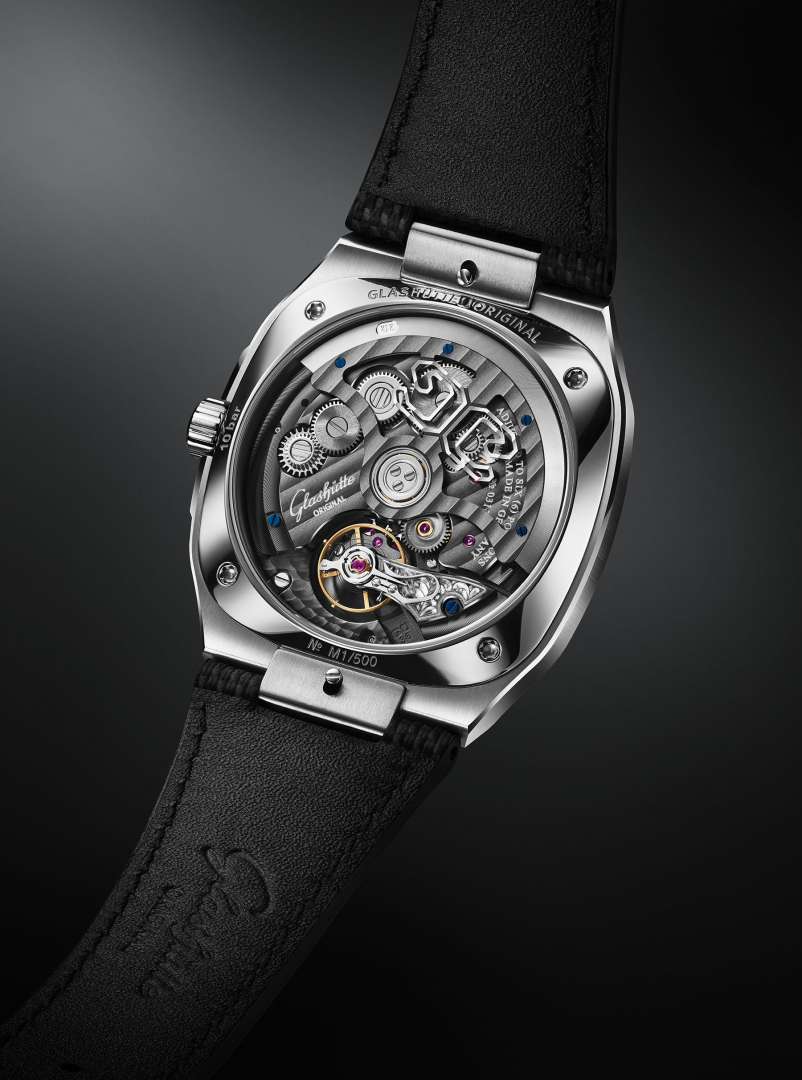
A connector element built into the case meets a matching clasp, and levers, pins, and grooves lock the strap in place with no spring-bar tool near your lugs. Press, swap, go: bracelet for the office, rubber for the weekend, no scratches earned. Integrated-bracelet watches usually punish experimentation, locking you into whichever configuration left the boutique. Glashütte Original built the experiment into the hardware instead, and every version ships ready for both lives from day one.
Pricing stays friendly for a manufacture watch with this much hand finishing. Rubber starts at $13,200 on either regular dial, the steel bracelet adds $1,300, and the limited black set lands at $16,300, which is $1,800 over a bracelet watch while adding the second strap and a 500-piece ceiling. Most of the money buys the movement, the dial work, and the finishing on both sides of the sapphire. That is where money in a watch should go.
Running since 2011, the Seventies line has lived in the shadow of its chronograph sibling. Smaller, thinner, and missing its most famous feature, the three-hand watch finally stands as its own idea. I’d take the brown one on the bracelet, keep the sand rubber in the box for summer, and accept the small date as the price of a watch that wears this well.


