

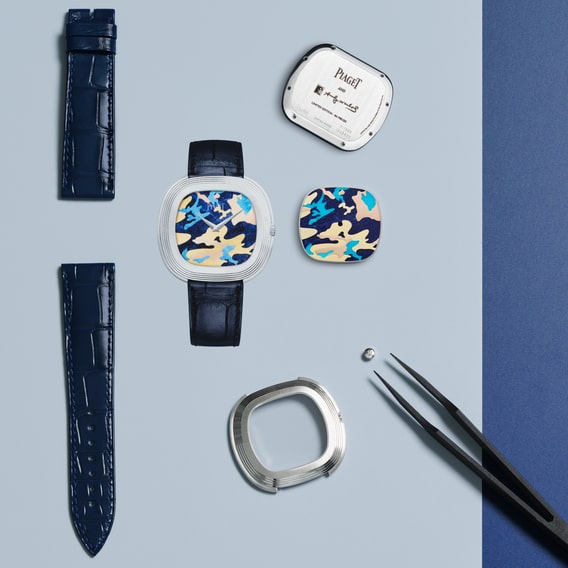
Camouflage was never meant to look this pretty. Piaget cut Warhol’s pattern from sodalite, turquoise and two shades of gold, fitting 27 pieces of stone and metal edge to edge into a single dial.
The Andy Warhol Camouflage is Piaget’s second collaboration piece with The Andy Warhol Foundation for the Visual Arts, limited to 86 pieces in a nod to 1986. It costs $87,500, and every dial takes one artisan more than 100 hours to design, research and assemble. I’ve never seen camouflage look this precious.
Fame, camouflaged. Back in 1986, Warhol painted his own face and then hid it, laying camouflage across his features until the most famous face in art went half-disappeared.
Those self-portraits were among the last works he made, twisting his favorite subject, celebrity, into something warier, a face trying to slip its own fame. Piaget’s artisans worked from that tension, and the dial never resolves into a portrait, staying abstract instead, all color and evasion. The paintings were playing that trick all along.
Twenty-seven pieces, cut like a puzzle
The dial is marquetry, the old decorative art of fitting cut pieces edge to edge until a picture appears, and here the picture is built from 27 individually cut pieces. No two dials come out alike. Deep ocean-blue sodalite does the shadows. Cerulean turquoise flashes where the pattern breaks open, and satin-finished yellow gold and polished pink gold warm the whole thing up like late light.
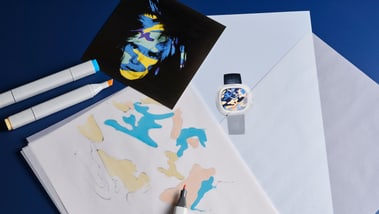
Each piece is cut, fitted and polished by hand, the joins disappearing at reading distance while the pattern stays wild at arm’s length, and the whole surface takes more than 100 hours to finish. Two slim dauphine hands float over the top, and Piaget leaves the surface otherwise bare, because anything printed across this dial would insult the stones and the hands that cut them. The effect up close is pure jewelry, all depth and glint.
Sodalite and turquoise are Piaget signatures, stones the maison has cut since its first ornamental dials, and both behave badly under the cutter, chipping if the hand rushes. That’s why the hours pile up. Gold behaves better, which is its own problem, because the metal pieces have to meet stone edges that never forgive a gap.
The cushion case Warhol collected
The frame is the famous one, a 45 by 43 mm cushion of rhodium-finished 18K white gold with stepped, gadrooned sides, and it measures just 8.08 mm thick. It dates to 1972. Warhol owned seven Piaget watches, and this silhouette was his era’s signature, the dress watch of Studio 54 nights and gallery dinners alike. The ridges catch light in stripes as the wrist turns.
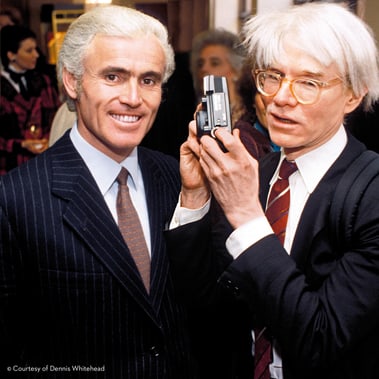
His friendship with the maison ran deep, and in 2024 Piaget formalized it, securing the exclusive right to use Warhol’s name and renaming this collection for him. The first collaboration piece arrived last year. This second one goes bluer, cooler and bolder, swapping the earlier warmth for ocean stone and white gold.
The Foundation’s share of licensing proceeds funds its grants for contemporary art, so the collaboration pays forward into the art world Warhol came from. The money loops back to working artists, which feels exactly right.
Before the rename, the line lived as the Black Tie, a connoisseur’s secret passed between collectors who liked their dress watches with a little sculpture in them. The Warhol name suits it better. He made celebrity into a surface, and this watch has always been a surface first and a timekeeper second. The gadroons help, ridges running around the case like the frame of a painting that refuses to be flat.
Thin, automatic and signed on the back
On the wrist the thinness does the talking, the cushion spreading its weight wide while the case stays slim enough to slide under a cuff without a fight. Water resistance is 3 bar, which means splashes, not swimming. This is a gallery watch, and it knows it. Mine would never leave the wrist.
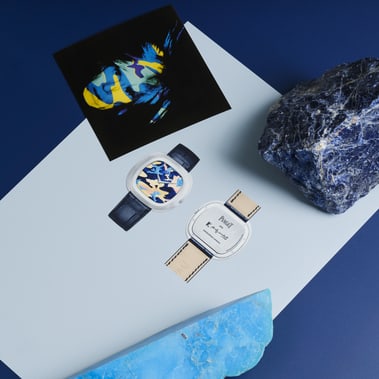
Under the solid caseback sits Piaget’s Manufacture 501P1, a self-winding movement only 3.63 mm thick and 20.5 mm across. It runs at 28,800 vibrations per hour on 23 jewels, holds 40 hours of power reserve, and wears its finishing properly: circular Côtes de Genève, bevelled bridges, blue screws and a slate-grey tungsten rotor. The caseback itself is satin-finished white gold.
Piaget laser-engraves Warhol’s signature and the individual edition number into that caseback, so every one of the 86 carries its own identity on the metal. A blue alligator strap and a rhodium-finished gold ardillon buckle finish the watch. It’s the prettiest signature in watchmaking this year.
At $87,500 the Camouflage isn’t really competing with other watches. It’s competing with art, and on that field it wins easily, because you can’t wear a silkscreen to dinner. Eighty-six collectors will get the joke, and the rest of us get to stare. I’d wear it with absolutely everything, and let the room do the adjusting.


