


MOBO is AiMOGA’s first home companion robot, a 0.9 meter humanoid built for family rooms instead of showrooms. Chery’s embodied AI brand opened global pre-orders for it at the 2026 Chery International User Summit in Wuhu.
MOBO first appeared at the World Robot Conference and the World Manufacturing Convention earlier this year, drawing strong interest at both shows. Interest followed it home. AiMOGA counts more than 10,000 prospective users since that August debut, and 35 early users became its first Global User Experience Officers with a year of free use.
The launch moves AiMOGA out of commercial service work and into the consumer home market for the first time. Its wider fleet already covers dealerships, retail floors, traffic management, security, education and healthcare, with cumulative deliveries past 3,000 units in more than 60 countries and regions.
MoAgent plans past a single command
MoAgent, AiMOGA’s proprietary AI brain, breaks complex instructions into steps and plans long-horizon tasks on its own. That turns a question-and-answer exchange into goal-driven help, where the robot sequences the work instead of waiting for the next prompt.
Planning runs ahead of action. A dual-brain layout pairs long-term planning with rapid responses, and AiMOGA quotes interruption response times under 0.2 seconds, with up to 16 tasks running in parallel before a paused job resumes.
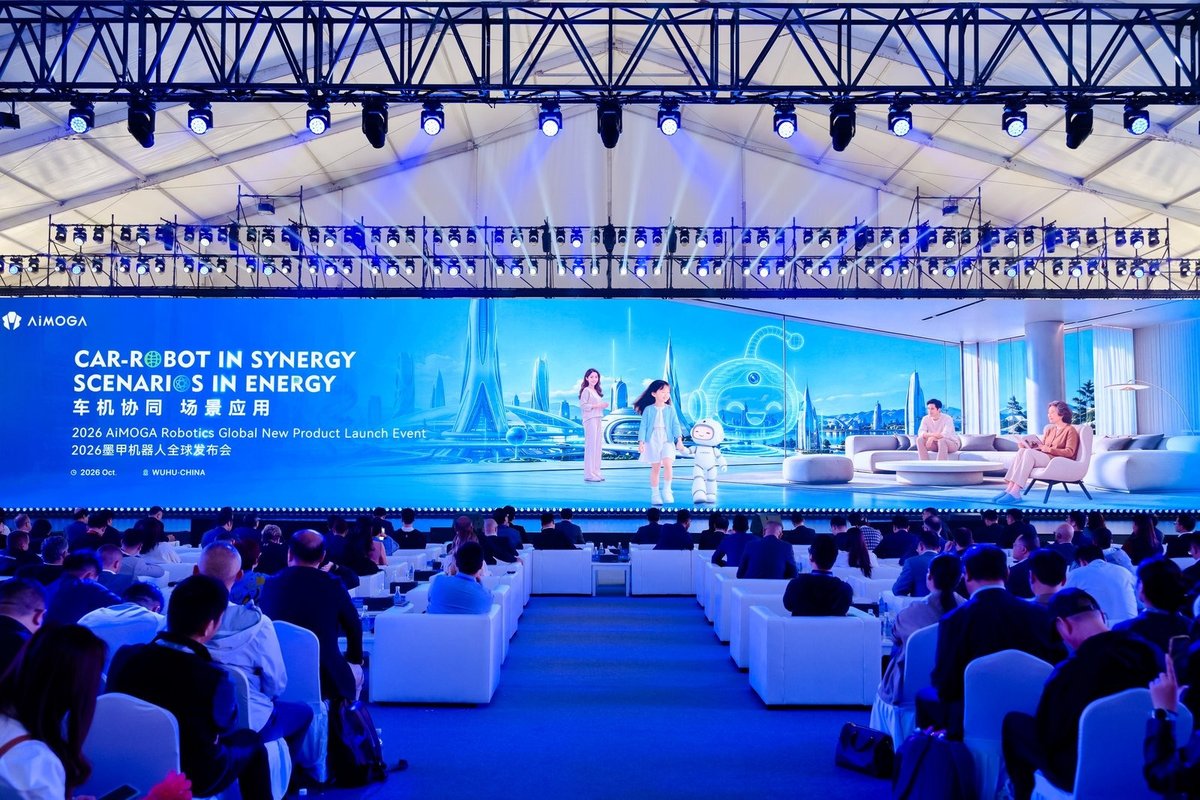
The summit floor put MOBO in a wider family of machines, with police robots patrolling mock traffic, healthcare robots guiding visitors and Mornine presenting on stage. Argos Pro, the quadruped, carried loads and followed handlers through its own zone. MOBO’s zone stayed domestic, with hands-on demonstrations running while pre-orders opened.
Memory inside MoAgent sorts facts, experiences and patterns into layers, so a preference learned once can guide a later task. A world model simulates changes in the physical environment and checks task outcomes, while MogaCloud handles remote task assignment and over-the-air updates.
A small body with 22 ways to move
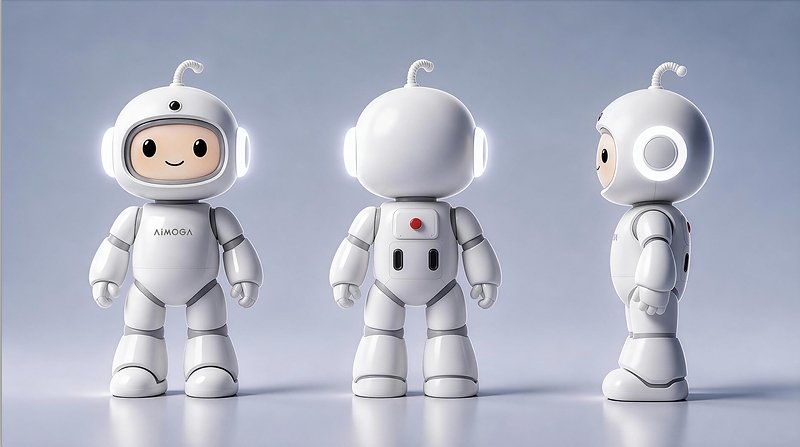
MOBO stands 0.9 meters tall and moves on a full-body system with 22 degrees of freedom. Those joints drive smooth gestures and dance routines, the kind of motion that lands as expression during a conversation at home.
Speech is only half the channel. It supports more than 20 languages for voice interaction, which suits households that mix languages across generations, and vision joins voice in every exchange so the robot can identify an object mid-conversation.
Five layers do the sensing work: spatial perception, interaction, execution, decision-making and cognition form a loop that feeds each new action. Social navigation reads pedestrian paths and interaction spaces, so MOBO adjusts its route around people instead of treating them as fixed obstacles. Each pass through the loop updates the next move.
Memory, navigation and privacy at home
Spatial perception lets MOBO map a home, navigate on its own and avoid obstacles that move into its path. Dynamic obstacle avoidance handles the moving kind, from a chair pushed back to a person crossing the room mid-task.
It remembers, with limits. Long-term memory stores each family member’s habits and preferences, and Face ID links those memories to the right person. Privacy protection is built in from the outset, with eligible data de-identified on the device before any cloud learning or validation step runs.
The first 35 Global User Experience Officers each receive a year of complimentary use, and their detailed feedback feeds directly into product and service changes over that year. That co-creation loop counts for a first consumer product, because home robots get judged in kitchens and hallways, not on launch stages. AiMOGA gets a year of real rooms to learn from.
Three jobs at home, and a car brain underneath
AiMOGA built MOBO around three scenarios: companionship for older adults, companionship for children and care for the whole family. Children get object recognition, question-and-answer help, storytelling and interactive English learning. Older relatives get conversation and self-set reminders.
Underneath sits CheryMind, the domain-specific foundation model behind the group’s intelligent mobility system, applying road-tested perception, decision-making, path planning and motion control to indoor rooms. Cars taught it roads. The same principles guide LUXEED vehicles through navigation and Super Intelligent Valet Parking, and AiMOGA plans a network of 300 experience centers to sell, service and demonstrate the robots.
Global pre-orders are open, and AiMOGA has published no price for MOBO, so early orders rest on the spec sheet alone. MOBO suits families who want a companion that talks, moves and remembers, and households whose job list starts with chores should skip it.


