

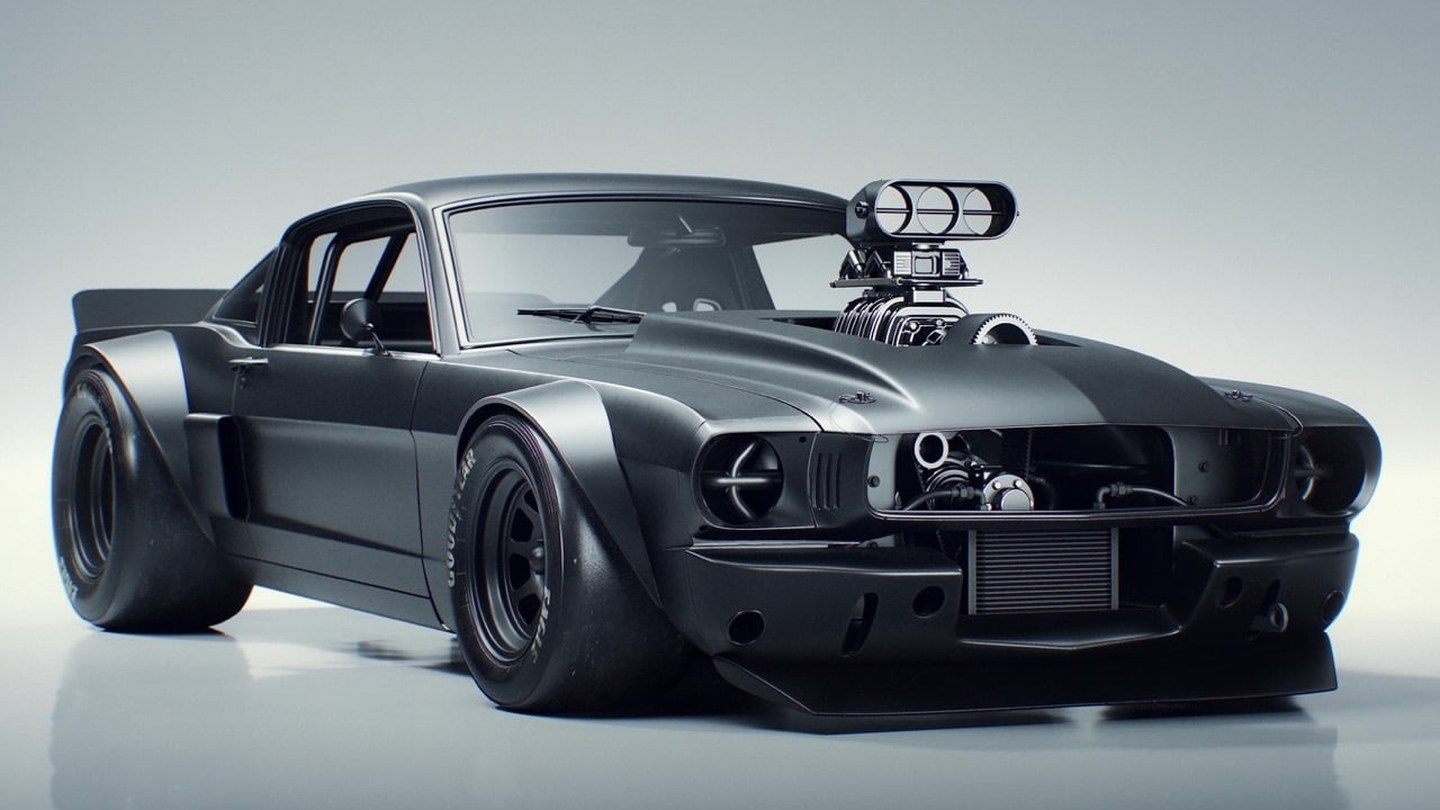
No grille. No chrome worth naming. Just satin black panels, box flares at all four corners, and a polished supercharger standing through the hood where a scoop would normally sit. This 1965 fastback render is the loudest quiet car on the internet this week.
It is not a shop build, and it never pretends to be steel. John Rendering, a 3D artist based in São Paulo, Brazil, published the project on Behance on November 4 under the title 1965 Ford Mustang | V8 Restomod, working from a 3D model credited to wirewheels.club and tagging the work for Autodesk 3ds Max and Corona Renderer.
The car exists as pixels, staged inside a seamless gray studio. That limit becomes the appeal, because a render can push proportions well past anything a cutting wheel would forgive.
Satin black first, nostalgia second
Start at the nose, because the nose has been emptied. The grille opening stays, the grille itself is gone, and the V8 hardware behind it becomes the face of the car, pulleys, hoses and all.
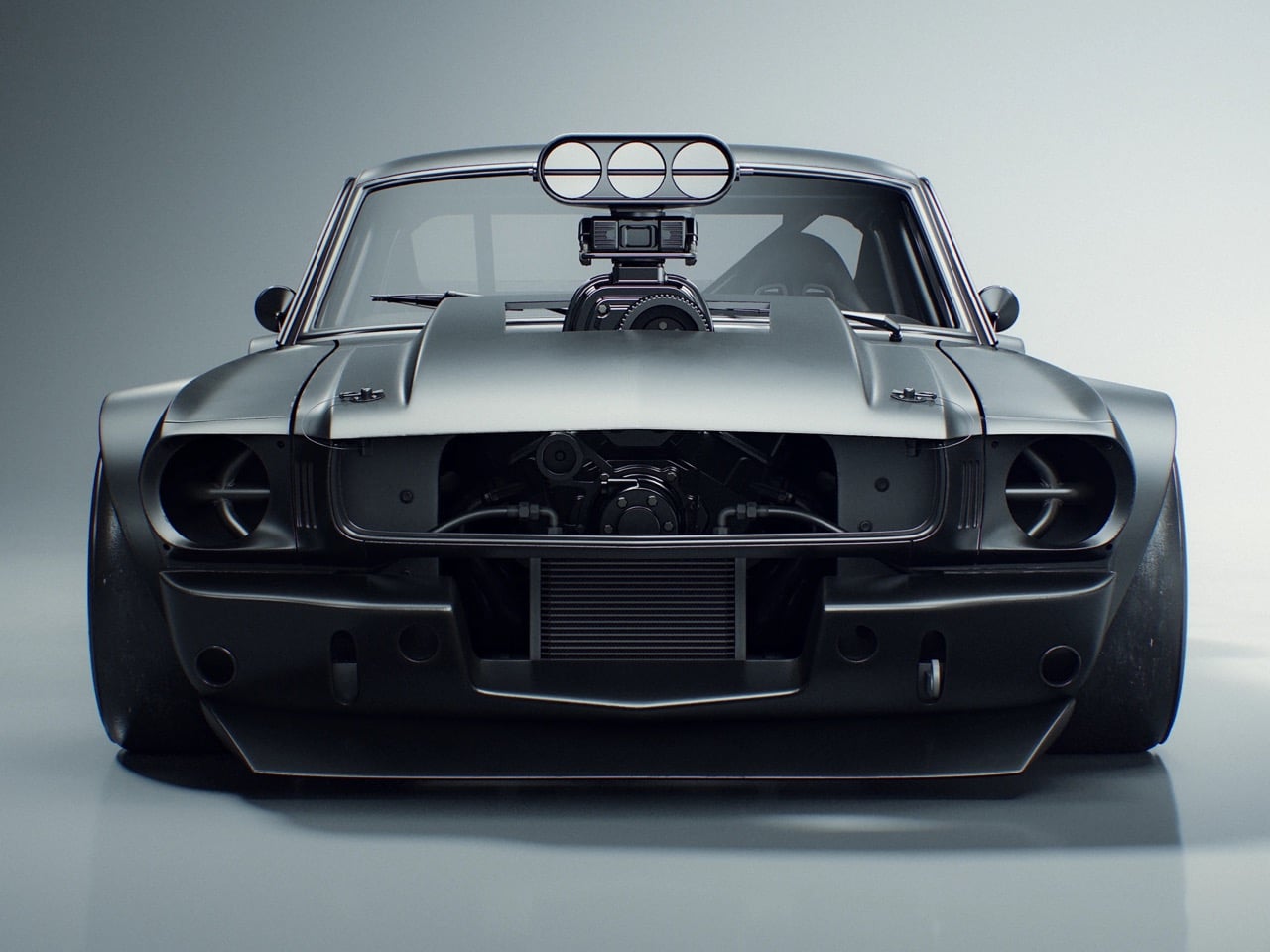
Down low, a cooler sits inside a reshaped valance above a deep front splitter, while the round headlight buckets stand hollow, crossed by a single bar each. Nothing up front is decorative. Every opening either feeds something, cools something, or gets out of the way, and the satin finish keeps all of that machinery looking calm instead of cluttered.
Black paint, zero shout. The hardware does the shouting.
It sets the tone for everything behind the nose, too, arches included.
Box flares with a Tokyo accent
Those four flares carry the design. They sit flat faced and squared off, bolted in spirit rather than blended into the fenders, the same visual language that made Japanese widebody builds famous on cars half this size and twice as polite.
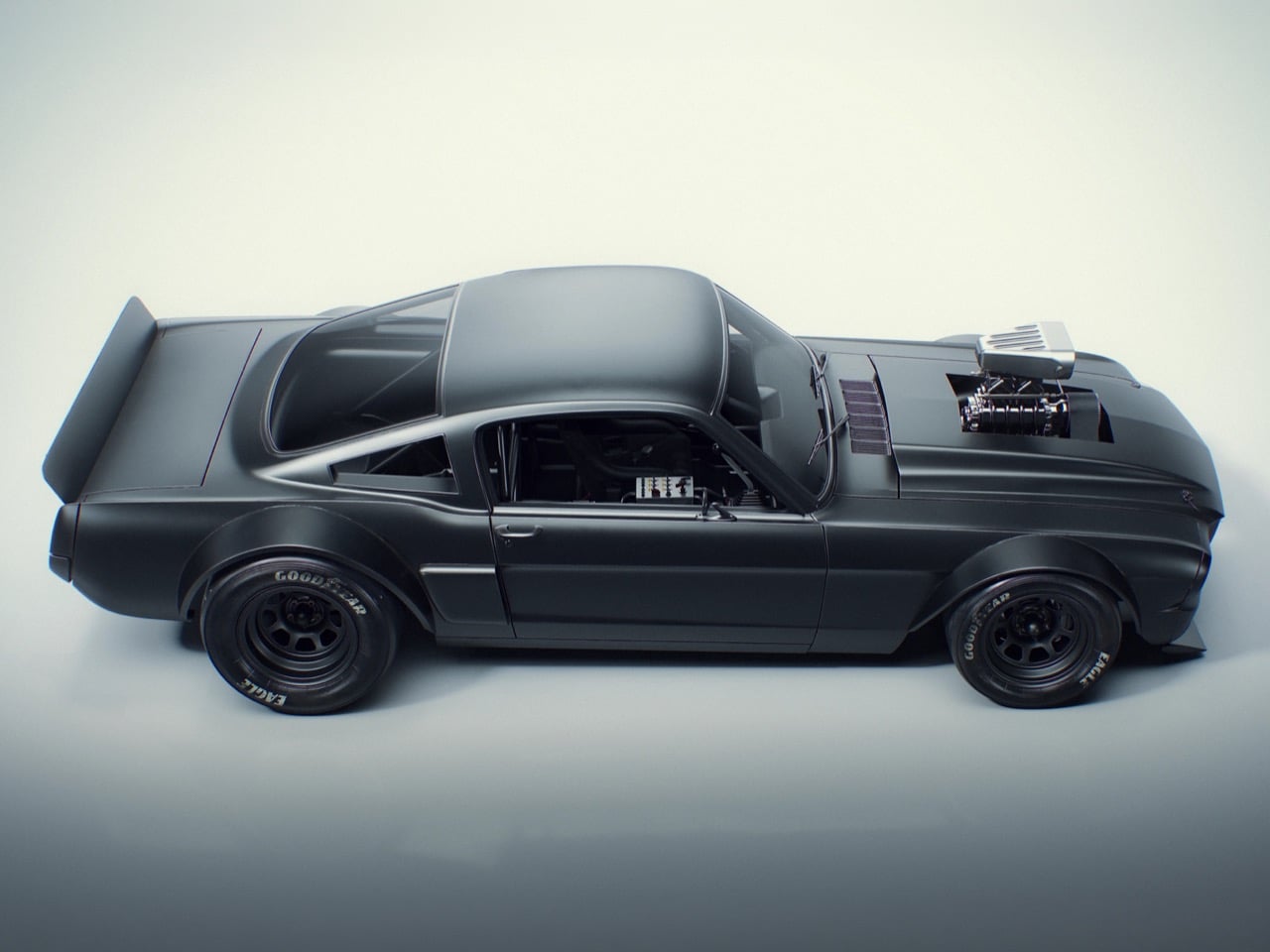
A rocker blade runs between the front and rear arches, tying the extra width into one line. The stance drops so low that the blade hovers just above the studio floor, and the rear tires swell far beyond the original bodywork, wide enough to change the silhouette from every angle. From above, the car looks pinched at the cabin and swollen at both ends.
American muscle rarely wears this cut. Here, it fits.
A drag strip fantasy, rendered
No engine spec was published with the project, so the powertrain story stays visual. What the render promises is a blown V8 in the classic drag racing mold, all finned casing and exposed belt drive, wearing a tall scoop with three round openings.

The supporting cast agrees with that fantasy. Goodyear Eagle lettering wraps the drag rubber, black race wheels fill the arches, and a roll cage fills the cabin behind a single racing seat. This is a car drawn for a Saturday night launch, not a Sunday cruise, and every surface keeps pointing back to the strip.
Would it hook up? A render never has to answer.
No timing slip, no dyno sheet, no excuses, and no apologies for any of it.
That freedom cuts both ways, though. A real build would need cooling, steering lock and suspension travel, and each fix would soften the stance a little. The render keeps the impossible version, slammed and swollen, which is exactly why it travels so well as an image.
At the back, the blade does the shouting
Turn the car around and the fastback taper runs into a flat spoiler blade, mounted high on four slim stays. It looks borrowed from a time attack paddock, and it refuses to follow the roofline down.
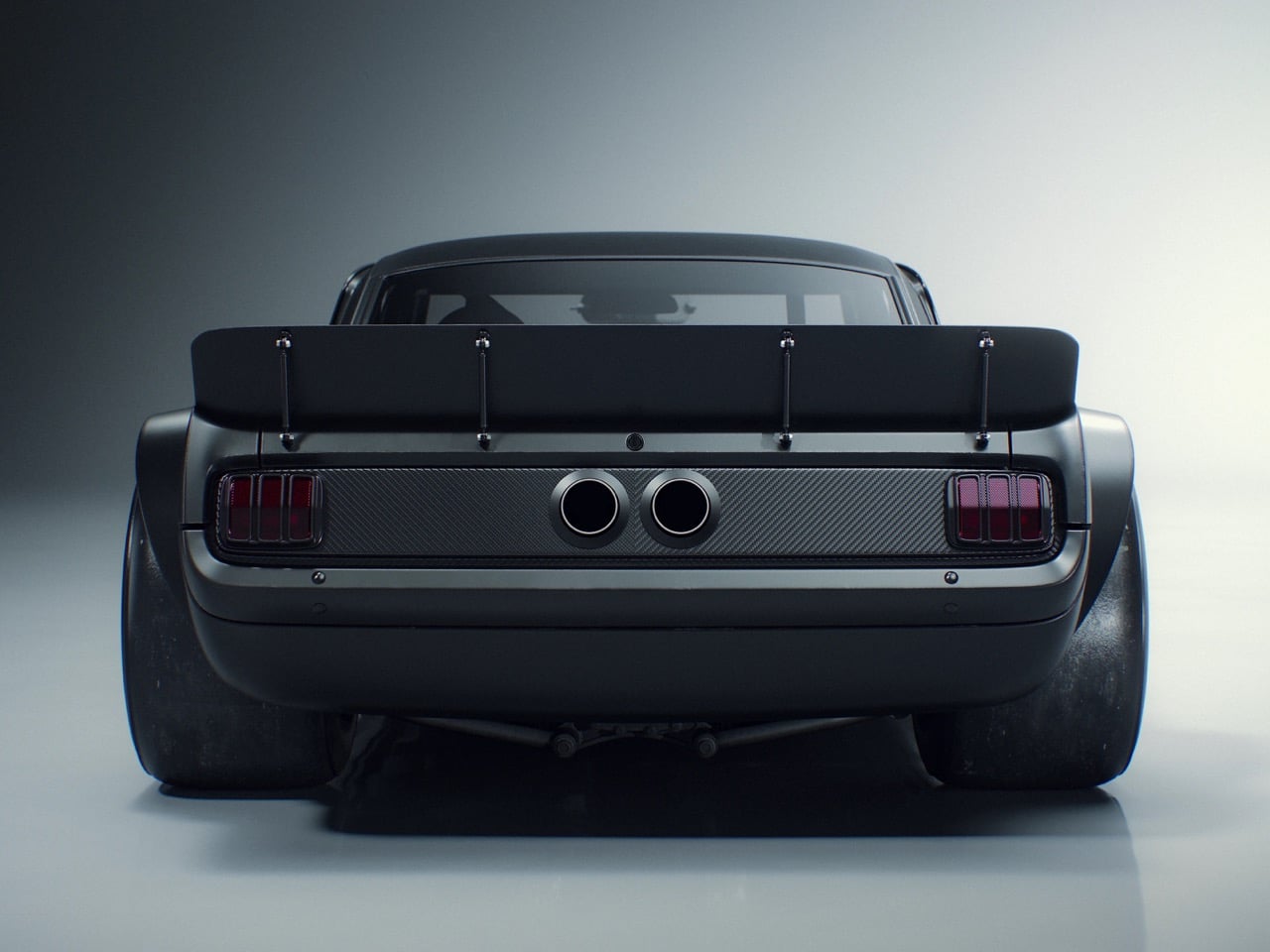
Below that blade, the rear panel switches to carbon fiber, carrying two large center exit exhausts between the classic three bar taillights, now tinted a smoked red. The original lamp shape survives intact, which anchors the whole rear view in 1965 even while the panel, the exhausts and the blade pull hard toward a modern race car.
The rear view also gives away the width best. Those rear tires sit outside the original quarters by a distance you notice before you notice the exhausts, filling the arches to the lip and squaring the whole tail. Park this shape beside a stock 1965 rear view and the stock car looks narrow, almost delicate, though it never looked that way in its own decade.
One polite gesture to the original. Only one.
The fastback shape survives all of it
Strip away the flares, the blower and the blade in your head, and the remaining outline is still pure first generation fastback, long hood, short deck and that single roofline sweep into the tail. John Rendering keeps those proportions untouched, and that restraint is why the wild parts land.
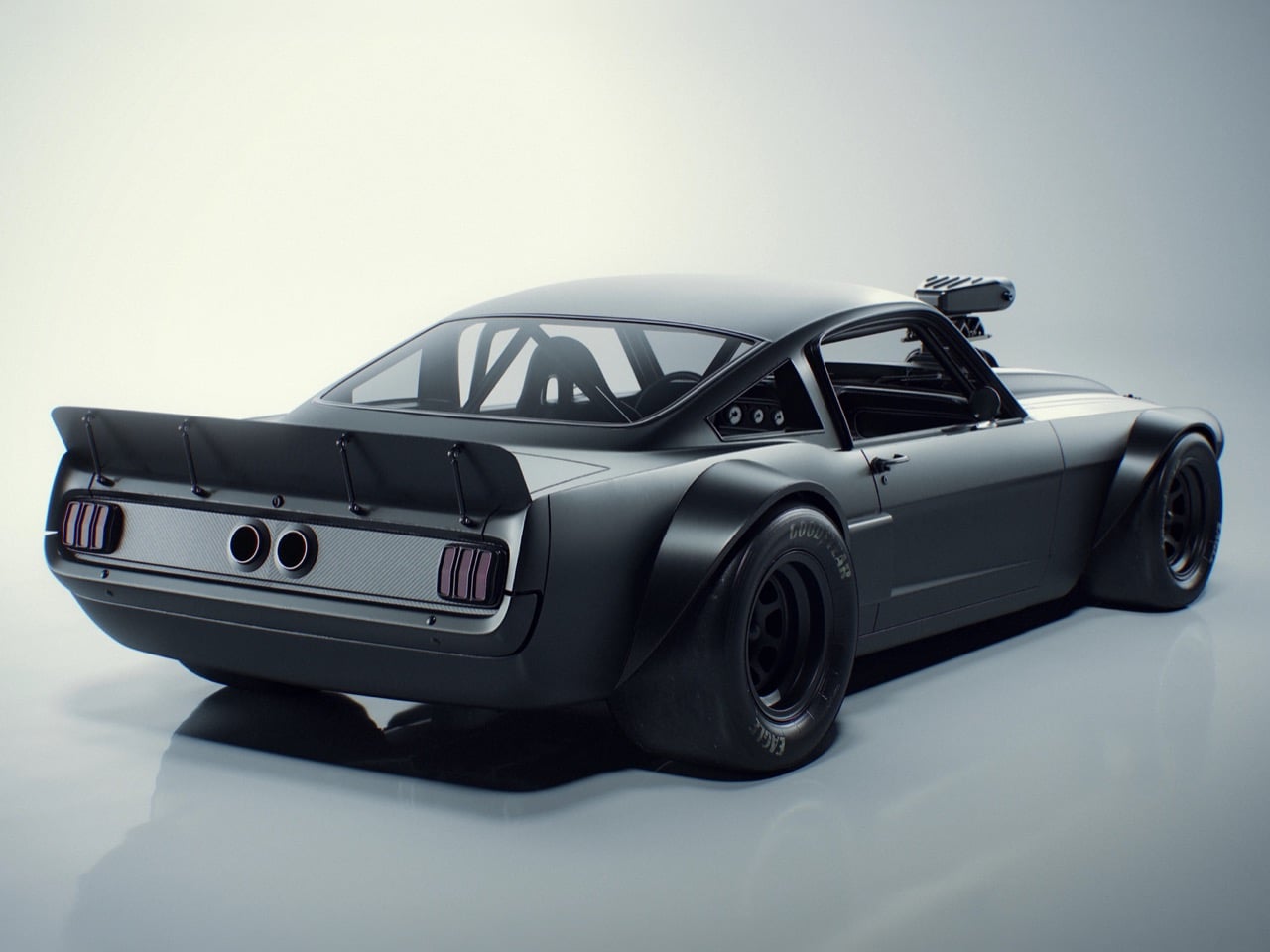
Sixty years of restomods have proved the same point from different directions. This silhouette can take almost any treatment, steel or digital, and stay instantly recognizable across a parking lot or a phone screen. The satin black finish helps here too, letting reflections draw the old curves while the new hardware sits in shadow, so your eye reads the shape before it reads the modifications.
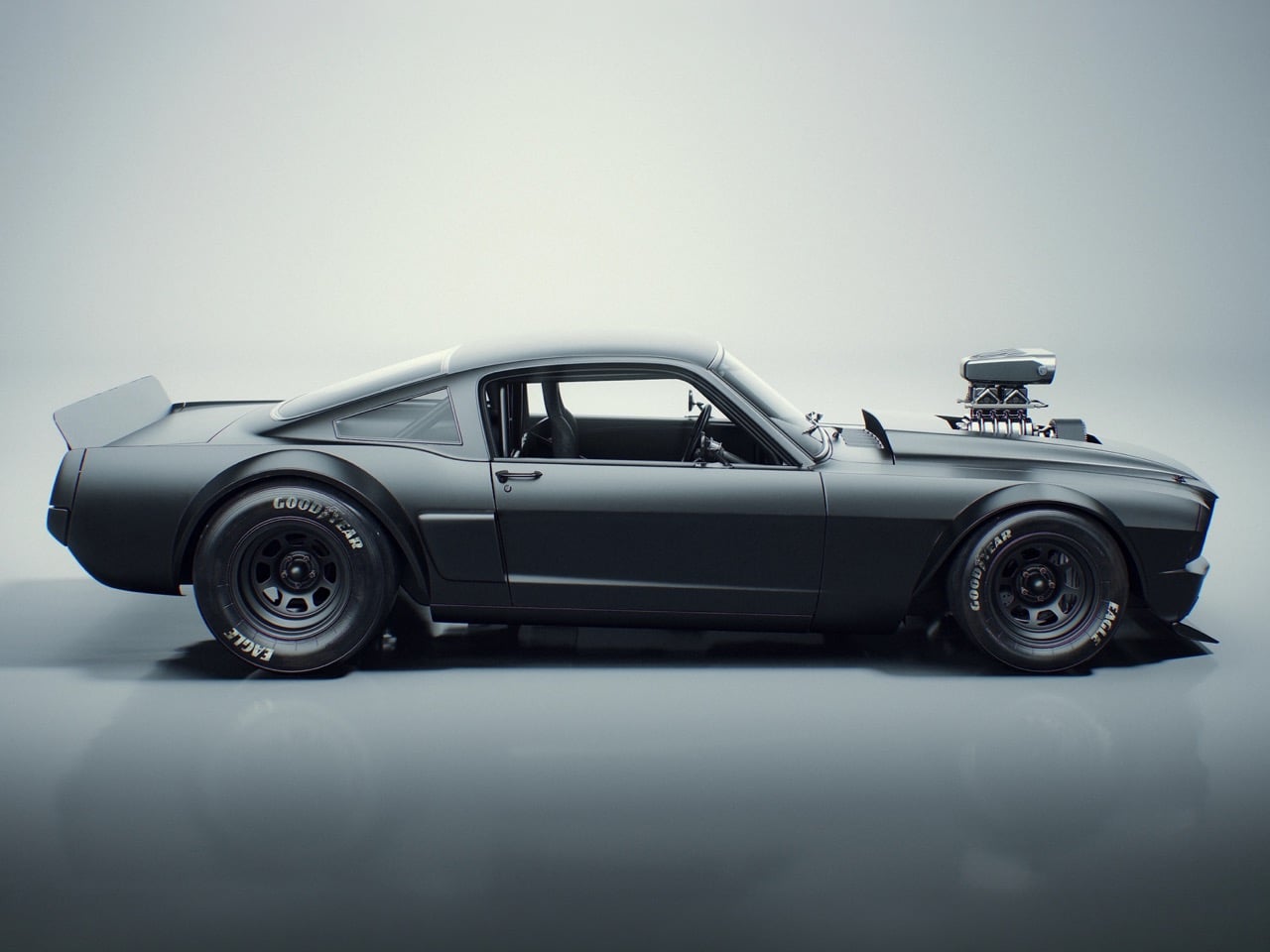
Somewhere, a real shop is looking at these frames and doing arithmetic on fender metal. That tends to happen with renders this resolved.
The best concept renders do exactly that job. They test a look in public, at full scale and full gloss, long before anyone commits real money or real sheetmetal to building it.
For now the car lives only on Behance, which suits it fine. A physical version would need a very understanding neighborhood, a tolerant suspension engineer and a hood nobody minded cutting. As a design study, it needs none of that, just a sixty year old silhouette strong enough to carry box flares, a deleted grille and a blower, and still be a fastback first.


