

Qatar Museums unveils Doha Pavilion: Gerhard Richter on 20 November, a permanent pavilion in MIA Park designed by the artist himself. Selldorf Architects worked with Richter to realise the building, which stands outside the Museum of Islamic Art.
Artists design pavilions often. Artists designing a permanent home for their own paintings and sculpture, and treating the building itself as part of the artwork, is a rarer proposition. Richter, at 94, has built himself a room that behaves like one of his works, at architectural scale.
- Permanent, site-specific pavilion
- MIA Park, Doha
- Unveiled 20 November 2026
The pavilion is permanent and site-specific.
Six walls wrapped in his own patterns
The announcement came in September, at an event in Berlin, with the opening set for November. Two months from announcement to unveiling is fast for a permanent building, and it signals how long the project had been developing in private before Qatar Museums said a word in public. Richter’s idea had been waiting since 2013 for its moment. The speed was a statement in itself.
MIA Park wraps around the Museum of Islamic Art on Doha’s waterfront. Families picnic on its lawns while the skyline across the water does the rest. The park is one of the most visited public spaces in the country, a deliberate choice for a permanent artwork. The pavilion lands in the middle of that daily life rather than behind a fence.
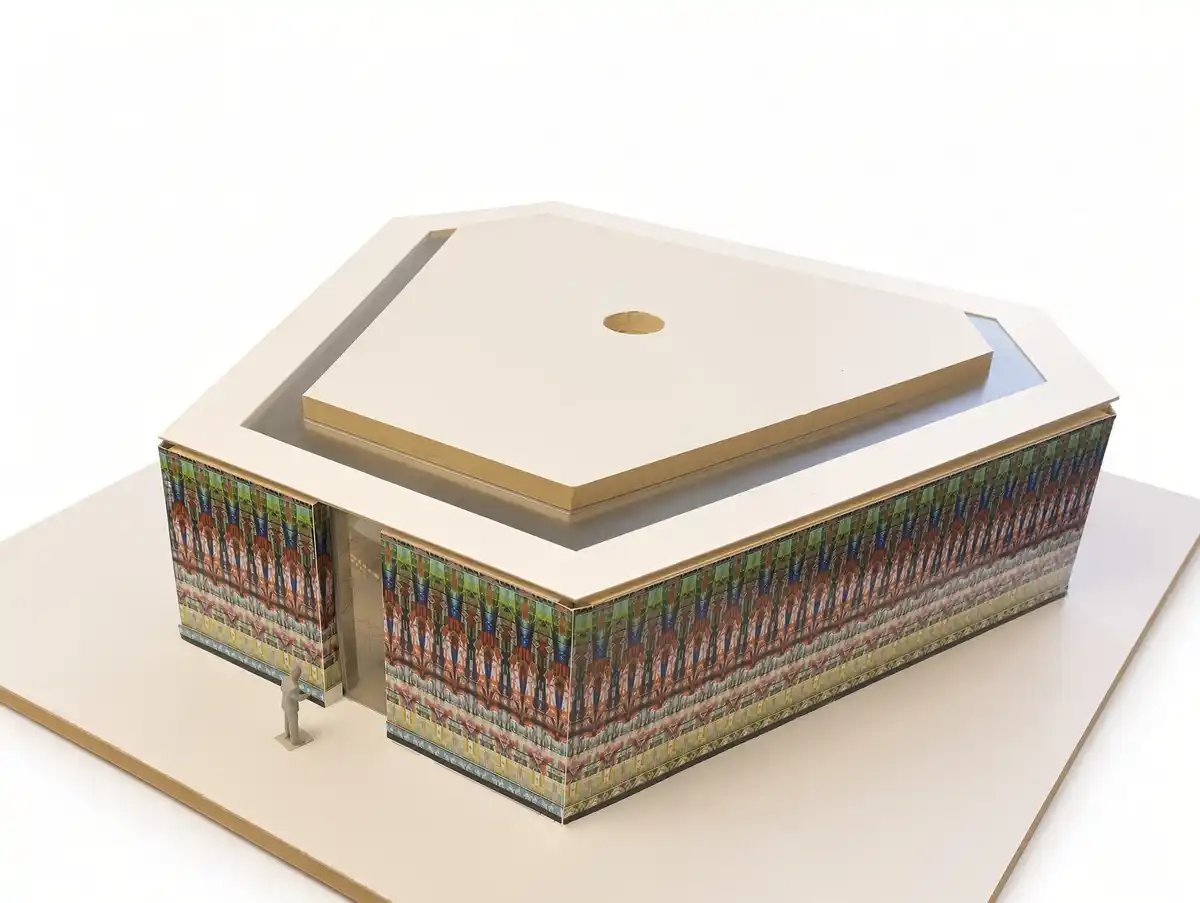
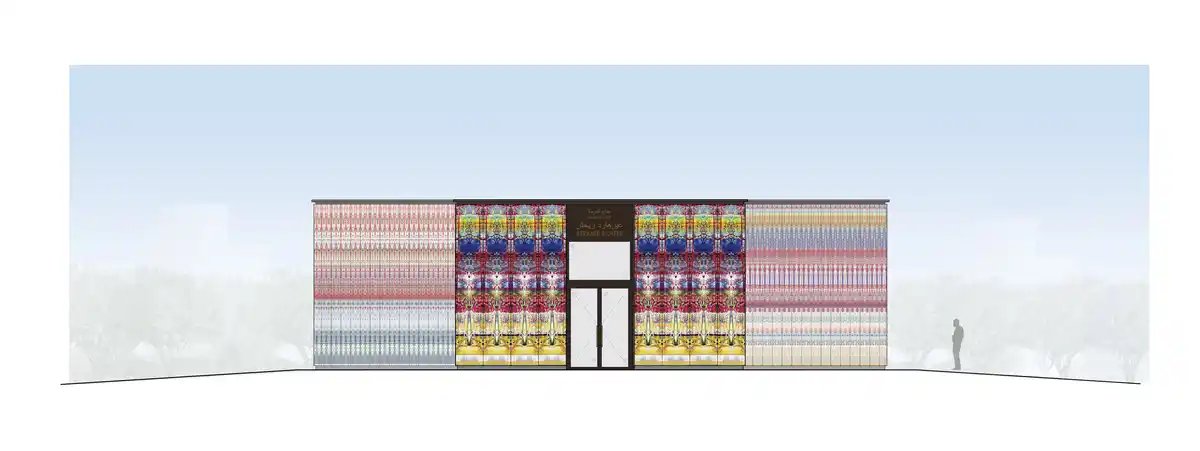
Six walls make a hexagon, and every wall wears printed panels. The patterns come from Richter’s digital experiments, the same process that produced his Strip paintings, scaled up from canvas to architecture and wrapped around a building visitors can walk into. Every approach across the grass becomes a first impression.
The source image is his Abstract Painting (724-4) from 1990. Richter divided that painting into vertical strips, then divided the strips again and again, and the repetitions became a visual system he has worked with ever since, in prints, in books and now in cladding.
His 2011 artist’s book, Patterns, documented that process page by page.
Printed panels carry the patterns rather than paint. Panels can be produced at architectural scale, replaced if damaged and read from a distance, and printing keeps every strip edge sharp in a way a painter’s hand on a wall never could. The building wears reproduction as its surface, on purpose.
The pavilion takes the book outdoors, printing the patterns across panels that wrap the building on every side. From across the park the hexagon looks like a single shimmering object, and only up close does the surface resolve into thousands of repeated slices of one painting.
Islamic art’s geometric traditions sit across the park at the Museum of Islamic Art. Richter has pointed to that kinship himself, and the siting sets pattern answering pattern across the lawns of MIA Park, a German painter’s system in conversation with centuries of Islamic geometry. The two systems were never meant to meet, which is what makes the meeting worth looking at.
Selldorf Architects brings museum manners to the project. The practice is known for quiet, exact buildings that serve art rather than compete with it, and realising an artist’s design calls for exactly that discipline, translating a painter’s system into panels, joints and tolerances.
Paintings, mirrors and a tower of strips inside
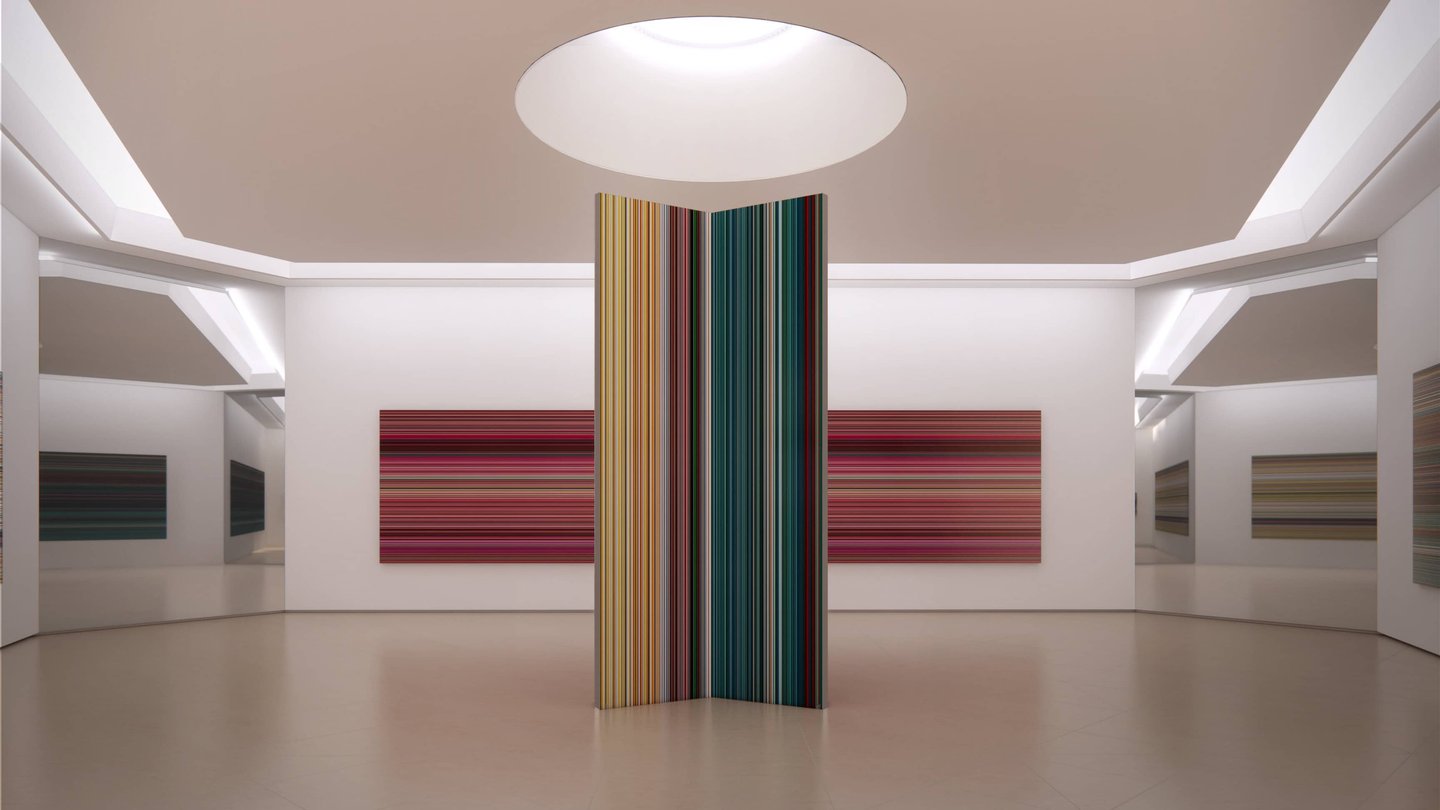
Inside, a selection of his paintings and sculptures fills the hexagonal room. Strip paintings line the walls, mirrors fold the space back on itself, and a Strip Tower rises in the centre under the skylight.
Mirrors do quiet work in a room like this. A mirrored surface folds the Strip paintings back into the space until visitors stand inside the pattern rather than in front of it, and Richter has used mirrors for decades. Here they turn a hexagon into a hall of repetitions.
A stone sculpture, Brunnen, stands outside the pavilion in the park.
The work spills past the walls, so the visit starts before the door and the building becomes one stop in a longer walk. Richter traces the idea to a trip to Doha in 2013. He had been developing the Strip paintings for about two years by then, and the city’s architecture set off the thought of a pavilion built from the same system.
- Opens 21 November 2026
- Runs to 30 April 2027
- Venues across Doha
The unveiling lands one day before Rubaiya Qatar opens. The new quadrennial runs from 21 November to 30 April 2027, and the pavilion gives its first visitors a permanent landmark on opening weekend, before a single exhibition crowd arrives.
Qatar Museums has spent years planting permanent works across Doha’s public spaces. A Richter pavilion joins that landscape as its most architectural piece, a building commissioned the way other institutions commission a sculpture and kept the way a city keeps a landmark. It will be maintained like one, too, with the park as its permanent gallery.
Quadrennials end and pavilions stay. Long after the exhibition closes, Richter’s hexagon remains in the park, a painting you can walk into, kept as part of Qatar’s public art landscape for whoever crosses MIA Park next.