
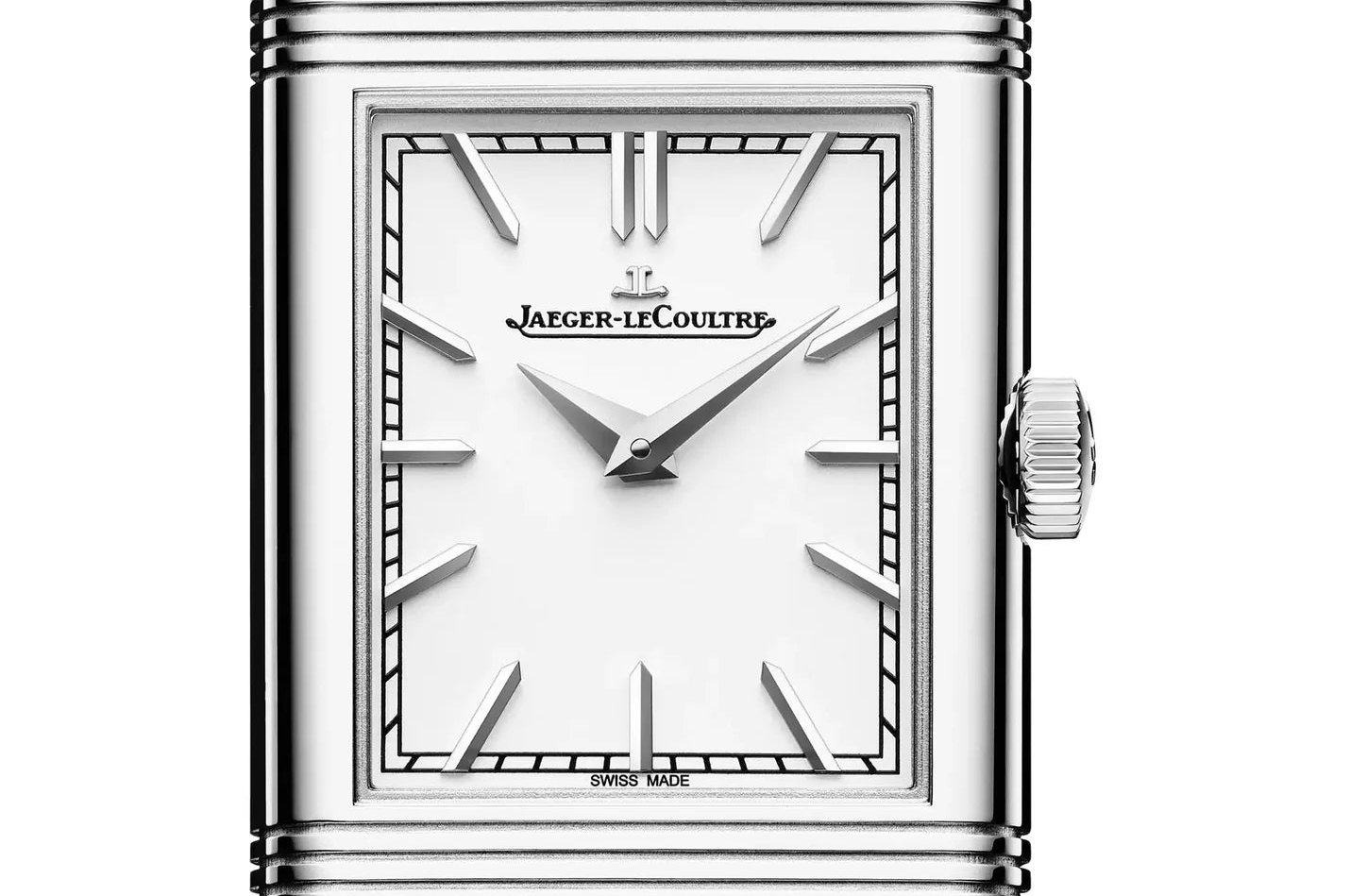
Most luxury watches now compete on size, spec sheets and wrist presence. The Reverso Tribute Monoface competes on restraint. Jaeger-LeCoultre built it at 40.1 by 24.4 millimeters, the proportions of the 1931 original.
Inside sits a hand-wound movement shaped to fit the case, and the dial tells the hours and minutes. Nothing else. That discipline is the whole proposition, and at $9,900 it’s aimed at buyers who already own louder watches and have stopped needing them.
Proportions from 1931, not a tribute act
The Reverso was created in 1931, a watch that could swivel its dial away from harm on the polo field, and the rectangular case has carried the same basic geometry ever since. This Monoface holds closest to that first watch, in size as much as shape.
The steel case keeps the rectangular form that makes a Reverso recognizable across a room, with soft curves where a modern sports watch would put hard edges. It wears flat, slides under a cuff and asks for no attention it hasn’t earned.
The dial is silvered opaline, quiet in person, with trapezoidal indexes and dauphine hands carried over from the early models. A railway minute track runs around the edge, the one graphic gesture on an otherwise calm face.
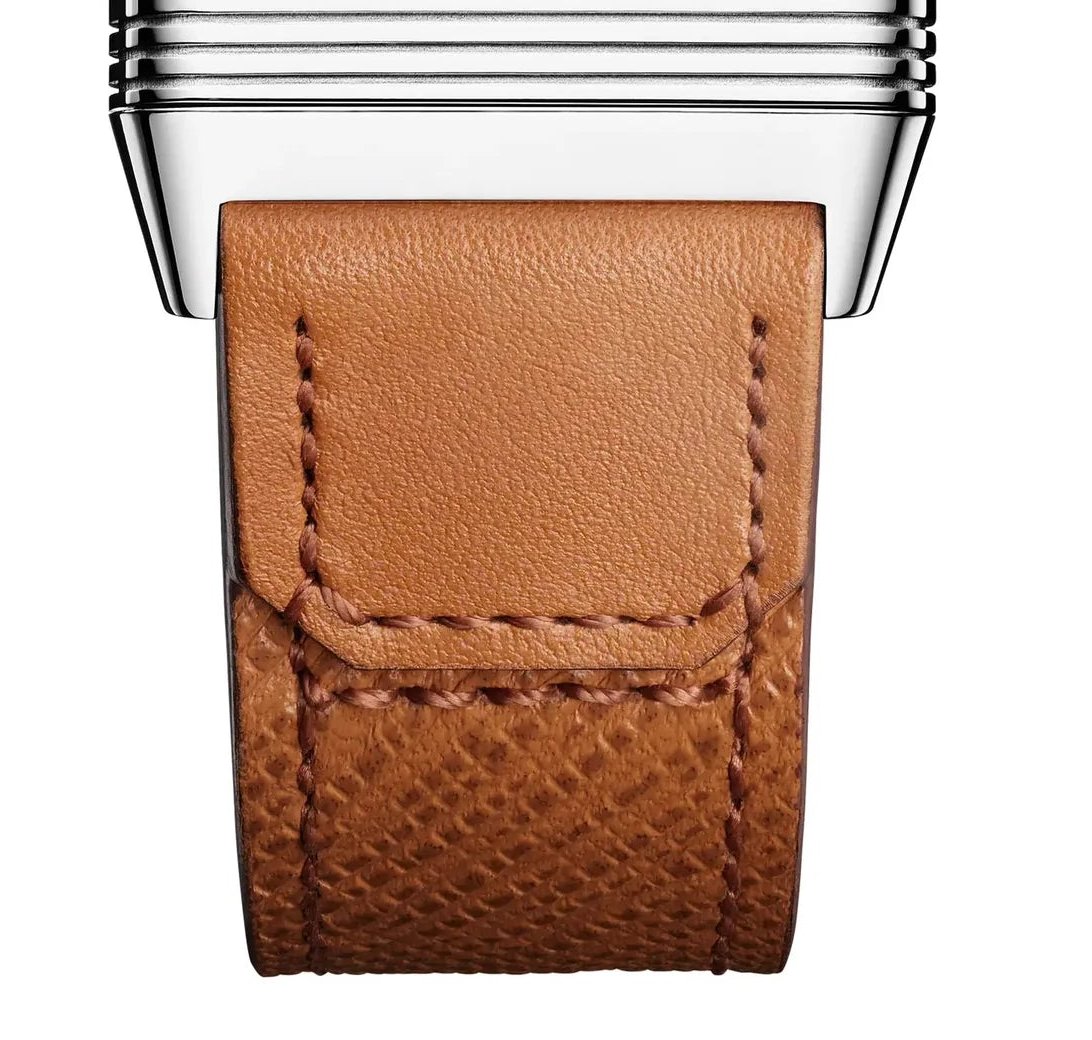
The strap is a Casa Fagliano design in two calfskin textures, smooth against grained saffiano, on an interchangeable mount with a folding clasp. Swap it in seconds and the watch changes register, from boardroom to weekend, without changing its mind about anything else.
A movement built to the shape of the case
Inside sits the Calibre 822, a hand-wound form movement, which means the mechanism itself is tonneau-shaped to follow the rectangular case rather than a round caliber lost inside it. Form movements are rare because they can’t be shared across a catalog.
It’s 2.94 millimeters thick, runs at 21,600 vibrations per hour and holds 42 hours of power reserve across 108 components and 19 jewels. Hours and minutes are the complete function list.
The caliber measures 22 millimeters across, a reminder that a form movement is designed from the case inward rather than adapted from a round blank. Everything inside the Monoface exists because the rectangle demanded it.
You wind it, you wear it for two days, you wind it again. The ritual is part of the ownership case, and Jaeger-LeCoultre has never pretended otherwise.
The blank side does the talking
Flip the case in its cradle and the reverse is a blank steel canvas, ready for engraving, lacquer or nothing at all. Owners have put initials, crests and entire scenes on that surface for ninety years.
That swivel was the founding trick in 1931, protection for the dial, and it remains the most personal surface in modern watchmaking. Nobody else’s watch carries a hidden side that belongs entirely to its owner.
Water resistance is 3 bar, which in daily terms means splashes and hand-washing, not swimming. A dress watch from 1931 lineage was never going to pretend otherwise, and the rating suits the brief.
The cost of the purity is absence, stated plainly. No seconds hand, no date window, no luminous plot to read in the dark, and a case that will look small on a large wrist.
Buyers cross-shopping a $9,900 steel watch will find rivals offering all of that, plus bracelets, plus longer reserves. The Monoface offers fewer things, finished better.
Ninety years of rectangular thinking
The Reverso’s second act began in 1991, when mechanical watchmaking was rebuilding itself and Jaeger-LeCoultre used the rectangular case to redevelop its command of high complications. A rectangular movement demands an entirely different architecture from a round one, and the Manufacture treated that constraint as a program.
The Monoface is the simplest expression of that program. No complication, no calendar, no second hand sneaking around a subdial. Just the shaped caliber, the swivel and the proportions.
Jaeger-LeCoultre designs the case to fit every wrist, and the quick-release strap system means the Fagliano design is a starting point rather than a commitment. The house also runs an engraving service for the reverse, for owners who would rather commission the work than commission a jeweler.
Where it sits in the line
The same case in pink gold, reference Q716216J, carries a grained gold dial and a $42,700 price, which makes the steel watch the thinking buyer’s route into the design. Above both sits the Monoface Small Seconds in white gold at $52,500, larger at 45.6 by 27.4 millimeters. The gold versions buy warmth, weight and a dial with more grain in it. They don’t buy a better rectangle.
Steel at $9,900 is where the proportions and the price agree with each other. Gold buys warmth and weight. It doesn’t buy a better shape.
That’s the trade, and it’s a fair one: the Reverso Tribute Monoface is the rare modern luxury watch that asks to be chosen for what it refuses to do. It won’t suit everyone. That’s precisely its qualification. If the rectangle is the attraction and the budget isn’t, Hamilton’s Boulton Mechanical keeps the shape and a hand-wound movement at $1,075 on Amazon.