
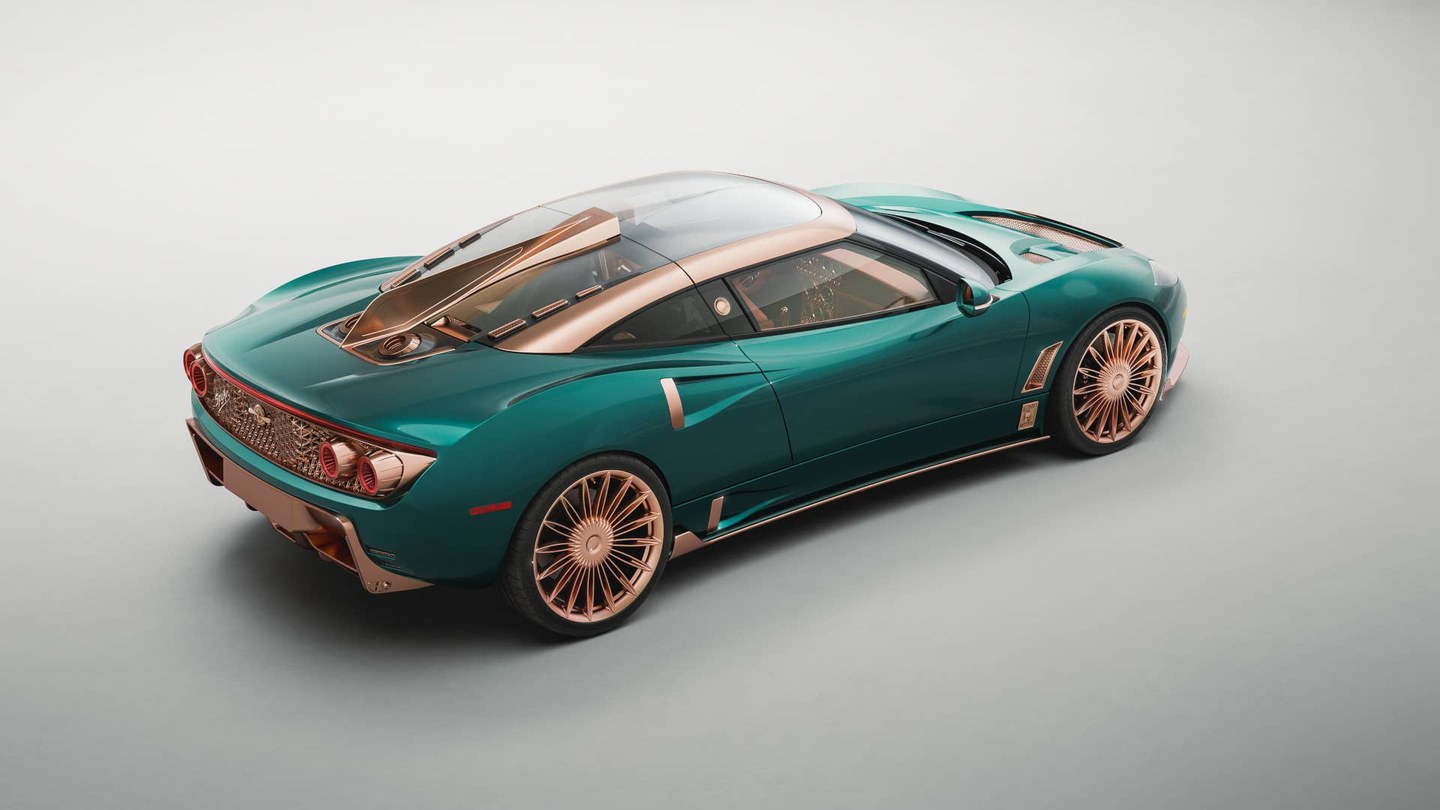
The C8 Preliator XXV is Spyker reduced to its essentials: hand-formed aluminum, rose gold brightwork, 800 horsepower and a six-speed manual in a market that stopped building them. Only 25 will exist.
Co-founder Victor Muller secured the rights to the Spyker name late in 2025, after the second of the company’s two bankruptcies, and the revived firm has since closed fresh funding and finished the car’s engineering. The car itself broke cover at The Quail during Monterey Car Week in August, finished in Quail Green with rose gold in place of chrome.
Rose gold over hand-formed aluminum
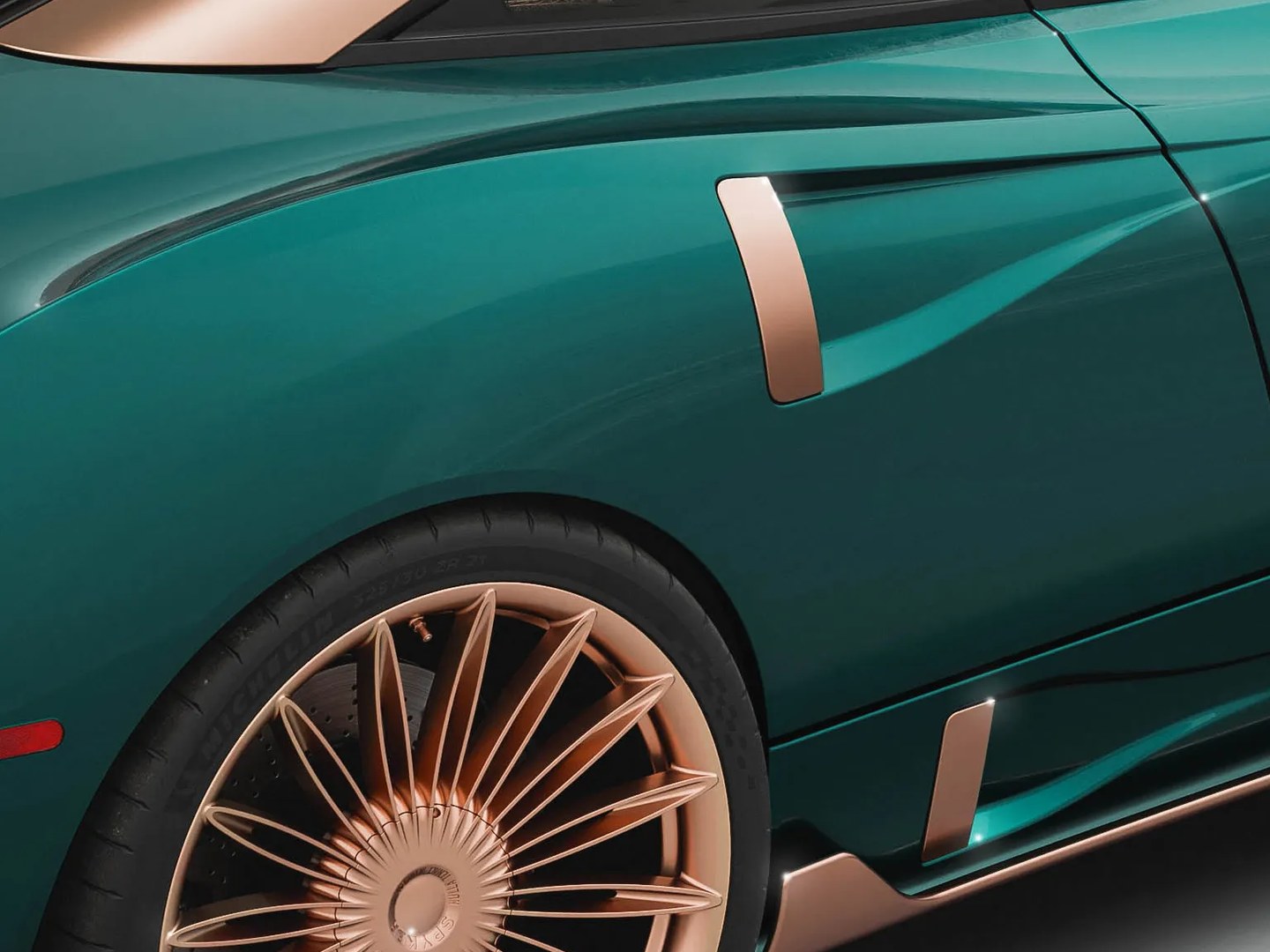
The launch car wears Quail Green, and rose gold brightwork follows every opening and edge of the body, so the trim becomes part of the surfacing rather than jewelry laid over it.
Spyker forms the panels by hand in aluminum, a slower route than the carbon fiber its rivals favor and the one the company has kept since the first C8. Aluminum is the house material. The company describes the pairing as color with depth, the green holding a deep and composed presence while the rose gold catches each edge and reveals the form as light moves across the panels.
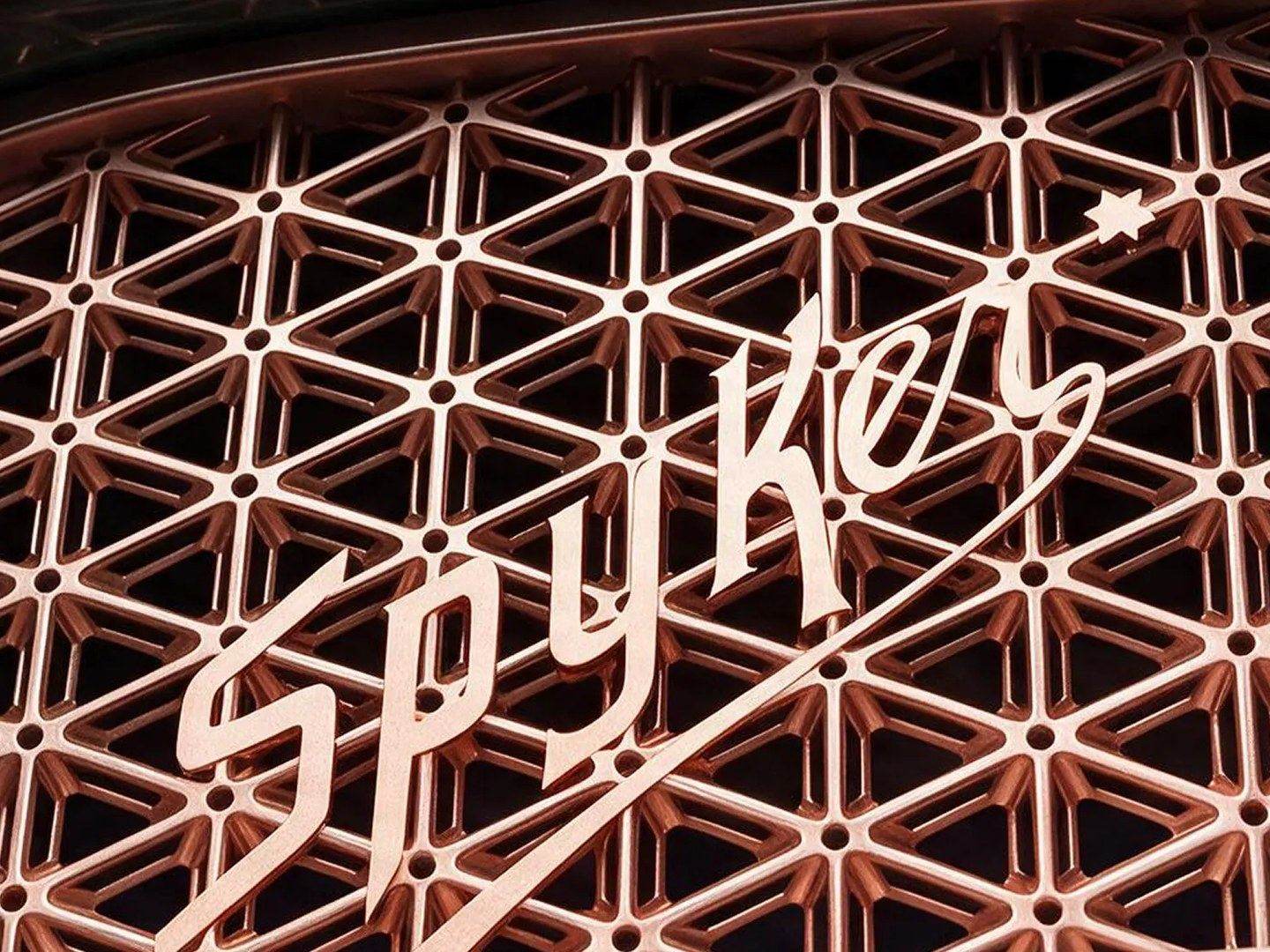
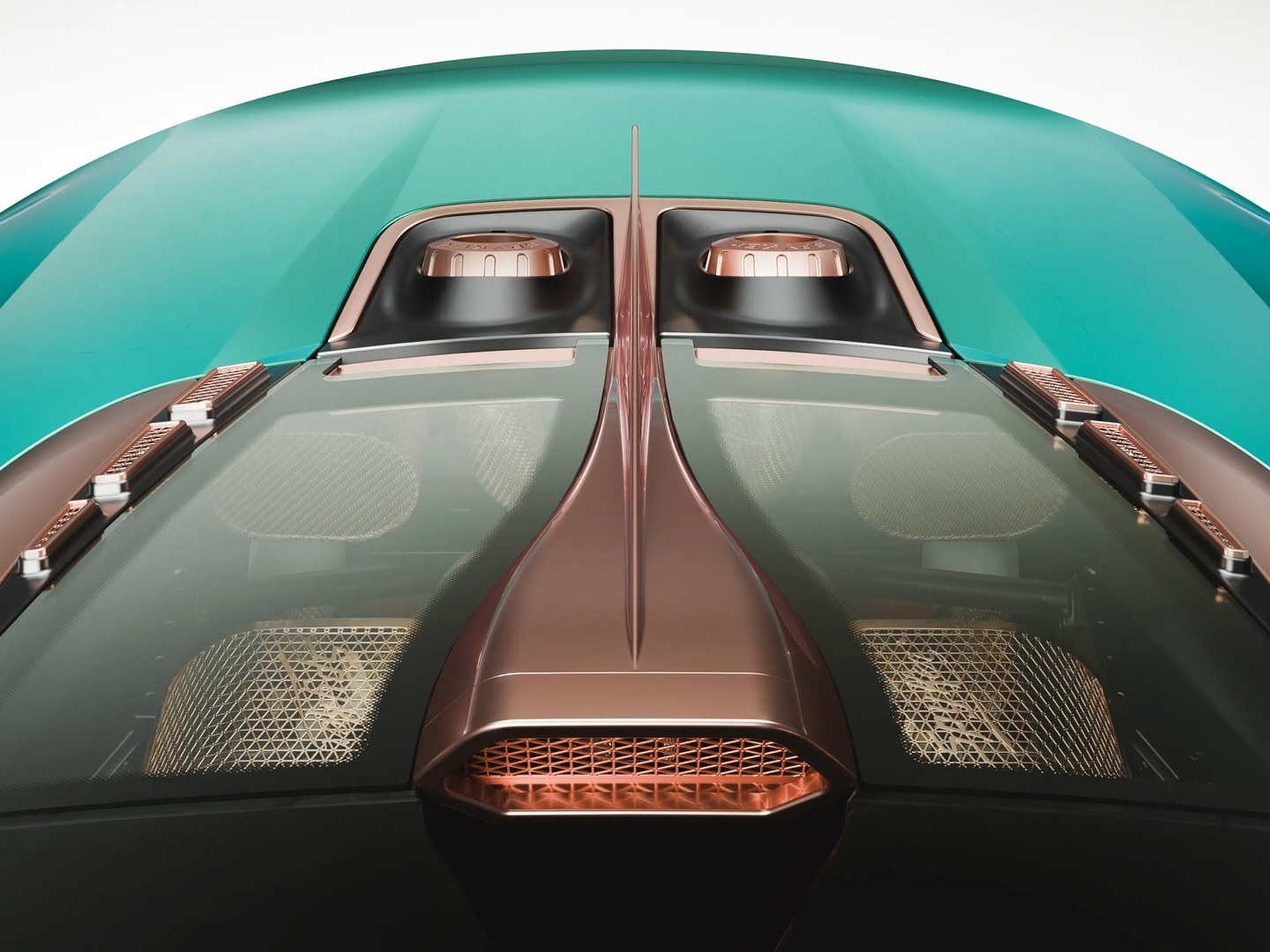
The grille is an iso-grid, a layered lattice borrowed from aerospace practice that draws strength from minimal material, and the same geometry repeats in the vents and brightwork across the car. An enlarged NACA intake sits in the flank and pulls air toward the engine, edged in the same rose gold.
Small winglets set into the side skirts take their shape from aircraft control surfaces, and the wheel spokes radiate in thin blades, cut to look like they’re already moving. Nothing on the car is decoration alone.
Eight thousand rpm and a clutch pedal
A 4.0-liter twin-turbo V8 sits behind the seats with 800 horsepower and 737 lb-ft of torque, revving to 8,000 rpm and driving the rear wheels through a rear-mounted six-speed manual gearbox.
Spyker claims 0 to 100 km/h in 2.7 seconds and a 217 mph top speed, against a dry weight of 1,525 kg, about 3,362 pounds.
The body stretches 4,628 mm over an aluminum spaceframe.
A dual-clutch gearbox would likely shave time from that sprint, though it would also remove the one interaction Spyker’s buyers are paying for, the gear change itself.
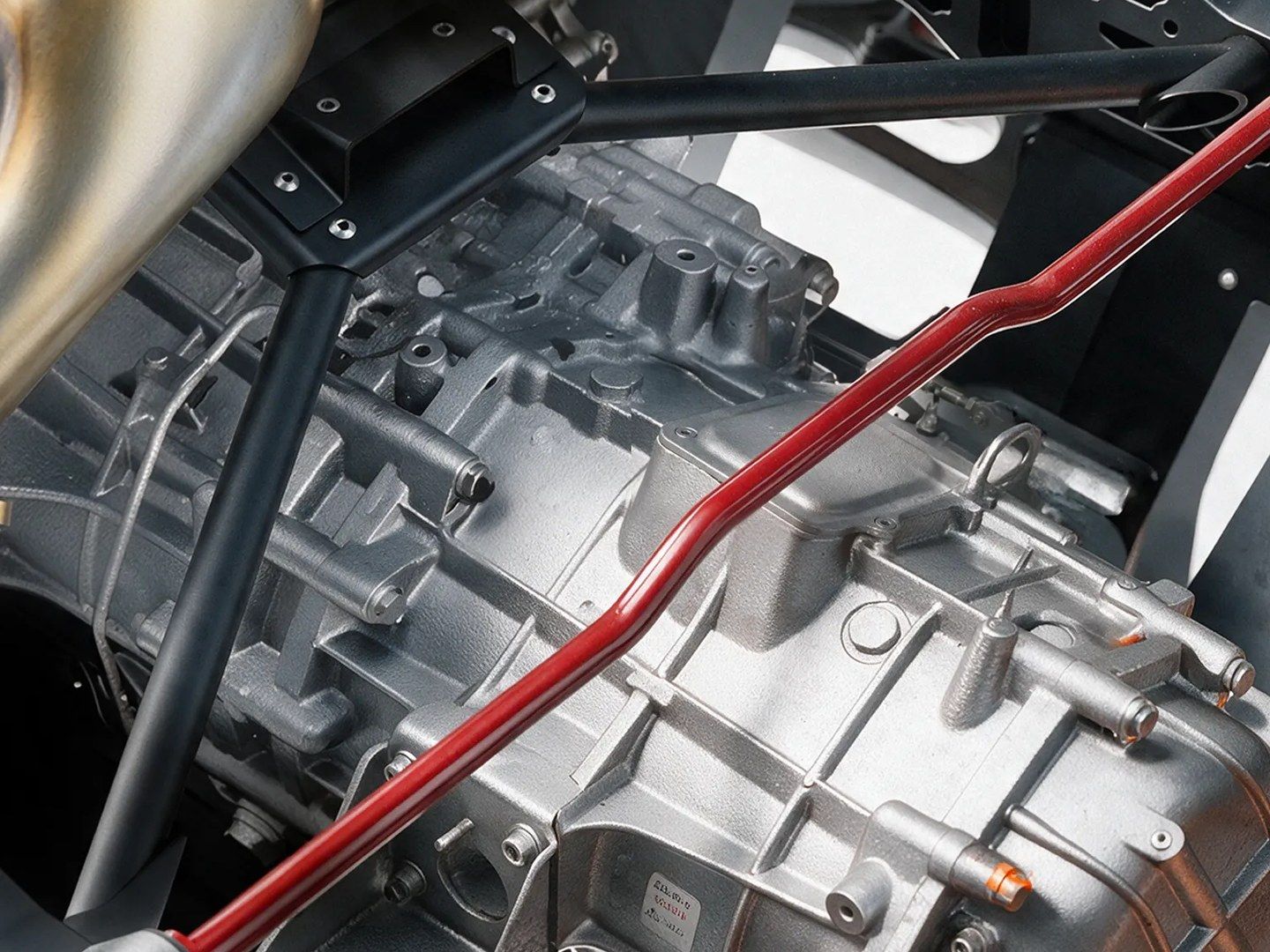
The maker’s own description of the transmission stays tactile: every change begins and ends with the hand, deliberate and mechanical, with the driver kept at the center of the car. No automatic is offered at all. The unit itself comes from Graziano Oerlikon and sits at the rear of the car, behind the axle line.
The spec stays pure combustion, no hybrid assistance and no battery, at a moment when most of the hypercar tier has added electric help of some kind.
As the revs climb toward the 8,000 rpm redline, the roof scoop feeds the V8 and the top-mounted exhausts carry its voice out over the tail.
Twenty-five cars at 2,100 hours each
Each Preliator takes roughly 2,100 hours to build, and Spyker plans to cap production near 50 cars a year, with the 25-car first run finished by the end of 2027, each one specified with its buyer before the build begins.
Muller is aiming past the supercar tier entirely. “We will position ourselves at the very top of the market, where Pagani, Koenigsegg, Bugatti, and Gordon Murray Automotive are the established brands,” he said.
Scarcity is the business plan. Earlier Spykers have been climbing at auction, which gives the revival a collector base that already treats the badge as worth keeping. The timing helps the pitch, with collectors spending heavily on low-volume cars that carry a hand-built story behind them, and a revived Spyker with a manual gearbox lands directly in that current.
Fifty cars a year is a workshop, not a factory, and that’s plainly the intent behind the cap.
Twice-bankrupt brands rarely get a third act, and Spyker’s road here ran through a failed attempt to buy Saab from General Motors between the two collapses.
A canopy, a scoop and a Latin motto
The glass canopy keeps the aviation thread Spyker has traded on from the start.
Spyker says the exchange runs both ways, with lessons from its Le Mans campaigns in cooling, balance, braking and durability folded back into the road car. Preliator is Latin for warrior, a name the original car earned in print long before this one had to fight for the company itself.
The Spyker name traces back to 1880, and the aviation detailing runs through the company’s history rather than arriving as a launch theme. At the center of each wheel sits the company’s motto in Latin, Nulla Tenaci Invia Est Via, no road impassable to the tenacious, which reads less like branding after two bankruptcies than like a defense.
It wants to be looked at.
Handovers begin in the second quarter of 2027, and every one of the 25 cars will be commissioned individually, by appointment, at a price Spyker declines to publish.