

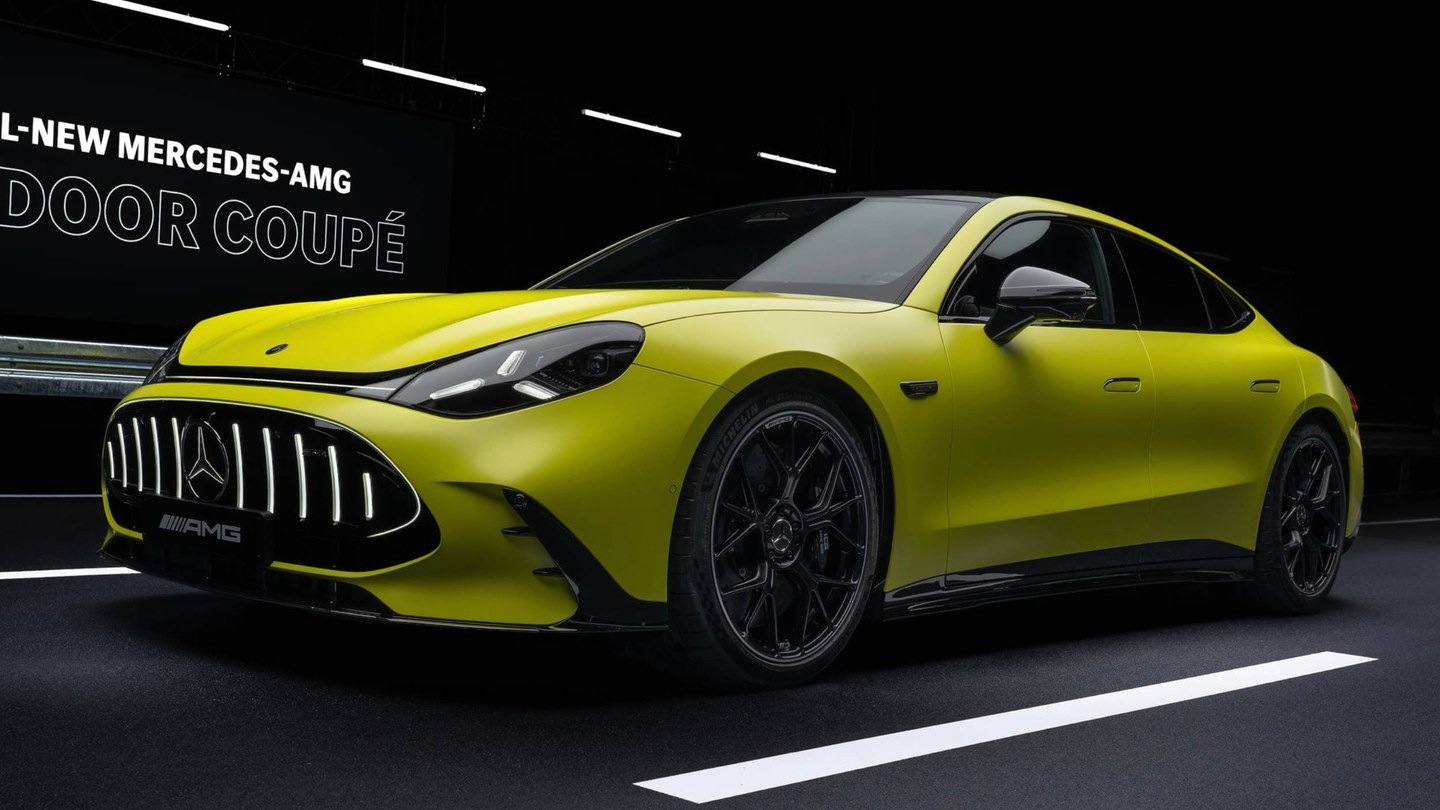
A long hood still runs the show.
Fastback roofline, steeply raked windshield, muscular rear shoulders: the silhouette carries the whole argument before a single number lands. This body sits 1.6 inches lower than the outgoing car despite a battery pack living in the floor. Mercedes could’ve hidden the electric hardware under a taller, safer shape. It didn’t.
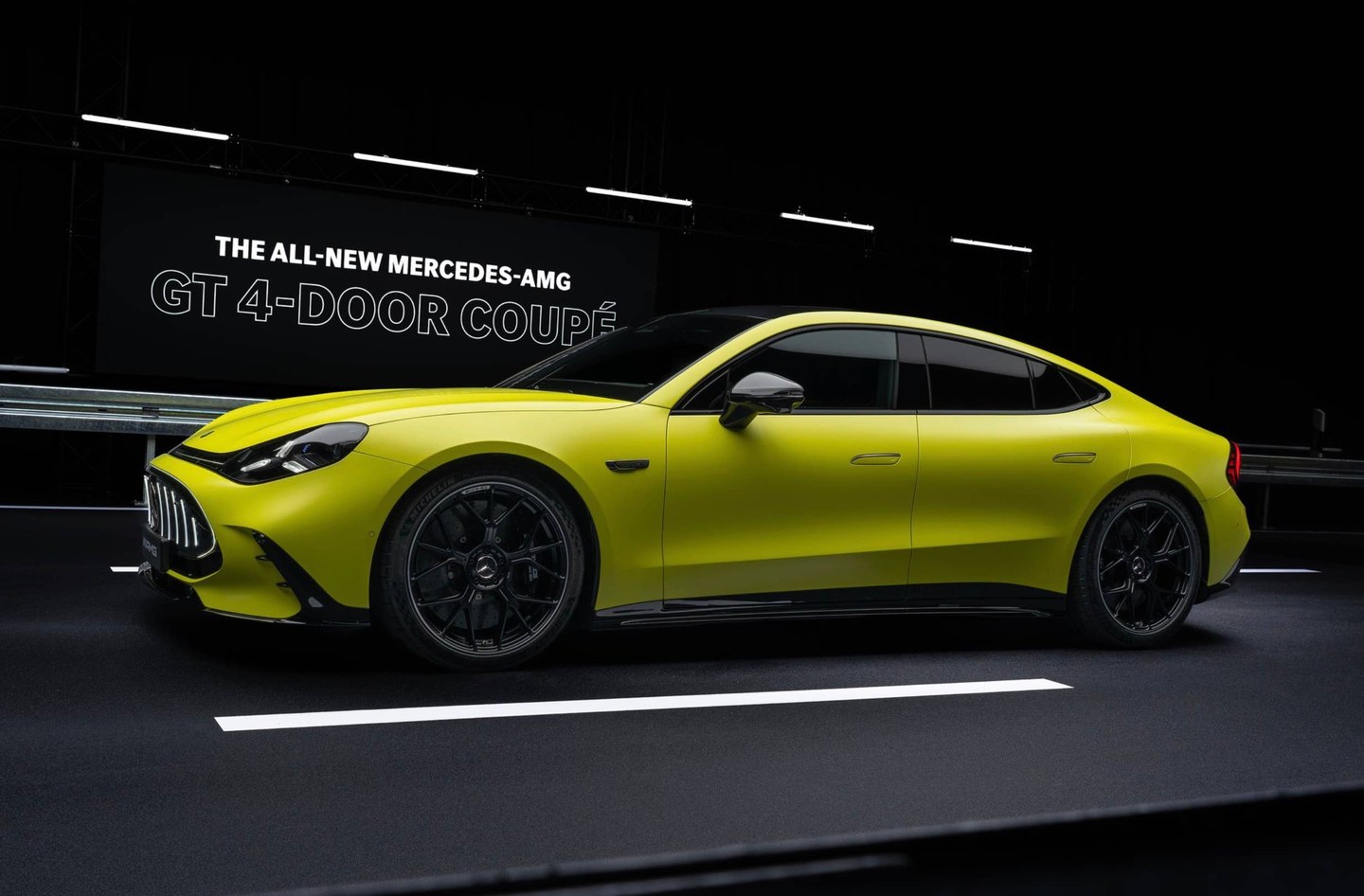
Details work the same brief. Vertical slats still fill the AMG grille, which gains optional illumination for the first time and wraps around an illuminated central star. Headlights carry star-design daytime running lights. Six circular taillights in a turbine pattern close the rear, mirrors mount on the doors in sports-car style, and flush door handles keep the flanks clean.
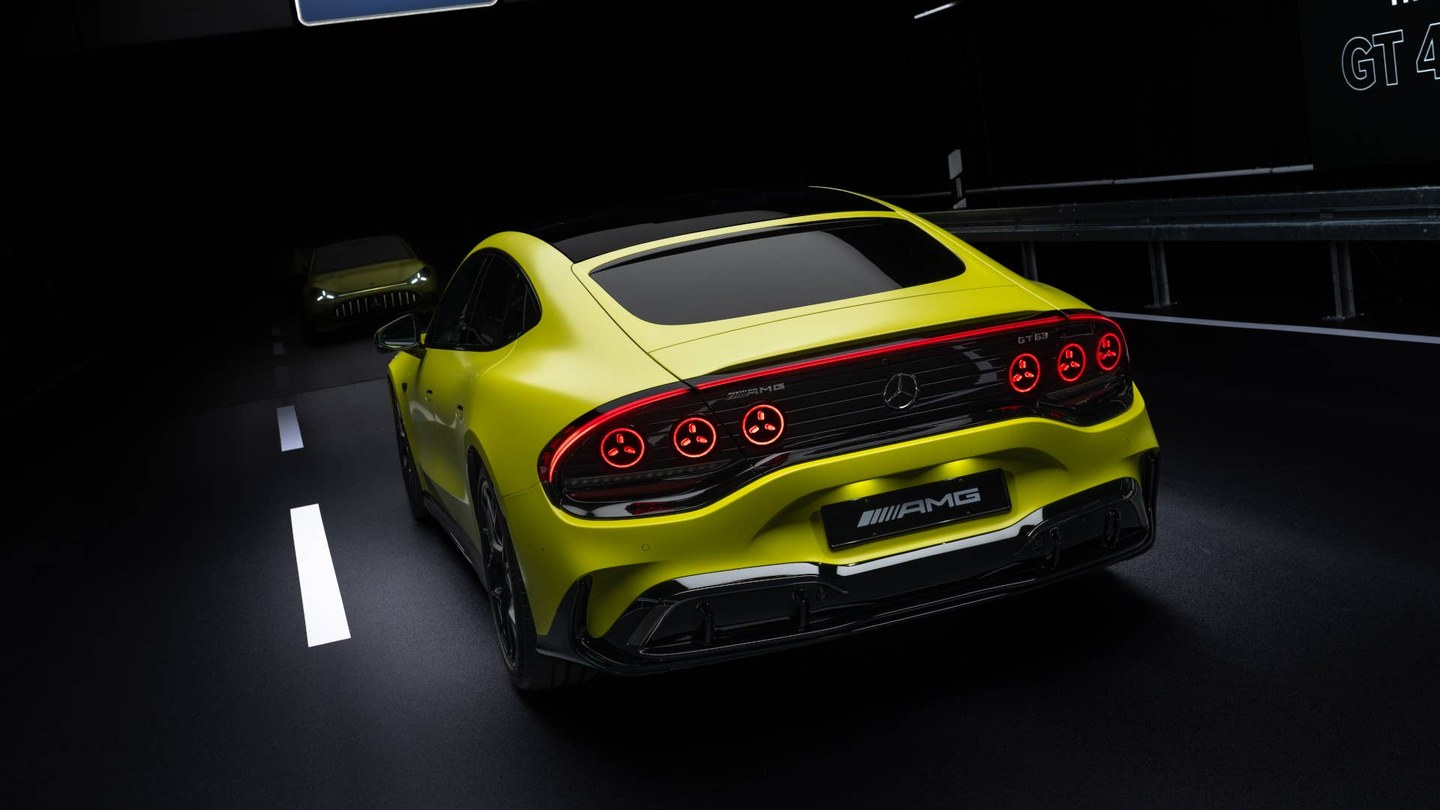
Then there’s the aero, most of it invisible until the car needs it. A retractable rear spoiler hides inside the trunk lid at low speed, then steps through angle positions above 50 mph and goes to its steepest setting when the car reads hard driving. Louvers behind the front intakes stay shut for range and open only when components ask for cooling.
Optional underbody elements drop at 75 and 87 mph to pull the car toward the road.
The drag coefficient comes in at 0.22.
Three axial flux motors do the pulling. Two sit at the rear axle, one at the front, and the layout is a production first for an electric car. The motors come from YASA, the British specialist Mercedes bought in 2021, and each one is a disc barely 3.5 inches wide, built in Berlin. Thin motors buy packaging freedom, and AMG spent it on the low body.
Peak output in the GT 63 reaches 1,153 hp with 1,475 lb-ft of torque. GT 55 output lands at 805 hp and 1,328 lb-ft. Those peaks arrive during launch control at an 80 percent charge, though the continuous figures sit lower: 711 hp for the 63, 503 for the 55.
Mercedes quotes 2.0 seconds to 60 mph for the GT 63 and 2.4 for the GT 55, both with the one-foot rollout the drag strip uses. Without it, the same runs take 2.3 and 2.7 seconds. Top speed caps at 186 mph with the optional AMG Performance Package.
The battery decides whether numbers like that repeat. It’s a 106-kWh pack built from 2,660 tall, slim cylindrical cells, each one bathed in non-conductive cooling oil, a layout drawn from Formula 1 practice and the AMG ONE hypercar program. Direct cooling holds cell temperatures steady under load, which is how the car keeps delivering peak output instead of rationing it after the first hard run.
Charging runs at up to 600 kW. Mercedes claims 10 to 80 percent in 11 minutes, and up to 462 kilometers (about 287 miles) of WLTP range added in ten. WLTP range tops out at 700 kilometers for the GT 55, about 435 miles, and 696 for the GT 63, about 432 miles.
EPA figures aren’t out yet, and the US number will land lower.
One catch sits underneath all of it. Curb weight runs 2,460 kilograms on the DIN scale, roughly 5,423 pounds. Two and a half tons is two and a half tons.
Rear-axle steering turns the back wheels against the fronts below 50 mph, shortening the car around town, then parallel above it for stability. Carbon-ceramic front discs pair with steel rears in a composite brake system built to blend regeneration and friction braking into one pedal feel. Active roll stabilization, standard on the GT 63, hydraulically links its dampers and drops the mechanical anti-roll bars entirely.
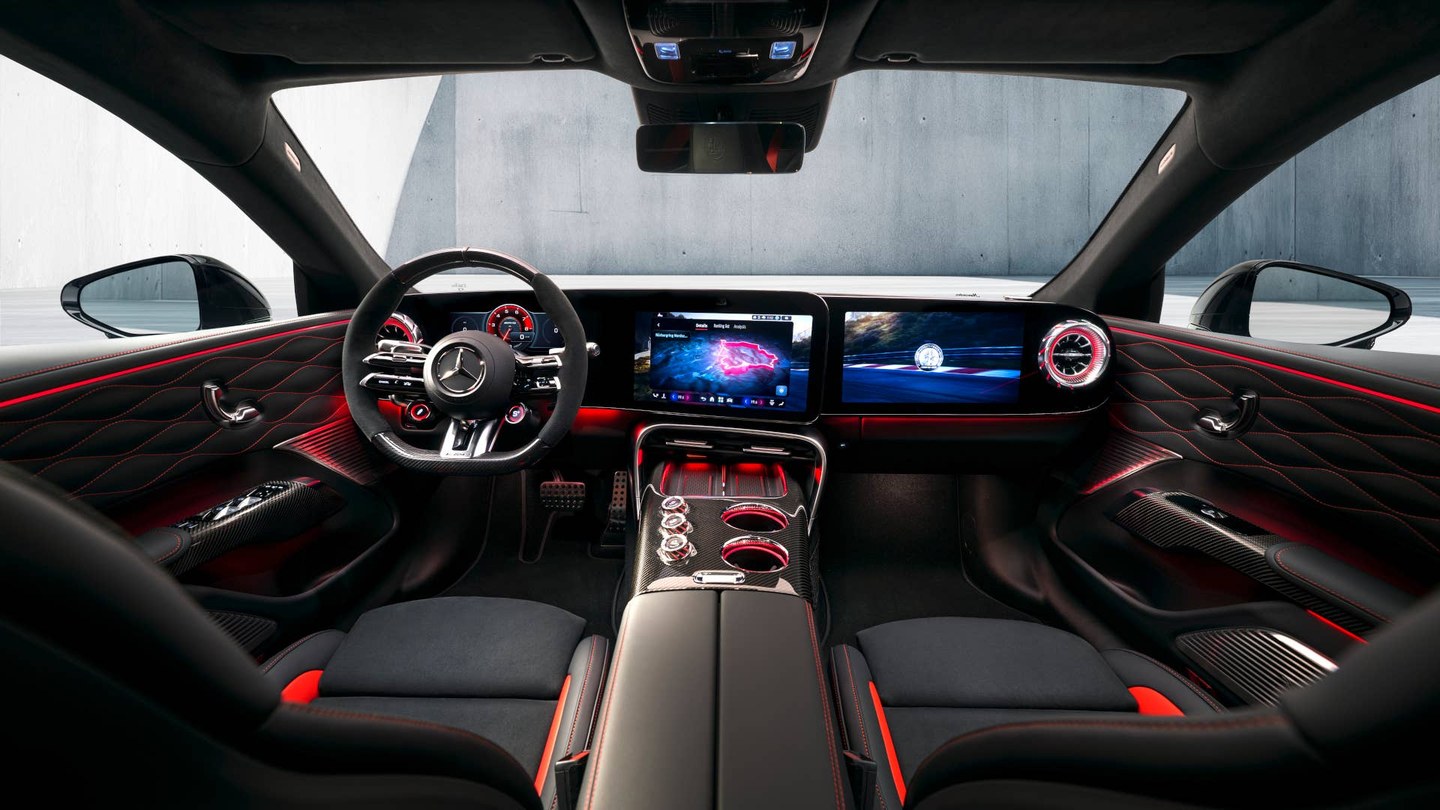
Then there’s the theater. AMGFORCE Sport+ rebuilds the V8 experience digitally: a sound mix drawn from more than 1,600 files, based on the old AMG GT R, with simulated gear changes that interrupt torque the way a gearbox would. Three rotary dials on the console let the driver tune motor response, agility, and traction across nine stages. It’s engineered nostalgia, and AMG isn’t pretending otherwise.
The cabin keeps the sports-car seating position and aims the whole dashboard at the driver. A 10.2-inch instrument display and a 14-inch central screen merge under one glass panel, angled toward the wheel; a second 14-inch screen serves the front passenger. Turbine vents cap each end of the dash, glowing with the ambient lighting at night.
Behind the front seats, the four-door brief takes over. Two contoured individual seats come standard, an optional three-person bench joins them, the backrests fold, and floor recesses buy real legroom. Above it all, the panoramic roof runs back to the rear glass and can switch between clear and opaque in segments, lit at night with AMG crests and racing stripes.
So the shape wins twice. The low fastback and the aero kit deliver the 0.22 drag figure and the near-435-mile WLTP range, and they give an electric AMG a silhouette with genuine GT presence from across a parking lot.
Pricing is the open question. Mercedes hasn’t published US numbers, and outside estimates run from about $145,000 for the GT 55 to about $185,000 for the GT 63. The GT 55 reaches US dealers late in 2026, the GT 63 in early 2027.
Editor’s take
AMG’s V8 cars sold a sound and a silhouette in equal measure. This one keeps the silhouette and makes its case on repeatable pace instead: a GT shape at a 0.22 drag coefficient, a cabin built for four, and pace that doesn’t fade after one launch. Whether the GT 55 undercuts the Taycan Turbo GT waits on a sticker Mercedes hasn’t published and an EPA figure that isn’t out yet. The design argument doesn’t wait on either number.


