

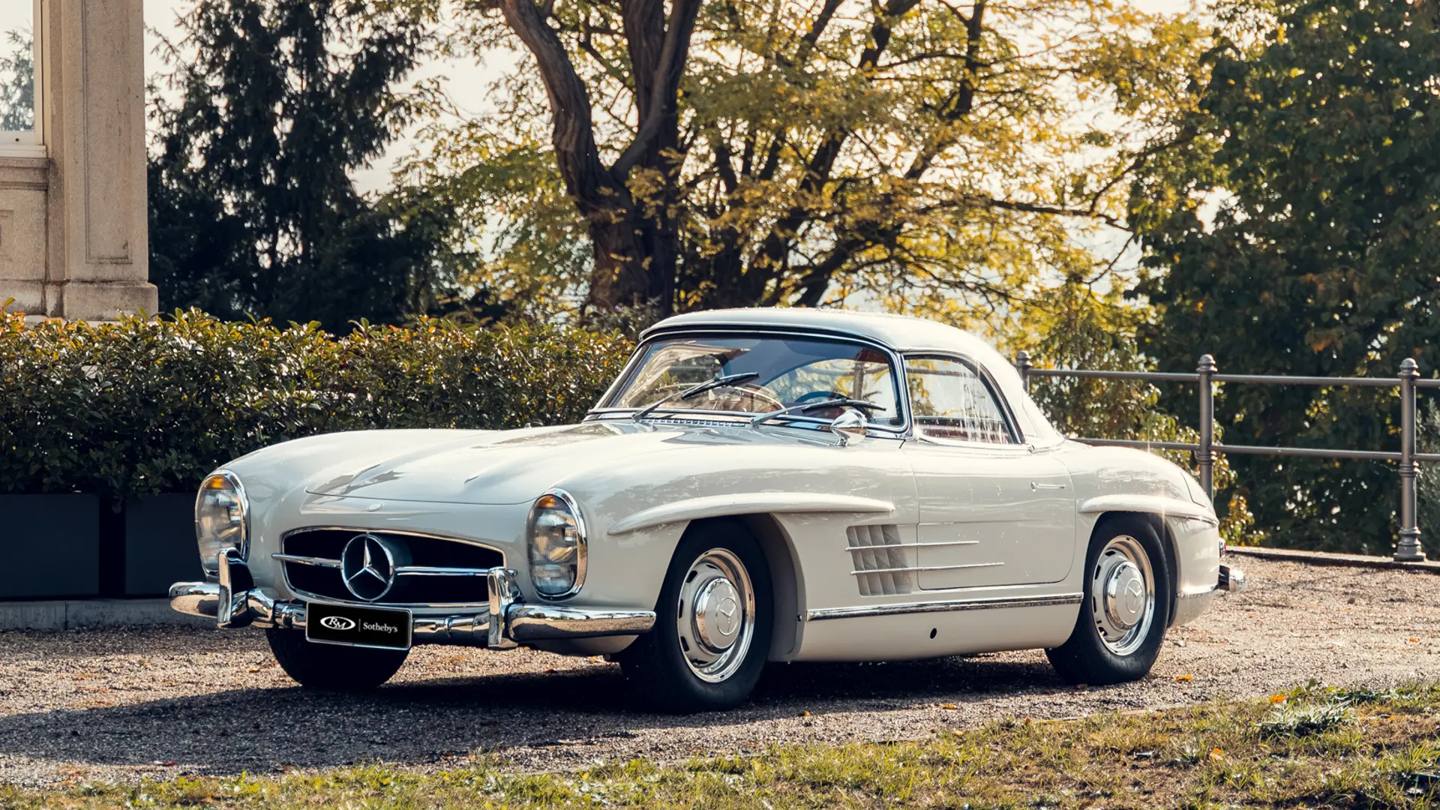
Motorworld Munich hosts the sale on 20 November 2026, and the catalogue reads like a syllabus of postwar European sports car design at its most confident. A final-year Mercedes-Benz roadster carries the cover.
Fifth year at Motorworld.
The room has settled into the European calendar, and the entry list shows a house playing to the home crowd: German engineering first, Italian coachwork close behind, two named collections doing the organisational work across thirteen cars that anchor the catalogue’s centre of gravity.
The 300 SL Roadster That Closes the Production Story
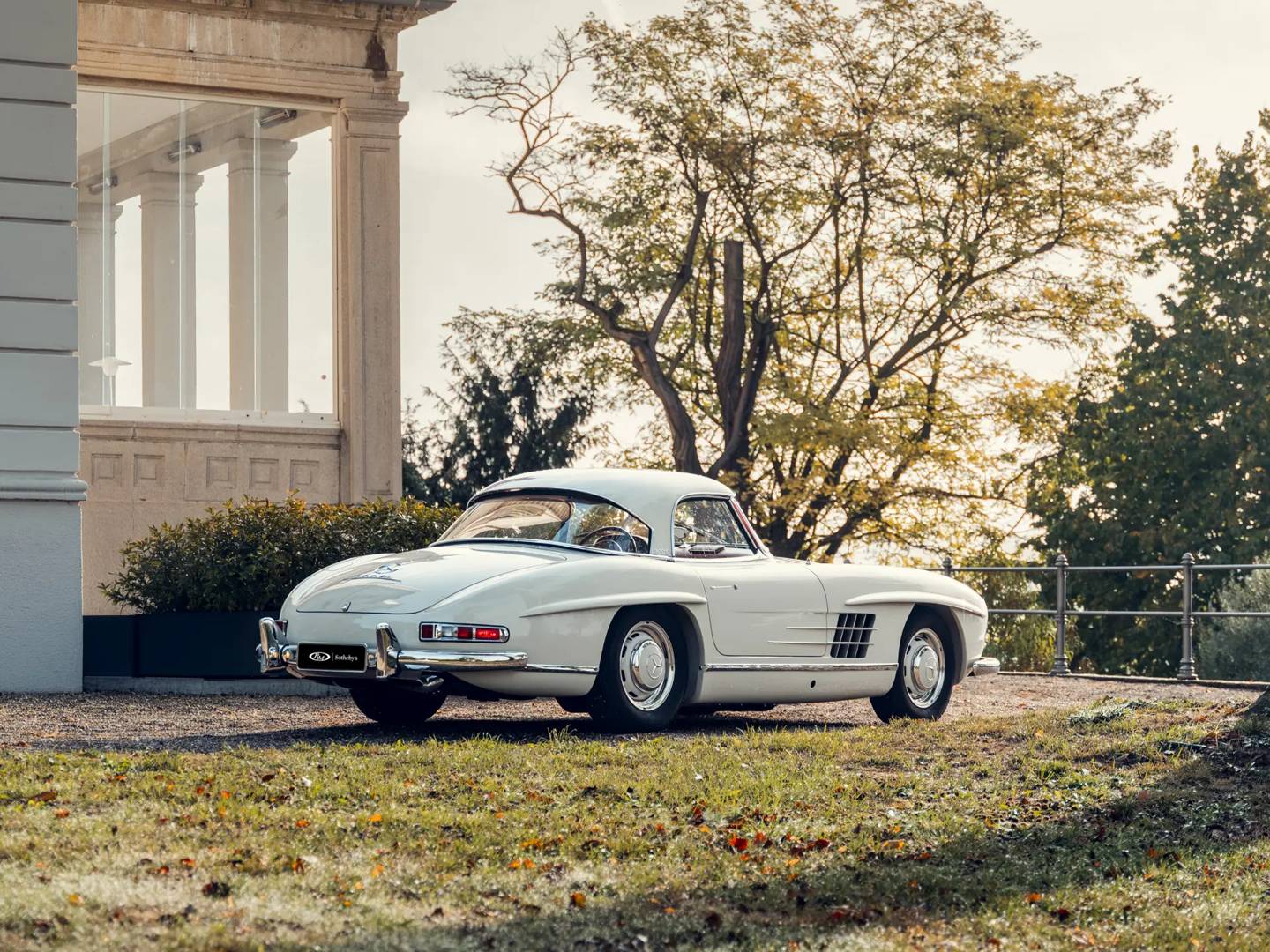
Chassis 003248 sits among the final 300 SL Roadsters built, one of 26 completed in 1963, and that position at the end of the line shapes everything about how the car presents today.
Position at the end of a production run changes how a car gets read. Early examples carry the experiment; late examples carry the accumulated answers, and this roadster holds the full late specification, the mechanical maturity of a design refined in public for a decade.
Four-wheel disc brakes. A lightweight alloy engine block.
White Grey paint over red leather is the factory combination, set off by a matching-colour hard top, and the pairing photographs exactly as dramatically as it sounds, pale coachwork against a cabin trimmed the colour of a theatre seat.
Matching numbers run across the engine, gearbox, differential and kingpins, the full checklist collectors recite from memory when a late roadster comes to market.
Refurbishment work completed in 2025 cost over €170,000, a figure that signals the standard the car was brought to before it was offered, and the fitted luggage in red leather travels with the car, trimmed to match the cabin it sits behind.
RM Sotheby’s places the estimate at €1,300,000 to €1,700,000, stated here as an estimate in the currency the house lists.
Design collectors will linger on this lot. The roadster’s proportions, long bonnet, low screen and that red cabin against pale paint, belong to a school of sports car design that valued elegance at speed over aggression at rest, and the market has been rewarding that school for years.
Seven Maseratis in The Tridente Collection
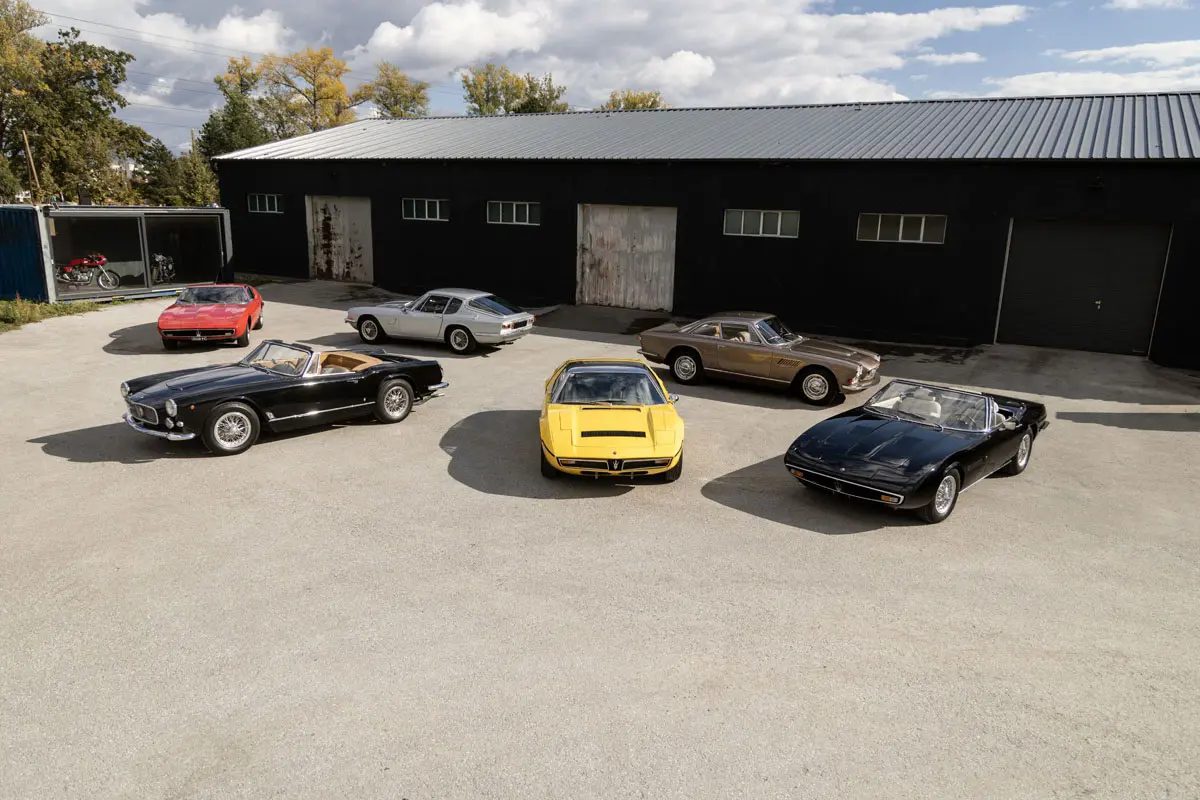
Golden-era Maserati design gets its own room within the sale, seven cars spanning 1963 to 1975, from open Vignale coachwork to the mid-engined Bora that closed the period.
A 1963 3500 GTi Spyder by Vignale opens the run.
All long bonnet and delicate brightwork, the Spyder comes from the years when Maserati still built grand tourers the way Milan built tailoring: by hand, to measure, with the seams showing exactly where they should and nowhere else.
Coupés carry the middle years of the set. A 1965 Mistral 3.7 and a 1967 Sebring 3700 GTi Series II by Vignale show two readings of the same grand touring brief, one compact and windswept, the other formal, upright and quietly imposing.
Ghia’s Ghibli appears twice, a 1968 4.7 Coupé and a 1970 4.7 Spyder, before a 1971 4.2 ‘Project’ by Vignale and the 1975 Bora 4.9 finish the collection, the Bora closing the era with a mid-engined silhouette that still looks a decade ahead of the Spyder that started the sequence. That is the detail guests remember.
Thirteen cars across the two collections give the sale its spine, and the arrangement is deliberate: Maserati for the Italian coachbuilt tradition, Porsche for the German engineering lineage, each marque shown across enough years to make the design evolution visible inside a single viewing.
Six Analogue 911s in The Porsche Heritage Collection
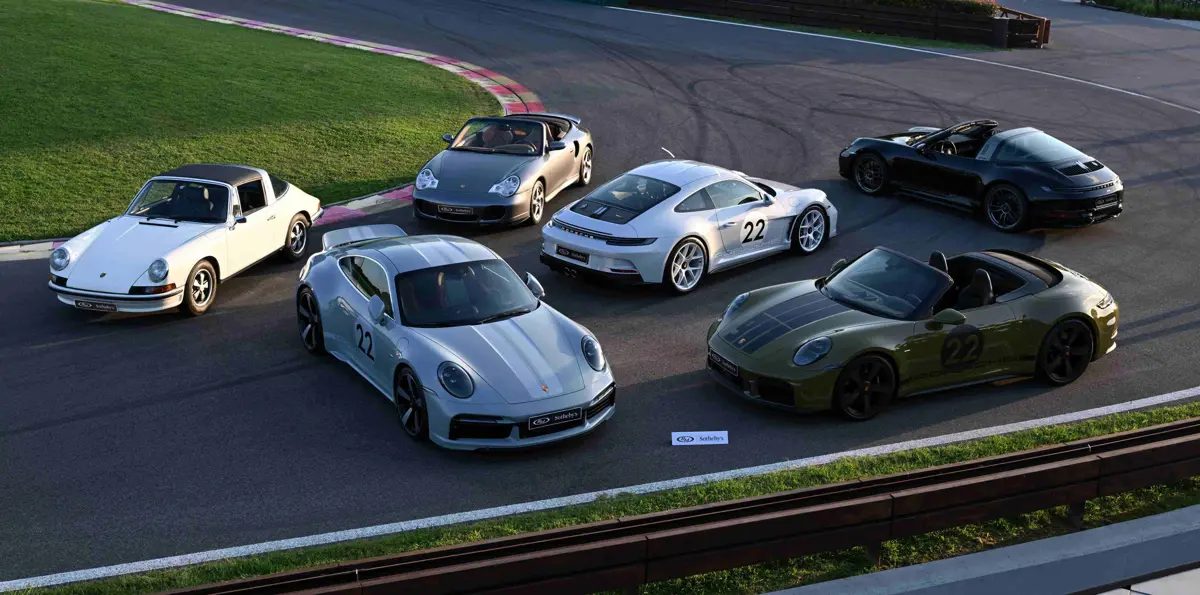
Six 911s, every one analogue and non-hybrid, trace the model from air-cooled beginnings to the limited editions of the current decade.
A 1973 911 S 2.4 Targa anchors the early end, the car Porsche built when the Targa bar still looked like sculpture and the flat six behind the cabin was the reason the car existed.
Modern entries hold their own against it.
A 2023 911 Sport Classic, a 2024 911 S/T and a 2026 911 Spirit 70 carry the heritage brief into the present range, joined by a 2005 911 Turbo S Cabriolet and a 2023 911 Targa 4 GTS Edition 50 Years Porsche Design, a spread that lets one silhouette tell fifty years of story.
Read as one group, the six cars chart how a single shape absorbed five decades of engineering change without surrendering its proportions, which is a design achievement no specification sheet captures.
No hybrids. No diluted brief.
BMW Answers on Home Ground
Bavaria’s own marque fields the deepest bench in the sale, starting with a 1939 328 Roadster, the pre-war sports car against which the rest of the company’s road-car history still gets measured in Munich.
A Spa-winning Group A 635CSi and a 3.0 CSL ‘Batmobile’ carry the racing thread forward.
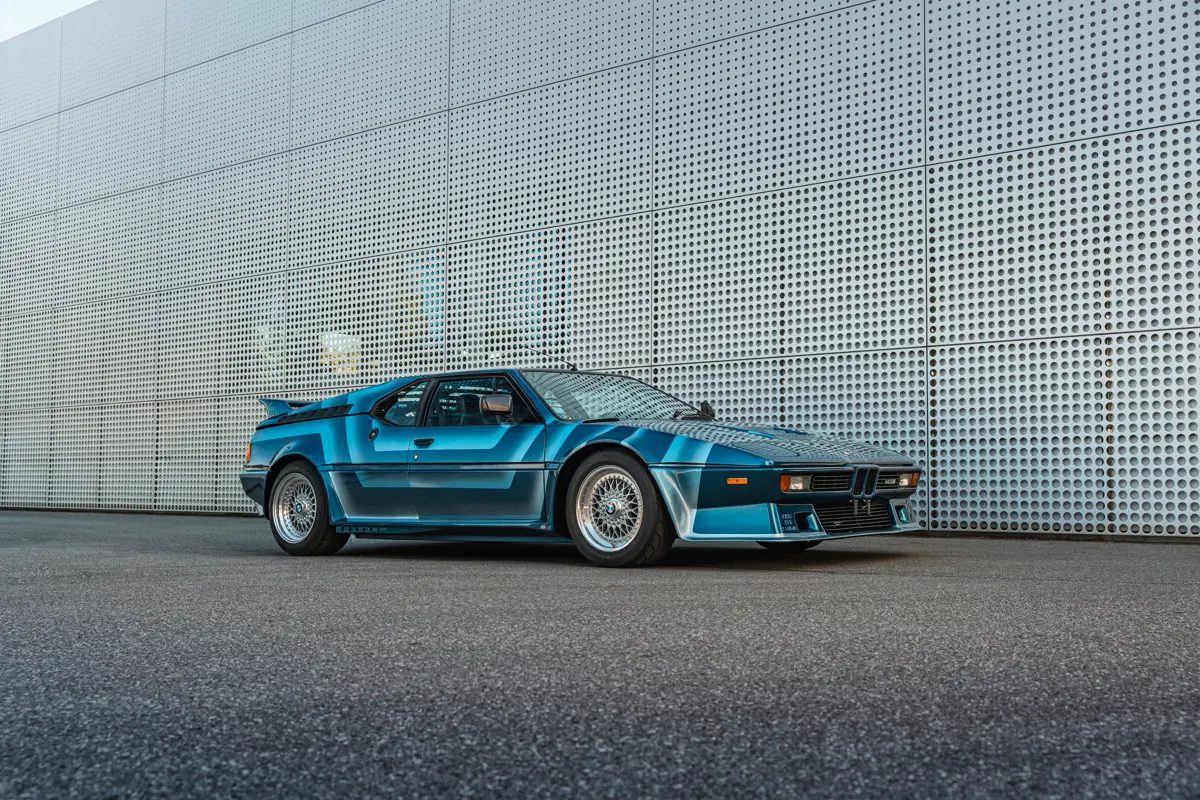
Two mid-engined M1s close the BMW story, one a standard road car and one an AHG-modified example from a run of ten, the Procar spirit in road trim, wedge profile, pop-up lamps and all.
Motorworld gives the sale a fitting stage, an industrial motoring complex where the cars sit among steel, glass and concrete rather than ballroom chandeliers, and the setting flatters machinery shaped by hand and eye rather than by wind tunnel.
Viewing the entry list as a design exhibition rather than a price list is the rewarding way into this sale, because nearly every car in it marks a point where a marque changed direction, and the catalogue has been assembled so those turning points sit in the same room, under the same lights, on the same November evening.
Munich keeps delivering. Five years in, the sale has a settled point of view, and collectors who care about design provenance as much as mechanical specification will find this catalogue arranged almost exactly to their taste.


