

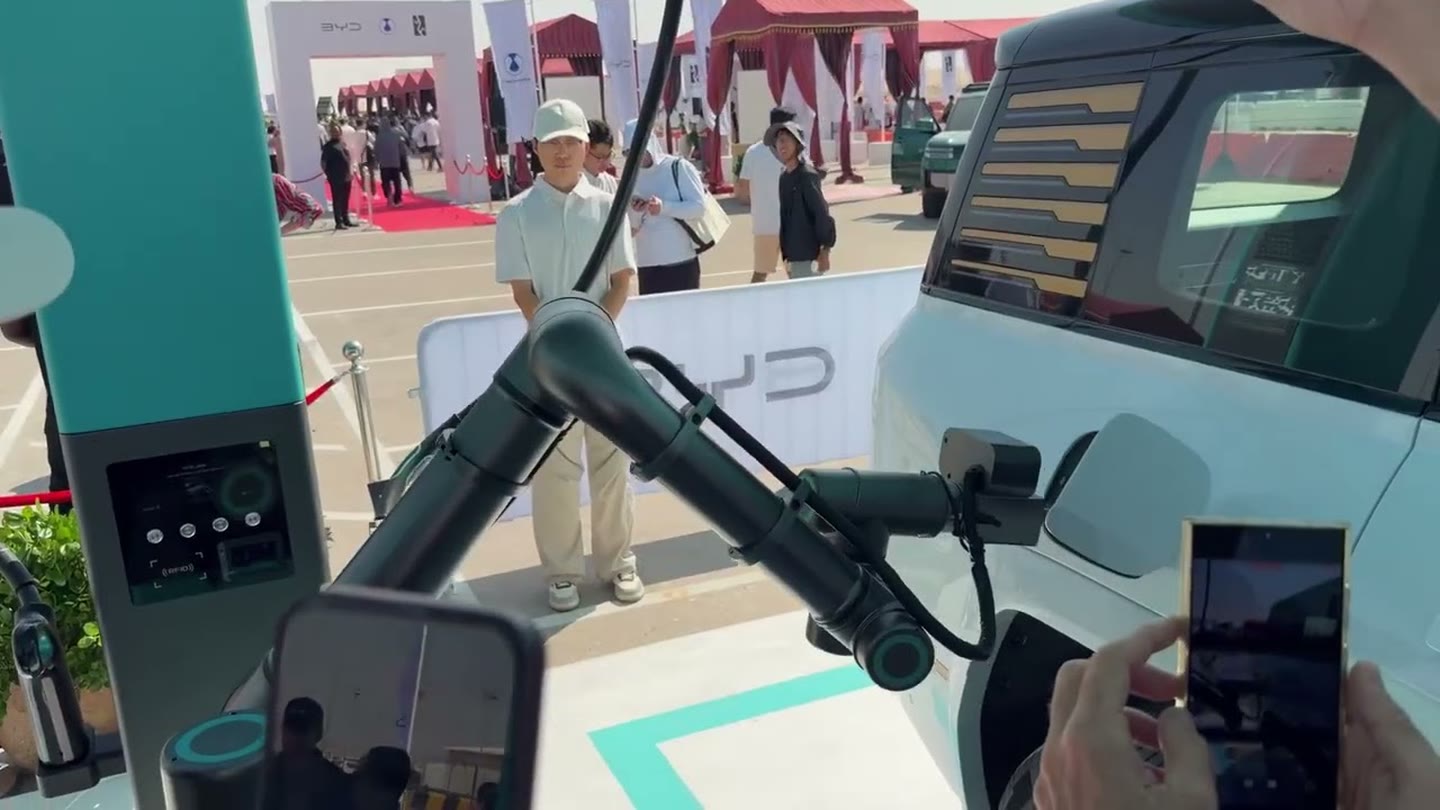
The car rolls into the bay and the driver gets out and walks away. What happens next is the station’s job: a black articulated arm swings out from the pillar, finds the charge port, pops the cover, and seats the charging gun. BYD showed its flash-charging robotic arm for the first time in the United Arab Emirates, at the company’s Abu Dhabi media weekend.
Nobody stands there holding a cable. In the Emirates’ heat, that is half the point, and BYD’s announcement leans on it directly: the driver never waits outdoors next to the car.
The arm is the visible half of it. Underneath sits the number BYD demonstrated on site, 1,000 kW of charging power, feeding a second-generation Blade Battery. In BYD’s Flash Charging framing, that battery runs from 10 to 70 percent in five minutes and from 10 to 97 percent in nine.
The station is the design
Start with the object itself. The Flash Charging station wears a single full-width canopy in BYD’s turquoise, carried on one pillar, the cable run kept short and tidy. It looks less like roadside furniture and more like a finished product, a gas station canopy rethought by an electronics company instead of the gray boxes lining most charging lots.
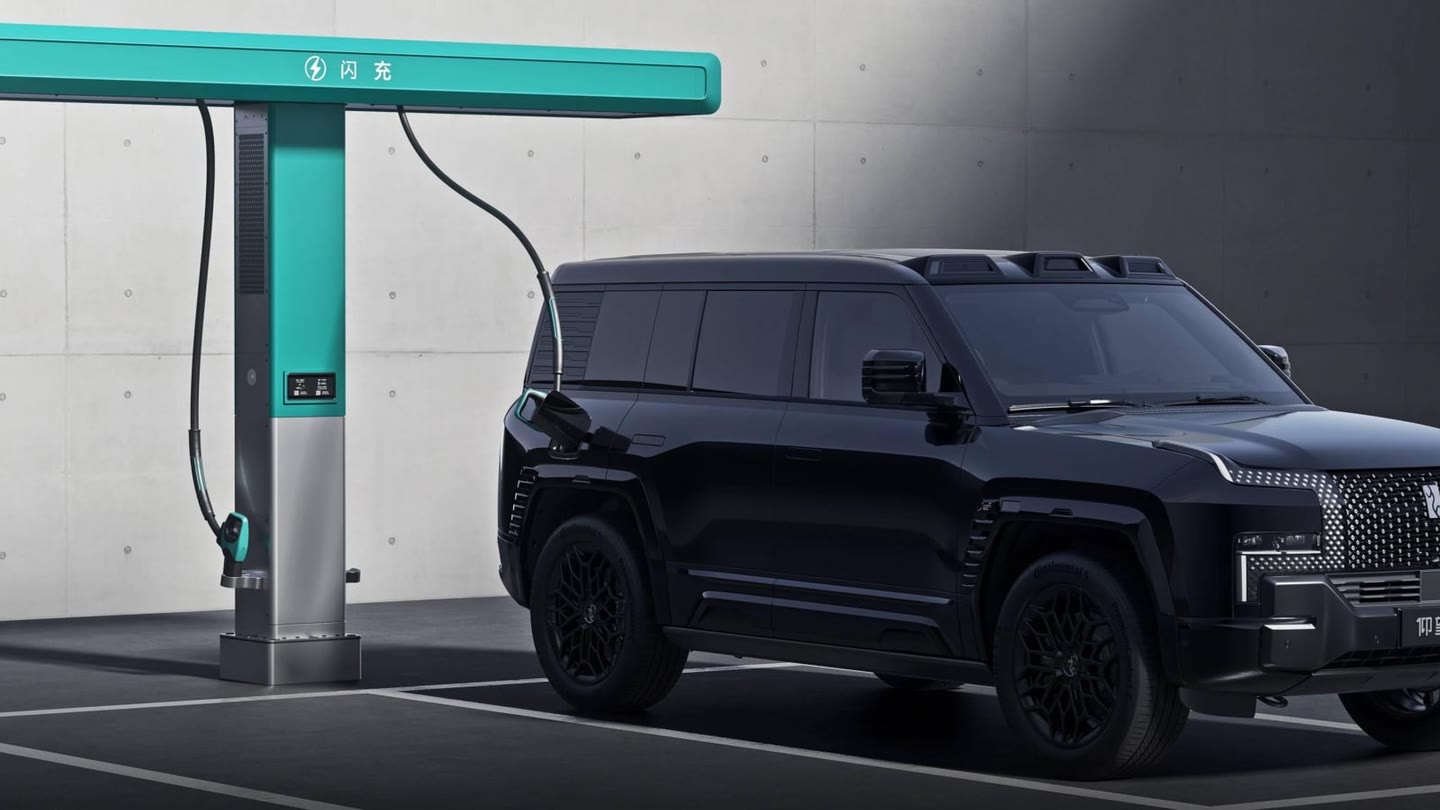
The canopy is not decoration. The station is an integrated solar-storage-charging unit: photovoltaic panels collect energy, storage cabinets buffer the supply, and the charger draws on both instead of pulling its full load from the grid at peak.
The arm is finished like a product too, not a prototype: matte black segments, exposed joints ringed in the same turquoise, and a head that carries both the gun and the sensors. BYD dresses its hardware as one family, and the robot is plainly part of the lineup rather than a lab rig bolted to a post after the fact.
Eyes first, then feel
Finding the port is the hard part, because no two drivers park the same way twice. The arm locates the charge port with visual recognition, then finishes the job through force-feedback control, feeling its way over the last stretch instead of trusting the camera alone. The pairing absorbs all the slop in how a car actually sits inside a painted bay.
It also travels.
BYD built the arm to handle the various charging interface specifications used in overseas markets, not just China’s. A charging robot fluent in one connector is a home-market demo. One that speaks several is equipment meant to ship abroad.
Nine minutes, untouched
The sequence runs end to end without a human hand in it. The arm opens the port cover, retrieves the gun, connects, and waits out the charge. When the session ends it disconnects, stows the gun, and closes the cover. The car sits finished, exactly as its driver left it, only fuller and ready.
Set against BYD’s own battery figures, what is on offer is a five-minute top-up or a nine-minute full charge, taken standing somewhere else entirely. The refueling stop stops asking for your time and your grip in the same visit.
There is a small courtesy at the end of it. The car is left closed up and complete, cover shut, nothing hanging open to the weather or the next driver.
One-Click Park & Charge removes the driver entirely
BYD unveiled a second layer at the same event, the same weekend it launched the Yangwang Altior. With One-Click Park & Charge, the car drives itself into the charging spot, and the arm connects once it settles, parking and charging folded into a single automated process.
Stella Li, BYD’s executive vice president, presented it on stage, and the car in the event footage is a Yangwang U8L.
That pairing is the tell. Assisted parking already exists, and very fast charging already exists. Wiring the two together so neither step needs a person standing by turns two known tricks into one service.
Warehouse robots first
The arm did not start with cars. BYD says it has worked on automatic charging robots for years, first for AGV equipment on warehouse floors, then for passenger-car parking scenarios. Its announcement also points at patent filings that reach further, reading a car’s battery level and tire pressure, even locating tire valves and inflating tires, all framed by BYD as future expansion, not features of the unit shown in Abu Dhabi.
Robots that learned on warehouse floors tend to be good at one thing above all: doing the same reach, the same grip, ten thousand times without complaint.
Editor’s take
Charging an electric car has exactly one old-fashioned step left: a person, a cable, and a socket. This removes it, and it removes it with the two things BYD sells best, design that looks considered and engineering built to scale. The arm and the canopy belong to the same thought, a station you would photograph instead of endure.
What BYD has not offered is the commercial detail: no price for the equipment, no availability date, no count of sites set to receive one. So the Abu Dhabi arm is a demonstration, not a product yet. But it demonstrates the finished idea, and the finished idea is a fuel stop with nobody working it, including you.


