

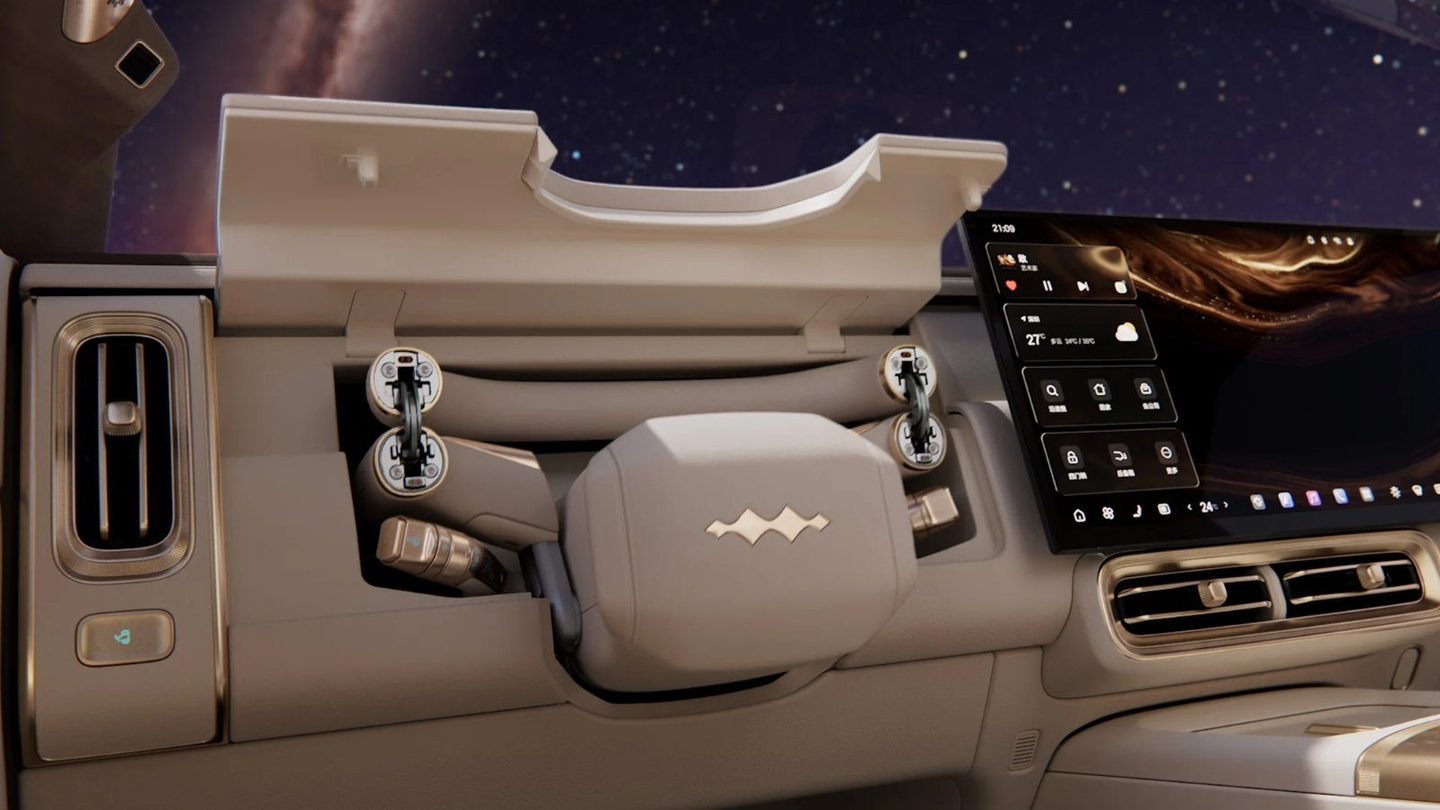
The Fang Cheng Bao Tai 9 parks, and its steering wheel swings through 180 degrees, drops into a compartment inside the dashboard and disappears behind a panel in ten seconds. It’s a lounge trick with serious engineering underneath it, built to last for years.
BYD calls it a world first for production cars. Pre-orders opened on November 9, it’s on sale in China now, and the fold is top-trim only, though the rest of the Tai 9 makes its own case without it.
The fold runs on a robot motor and five backups
Steer-by-wire makes the fold possible, because no column ties the wheel to the front tires, so the wheel is free to travel once the car is parked. The top trim runs brake-by-wire as well, and hinges swing the wheel flat into a compartment built into the dash behind a panel. The airbag stays mounted outside that compartment, ready to fire with the wheel out or tucked away. Only the top trim gets the fold.
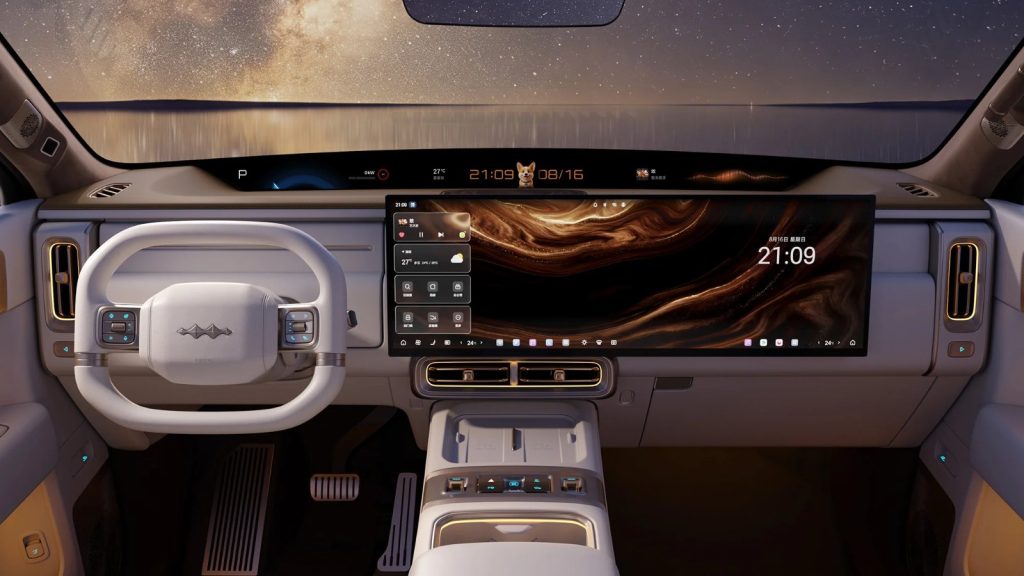
The party trick has a serious safety case behind it. Five redundancies cover power supply, communication, sensing, control and actuation, and the system carries ASIL-D safety certification. The motor is a high-precision servo borrowed from BYD’s humanoid robot program, where the same class of unit drives robot hands. Deployed again, it’s a plain D-shaped wheel with a full rim and physical switchgear, and there’s nothing new to learn before driving off. It’s a conventional wheel doing an unconventional thing.
The fold stays locked out unless the car is completely stationary. Durability testing ran the fold 96,000 times, against a hinge rated for 80,000 cycles.
A boxy flagship on a unibody, sized past the Bao 8
Fang Cheng Bao built its name on squared-off off-roaders, and the Tai 9 keeps the family silhouette. A continuous light signature runs across the nose, and dagger-shaped taillights mark the back.
Underneath, though, it breaks with the Bao 8, trading body-on-frame construction for a unibody that frees cabin space the frame would have eaten. The glasshouse stays flat and upright to the tailgate. It measures 5,270 mm long, 1,999 mm wide and 1,850 mm tall on a 3,130 mm wheelbase, with six seats arranged 2+2+2 and three interior color schemes to pick from. Six exterior colors carry the design, and nothing about the shape apologizes for its size.

536 horsepower, and it turns like a compact
The Tai 9 is the first model on BYD’s DMS Super Hybrid All-Round Platform, which blends the efficiency brief of DM-i, the performance of DM-p and the off-road brief of DMO in one architecture. A 1.5-liter turbo engine works with electric motors at both axles for a combined 400 kW, or 536 hp, and the run to 100 km/h takes 4.8 seconds with all four wheels driving.

The 66.48 kWh second-generation Blade battery returns 400 km of electric range on the CLTC cycle and 310 km on the stricter WLTC cycle. Combined range runs to 1,630 km. Depleted, it burns 6.4 liters per 100 km.
Flash charging takes the battery from 10% to 97% in nine minutes. Air suspension and rear-wheel steering are standard across the range, and the rear wheels help this 5.27-meter SUV turn inside a 3.5-meter radius, like a car half its length. Six-piston front calipers stop it in 34.5 meters from 100 km/h, and every trim carries LiDAR and BYD’s God’s Eye B driver assistance as standard.
Parked, the front seat turns into a lounge
Stowing the wheel frees 25 cm in front of the driver, and BYD counts the driver’s usable space at 80% once it’s gone, up from 60.3% with the wheel in place and the driver bolt upright. One button then raises the seat cushion and reclines the backrest to 165 degrees in 20 seconds, and a tray table folds out where the wheel used to sit. The driver’s seat becomes a bed.
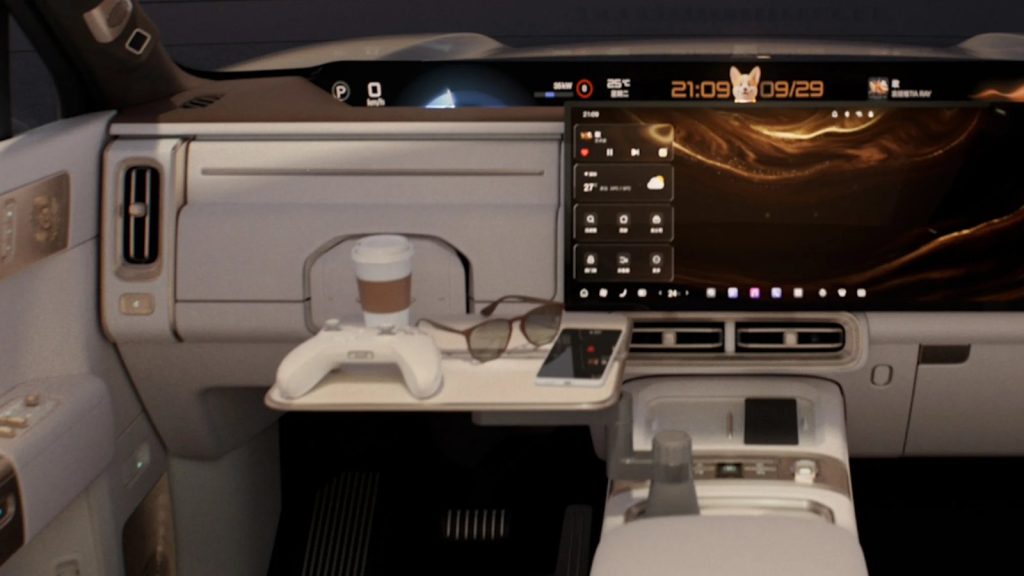
A 30-inch panoramic screen runs right across the dash. A 21.4-inch screen folds down from the ceiling for the rows behind, and an 11.5-liter refrigerator rides aboard too.
The front passenger gets a zero-gravity rocking chair, and heating, ventilation and massage run through all three rows of seats. Nappa leather covers the seats, wireless phone charging pads sit in the console, and the second row gets zero-gravity chairs all of its own.
The tradeoff is plain enough: the wheel performs its trick only at a standstill, so today it buys rest space at charging stops, not a taste of self-driving, and the hardware underneath is what a hands-off car needs. Xiong Tianbo noted at the launch that the industry has talked about folding wheels since 2016, and the column kept every one of them a concept. BYD developed the system over more than three years and holds 272 patents on it.
China’s steering rules changed in July 2026, dropping the mechanical-link requirement for systems that meet the new redundancy and fail-safe rules, which is the door this wheel walked through. With the trade-in subsidies BYD is offering counted, the entry price drops to 273,900 yuan. Prices start at 279,900 yuan, about $41,800, for the 4WD Max, with the Foldable Smart Cabin at 329,900 yuan, about $49,200, and the Tai 9 is on sale in China now, at dealers across the country.


