

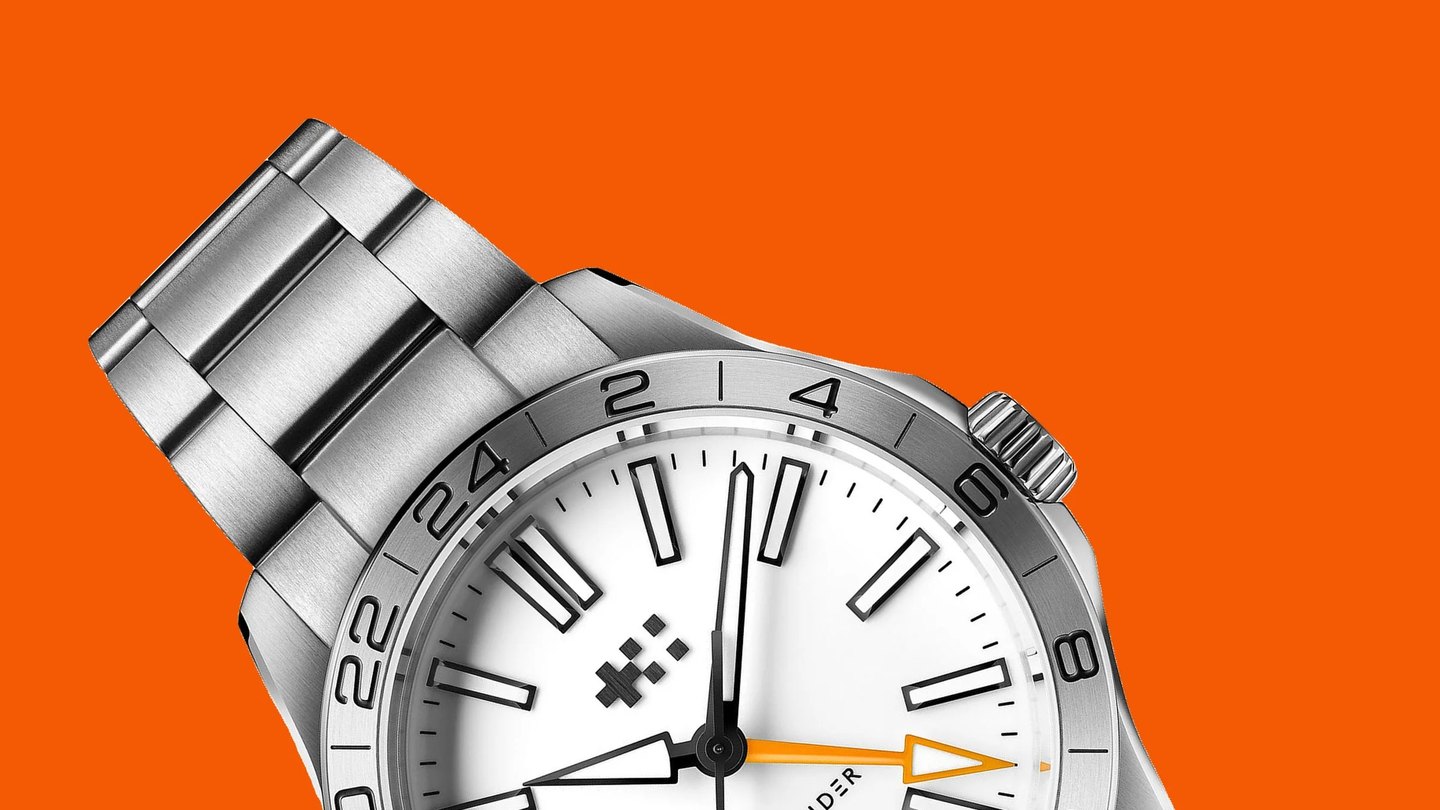
Everyday watches spent 2026 getting smaller, with the industry’s center of gravity sliding toward 36mm cases and vintage proportions. Christopher Ward just walked the other way, toward the wrists everyone else abandoned.
The second-generation C63 Sealander Automatic now comes in a 42mm case, and the Sealander GMT in a 44mm; both keep the same design, the same movements and the same five dial colors. Prices didn’t move either.
Same watch, bigger case
Nothing about the design needed rescuing, so none of it was touched or reworked. The Light-catcher case, redesigned and slimmer for this generation, keeps its sculpted flanks and polished lacquer dial. The indexes stay diamond-polished and tapered, the hands stay slim, and the Sealander name sits printed on the dial for the first time in the line’s life, after five years of dials that carried no name at all.
April’s overhaul made it the flagship everyday watch. The Sealander launched five years ago as the brand’s everyman watch.
That restraint is the story here: size was the only complaint left against the gen-2 Sealander, a watch built to be worn every day and anywhere, at work and away, and size is the only thing that changed. Everything cross-shopped against it got smaller this year, which makes the gap this watch fills wider, not narrower, as larger wrists get left with fewer everyday choices.
The 42mm Automatic
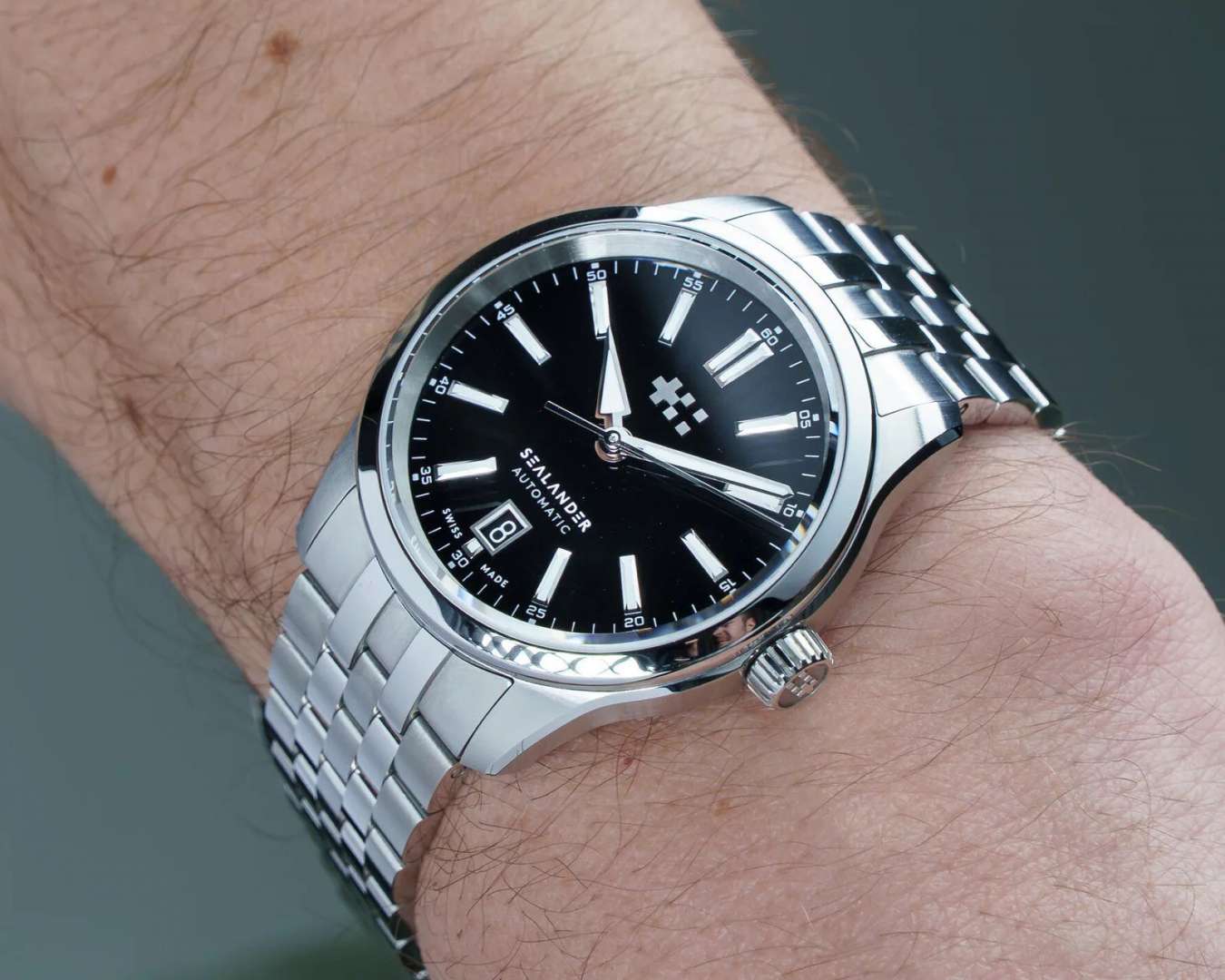
The time-and-date C63 Sealander Automatic tops out at 42mm now, up from the 39mm ceiling the line carried since April, when the second generation arrived in 36mm and 39mm only. Inside is Sellita’s SW200-2 Power+, a 26-jewel automatic with a 65-hour power reserve and accuracy rated at -5/+12 seconds per day; it’s the same movement story the smaller sizes already tell, now in a case with more presence.
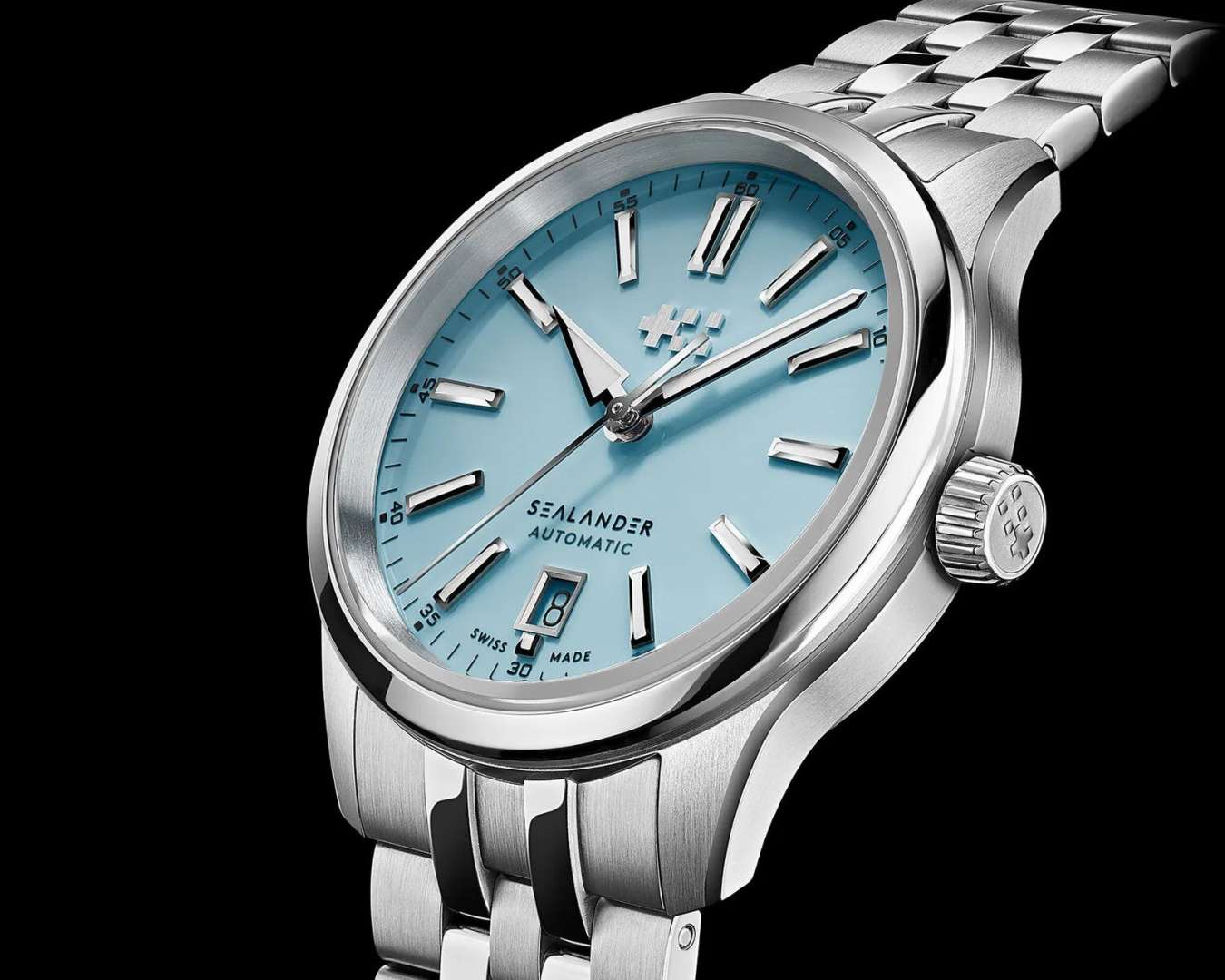
The details stay pure Sealander. A fully polished bezel, a conical crown with no guards, a sapphire exhibition caseback and a raised, applied date window at 6 o’clock carry over untouched. Sky Blue on the rubber strap is the variant Christopher Ward lists as orderable, at $1,290 today.
Christopher Ward credits an optimized gear train, a redesigned barrel and mainspring, enhanced automatic winding and an updated balance assembly for the jump to 65 hours, up from the 38 hours the first generation managed. The reserve isn’t a number pulled from a bigger barrel alone; it’s the sum of the four changes above, working together.
The seconds hand lost its Trident counterbalance in this generation, a small simplification that suits the cleaner dial. Simpler reads better at 42mm, where there’s more dial to look at and less hardware competing for attention, and the eye lands on the time first.
On leather it starts at $1,150. Rubber takes it to $1,290, the Bader bracelet to $1,375 and the Consort to $1,430. The ladder didn’t move when the case grew, rung for rung.
The 44mm GMT
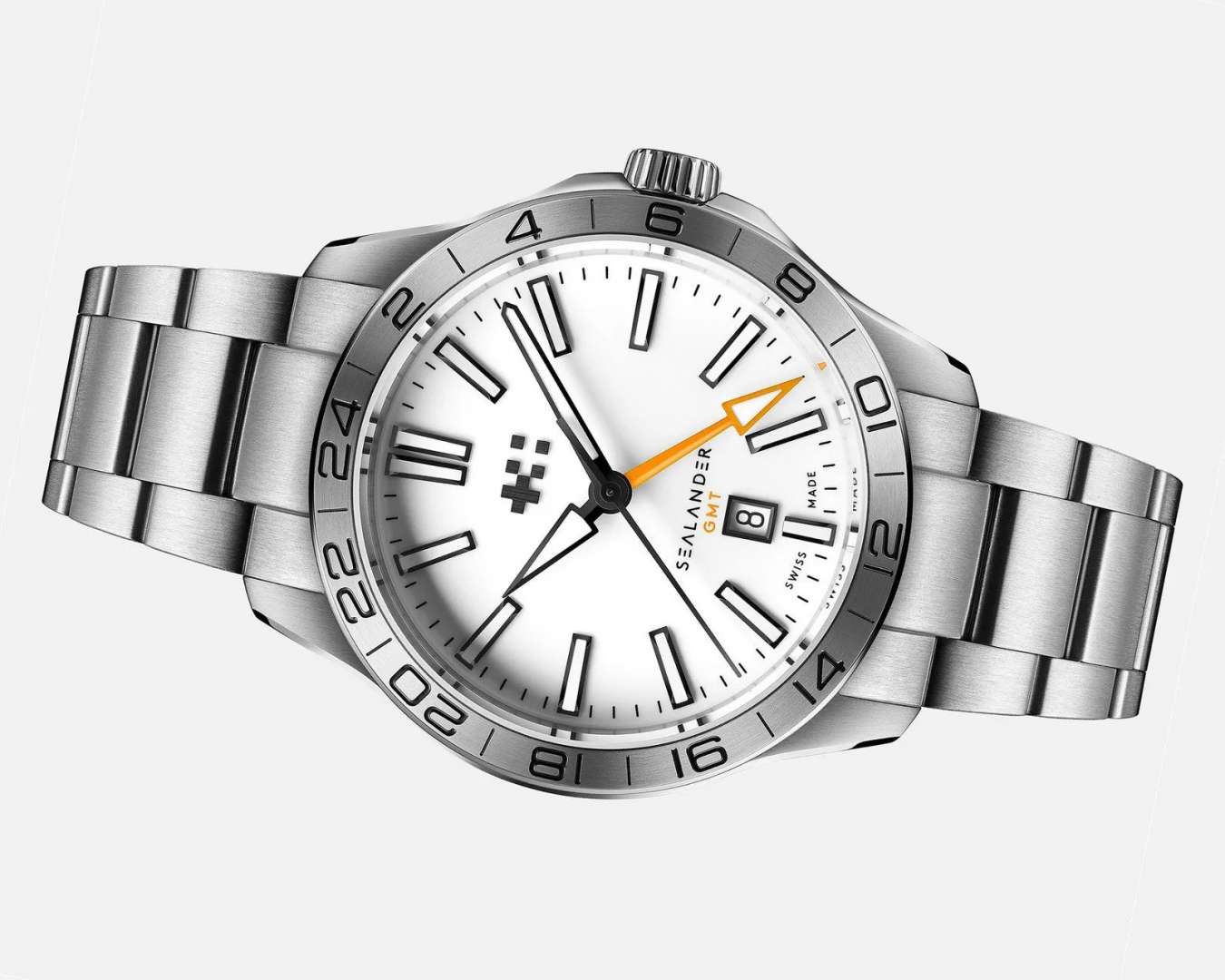
The GMT makes the bigger jump, from a 42mm ceiling to 44mm, and it wears its size with intent, the largest case the Sealander name has carried. A new mid-case gives this generation a more rugged build than the Automatic, and the conical crown gains guards; the bezel is reproportioned too, larger and set at a shallower angle for legibility at a glance.
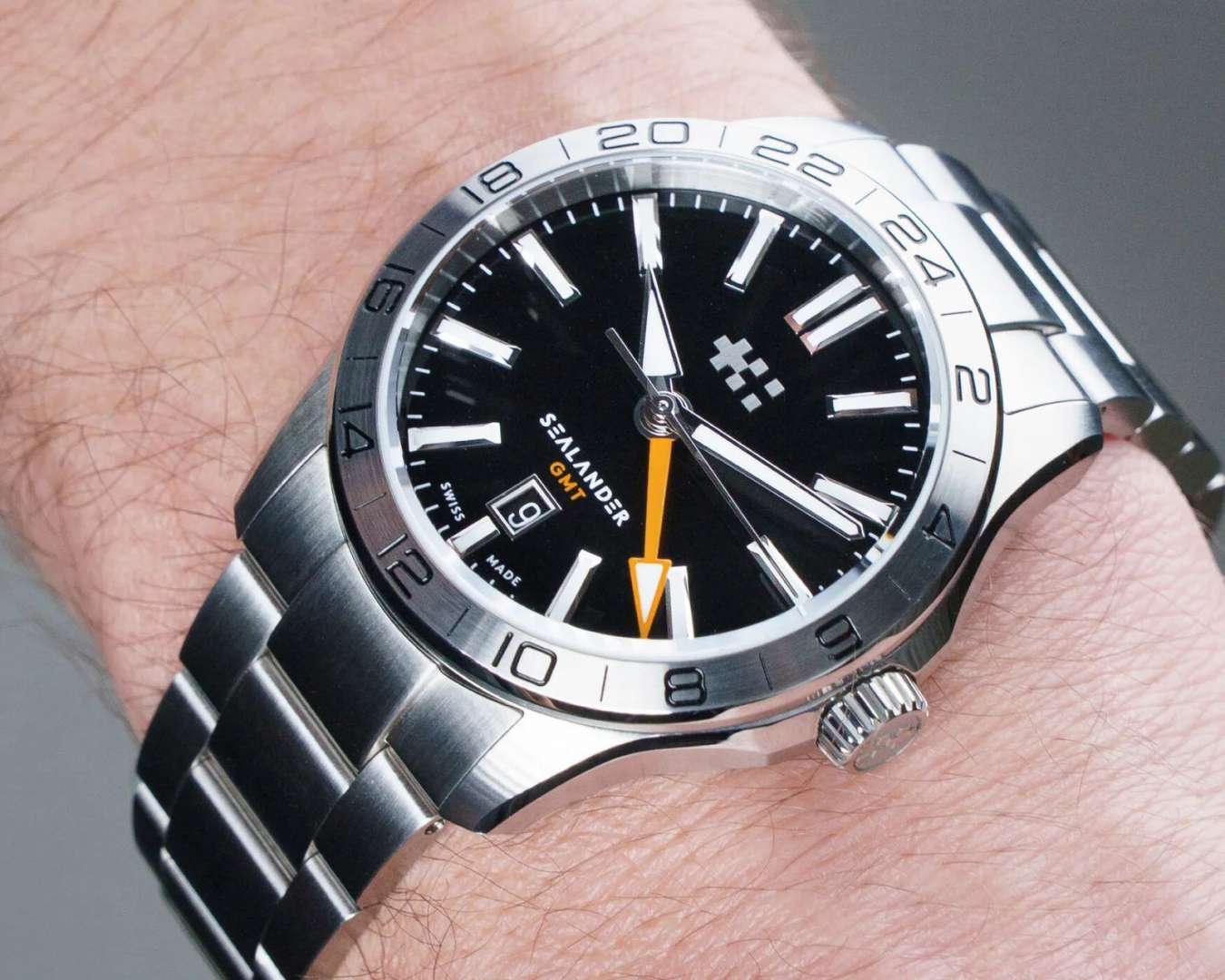
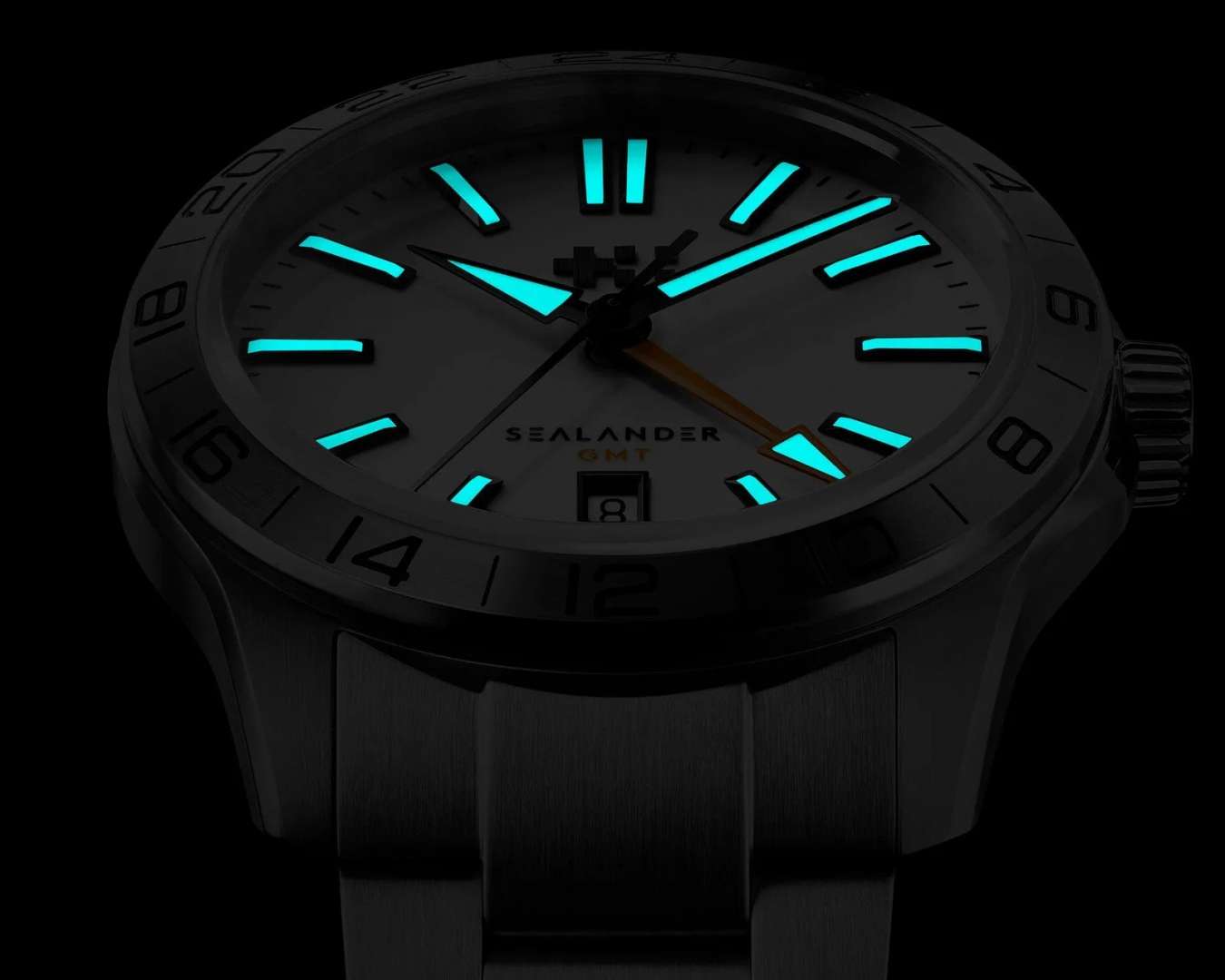
Sellita’s SW330-2 does the traveling work, a 25-jewel automatic beating at 28,800 vibrations per hour, with the GMT hand setting independently of the hour and seconds hands so a second time zone adjusts without stopping the watch. The reserve runs to 56 hours, and the fully painted GMT hand comes in orange on the black and white dials, glowing blue in the dark like the rest of the handset.
The date sits at 6 o’clock under a raised, applied window, same as the Automatic. It keeps the dial balanced, mirroring the Automatic’s layout. It’s the kind of symmetry you notice every time you glance down in an airport between flights, checking the second zone against the board.
Three are new. Five dial colors carry across both new sizes: a warmer white, pistachio, pink, sky blue and black, the same five shared with the smaller cases.
This one is sold as a preorder. The white-dial 44mm on the Bader bracelet is $1,620, shipping in late December.
The bracelet is the clever part
Both watches ride on the same hardware, from the bracelets down to the straps. The hardware carries a trick worth knowing: the Bader three-link and Consort five-link steel bracelets use Christopher Ward’s iLink system, which lets links come out without tools, so sizing a bracelet at the kitchen table stops being a jeweler’s job.
Turn either watch over. The exhibition caseback shows the movement’s finishing, rather than hiding it behind steel. The in-house-designed rotor is skeletonized, sandblasted beneath, with linear brushing across the top and concentric circular brushing on the weight; it’s theater most brands at this price skip behind a steel back.
Rubber in black or white and leather in black or brown round out the options, depending on dial color. In the dark, the lumed hands and indexes glow blue, GMT hand included, so the second zone stays readable overnight.
What it costs, and where it sits
Prices match the existing sizes exactly, across every strap and bracelet combination the line offers. The Automatic runs $1,150 to $1,430 across leather, rubber and the two bracelets, and the GMT runs $1,395 to $1,675 the same way; availability splits by variant, so the exact configuration is worth checking before ordering.
We covered the first-generation Sealander Automatic at 39mm and $930, a watch that got its proportions right with the older SW200-1 inside, and the 38-hour reserve its SW200-1 managed. This generation is a different proposition: a slimmer case, a 65-hour movement, and now the sizes the first one never offered; the honesty stayed, and the wrist presence the original never had is finally here.
Most brands are shrinking their everyday watches across their whole ranges because small is fashionable right now, and Christopher Ward read the same market and found the wrists everyone else walked away from. A 44mm GMT with a caller movement, an exhibition back and this level of finishing at $1,620 is a hard spec sheet to beat, on paper or on the wrist. The 42mm Automatic will sell to the same crowd, quietly, the way everyday watches do.
If your wrist has been waiting for the Sealander to grow up, in either of two sizes, it just did. Twice.


