

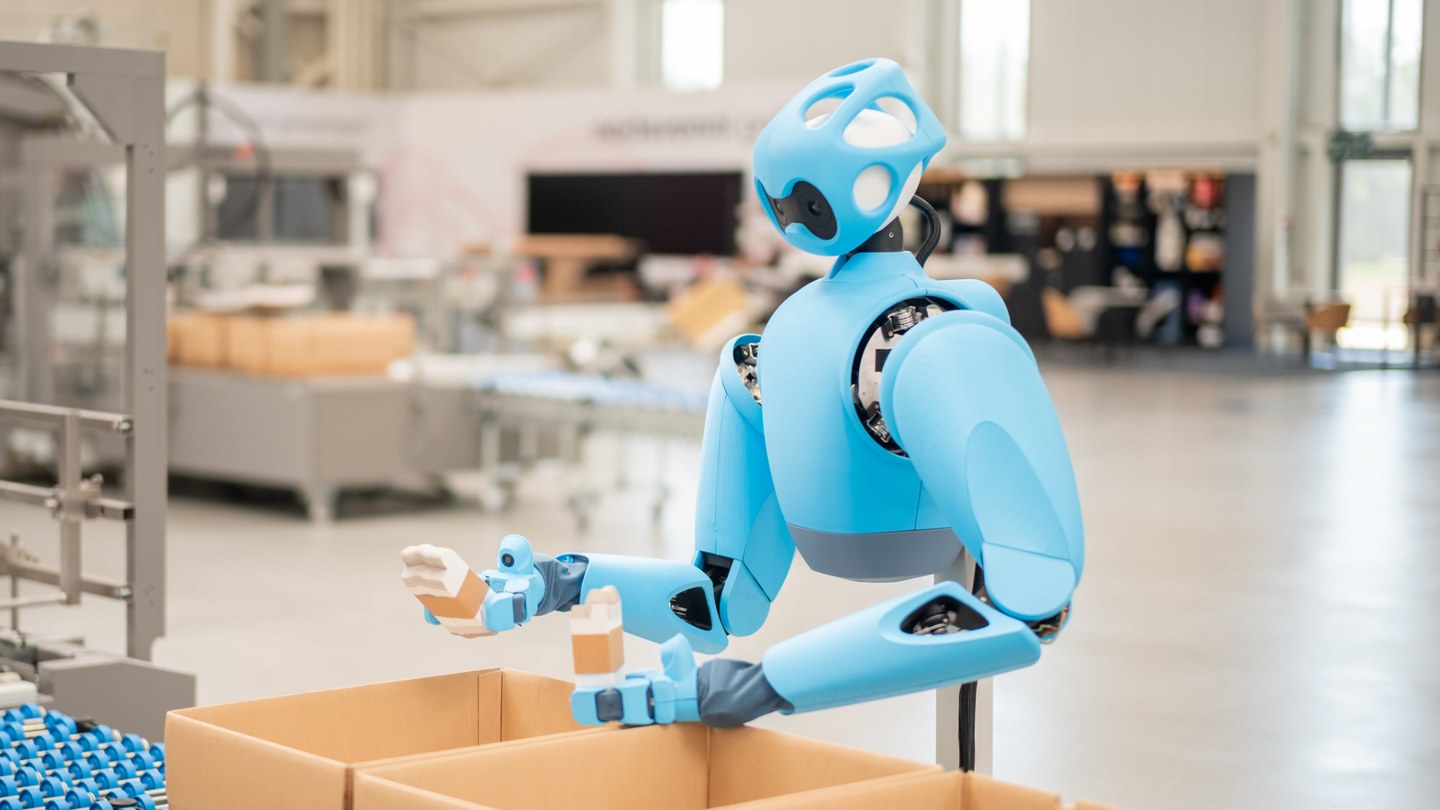
Most humanoid robots make their entrance walking, legs first and cameras rolling. AIR rolls in on wheels instead, a torso and two arms riding a base built for flat factory floors, no cage and no legs.
The new machine from Swiss startup Embodied AI has a torso, two arms and a head, and under all of it a wheeled base, because the place it’s built for, the factory floor, is flat. It was unveiled at Humanoid Europe 2026 in Munich on November 6, and it skips the cage most industrial robots work behind.
The look gives the brief away. Rounded shells in a bright, friendly blue, a head like a perforated helmet with the camera eyes set behind a dark band, a soft exterior over everything. It’s shaped to be bumped into at a packing station, not admired behind glass.
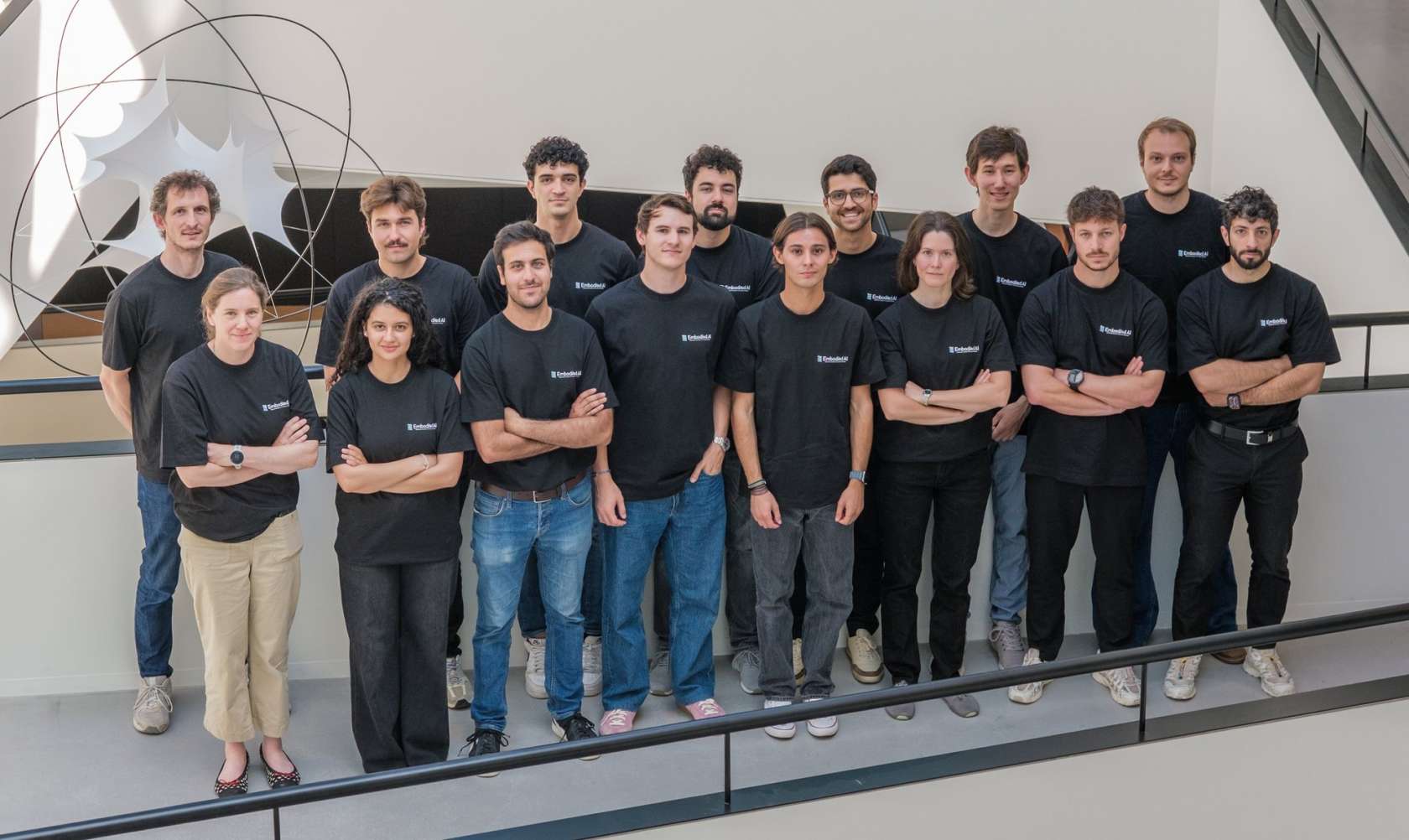
Twenty-five people in Lausanne designed it. The whole machine went from research to unveiling in nine months.
The timing isn’t an accident. Deloitte and The Manufacturing Institute count as many as 1.9 million US manufacturing jobs that could go unfilled by 2033, and the Manufacturing Leadership Council puts manufacturers planning to use physical AI within two years at 22%, more than double today’s 9%.
Deloitte also expects over 80% of factory task hours to stay human-driven. The opening here is beside people, not instead of them.
Built soft on purpose
The heavy hardware hides in the torso. Motors, gearboxes and electronics all sit inside the body, and the arms run on tendons, so the parts that swing near people carry almost no mass.
Bump one and it gives way. There’s no software limiter doing that job. The arm itself has nothing heavy to hit you with.
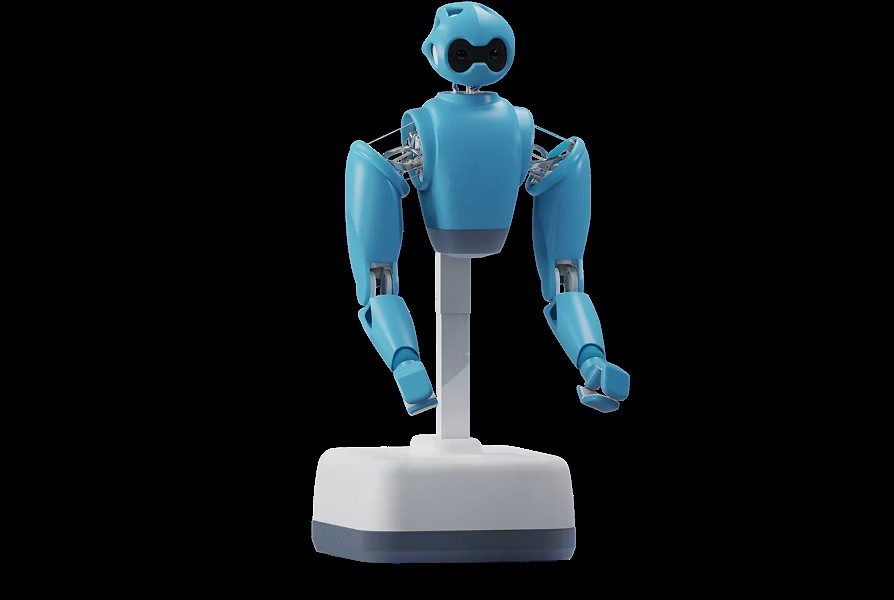
Wheels are the unfashionable choice, and the company defends them in one line: factory floors are flat, and wheels are more stable. There are no stairs on a production line. The low base also keeps the whole machine steady at elbow height, which suits a robot built to work within arm’s reach of people all shift.
The design follows ISO/TS 15066:2016, the technical specification for collaborative robots, and the safety list is physical: a soft exterior, low inertia, compliant joints, high-frequency sensing. CE marking is planned for 2027. Founder and CEO Francesco Stella, 28, developed the arm out of his PhD research at EPFL and did further research at MIT CSAIL, and his reasoning runs through everything the team built.
In robotics, he says, incorrect actions have immediate and irreversible physical consequences. An AI that recommends the wrong product hurts nobody. A robot that swings wrong can hurt somebody badly. So the safety went into the metal and the plastic first, and the code second.
It starts work before it knows the job
AIR doesn’t arrive trained. A human operator runs it through its first shifts on a customer’s line, driving the arms remotely while the robot does real work from day one.
Every run gets recorded. Those recordings become the training set, gathered on the actual task, on the actual line, under actual factory light.
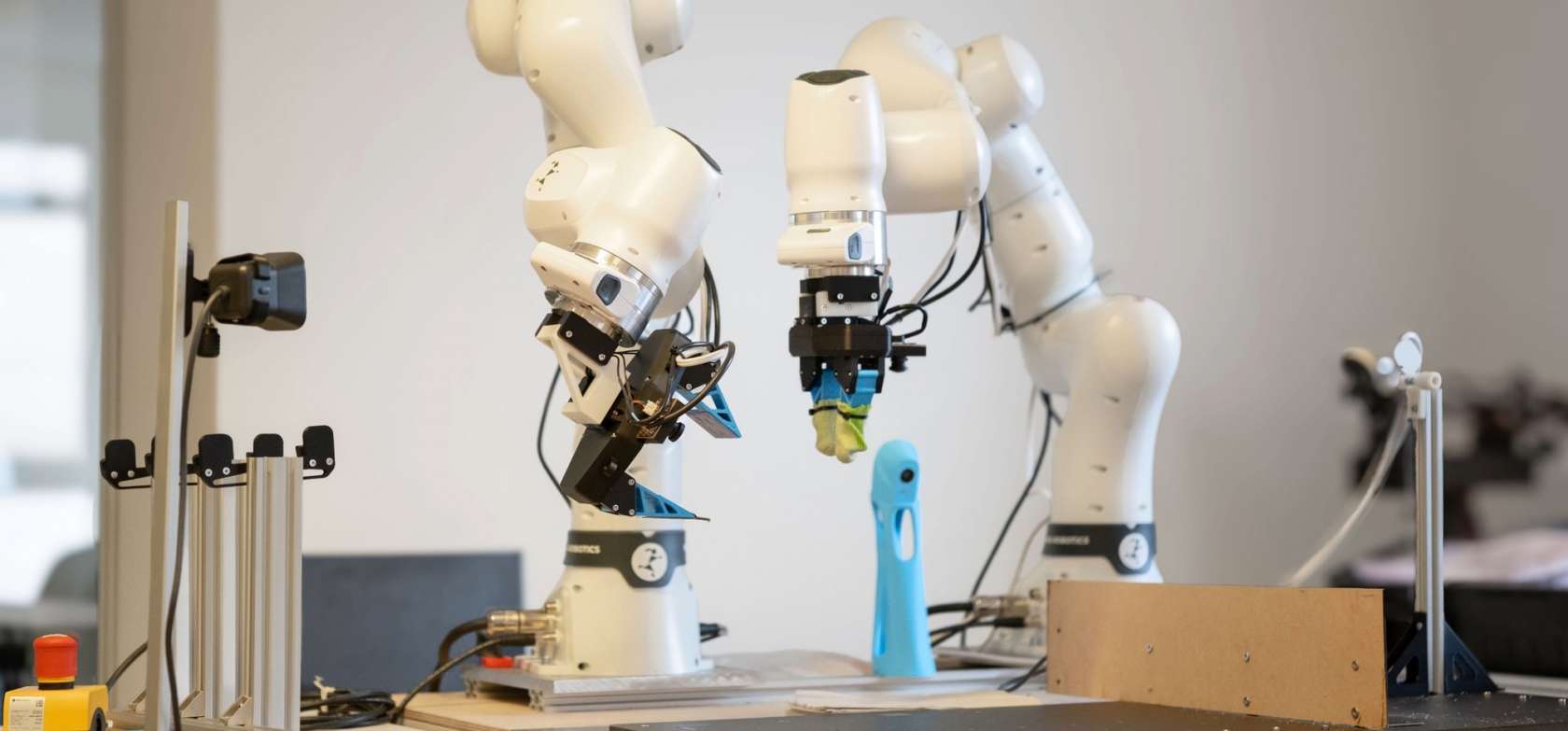
Compact models learn each task on site, coordinated by a vision-language model and running on the robot itself. Within about a month, the company says, AIR usually handles the job on its own. The operator stays on call for anything it hasn’t seen, and what one robot learns, the next one can use.
The work on the list is the fiddly kind. Complex assembly, picking, placing and plugging, kitting and packaging, SMT support, cable handling. Jobs that change too often for a fixed robot and need fingers more than force.
It’s the manual work that never repeats the same way twice. The proof is already running on a customer’s line.
The same stack runs in paid factory deployments on the company’s two-arm cell. When a leading consumer electronics manufacturer tested five funded startups on a cable-handling task, none of them met its targets. Embodied AI met all of them, reaching 98% reliability against a 90% goal. Paid pilots since then have averaged 95% task success. The customers stay unnamed, and the figures are the company’s own.
Twenty-five people in Lausanne
Embodied AI is an EPFL spin-out headquartered in Lausanne, Switzerland, with an office in Rome. Stella co-founded it with CTO Kai Junge and COO Max Polzin, robotics PhDs drawn from Cambridge, ETH Zurich and EPFL. The company’s first funding round, led by Faber with TechShop, Look AI Ventures, Plug and Play and Vento, was announced alongside the robot.
Contracts are already signed with major manufacturers worldwide, and AIR is being tested at some of them while the company plans scaled production. Orders opened after the Munich unveiling.
What hasn’t been published is a price, a payload figure, a delivery date, or the basic dimensions. Height, weight, reach and battery life are all still blank on the sheet.
The date that counts is the 2027 CE mark. Europe’s new machinery rules take effect that January, with fresh requirements for machines that keep learning after delivery and work close to people. AIR was designed straight at that door, and the mark decides when it can be sold as a finished machine across the EU.
The humanoid race is spending billions on legs. This team spent nine months deleting them, and what came out looks like factory equipment first and a robot second: a soft blue torso at the end of a line, packing boxes beside the people it was built to help.
If the mark lands in 2027, that silhouette stops being a novelty. It becomes part of the furniture of the modern factory floor, which is the future this small Lausanne team is designing for.


