

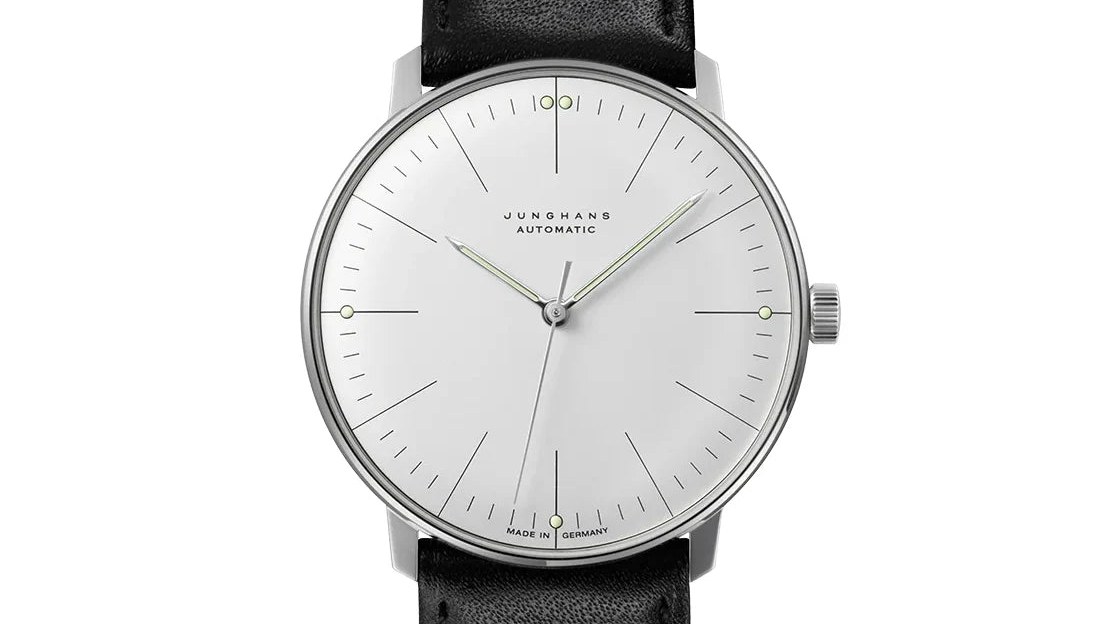
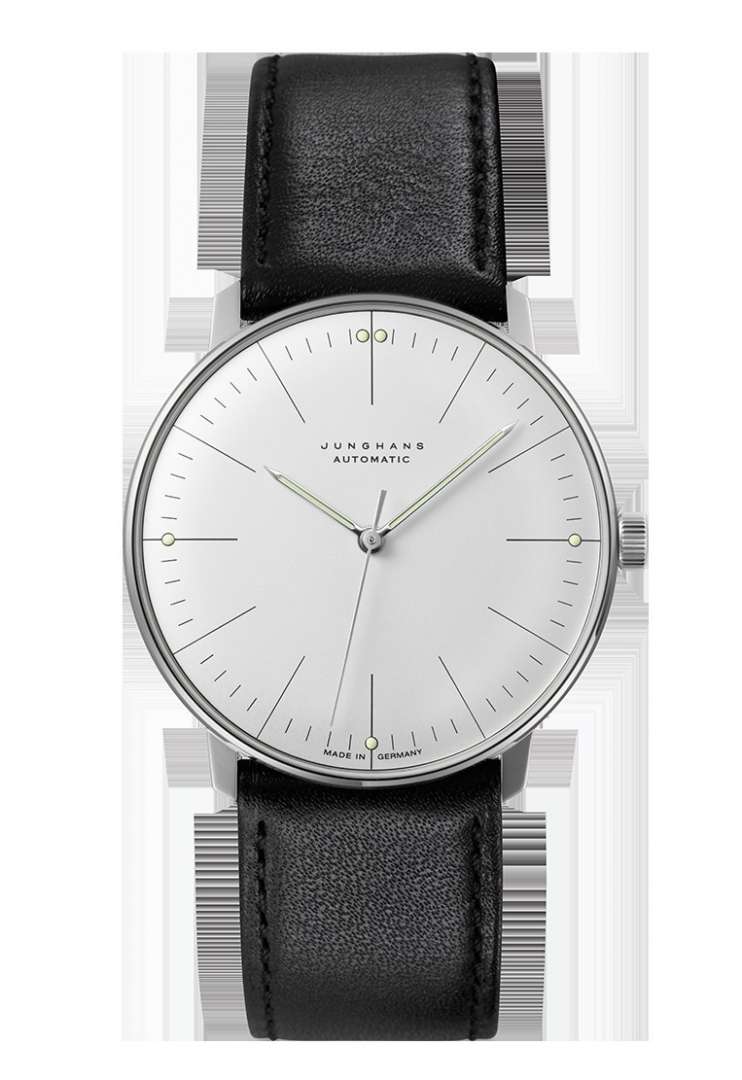
The Junghans max bill Automatic dial fills its case edge to edge, and it still leaves most of its surface empty. Nothing else asks for attention. Squared numerals and a fine minute track carry the time in silence.
The Bill design language, kept intact
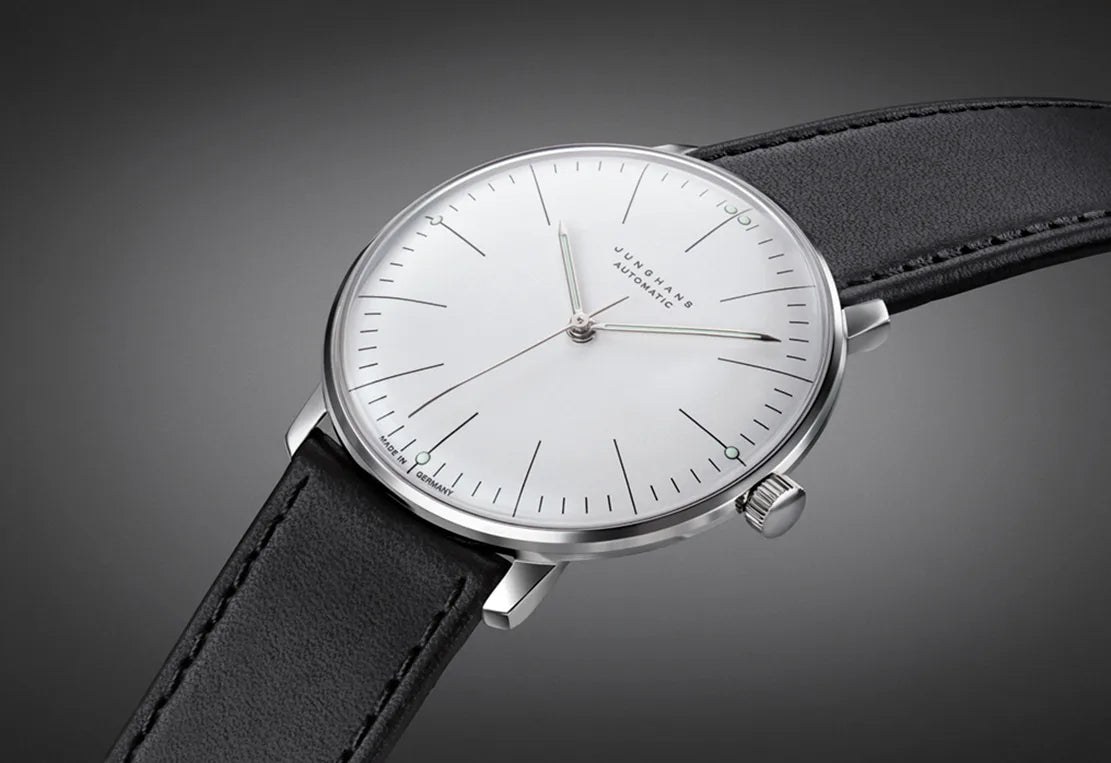
Max Bill began working with Junghans in 1956, and his first mechanical wristwatches for the house arrived in 1961. The layout on this reference follows that early work closely, with the same calm spacing and the same refusal to decorate without a reason.
The numerals do the visual work here. Bill drew them as squared, geometric forms, each one reduced to straight lines and clean angles. The 4 sits like a small upturned chair, a detail collectors spot before they read the brand name above it.
There’s no date window here. A date would sit at three on the 27/3501.02 and break the dial’s side-to-side symmetry, so Junghans leaves that space clean and lets the numerals hold the balance alone.
Luminous substance on the hands and the minute track keeps the watch readable after dark without changing its daytime character at all. It’s a practical touch, kept deliberately small against the pale dial. Legibility stays calm in low light, because the glow sits in small points and thin hands rather than across broad markers or printed blocks.
Bill trained at the Bauhaus and worked across architecture, painting, sculpture, and product design, so the watch sits inside a much larger body of work. His breadth shows in the dial’s discipline, because every element holds its space through function rather than habit or ornament.
The minute track runs fine and close to the dial’s edge, and it gives the open center room to breathe without leaving the face feeling unfinished or sparse. Reading the time takes a single glance, and nothing on the dial asks for a second look first.
A polished case under a domed crystal
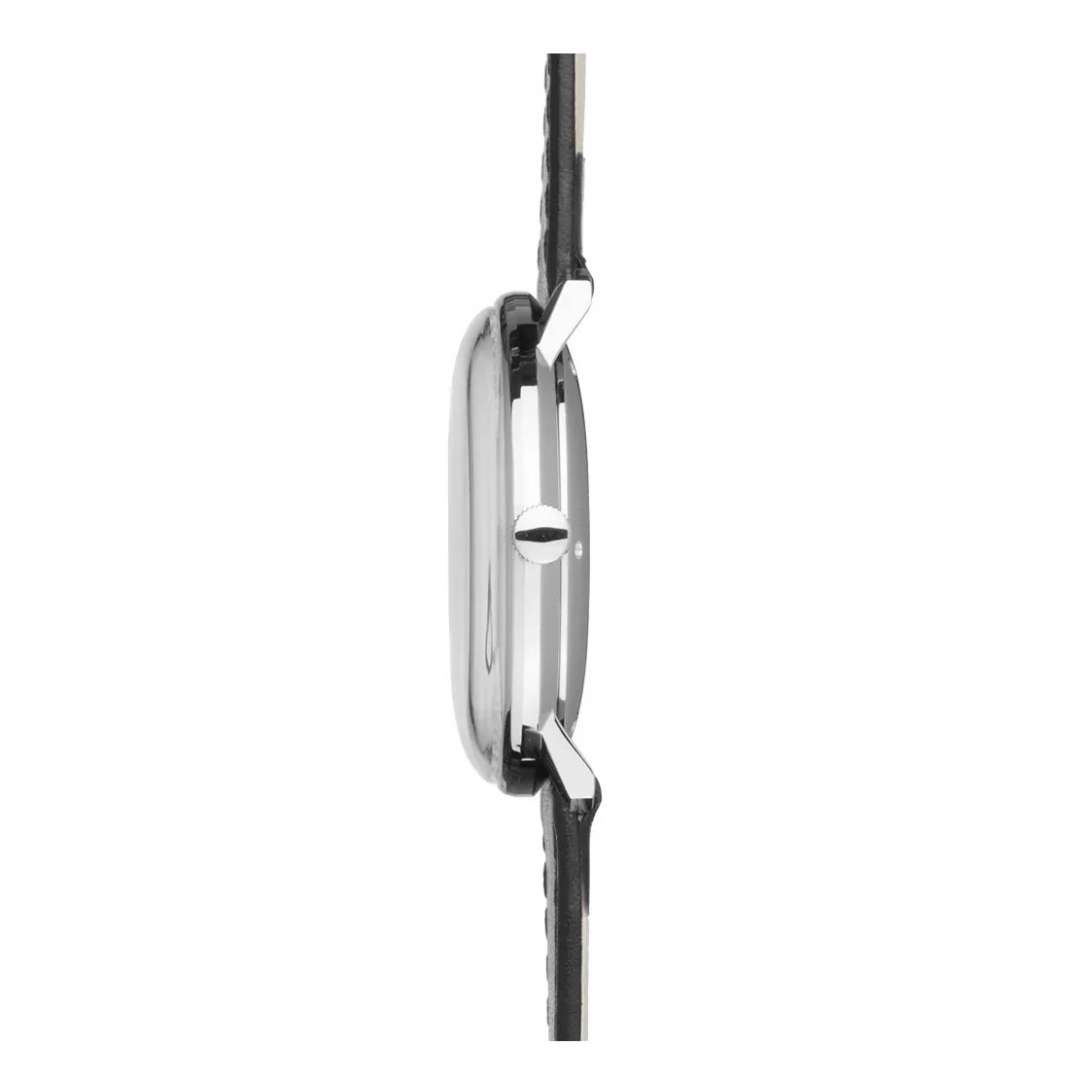
The polished stainless steel case measures 38.0 mm across and 10.0 mm high, dimensions that suit a design drawn for everyday wear in 1961. It doesn’t chase presence. The watch sits flat and light against the wrist.
A domed sapphire crystal rises over the dial, and it’s anti-reflective, so the curve catches less glare than a polished dome usually would. The curve also softens the dial’s edges when the watch turns in the light.
Water resistance reaches 5 bar, enough for rain and daily splashes around a sink or a wet commute. It’s not a swimmer’s rating. The leather strap wouldn’t thank anyone for testing it in a pool either.
Polishing also suits the design’s age, since the early watches carried bright cases that framed the pale dial like a picture rail around a print. The effect stays formal without turning dressy, and the watch pairs as easily with a knit as with a jacket.
The J800.1 does the quiet work
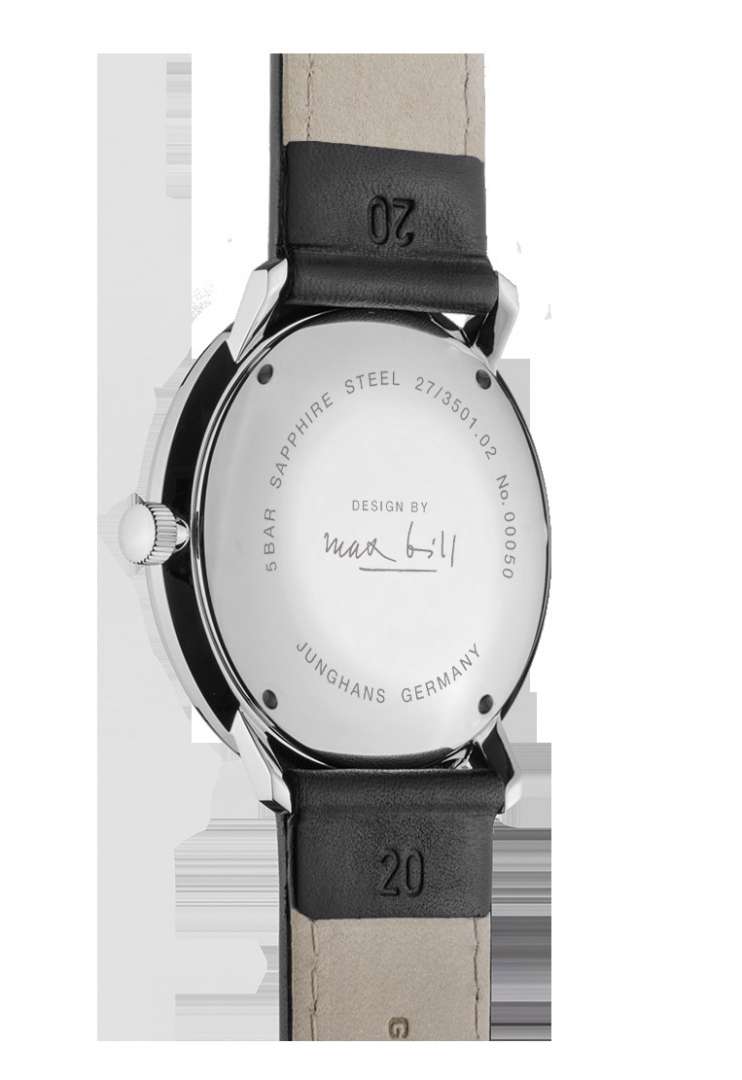
Inside sits Junghans calibre J800.1, a self-winding movement that winds from the motion of the wearer’s wrist through the day. There’s no battery to change. The watch simply asks to be worn regularly.
Power reserve runs to 38 hours, so the watch keeps going through a day off the wrist and into the next morning. Set it down on a Friday night, and it’ll still be running on Sunday.
The specification stays deliberately plain, and that plainness fits the design above it rather than competing with it for attention. Bill’s dial never promised technical theatre. It promised clarity, and the movement supports that promise quietly.
Servicing follows a familiar pattern for a movement from this family, and independent watchmakers know the architecture well, which keeps long-term ownership straightforward for a design-led watch. That practicality suits the piece, since a watch drawn in 1961 shouldn’t demand specialist care in 2026.
Leather, a buckle, and an easy fit
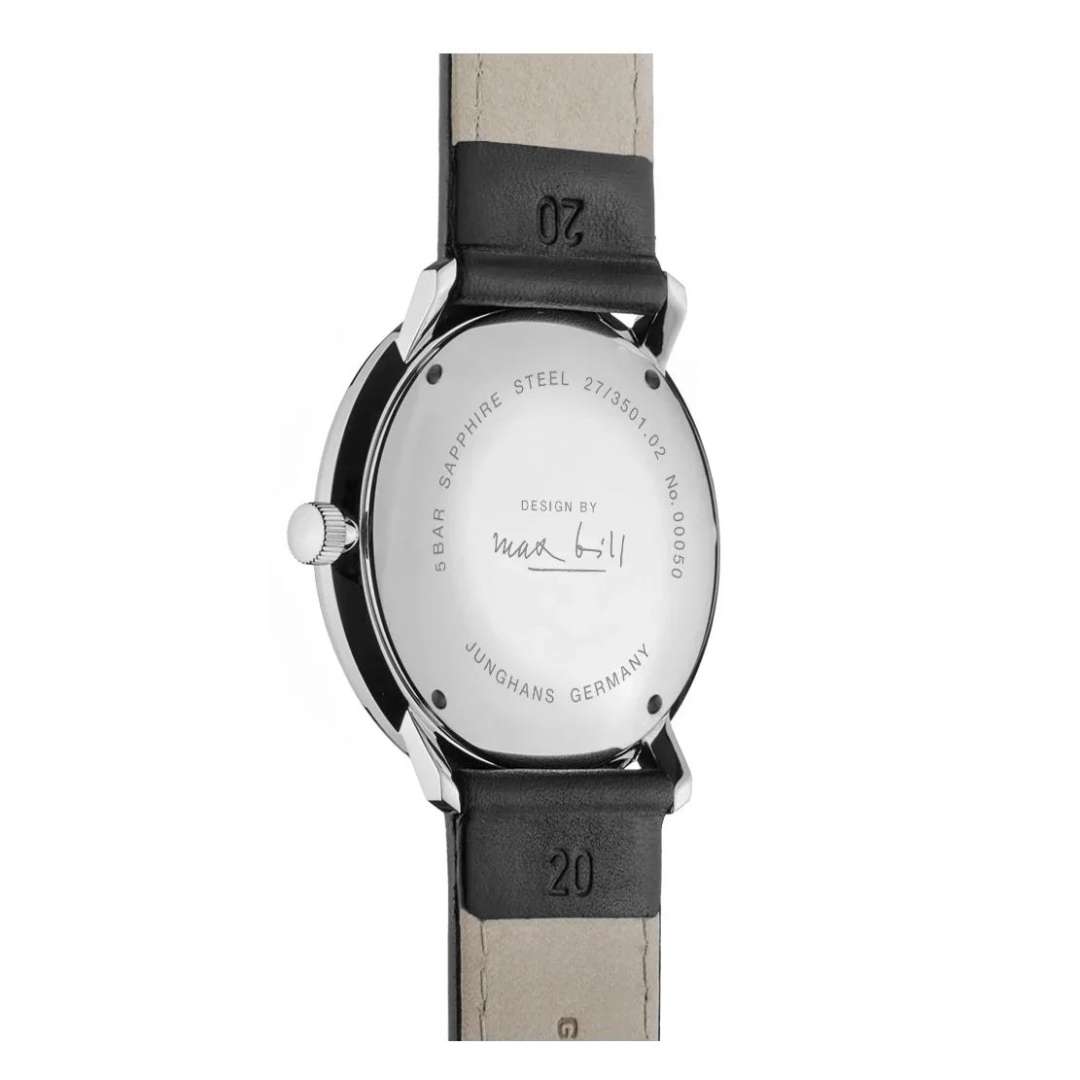
The black leather strap closes with a stainless steel buckle, a pairing that keeps the silver dial and polished case in a monochrome frame. It’s a sober combination. Nothing in the color palette reaches for contrast.
At 38.0 mm with a short 40 mm length across the lugs, the case settles on smaller wrists without the strap ends wrapping too far. The 20 mm strap width also opens a wide field of replacement straps.
Under a shirt cuff, the 10.0 mm height slides clear instead of catching on fabric through the day at a desk. Such ease is part of the design’s appeal, since a watch this restrained shouldn’t announce itself through a sleeve.
Black leather also keeps the focus on the dial’s geometry, because a steel bracelet would add reflections and visual weight that the original design never carried. Owners who prefer a bracelet can fit one later. The lug width follows a common standard. The stock strap keeps that original pairing intact from the first wearing day.
Restraint, kept on the wrist
Junghans has made watches in Schramberg since 1861, and the max bill line remains the clearest record of what the Bauhaus brought to that Black Forest workshop. The forms stayed useful, and the decoration never arrived.
Buy the max bill Automatic 27/3501.02 at $1,670 if a calm, design-led watch belongs in a daily rotation. Skip it if a larger case, a date display, or a swim-ready rating sits higher on the list.
Sixty-five years after Bill drew the first wristwatch dials, the design hasn’t needed a rescue, a revival, or a limited-edition excuse to stay in the catalog. It simply stayed in production. Few product designs from 1961 can say the same without qualification.


