

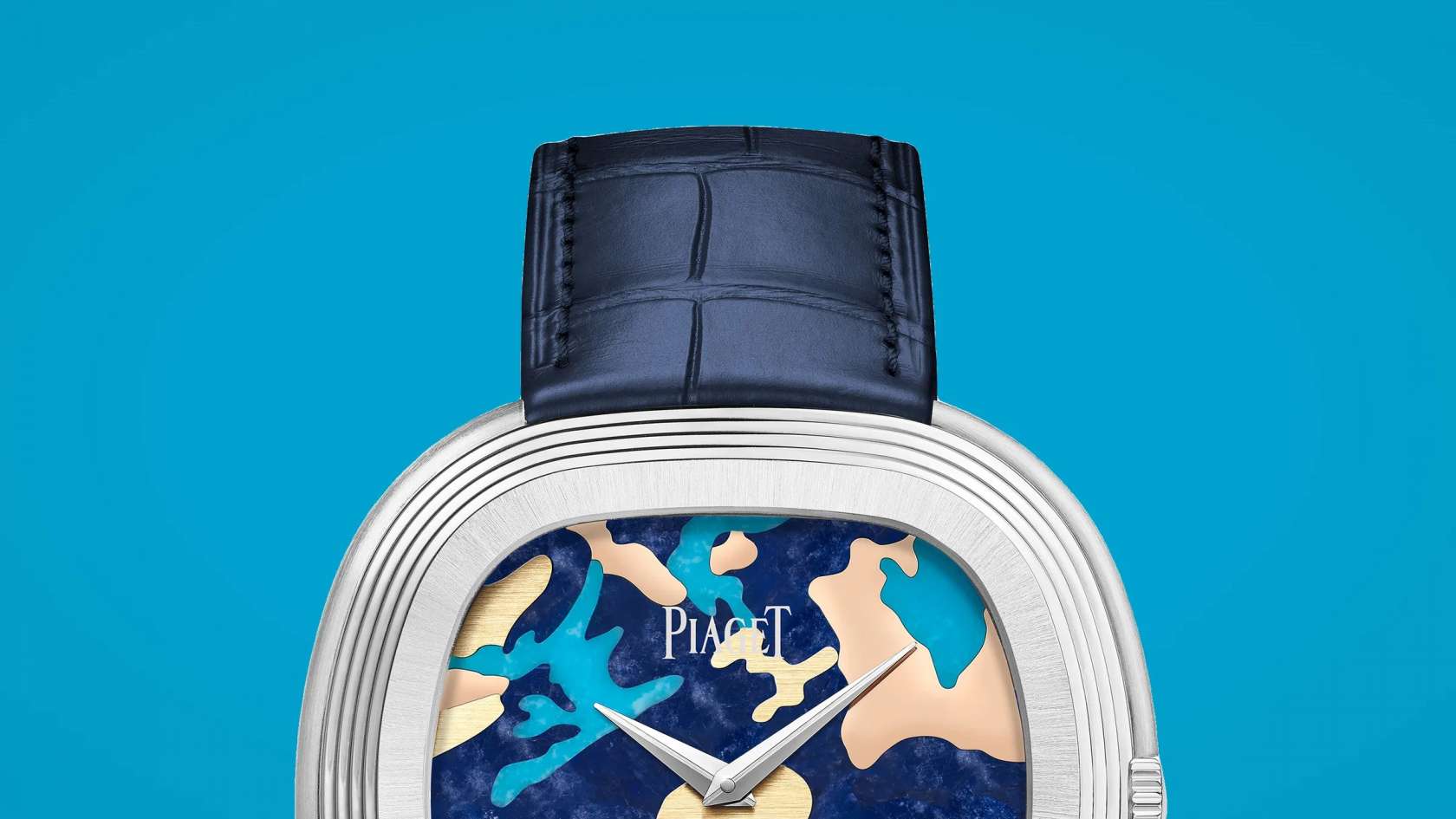
Warhol’s camouflage self-portraits hid a face inside a military pattern, and Piaget’s newest limited edition hides the pattern inside a watch dial. Twenty-seven pieces of stone and gold rebuild the motif at 45mm, in blues Warhol never printed.
A dial assembled like a jigsaw
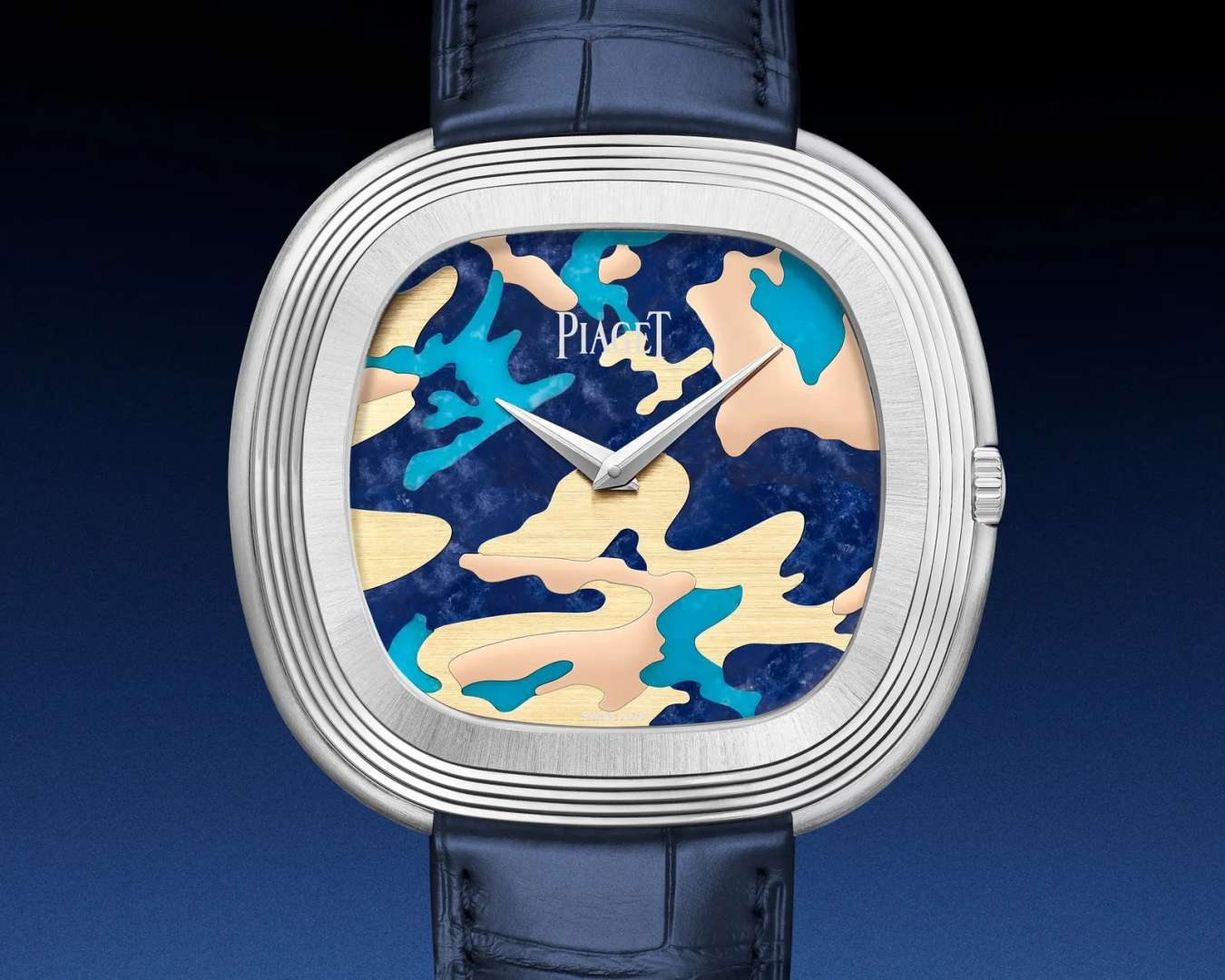
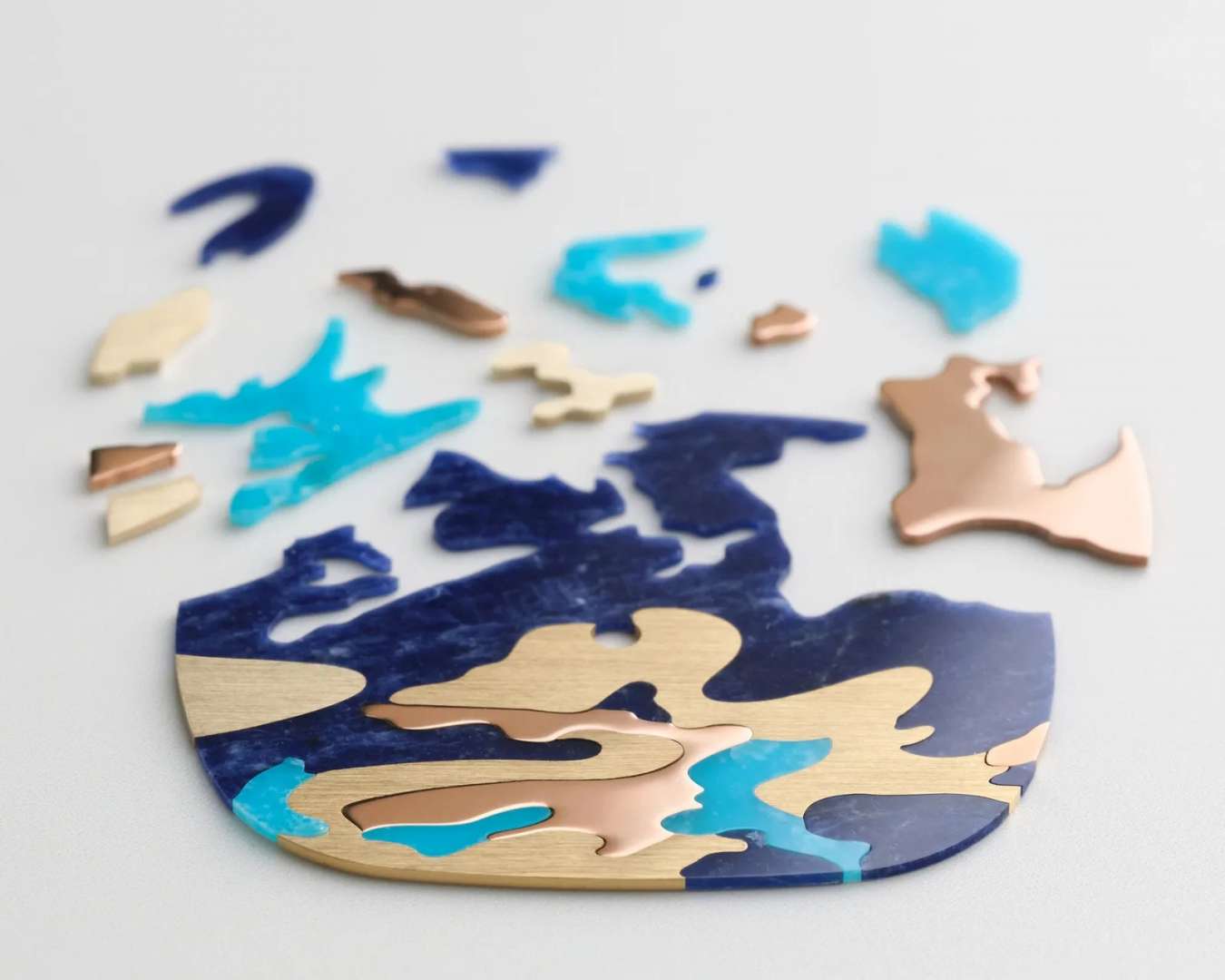
The dial is ornamental stone marquetry, cut from sodalite and turquoise and set alongside satin-finished yellow gold and polished rose gold. Each of the 27 pieces is shaped to its neighbor, so the camouflage flows across the dial as one continuous, broken surface.
More than 100 hours went into designing, researching and assembling the dial, and the work shows in the joins, since stone and metal expand and cut at different rates. A pair of polished dauphine hands sits at the center, and the Piaget logo at 12 o’clock is the dial’s only marking.
The edition was announced on November 5, 2026, under Piaget’s licensing agreement with The Andy Warhol Foundation for the Visual Arts. The agreement lets the maison produce one Warhol-inspired watch each year.
The colors stay in a blue register, deep sodalite against brighter turquoise, with the two golds warming the gaps between them. It’s camouflage translated into jewelry, and the pattern looks like landscape from across a room and as stonework up close.
The cushion case Warhol actually wore
The watch rebuilds reference 15102, the cushion-cased model Piaget produced between 1972 and 1977 and one of seven Piaget watches Warhol owned. He bought his in 1973, and the design’s stepped, gadrooned profile has carried his name officially since the 2024 licensing agreement with The Andy Warhol Foundation.
Warhol collected Piaget watches the way he collected everything, in multiples and with intent, and the brand traded on that connection for a decade under the Black Tie name. The 2024 agreement changed the footing from nickname to license, so the collection now carries his name openly and the Foundation shares in each edition. That shift shows in the dial work, which treats the artwork as source material to deconstruct rather than a picture to shrink.
This edition keeps the original proportions at 45mm by 43mm, rendered in 18-carat white gold with a rhodium finish and an inset crown. A navy alligator leather strap with a white gold pin buckle fits directly into the lugless case, so the strap line runs unbroken from the case flanks.
The gadroons deserve their own note, because the stepped ridges around the case catch light in bands and give the cushion its jewelry finish. Piaget has used the profile since the original reference, and it separates this watch from every round dress case on the market. In white gold with a rhodium finish, the ridges read cool and architectural against the warm golds inside the dial.
Stone dials are a Piaget signature reaching back decades, and the maison’s workshops cut hardstone long before it became a trend across Swiss watchmaking. The camouflage dial pushes that heritage into marquetry, where the pattern depends on the fit between pieces rather than the beauty of any single stone. Sodalite supplies the deep blues, turquoise the brightness, and the golds keep the composition warm enough to read as jewelry rather than a mineral sample.
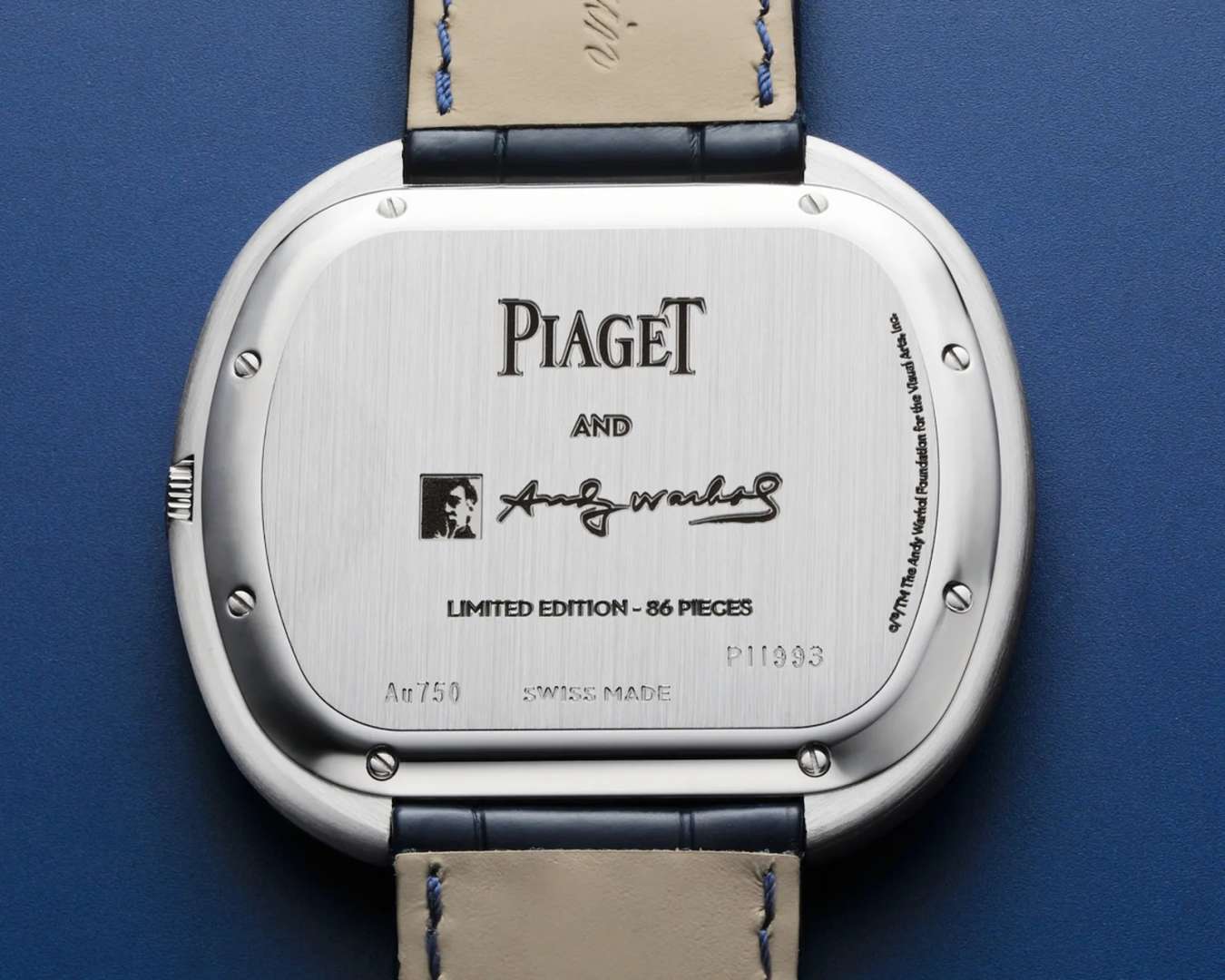
The solid caseback carries a laser-engraved Piaget logo, Warhol’s signature and the individual edition number of each watch. It’s a closed back, which suits a design that puts all of its craft on the dial side.
The strap is navy alligator leather with a calf lining. Its white gold pin buckle carries the Piaget signature, engraved rather than printed.
Eighty-six pieces will be made in total. Each carries its edition number engraved on the caseback, beside Warhol’s signature and the Piaget logo.
The watch is water resistant to 30 meters. It’s a dress watch through and through, and it dresses like one.
Calibre 501P1 and an edition of 86
Piaget’s self-winding manufacture Calibre 501P1 powers the watch, beating at 4Hz with a 40-hour power reserve across 23 jewels. The movement measures just 3.63mm thick, which keeps the cushion case at 8.08mm and preserves the flat, wide stance of the 1972 original.
Production is limited to 86 pieces, a nod to 1986, the year Warhol created the camouflage self-portraits behind the dial. Piaget sells the watch through its own boutiques, and the edition follows the Collage piece as the second annual release under the Foundation partnership.
Piaget’s artistic director Stéphanie Sivrière describes the objective as taking inspiration from Warhol’s creations without strictly reproducing each work on a dial. The camouflage here is deconstructed, its military pattern abstracted into an architectural layout of hand-cut stones. Nothing on the dial depicts a face, yet the self-portrait source stays legible in the pattern’s restless, overlapping shapes.


