

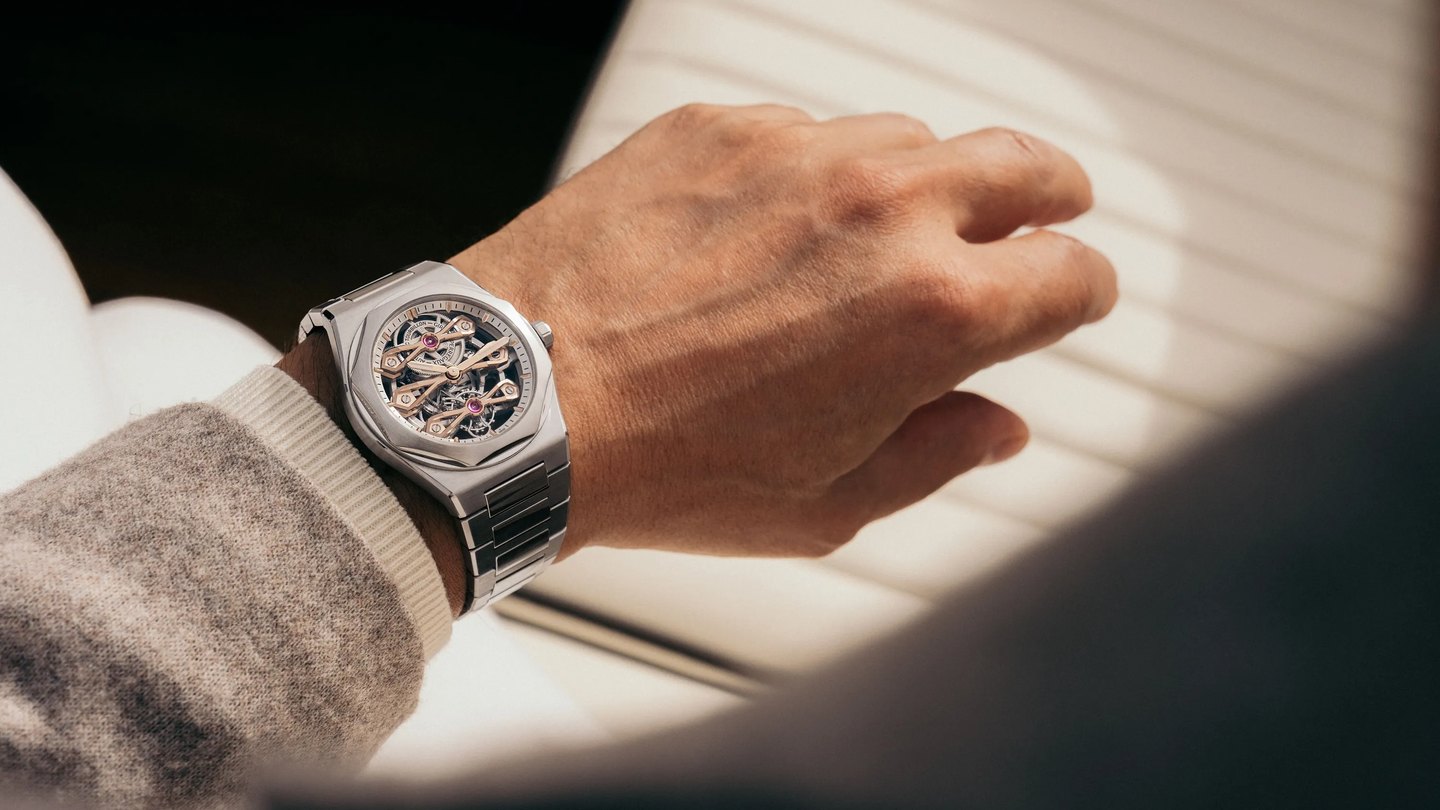
The Laureato Fifty Three Gold Bridges skips the dial entirely. Three arrow-shaped bridges in rose gold span the open face instead, holding the barrel, the gear train and the tourbillon in one straight line, and that line is the design.
It’s a 159-year-old idea, rebuilt for the Laureato’s fiftieth year and priced at $182,000.
Girard-Perregaux developed a new caliber for this watch alone, in this one size, then set it in a stainless steel case with a white gold octagonal bezel. Nothing here is borrowed from a smaller or larger sibling. The case and the movement were drawn together, and the fit shows it. Most calibers are designed once and cased a dozen ways. This one runs the other direction, one movement for one watch.
The maison’s own framing is that beauty gets built from within: structure, proportions, function and detail conceived together, with life on the wrist in mind. The Fifty is that framing with a price tag.
The bridges carry the design
Constant Girard sketched the Three Bridges layout in 1867, turning a movement’s structure into its face. The arrows were engineering first: a way to hold the barrel, gear train and tourbillon in exact alignment, visible at a glance. Nothing decorative came later. The decoration is the engineering, seen clearly.
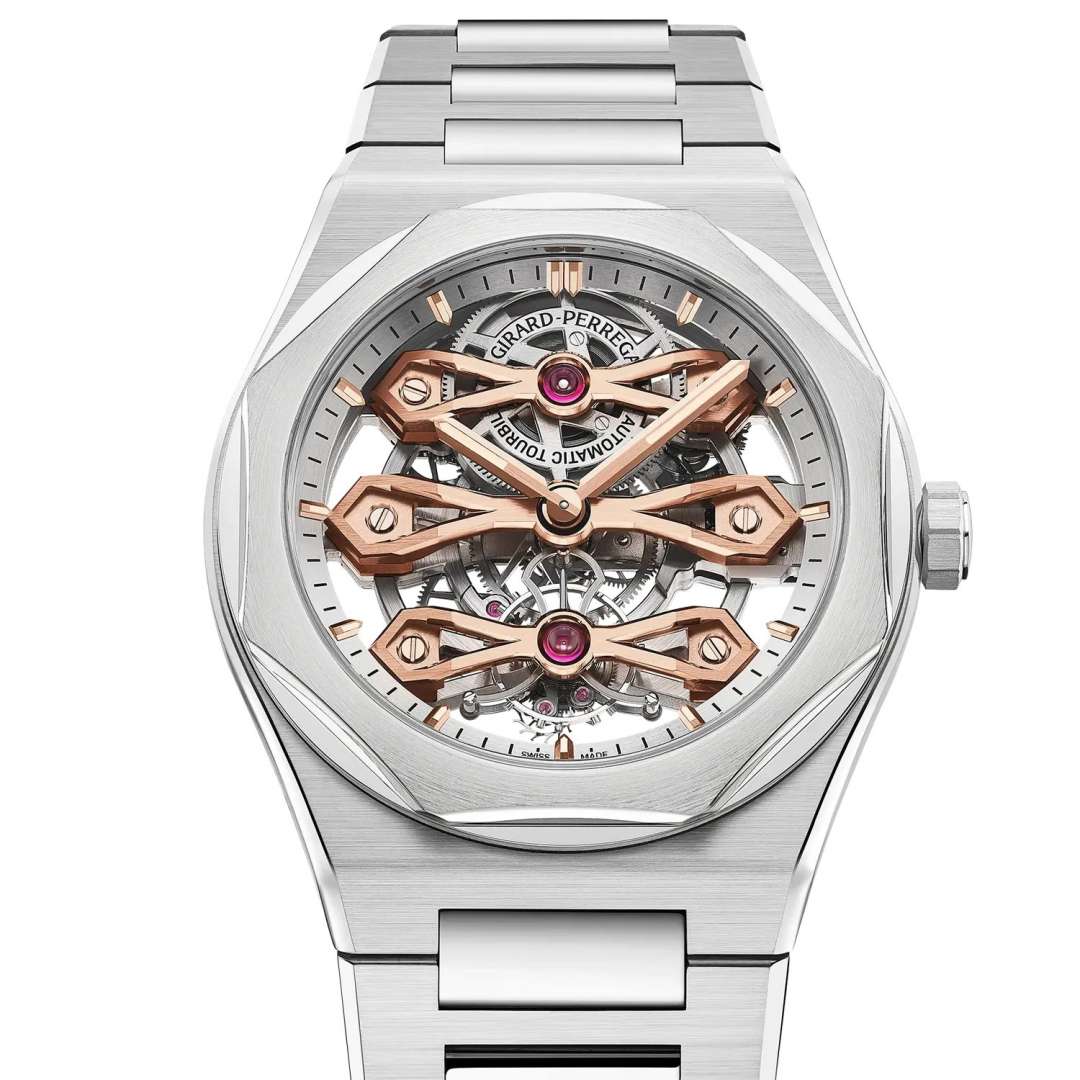
This time the bridges are rose gold. The warmth plays against polished bevels and satin-finished surfaces across each arrow, so the bridges catch light differently from every angle while the steel around them stays cool and brushed. Rose gold is the warmest of the gold alloys, and here it carries the whole face.
Rose gold hands and indices pick up the same warmth. Nothing on the face runs cold except the steel itself.
Framing all of it is the Laureato’s white gold octagonal bezel, polished and satin-finished in alternating planes. The bezel is the line’s signature since the first Laureato, and here it works as a picture frame in a second precious metal, so the watch reads gold on gold before the eye reaches the movement. Even the minute track stays in the same warm register.
No dial furniture hides anything here, so the finishing carries the decoration alone. Polished bevels throw the light back. Satin surfaces hold it, and the contrast changes every time the wrist turns.
The layout dates to pocket watch days, when a movement’s architecture was the visible craft and makers showed their work. One hundred fifty-nine years on, Girard-Perregaux still lays its flagship open the same way.
A caliber drawn for one case
The caliber is the GP9620, in its GP9620-2856 form, and Girard-Perregaux developed it for this model alone, in this one size. That commitment is rare because it’s expensive: a movement that fits nothing else in the catalog, drawn so the case and caliber land as one object.
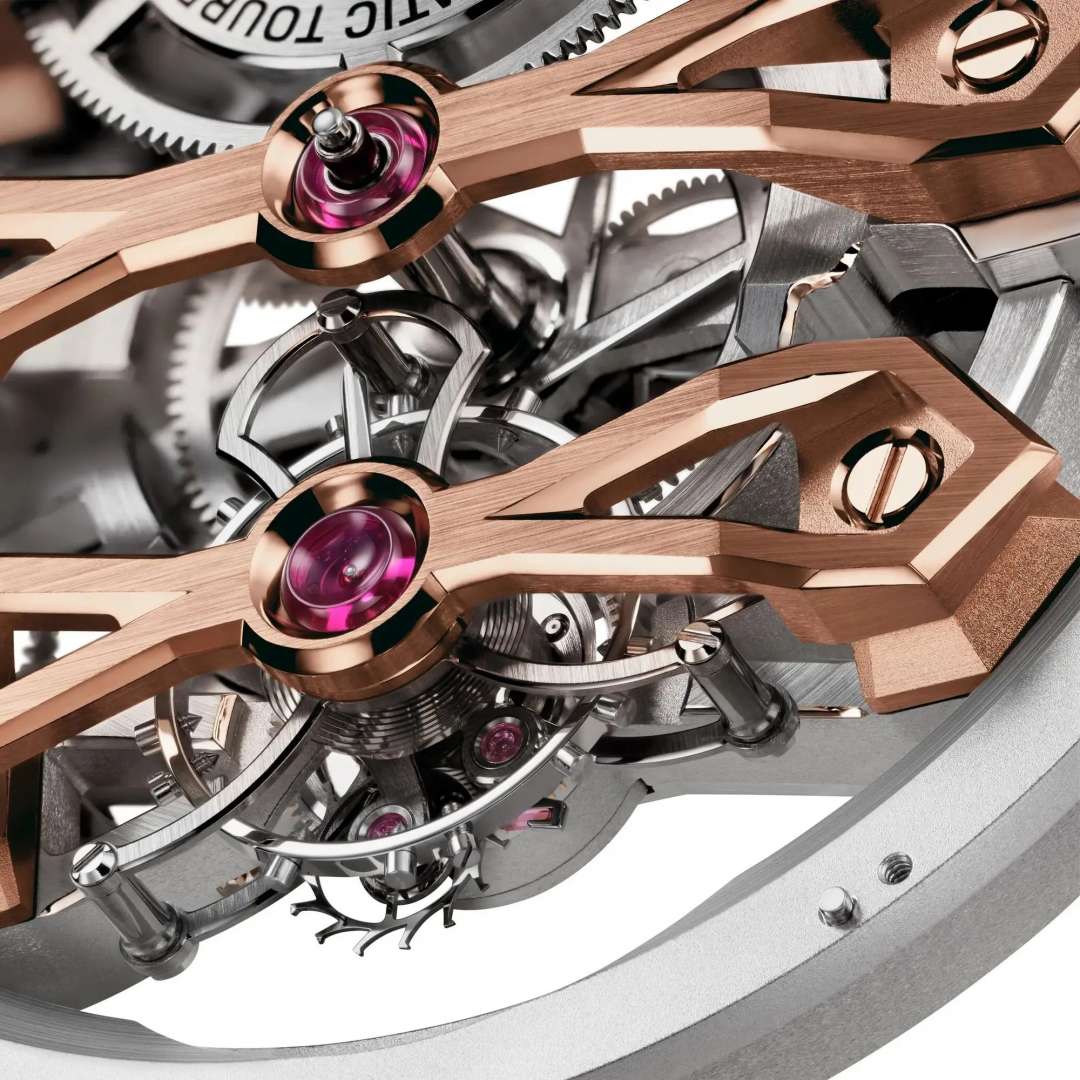
Extreme skeletonization opens the view straight through the caliber. The alignment reads top to bottom: barrel, gear train, tourbillon. The tourbillon rides in a lyre-shaped titanium cage beneath the lower bridge, turning in the open.
Winding hides, too. Girard-Perregaux’s patented platinum micro-rotor sits behind the barrel, so the automatic winding runs without parking a half-moon of metal across the view. Platinum earns the spot on density, so a small arc of it winds the mainspring without needing the full sweep of a standard rotor.
The numbers behind the glass are 303 parts and 33 jewels, beating at 21,600 vibrations an hour. The caliber measures 32 mm across, sized to the 41 mm case with no room wasted and none left over, which is what designing the two together actually buys. Every one of those parts is visible somewhere in the stack.
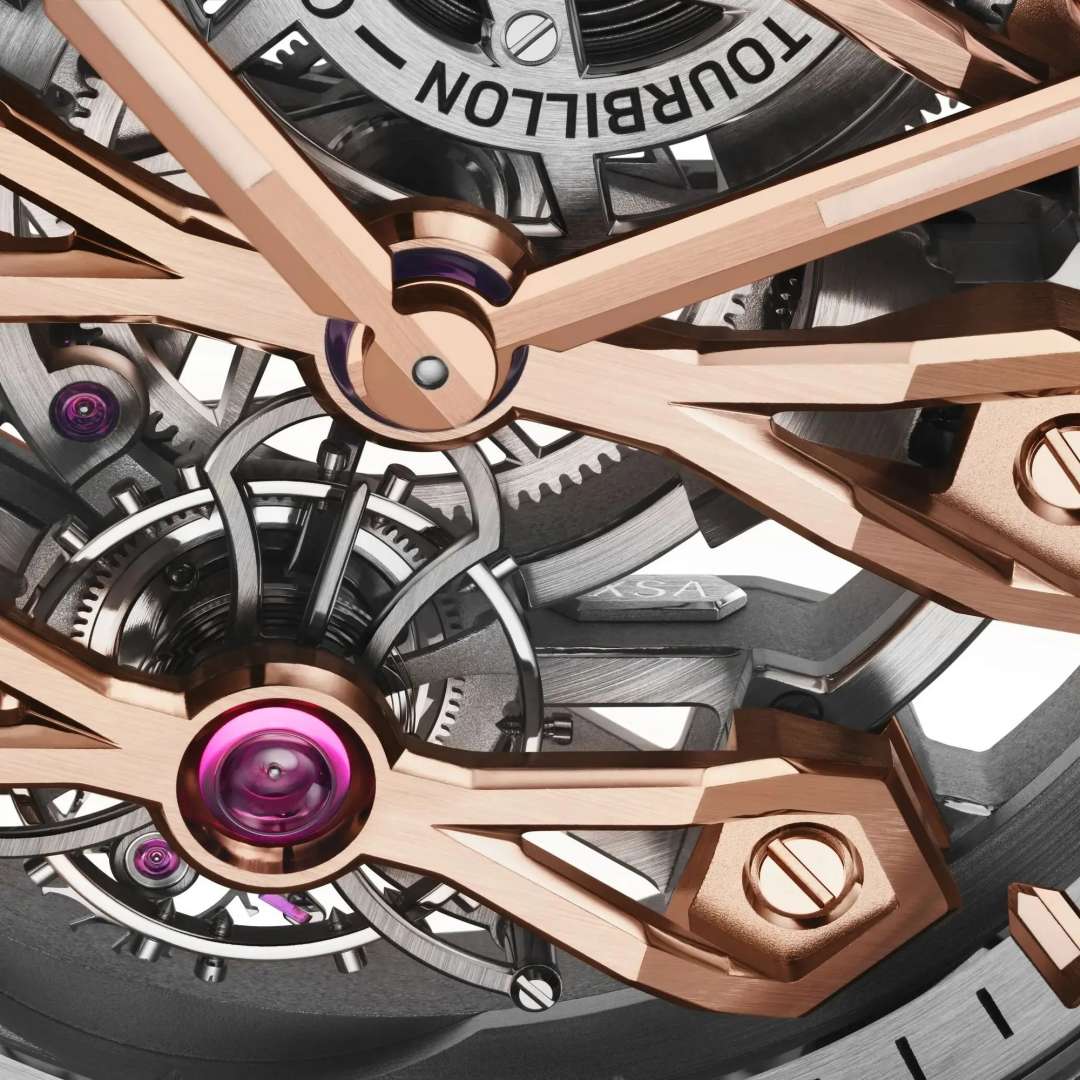
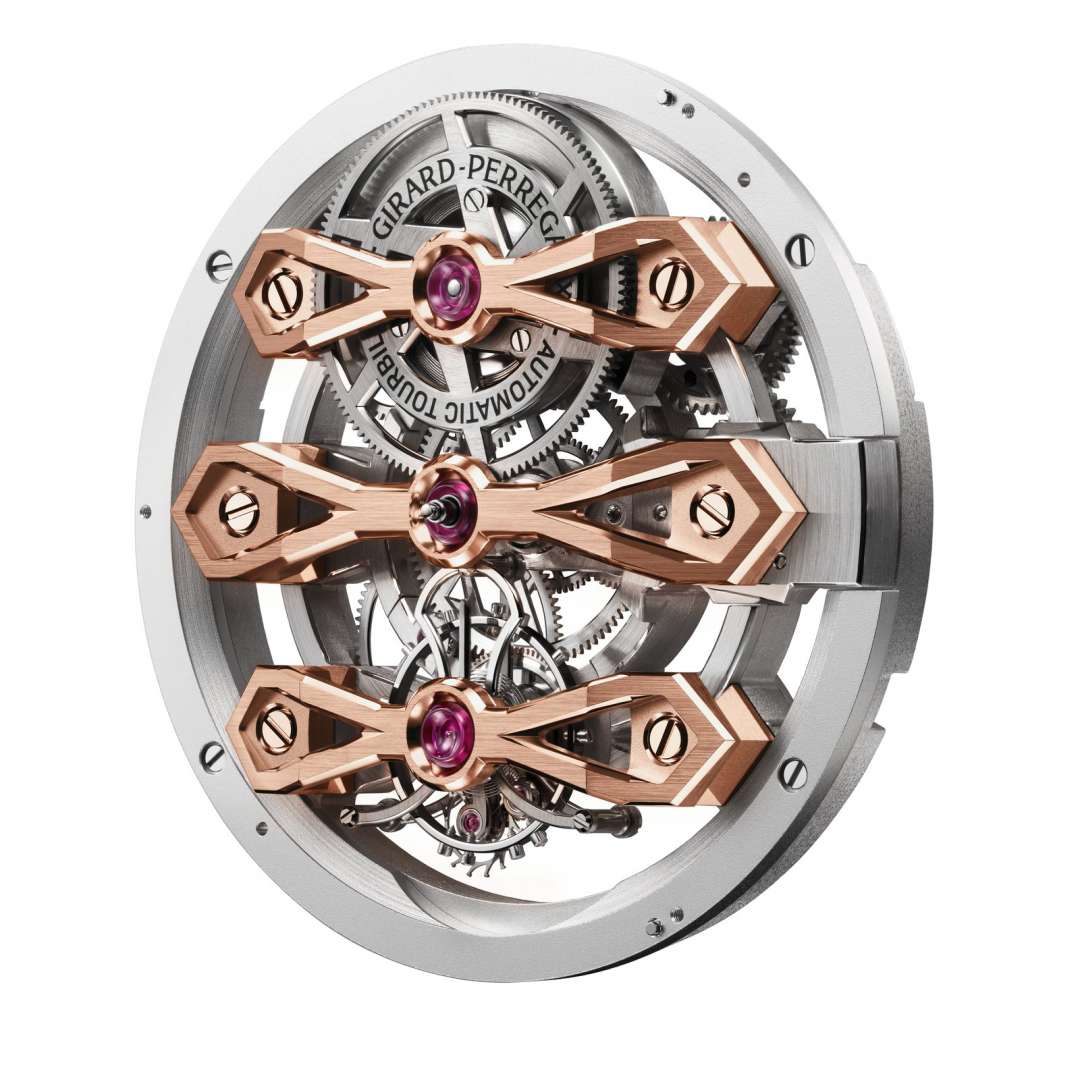
Building a caliber for one case size also means the skeletonization could be cut to this exact architecture, openings placed where the 41 mm frame puts them. A shared caliber would have forced compromises somewhere along the line. It also means the bridges could be drawn at the exact span the case allows, arrowheads landing where the design wanted them rather than where a shared platform dictated.
Steel outside, precious metal within
The case is stainless steel, 41 mm across and 10.85 mm thick, slim for a tourbillon watch. Sapphire covers the front and the back, and the integrated steel bracelet runs the case’s brushed planes straight into the links, so the silhouette stays unbroken from lug to lug.
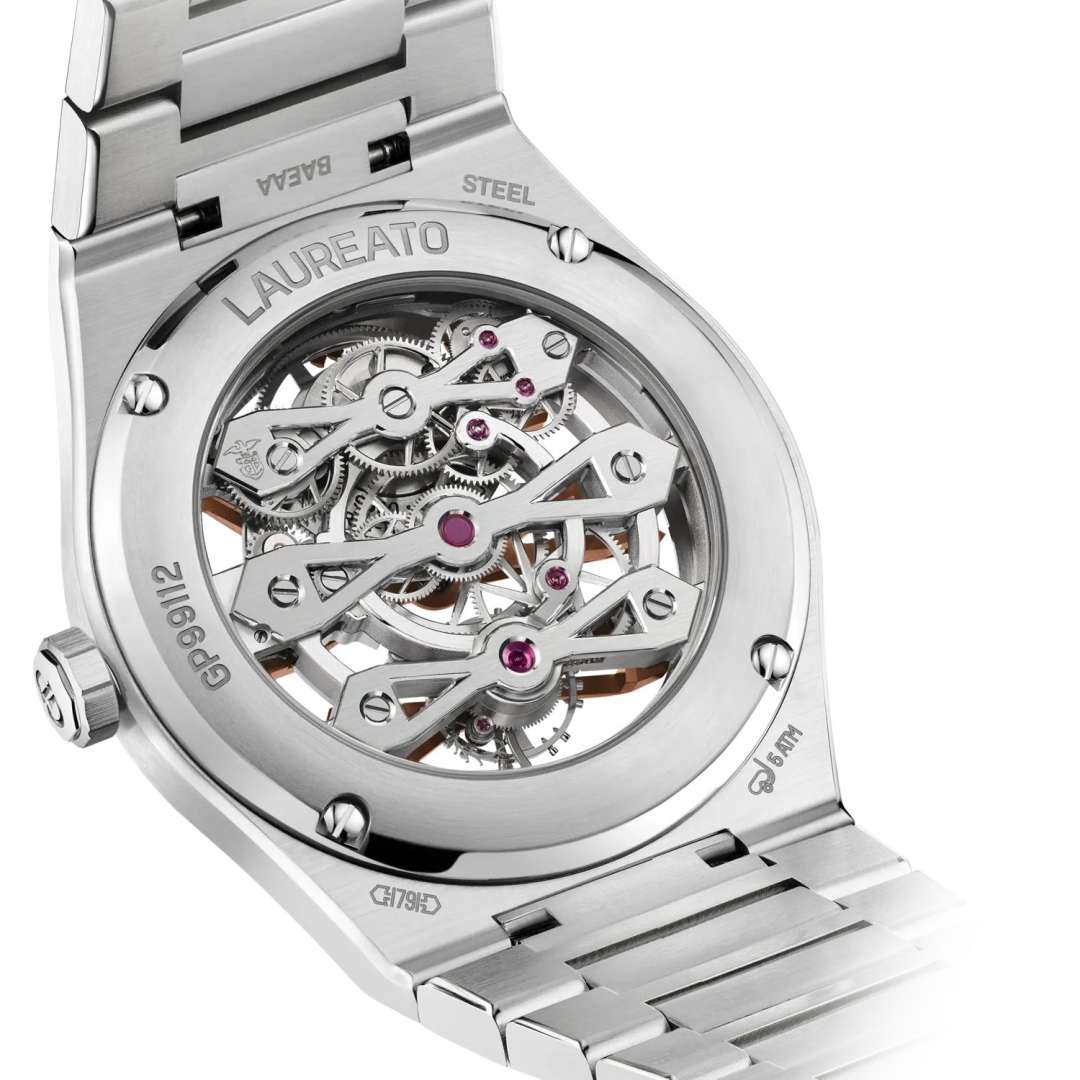
From behind, the bridges read in bright steel tones under the sapphire back, with LAUREATO engraved around the rim and the GP99112 marking stamped into the case. The rose gold shows through from the front in flashes between the wheels.
Water resistance is 50 meters. This is a dress machine in a sports watch’s silhouette, and it knows it.
The Fifty in the name marks the Laureato’s fiftieth anniversary, and the watch lands as the newest word in a line Girard-Perregaux has refined for five decades. The formula has been copied by half the industry in that time. Steel sports watches with integrated bracelets are everywhere now. Almost none of them carry a tourbillon under three gold bridges.
On paper it wears as a sports watch: 41 mm, steel, bracelet. Through the sapphire it’s haute horlogerie of the oldest school, and the two registers never resolve into each other. That tension is what the Laureato line has traded on for fifty years, and this is its sharpest form yet. Steel outside, white gold on the bezel, rose gold in the movement: three metals, three temperatures of light, one watch.
Most skeleton watches show off a movement. This one shows off a floor plan, three bridges sketched when watchmaking was still a bench trade, still deciding where every wheel sits in 2026.
The steel keeps the outside quiet. The rose gold is under no such obligation.
The Laureato Fifty Three Gold Bridges is Girard-Perregaux selling its oldest idea as its newest watch. The idea has aged well.


