

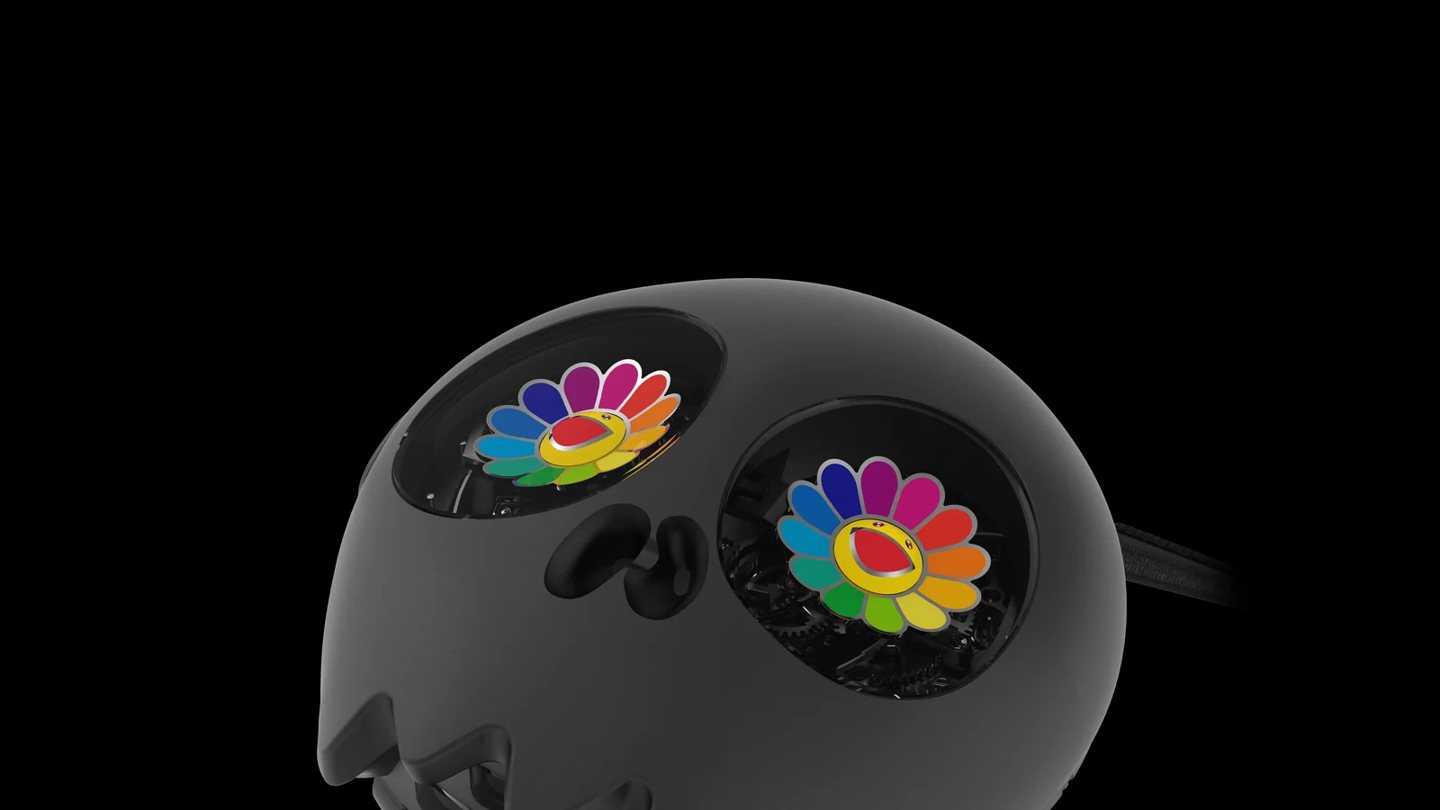
Takashi Murakami’s first watch under his own name is a sculpted titanium skull, and the flowers sit where the eyes should be. Time Objects is his own brand, built with Swiss watchmakers through his Kaikai Kiki company.
Skulls and flowers have shared his canvases for decades, one standing for death and the other for the life that keeps blooming anyway, and the brand calls that pairing The Chronos Paradox. DLMag covered his Hublot Classic Fusion collaboration back in 2021, when the flower first landed on someone else’s watch.
Murakami originated the Superflat theory and built characters like his smiling Flowers into a visual language that moved from Tokyo galleries into fashion and music collaborations worldwide. The watch takes that language off the wall and machines it in titanium, at full sculptural scale and in three dimensions.
Six hundred skulls before the shape settled
Finding the form took more than 600 skull studies before the sculptural architecture of the first Time Object locked in, and the finished case is Grade 5 titanium built from 33 components. There’s no motif applied to a standard round case here, because the skull is the case, teeth cast along the jaw and the whole head measuring about 44 mm across and 18.4 mm tall.
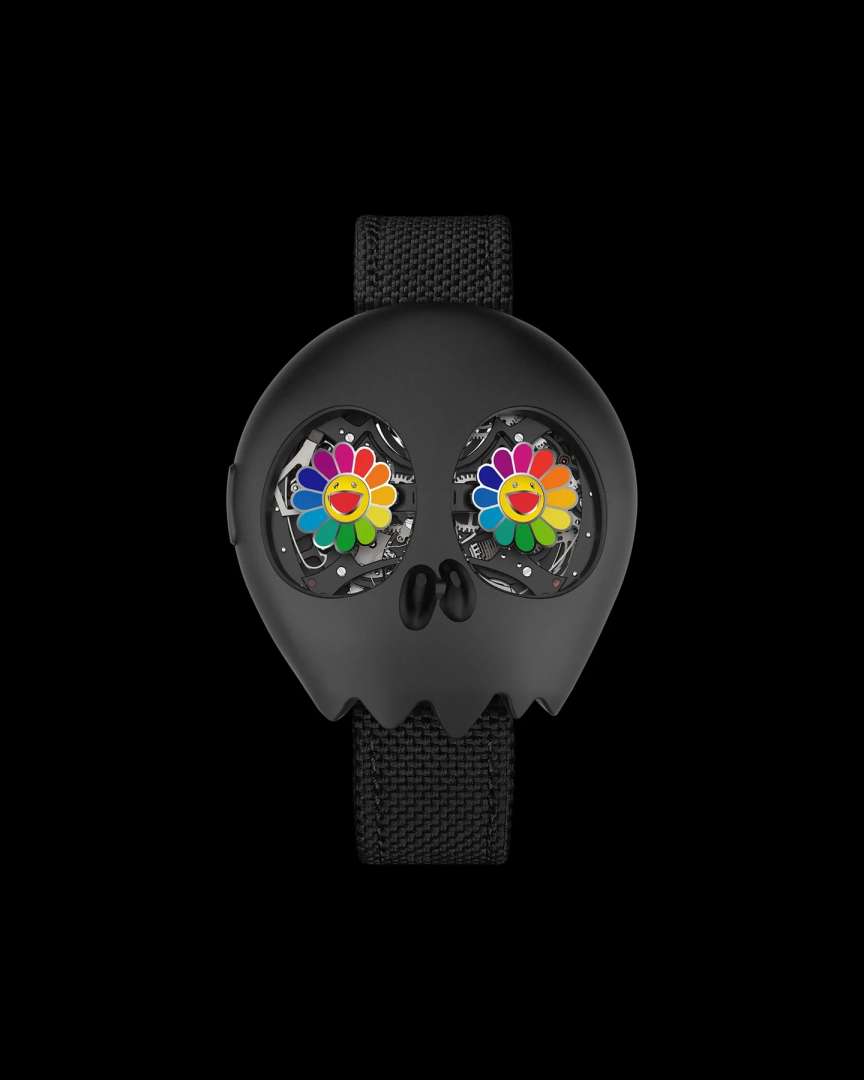
Within the eye sockets the flowers bloom on a ball-bearing system, their petals rotating with the movement of the wearer’s hand, so the face changes as the wrist moves through the day. The flowers tell no time at all.
The head wears big and knows it.
Sapphire with an anti-reflective treatment covers the front. An open sapphire back closes the rear, and water resistance stops at 30 meters. This is sculpture that tolerates a splash rather than a swim.
The time lives in the jaw
There’s no crown, no conventional dial and no hands anywhere on the skull, and the hours and minutes instead appear through a lateral aperture cut into the case band at six o’clock. The wearer tilts the watch outward to read it, the hour shown on a rotating cylinder and the minutes trailing behind it on a disc.
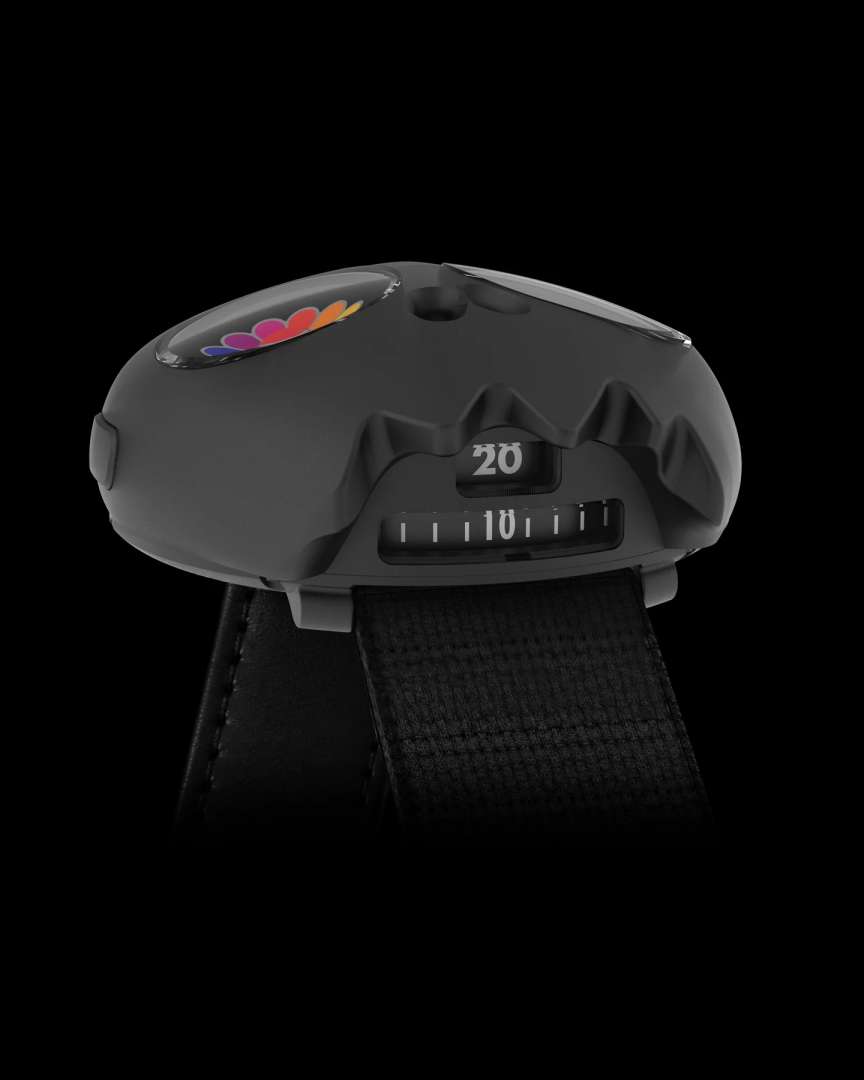
The cylinder carries the full 24 hours and jumps instantaneously the moment each new hour begins, while the minutes advance continuously underneath on black ruthenium discs printed with white decals. The hour lands exactly.
That’s the trade the design makes, sculpture first and legibility second, and it cuts both ways every time the wearer checks the hour.
A flower for a tourbillon, viewed from the back
Calibre KM 7012 TM was developed exclusively for Murakami, a hand-wound movement of 409 components and 81 jewels that beats at 3 Hz and delivers a 125-hour reserve. The tourbillon sits at twelve on the caseback side, decorated with his signature flower motif, and the barrel bridge beside it carries an engraving of skulls and flowers.
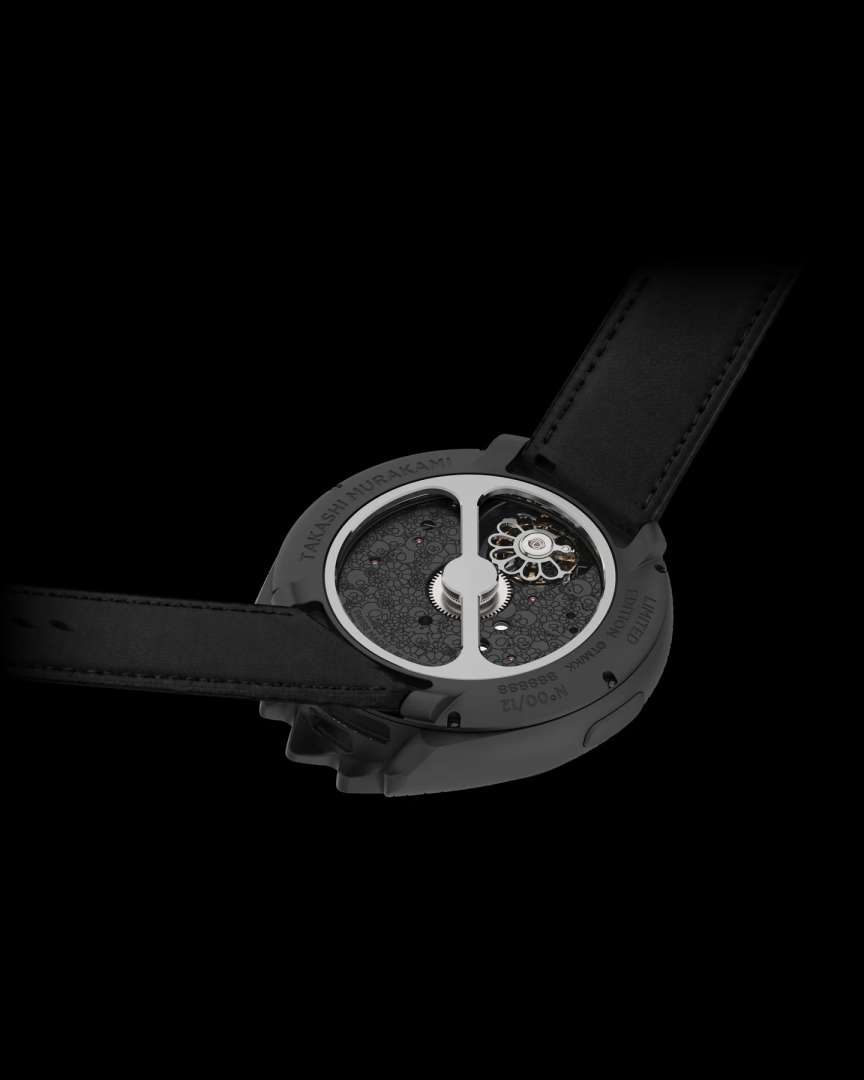
The back outshines the front.
Five days of reserve means the sculpture survives a long weekend off the wrist and still shows the right hour when it goes back on, the cylinder waiting in the jaw where it stopped. The black rubber strap closes with a Grade 5 titanium folding clasp sculpted as a small skull and adjustable for length, a detail that keeps the sculpture going right down to the hardware.
Five versions, and the plain ones stop at twelve
Chapter One launches with five interpretations of the same skull, and across the collection the materials, finishes, colors and gem setting change while the sculptural architecture and the mechanical concept stay the same. A buyer chooses a surface and a finish rather than a different watch underneath.
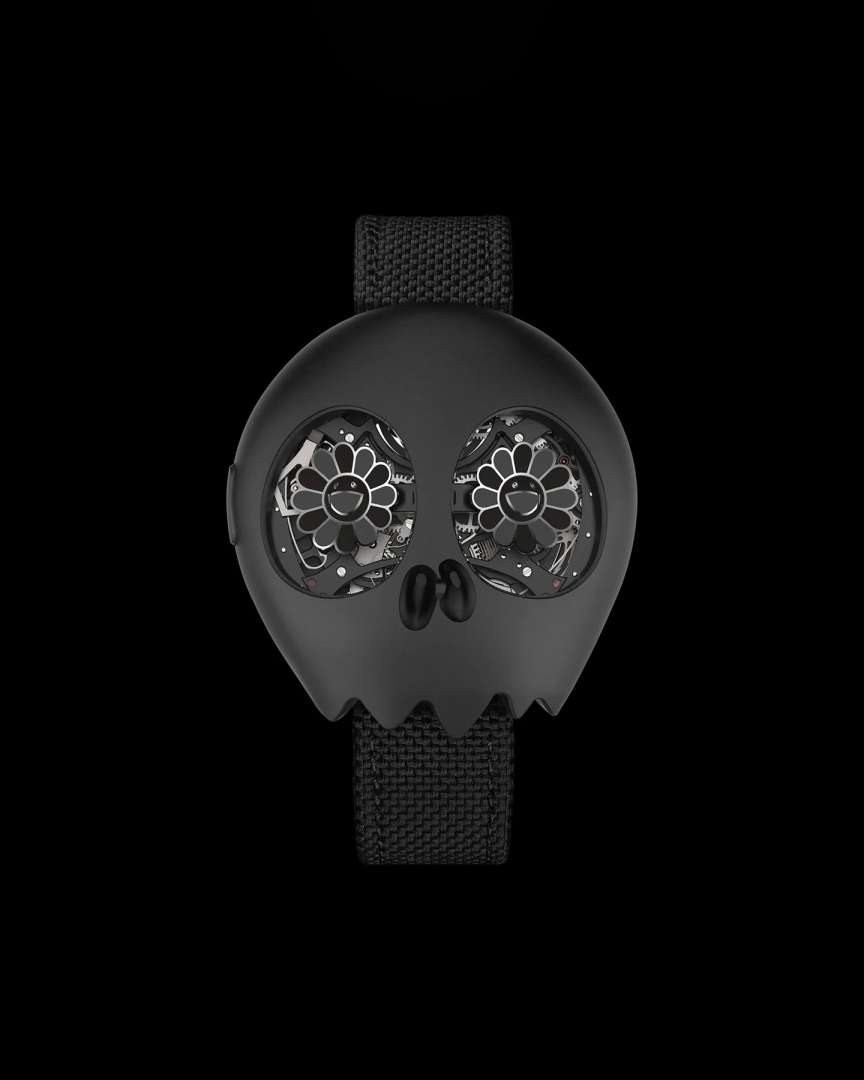
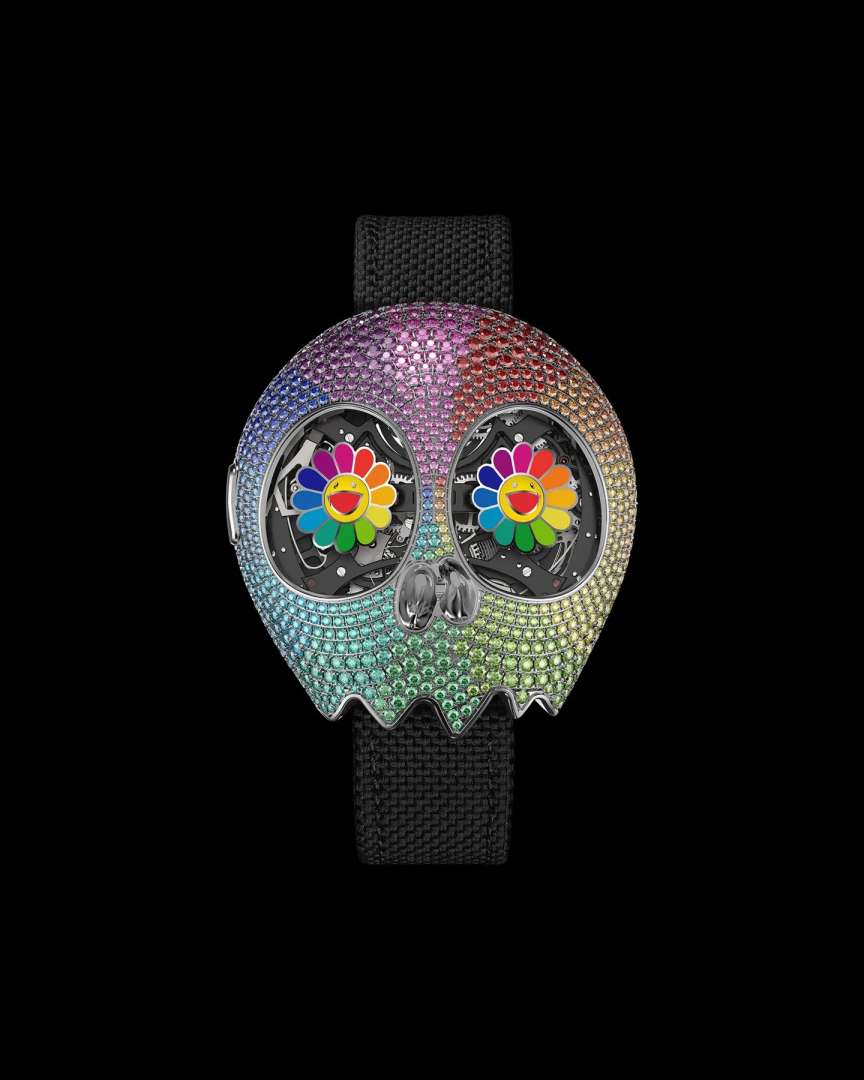
Black Rainbow wears its flowers in full color under microblasted titanium with a black DLC coating, and All Black turns the flowers black to match the case. Each of those two editions stops at 12 numbered pieces and $102,400 before taxes, sold through Kaikai Kiki and its authorized partners, with the references TMSKL26-TN-RAIN and TMSKL26-TN-ALLB.
Just twelve pieces each.
Above them sit three jewelry versions in polished titanium, each set with 744 stones totaling 9.3 carats, produced in small quantities the brand hasn’t numbered publicly. Full Pavé Rainbow runs $168,700, Full Pavé Black Diamonds $171,100 and Full Pavé Diamonds $178,300, every figure before taxes.
The dream, stated in his own words
Murakami puts the motive in his own words: “Watches have always been my dream. This is because watches govern time, while art transcends time.” The Chronos Paradox names the tension the finished object carries, life set against death and one passing moment set against eternity, and the skull holds both sides at once.
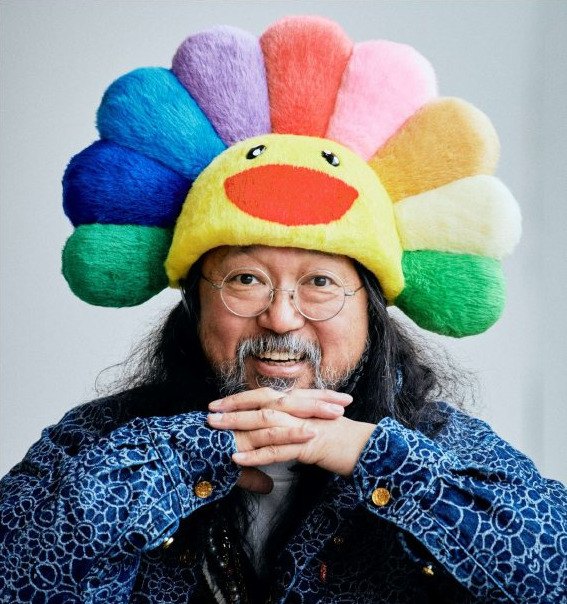
He founded Kaikai Kiki in Tokyo and built it into the company that produces his art and runs his galleries, and Time Objects sits inside that company rather than inside a watch group. The brand is his, and so is the risk.
The works reach buyers through Kaikai Kiki and selected luxury watch retailers, by enquiry rather than a checkout button, and collectors open a conversation about the skull and the finish instead of watching a stock counter tick down. That suits an edition of twelve far better than a buy button would.
Buy the Black Rainbow at $102,400 if you collect Murakami’s sculpture and want the one object that moves from his world onto your wrist, its flowers spinning as your hand turns through the day. Skip it if reading the time at a glance is the job, because this skull makes you tilt your wrist for every hour it shows.


